This site is supported by our readers. We may earn a commission, at no cost to you, if you purchase through links.

Size shapes every decision you make—whether a couch fits through your door, a shirt drapes your shoulders right, or a bridge holds the weight of traffic. Get it wrong, and consequences range from mildly annoying to genuinely dangerous. A single millimeter of error in a medical implant can mean the difference between recovery and serious harm.
Yet most people treat size as obvious, something you just know instinctively. You don’t. Size has a precise language—units, tools, standards, and contextual meanings that shift depending on what you’re measuring and where in the world you’re standing.
Table Of Contents
- Key Takeaways
- What Does Size Mean?
- How Size is Measured
- Size in Everyday Language
- Size in Clothing and Products
- Practical Importance of Size
- Frequently Asked Questions (FAQs)
- What do you mean by size?
- What is a size 7 woman in inches?
- What is the difference between size and magnitude?
- What is the definition of size?
- What are the different sizes?
- What are some synonyms for size?
- Who owns size Co UK?
- Is size 9 a 42?
- What is the noun of size?
- How are taxes treated in the Consumer Price Index?
- Conclusion
Key Takeaways
- Measurement errors aren’t just inconvenient—they cause 17% of medical injuries and trigger costly product recalls, so precision is a safety issue, not a preference.
- Clothing sizes lie: vanity sizing and regional standards mean a US 8, UK 12, and EU 40 are the same body, so always measure yourself instead of trusting the tag.
- Size shapes buying behavior in sneaky ways—oversized packages signal value, mini formats feel premium, and poor size guides drive nearly half of all online returns.
- From 2nm transistors to nanoscale materials, size governs how technology actually works, because at small enough scales, physical dimensions change electrical and optical behavior entirely.
What Does Size Mean?
Size is one of those words you use every day without thinking twice about it. But its meaning runs deeper than just "big" or "small" — it carries history, context, and real precision depending on how you use it.
Here’s what you need to know about where the word comes from and what it actually means.
If you’re curious about the full picture, nyjer seed’s origins, uses, and safety for backyard birds are all covered in one handy place.
Definition of Size
Size is your measuring stick for the world. It captures physical magnitude — how much space something takes up, its spatial extent, its weight in the scheme of things. Think length, width, volume. These aren’t just numbers; they’re how you make sense of what fits, what works, what matters.
Relative dimensions and proportional analysis help you compare objects with precision and control. Understanding the concept of math size properties is essential for making accurate measurements and comparisons.
Etymology and Linguistic Origins
The word you use every day has deep roots. "Size" traces back to Old French assise — a legal sitting to fix official amounts. Latin roots in assidēre ("to sit beside") gave it that judicial weight.
Over centuries, a semantic shift pulled it from courtroom assessments into everyday measurement language. Historical context shaped meaning quietly, evolving through Medieval terms into the neutral, practical word your dictionary defines today.
Understanding the concept of size related words can provide further insight into the evolution of language.
How Size is Measured
Measuring size isn’t complicated once you know the basics. It all comes down to the right units, the right tools, and why getting it accurate actually matters.
Here’s what you need to know.
Standard Measurement Units (Inches, Centimeters, Meters)

Inches, centimeters, meters — three different languages saying the same thing. One inch equals exactly 2.54 centimeters. One meter holds 100 centimeters. These aren’t arbitrary — they’re precision scaling built into metric systems so measurement stays consistent across borders.
Multiply inches by 2.54 to get centimeters. Master these conversion factors and unit conversions, and you control how you interpret scale, magnitude, and extent anywhere in the world.
Tools and Methods for Measuring Size
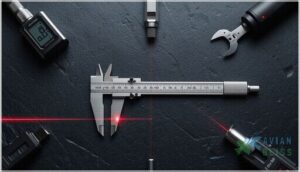
Once you know your units, you need the right tool. Here’s what pros reach for:
Before you buy anything, cross-reference your measurements against the bird bath replacement parts compatibility guide to confirm you’ve got the right fit for your specific model.
- Vernier Calipers — measure external and internal dimensions to 0.02 mm
- Micrometer Precision — hits 0.001 mm for serious small-scale work
- Laser Meters — capture large-scale distances fast
Need irregular surfaces? Ultrasonic Sensors and 3D Scanners handle complex dimensions without contact.
Importance of Accurate Measurement

Precision isn’t optional — it’s your safety net. Measurement errors in medical dosing cause 17% of patient injuries, while off-spec manufacturing parts trigger costly recalls.
Measurement errors aren’t minor mistakes—they cause 17% of medical injuries and trigger costly recalls
Quality control depends on dimensional analysis done right. In construction, misreading proportions once cost one team $50,000.
Precision tools and safety standards exist for a reason: getting the size and extent of things exactly right protects everyone.
Size in Everyday Language

Size shows up in your everyday language more than you probably realize. From describing a problem as "huge" to calling a win "massive," the word does a lot of heavy lifting in how you talk and think.
Here’s a closer look at how size works in common expressions, communication, and meaning that shifts depending on context.
Usage in Common Expressions
Size shows up everywhere in everyday speech. You’ve heard "big fish in a small pond" — someone dominant locally but invisible elsewhere. Or "drop in the bucket," meaning your effort barely registers against the full extent needed.
These phrases let you size up situations fast, cut inflated egos down to size, and remind you one size fits all rarely does.
Size as a Descriptor in Communication
Words carry weight. When you describe something as "massive" instead of just "big," you shift the entire picture in someone’s mind. Size perception lives in that gap.
Three things that break Communication Barriers fast:
- Use Relative Measures: "tennis ball–sized" beats "5 centimeters"
- Add Contextual Clarity: pair size with a familiar reference
- Anchor Visual Imagery: proportion defines meaning better than raw numbers
Contextual Variations in Meaning
Context flips meaning fast. "Large" in clothing sizing isn’t "large" in set cardinality — one measures fabric, the other counts distinct elements. Word size means something technical to engineers. Sample count shifts statistical weight. Physical scales span Planck lengths to galaxies. Here’s how context reshapes size:
| Context | Term | Actual Condition |
|---|---|---|
| Computing | Word Size | 32 or 64 bits |
| Math | Set Cardinality | Element count |
| Science | Physical Scales | Planck to universe |
Size in Clothing and Products

Getting dressed shouldn’t feel like solving a puzzle, but the wrong size can throw off everything. Clothing sizes vary wildly depending on where you shop and where you’re shopping from.
Here’s what you need to know to find your fit and navigate the numbers.
Clothing Size Charts and Standards
Clothing labels lie sometimes. Vanity sizing means a size 8 today runs bigger than it did decades ago — brands quietly shift body measurements while keeping the same number.
ISO standards like 8559 push for size standardization globally, but most brands still publish their own size guides.
Check actual body measurements on any size chart. Don’t trust the label alone.
Measuring for The Right Fit
Grab a tape measure. Wrap it around your bust, waist, and hips — snug but not tight. That’s your actual size, not the number on a tag.
Use brand-specific size guides and fit analysis before buying. Measurement techniques like tracking body proportions beat guessing every time. Sizing systems vary, but your measurements don’t lie.
Size Conversion Between Regions
Your measurements don’t change — but the label on the tag sure does. A UK size 12 becomes a US 8 and an EU 40 the moment you cross borders.
Regional Size Charts follow different International Standards, so knowing your Global Measurements keeps you in control. Use Conversion Formulas and Size Equivalents to decode classifications fast — no guesswork, no returns.
Practical Importance of Size

Size isn’t just a number — it shapes nearly every decision you make, from buying a couch that fits your living room to designing a microchip smaller than your fingernail.
It shows up in labs, stores, and your daily routine in ways you mightn’t even notice. Here’s how size plays a practical role across three key areas of life.
Impact on Purchases and Choices
Size drives your purchase decisions more than you think. Package Perception, Value Pricing, and Size Convenience quietly shape Consumer Behavior every time you shop. Here’s what actually happens:
- Big packages signal better value — even when unit prices match
- Mini formats feel premium, so you pay more per gram
- Smaller sizes fit tight budgets and tiny city kitchens
- Poor size guides cause 45–53% of online returns
- Bulk sizes reduce shopping trips for those with storage space
Size in Science and Technology
Beyond the shopping cart, size runs the whole show in science and tech.
| Scale | What Changes |
|---|---|
| Nanoscale Materials | Quantum Effects flip electrical and optical behavior |
| Semiconductor Scaling | Transistor gates hit 2nm — smaller means faster |
| Microfabrication | Physical dimensions and measurements determine device performance |
Size Dependence isn’t abstract. It’s the reason your phone exists.
Size Comparisons in Daily Life
Daily life runs on size comparisons — whether you’re eyeing Vehicle Space before a road trip or checking Clothing Fits across regional charts.
A deck of cards tells you if your protein portion is right. A tennis ball maps out your rice serving.
Furniture Scale, Food Portions, Product Sizes — your instinct for dimensions and measurement keeps every choice grounded in reality.
Frequently Asked Questions (FAQs)
What do you mean by size?
Think of a shadow — it tells you something’s there, but not exactly what. That’s size: your perception of bulk, dimension, and relative scale giving shape to the world around you.
What is a size 7 woman in inches?
Junior size 7 fits a 32-inch bust, 24-inch waist, and 34-inch hips. Your back-waist length runs 25 inches. These standard measurements suit heights between 5’4" and 5’5".
What is the difference between size and magnitude?
Size covers physical extent and bulk. Magnitude gives you scalar values — a single number showing how much. One describes dimensions. The other quantifies intensity.
Both measure reality. Different tools, different jobs.
What is the definition of size?
It’s your measurable quantity — physical magnitude, spatial extent, proportional dimensions, or relative bulk. Basically, it tells you how big or small something is. A definition worth knowing.
What are the different sizes?
From a child’s shoe to a warehouse shelf, dimensions shape every choice you make. Size variations span clothing, screens, tires, and paper — each with its own measurement types, standardization, and categorization system.
What are some synonyms for size?
Think magnitude, bulk, dimensions, extent, or proportions. Each synonym shifts the meaning slightly — bulk suggests weight, span captures reach, and scale frames comparison. Pick the one that fits your measurement context best.
Who owns size Co UK?
JD Sports owns Size? (size.co.uk) — acquired in 2010 for £21 million. Behind JD Sports sits Pentland Group, the Rubin family’s firm, holding majority control. That’s your corporate control chain.
Is size 9 a 42?
For men’s shoes, yes — a US size 9 usually equals EU But brand variations matter. Women’s size 9 usually runs EU Always check foot length measurement and brand-specific sizing standards.
What is the noun of size?
Size is a noun. It names a thing — specifically, physical dimensions, bulk, or extent.
It carries semantic meaning in both countable and uncountable noun forms, covering everything from measurement units to size classification systems.
How are taxes treated in the Consumer Price Index?
The CPI quietly absorbs what you actually pay. Sales taxes, excise duties on fuel and tobacco, and user fees like tolls all fold into the calculation — reflecting your true out-of-pocket cost, nothing hidden.
Conclusion
Funny how we trust gut instinct for something this precise. "Looks about right" has collapsed shelves, botched surgeries, and sent countless flat-pack nightmares back to the store. Size doesn’t negotiate—it just reveals whether you paid attention.
Once you understand its language—units, tools, context—you stop guessing and start deciding with confidence. That shift from assumption to precision isn’t just practical. It hands you control over every space, object, and choice that size quietly governs.
- https://newpathworksheets.com/math/grade-3/units-of-measure-2?dictionary=size&did=128
- https://www.merriam-webster.com/dictionary/size
- https://www.psychology-lexicon.com/cms/glossary/52-glossary-s/1729-size-constancy.html
- https://elifesciences.org/articles/38187
- https://www.splashlearn.com/math-vocabulary/measurements/size