This site is supported by our readers. We may earn a commission, at no cost to you, if you purchase through links.
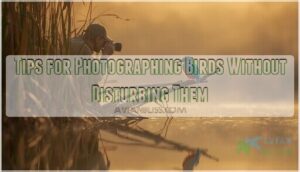
Most people never get close enough to a bird to see the fine barring on its feathers or the flicker of awareness in its eye. Not because the birds aren’t there — they are — but because most people announce themselves long before they arrive.
A slammed car door, a bright jacket, a too-eager stride through the brush, and the tree empties before you’ve even raised your camera. The birds that tolerate you aren’t tame; they’ve simply decided you’re not a threat. That distinction is everything.
Learning to photograph birds without disturbing them is less about gear than it is about learning to move through a landscape like you belong there — and the payoff, when it works, is a frame full of behavior no one else was patient enough to earn.
Table Of Contents
- Key Takeaways
- Preparing for Bird Photography
- Approaching Birds Without Disturbance
- Camera Settings and Techniques
- Ethical Practices in Bird Photography
- Capturing Natural and Striking Images
- Frequently Asked Questions (FAQs)
- What are common bird photography mistakes?
- What is the best way to photograph birds?
- How do weather conditions affect bird photography?
- Can bird calls help locate hidden subjects?
- What time of day is best for shooting?
- How do I handle unpredictable bird flight paths?
- Should I photograph birds alone or in groups?
- Conclusion
Key Takeaways
- Birds don’t flee from your gear — they flee from how you move, so slowing down and approaching at an angle matters far more than any lens you bring.
- Blending into your surroundings with neutral colors and soft fabrics isn’t just about camouflage — it signals to birds that you’re part of the landscape, not a threat.
- Learning to read stress signals like alarm calls, stiff postures, and tail-flicking lets you pull back before the bird bolts, keeping both the moment and the bird intact.
- Ethical field habits — staying at least 25 yards back, avoiding nesting sites, and walking away when a bird shows stress — aren’t limitations, they’re what separates good photographers from ones who just get lucky.
Preparing for Bird Photography
Before you even raise your camera, what you bring and how you show up matters more than most people expect.
Your mindset, patience, and positioning all play a role—and setting up your camera at a bird feeder is a perfect example of how location can make or break the shot.
The right gear, clothing, and a little homework on your subject can be the difference between a great shot and a spooked bird.
Here’s what to sort out before you head into the field.
Choosing The Right Equipment
The right photography equipment is your silent passport into a bird’s world. Choose gear that keeps you back and lets the bird stay free.
- Use telephoto lenses (300–600mm) to frame birds tightly from a distance
- Pick camera bodies with fast autofocus and high burst rates
- Enable silent modes to kill shutter noise near skittish species
- Use a tripod with a fluid head for smooth, shake-free tracking
- Add lens accessories like hoods and weather covers for staying power
Good photography equipment lets you wait longer, move less, and shoot better.
Dressing to Blend With The Environment
Your gear gets you close — but what you’re wearing gets you closer. Birds don’t care about your lens; they care about that neon jacket screaming danger from fifty yards out.
Camouflage clothing and neutral colors like olive, khaki, and muted brown are your best fieldcraft tools. Fabric choices matter too — soft fleece beats stiff nylon every time because quiet movement is invisible movement.
Seasonal adaptation keeps you honest. In green summer woods, dark greens disappear. In dry autumn grass, swap to tans and beige. Accessory concealment rounds it out — cover your lens, your tripod, even your hands. Birds notice shapes and flashes before they notice you.
For additional strategies, learn about effective to boost your chances of getting close.
| Habitat | Best Colors | Fabric Type |
|---|---|---|
| Dense forest | Dark green, brown | Soft-shell, fleece |
| Dry grassland | Tan, beige, muted brown | Brushed cotton |
| Wetlands/shore | Gray, muted blue | Waterproof, soft-shell |
| Open fields | Olive, khaki | Lightweight camo |
| Winter/snow | White-gray blend | Insulated camo |
This is where bird photography techniques and ethics meet — blending in means less stress on the bird, better behavior captured, and better wildlife photography overall.
Pairing good ethics with the right gear makes all the difference, so it helps to know how to choose a bird watching camera before heading out.
Researching Bird Behavior and Habitats
Blending in sets the stage — but knowing your subject closes the deal. Before you ever raise your camera, study bird behavior and habitat selection for your target species.
eBird’s bar charts show exactly when and where activity peaks by week. Understanding nesting habits, migration timing, and behavioral patterns means you’re already where the bird wants to be — before it arrives.
For practical insights on using species range and abundance maps, explore additional tools eBird offers to fine-tune your location and timing.
Approaching Birds Without Disturbance
Getting close to a bird without sending it flying is honestly one of the most rewarding challenges in wildlife photography. It comes down to a few habits that, once they click, change how you move through the field entirely.
Here’s what actually works.
Moving Slowly and Patiently
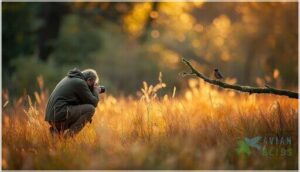
Think of yourself as a guest in their world — move like you belong, not like you’re chasing.
Move through their world like you belong there, not like you’re chasing something
- Take two or three steps, then pause 10–20 seconds.
- Approach at an angle, never straight on.
- Keep your arms close and movements smooth.
- Wait until the bird resumes feeding before advancing.
- Use zigzag paths to close distance naturally.
Patient fieldcraft rewards you with shots that feel earned.
Recognizing Bird Warning Signs
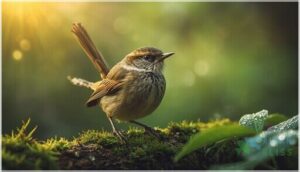
Birds tell you everything — you just have to listen. Vocalization changes are your first clue: cheerful song dropping into sharp Bird Alarm Calls means back off.
Warning Postures follow fast — a stiff, slim body with a fixed stare signals Flight Initiation is seconds away. Stress Signals like tail-flicking and step-by-step edging are fieldcraft gold in bird photography and bird watching.
Read them right, and wildlife conservation starts with you.
Using Natural Cover and Blinds
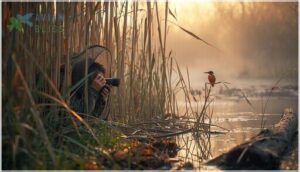
Cover is freedom — the difference between a bird that ignores you and one that vanishes.
Use Natural Barriers like hedgerows, reeds, and fallen logs as Concealment Methods that feel native to the habitat.
For Blind Placement, set up days early so bird behavior normalizes around it. Smart Camouflage Techniques and Habitat Blending make your hides and blinds practically invisible in wildlife photography.
Camera Settings and Techniques
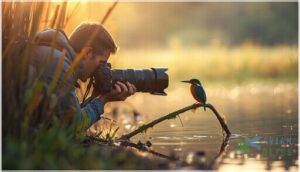
Getting close to a bird without spooking it’s only half the battle — your camera still has to do its part.
The right camera settings and gear can mean the difference between a sharp shot and a blurry miss.
Here’s what actually works in the field.
Using Telephoto Lenses for Distance
Your lens selection defines how close you can get without ever moving an inch. For most bird photography, a focal length between 400mm and 600mm fills the frame beautifully while keeping a respectful distance.
Telephoto techniques like background compression flatten distracting foliage, making your subject pop. Good image stabilization — five stops in some lenses — manages those tricky, low-light moments without sacrificing sharpness.
Employing Silent Shooting Modes
Your camera’s click can end a moment before it begins. Silent mode benefits go beyond courtesy — they’re a direct line to natural bird behavior.
Here’s what smart camera configuration looks like in practice:
- Electronic shutter removes mechanical noise entirely, letting shy species stay calm.
- Rolling shutter distortion matters more with fast-moving birds than perched ones.
- Field applications shift — use silent mode close-in, hybrid shutters for flight.
- Ethical photography practices mean firing quietly during courtship or feeding without changing the scene.
Optimizing Shutter Speed and Aperture
Two settings make or break your shots: shutter speed and aperture. For perched birds, 1/500s usually holds the moment steady. For birds tearing through open sky, push to 1/2000s or faster — Fast Motion Capture starts there.
Aperture Priority at f/5.6 gives you clean Depth Of Field without sacrificing the blurred background that makes feathers pop. Let ISO Management handle the rest automatically.
Ethical Practices in Bird Photography
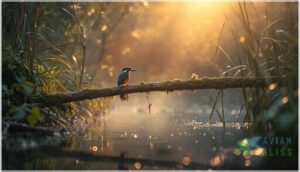
Getting the shot is only half the story — how you get it matters just as much.
Ethical bird photography isn’t about limiting yourself; it’s about being smart enough to know when to hold back.
A few key practices will keep both your conscience and your subjects intact.
Maintaining Safe Distances
Most birds will tell you exactly when you’ve crossed the line — you just have to listen.
Distance guidelines exist for a reason: a safe approach of at least 25 yards gives birds the buffer zones they need to feed and rest without stress.
Fieldcraft and bird behavior knowledge helps you read those subtle cues, keeping your presence minimal and your wildlife photography ethics intact.
Avoiding Sensitive Times and Locations
Timing matters as much as distance. During Breeding Season — roughly early spring through midsummer — birds near nests are at their most vulnerable.
Disturbance Minimization means skipping nest sites entirely and checking wildlife refuges for trail closures. Nocturnal Roosts deserve the same respect; flash and flashlights can disorient roosting owls.
Location Privacy helps too — don’t post exact coordinates for Sensitive Habitats online.
Respecting Bird Welfare Over Photos
Protecting location data is a start, but Ethical Photography goes further — it means walking away when a bird is clearly stressed, even if the light is perfect.
Responsible Shooting puts Animal Welfare first, full stop. If you notice Bird Stress Signs like intense staring or alarm calls, that’s Wildlife Conservation in action. No shot is worth compromising a bird’s safety or survival.
Capturing Natural and Striking Images
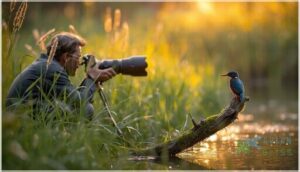
Getting close without spooking the bird is only half the work — the other half is making the shot worth taking. Knowing a few simple techniques can be the difference between a snapshot and a photo that stops people mid-scroll.
Here’s what to focus on when it’s time to compose and capture.
Composing With The Rule of Thirds
The rule of thirds is one of the simplest photography composition tools that delivers the biggest payoff in bird photography. Instead of centering your subject, shift it onto a vertical thirds line and watch the frame come alive.
Place the bird’s eye on one of the four power points, match the directional gaze to open space, and use cropping techniques to fine-tune horizon placement afterward.
Focusing on Eyes and Behavior
Placement matters, but the real intimacy in bird photography lives in the eyes. Sharp Eye Focus Techniques pull viewers straight into the frame — use single-point autofocus directly on the nearest eye.
Catching life in photographs is also about Catchlight Photography: position the sun behind your shoulder for that spark. Watch Relaxed Postures and Bird Behavior Patterns closely, because calm birds reveal the best Head Positioning and authentic behavior worth capturing.
Utilizing Natural Light and Backgrounds
Light is everything in bird photography. Golden Hour — that 20-to-40-minute window after sunrise or before sunset — wraps your subject in warm color that midday simply can’t match.
Shoot with the sun behind you for clean Light Direction and natural feather detail. Use Background Blur with a wide aperture to create a soft Natural Backdrop, letting the bird breathe free inside the frame.
Frequently Asked Questions (FAQs)
What are common bird photography mistakes?
Slow and steady wins the race” applies perfectly to bird photography.
Getting Too Close, Ignoring Signals, Bad Equipment, Poor Ethics, and Weak Composition are the five most common mistakes that quietly sabotage your wildlife photography.
What is the best way to photograph birds?
The best way to photograph birds combines patient wildlife ethics, smart camera settings, and reading flight patterns. Stay back, move slow, and let the bird photography come to you.
How do weather conditions affect bird photography?
Weather shapes everything in bird photography. Golden hour light reveals feather detail, overcast skies simplify exposure, and wind affects bird behavior dramatically.
Read the forecast before heading out — atmospheric conditions determine your shot.
Can bird calls help locate hidden subjects?
Yes — bird calls guide you straight to hidden subjects. A repeated note from dense reeds or a mobbing chorus pointing at one tree tells you exactly where to pre-focus before the bird ever steps into view.
What time of day is best for shooting?
Golden hour wins every time — that soft dawn light or the warm glow just before dusk gives you flattering color and active birds.
Midday harsh sun flattens everything. Arrive early, stay late.
How do I handle unpredictable bird flight paths?
Birds rarely follow a script. Switch to continuous autofocus, leave space ahead in your frame, and let wind direction guide your flight path prediction — nature takes care of the rest.
Should I photograph birds alone or in groups?
Solo often wins. One quiet photographer causes less Group Disturbance than scattered crowds.
But a tight, well-coordinated group sharing Collective Movement can work too — birds track one “object” instead of many.
Conclusion
A thousand hours in the field won’t matter if you storm in like you own the place. The birds will always know before you do.
But when you slow down, dress right, read the landscape, and earn your spot in it, something shifts — they stop leaving. That’s the quiet reward behind every tip for photographing birds without disturbing them: not just better photos, but a seat at a table most people never even knew existed.
- https://atlanticflywayshorebirds.org/human-disturbance/a-guide-to-ethical-photography/
- https://www.allaboutbirds.org/news/bird-photography-tips-how-to-get-close-to-birds-without-disturbing-them/
- https://vocal.media/earth/ethical-bird-photography-best-practices-for-protecting-their-natural-habitat
- https://www.audubon.org/photography/awards/audubons-guide-ethical-bird-photography-and-videography
- https://birdallianceoregon.org/blog/ethical-wildlife-photography/