This site is supported by our readers. We may earn a commission, at no cost to you, if you purchase through links.
 You’ll discover incredible true facts about bird species that showcase nature’s most remarkable creatures.
With over 9,500 bird species worldwide, these feathered marvels display extraordinary abilities that’ll leave you speechless.
Some hummingbirds fearlessly attack hawks despite being thousands of times smaller.
Arctic terns migrate 44,000 miles annually—that’s like circling Earth twice!
Certain birds can see ultraviolet light, detect magnetic fields, and even produce their own gas to hunt worms.
From budgies catching yawns to songbirds creating music with their wings, birds possess intelligence and skills that rival many mammals.
These amazing adaptations reveal secrets about survival and evolution.
Table Of Contents
- Key Takeaways
- Bird Species Overview
- Physical Bird Characteristics
- Bird Behavior Patterns
- Bird Size and Strength
- Bird Senses and Abilities
- Interesting Bird Facts
- Frequently Asked Questions (FAQs)
- What are the unique traits of birds?
- What are birds intelligence facts?
- What special ability do birds have?
- What are some facts about live birds?
- How do birds migrate without getting lost?
- What do baby birds eat after hatching?
- Why do some birds fly in formations?
- How long do different bird species live?
- What causes birds to change feather colors seasonally?
- Conclusion
Key Takeaways
- You’ll discover over 11,000 bird species exist worldwide, with Colombia hosting nearly 1,900 species—showcasing incredible diversity from tiny hummingbirds weighing less than a penny to massive ostriches reaching 346 pounds.
- You’ll be amazed by birds’ extraordinary senses and abilities—they see four colors including UV light, detect magnetic fields for navigation, and some species like turkey vultures can smell carrion from over a mile away.
- You’ll find that birds possess remarkable intelligence rivaling mammals—crows recognize human faces for years, parrots solve arithmetic problems, and Clark’s nutcrackers remember thousands of hidden seed locations across vast territories.
- You’ll witness incredible physical adaptations like hollow bones that reduce weight by 20% for flight, feathers that actually outweigh their entire skeleton, and specialized features like the Sword-billed Hummingbird’s bill that’s longer than its body.
Bird Species Overview
You’ll be amazed to learn that over 11,000 bird species exist worldwide, making them the most diverse group of land animals on Earth.
Colombia leads the world with 1,884 different bird species, showcasing the incredible variety these feathered creatures offer across different habitats and climates, with diverse group being a key characteristic.
Number of Bird Species Worldwide
You’ll discover approximately 10,500 bird species worldwide, though estimates range from 9,000 to 11,000 due to varying bird taxonomy standards.
Species Discovery Rate averages 20 new finds annually, particularly in tropical biodiversity hotspots.
Data Collection Methods using genetic analysis reveal previously unknown avian diversity.
However, Extinction Risk Factors threaten bird population stability, while Undiscovered Bird Species likely exist in remote regions.
Conservation Impact Metrics guide protection efforts for bird species diversity.
Classification of Bird Species
Scientists organize bird species into taxonomic orders based on evolutionary relationships and shared characteristics.
This bird classification system reveals fascinating patterns in avian diversity and helps us understand how different bird species evolved over millions of years.
Here are three major bird classification groups:
- Passeriformes Diversity – The largest order containing over 5,700 perching bird species including songbirds, finches, and crows
- Raptor Classification – Falconiformes encompass 309 predatory species like eagles, hawks, and condors with powerful hunting abilities
- Psittaciformes Traits – 368 parrot species featuring zygodactyl feet and hooked bills for climbing and seed-cracking
Country With Highest Number of Bird Species
Colombia takes the crown as the world’s biodiversity hotspot, hosting approximately 1,900 bird species—nearly 20% of all avian diversity globally.
This South American gem’s varied ecosystems, from Amazon rainforests to Andes mountains, create perfect habitats for endemic species.
Conservation efforts protect these unique birds while ecotourism impact grows, making bird habitat preservation essential for maintaining this extraordinary bird ecology treasure.
Physical Bird Characteristics
You’ll discover that birds possess some of the most remarkable physical features in the animal kingdom, from hollow bones that make flight possible to feathers that actually weigh more than their entire skeleton.
Their bodies showcase incredible adaptations, including bills longer than their bodies, tongues that extend four inches, and eyes so advanced they can keep most of their visual field in perfect focus.
Unique Bird Features

You’ll discover that bird species showcase remarkable Feather Uniqueness – their feathers actually weigh more than their entire skeleton.
Beak Adaptations vary wildly, from the Sword-billed Hummingbird’s bill that’s longer than its body to toucans using oversized beaks for temperature control.
Bird anatomy includes hollow bones for lighter flight, while Avian Senses feature exceptional eyesight with flatter eyes than mammals.
These bird adaptation marvels demonstrate incredible bird intelligence through specialized features, showcasing incredible bird adaptation marvels.
Adaptations for Flight
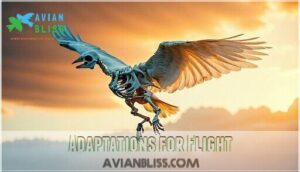
How do birds defy gravity with such grace? Their hollow bones reduce weight by up to 20%, while specialized feather structure creates lift and reduces drag.
Wingspan variation allows different flight styles, from hummingbird hovering to albatross soaring.
Powerful flight muscles comprise 15-25% of body weight, paired with efficient respiratory systems that extract maximum oxygen for sustained bird flight through remarkable bird anatomy evolution.
Exceptional Eyesight

You’ll be amazed by birds’ exceptional visual acuity – they see details four times sharper than humans.
Their color perception includes UV vision, revealing hidden patterns on flowers and feathers invisible to us.
This superior bird eyesight enables precise prey detection from incredible distances, and some species even possess remarkable night vision for hunting in darkness.
Making bird vision truly extraordinary.
Bird Behavior Patterns
You’ll discover that birds possess remarkable intelligence and complex behaviors that rival many mammals.
From crows that recognize human faces to parrots solving arithmetic problems, these feathered creatures communicate through intricate songs, dances, and displays.
While demonstrating unique sleeping patterns that keep them alert to danger, they showcase a range of complex behaviors.
Intelligent Bird Species
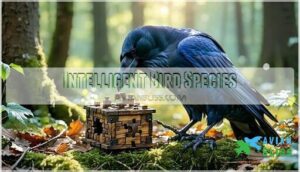
Intelligence runs deeper than you’d expect in the bird world. Ravens showcase extraordinary crow problem-solving abilities, matching primate-level cognition in complex tasks. Parrot communication extends beyond mimicry to genuine understanding of concepts like numbers and colors.
Birds possess intelligence that rivals our closest primate relatives in problem-solving and communication skills.
Here are three remarkable examples of bird cognition:
- Jay memory allows Clark’s nutcrackers to relocate thousands of hidden seeds across vast territories
- Pigeon recognition enables these urban birds to distinguish individual human faces for years
- Raven mimicry includes sophisticated bird tool use and multi-step puzzle solving
These abilities demonstrate that bird behavior involves genuine intelligence, not just instinct. Owners can find enrichment and stimulation with specialized toys.
Communication Methods

You’ll find bird communication fascinating – these creatures use multiple methods to share information.
Birdsong dialects vary by region, much like human accents.
Birds combine vocalizations with plumage displays to attract mates and establish territory.
Alarm calls warn of danger, while mimicry usage helps some species blend into their environment or confuse predators.
Many resources are available to help with accurate bird identification.
| Communication Method | Purpose |
|---|---|
| Birdsong dialects | Regional identification, mate attraction |
| Plumage displays | Territorial claims, courtship rituals |
| Alarm calls | Danger warnings, flock coordination |
| Tactile communication | Parent-chick bonding, social grooming |
Sleeping Patterns

While birds communicate through various calls and displays, their sleeping habits reveal equally fascinating adaptations.
You’ll discover that many bird species use unihemispheric sleep, keeping one brain hemisphere awake for vigilance. This sleep pattern allows penguins and mallards to maintain awareness while resting.
Some birds achieve in-flight sleep by gliding on air currents. Communal roosting provides warmth and safety, while hibernating birds like poorwills demonstrate remarkable physiological control during rest periods.
Many species also utilize thermogenesis to stay warm during sleep, showcasing their ability to adapt and survive through remarkable physiological control.
Bird Size and Strength
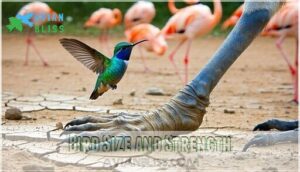
You’ll be amazed by the incredible size differences among bird species, from tiny hummingbirds weighing less than a penny to massive ostriches standing nearly nine feet tall.
These remarkable creatures also possess surprising strength, with some birds capable of lifting prey heavier than themselves while others can generate enough force to crack tough nuts with their beaks.
Largest and Smallest Bird Species
You’ll discover incredible size differences across bird species, from towering giants to tiny jewels of nature.
The common ostrich stands as the heavyweight champion, reaching up to 346 pounds and laying eggs that weigh over three pounds each.
One of the largest flying birds, the Wandering Albatross boasts an impressive wingspan.
- Ostrich Size: Common ostriches reach 346 pounds, making them the heaviest birds alive
- Hummingbird Weight: Bee hummingbirds weigh just 1.95 grams, lighter than a penny
- Heaviest Flying: Great bustards can fly despite weighing 46 pounds
- Egg Size: Ostrich eggs are 6,000 times heavier than hummingbird eggs
- Cassowary Talons: Southern cassowaries sport four-inch dagger-like claws for protection
Strongest Bird Species
You’ll discover harpy eagles reign as nature’s strongest fliers, lifting prey weighing 30 pounds with their incredible grip strength.
Their massive talons exert over 500 pounds of pressure per square inch, while dense bone density and exceptional muscle mass enable this lifting capacity.
Philippine eagles showcase similar beak power and bird strength adaptations, carrying prey four times their size through specialized bird adaptations that make these bird species truly remarkable examples of avian power.
Some eagles, such as the harpy eagle, possess five-inch talons that are larger than a grizzly bear’s claws.
Unique Bird Abilities
Beyond raw strength, birds possess remarkable abilities that seem almost supernatural.
You’ll find oilbirds using echolocation like bats to navigate dark caves.
Common poorwills enter true hibernation, the only known bird species to do so.
Crows demonstrate impressive tool use, crafting hooks from wire.
Many bird species excel at mimicry, copying sounds perfectly.
Their navigation skills let them travel thousands of miles with pinpoint accuracy.
Bird Senses and Abilities

You’ll discover that birds possess extraordinary sensory abilities that far exceed what most people imagine.
Their remarkable senses of smell, vision, and hearing enable them to navigate complex environments, locate food sources, and communicate across vast distances with precision that rivals advanced technology.
Birds’ Sense of Smell
Contrary to popular belief, many bird species possess remarkable olfactory abilities.
Turkey vultures detect carrion from over a mile away through smell, while kiwis use nostrils at their beak tips for prey detection underground.
Seabirds rely on olfactory navigation across vast oceans, detecting chemical compounds from phytoplankton.
These adaptations showcase how bird anatomy supports diverse sensory strategies beyond vision.
Birds’ Eyesight and Vision
Bird eyesight surpasses human vision dramatically.
You’ll be amazed that birds see four colors compared to our three, including UV vision that reveals hidden patterns on flowers and feathers.
Their flatter eye structure keeps more of their visual field in sharp focus simultaneously.
This exceptional color perception and prey detection ability lets bird species spot tiny movements from incredible distances, making their eye structure perfectly adapted for survival and bird behavior like hunting and navigation.
Birds can also suffer from various ailments, including avian conjunctivitis symptoms, which highlights the importance of understanding avian health.
Birds’ Hearing and Communication
You’ll find that birds possess remarkable hearing abilities that surpass human capabilities.
Their syrinx enables complex bird vocalizations, while some species use ultrasonic communication beyond our hearing range.
Here’s what makes avian language fascinating:
- Birdsong dialects vary by region, like human accents
- Vocal mimicry allows parrots to copy sounds perfectly
- Bird hearing detects frequencies from 0.02 to 20,000 Hz
- Bird communication methods include calls, songs, and visual displays
- Bird song identification helps locate mates and territory
To better study these sounds, researchers often use specialized listening devices.
Interesting Bird Facts
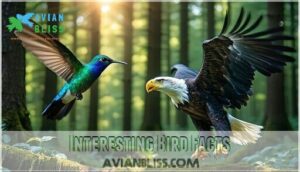
You’ll discover that birds have some of the most surprising behaviors in the animal kingdom.
From tiny hummingbirds that fearlessly chase away massive eagles to birds that can catch yawns just like humans, these feathered creatures continue to amaze scientists with their unexpected abilities.
Ruby-throated Hummingbirds’ Fearless Behavior
Despite your size, this tiny hummingbird shows remarkable fearless behavior when defending territory or resources.
Ruby-throated Hummingbirds chase away larger birds from their territories and pursue hawks in defense of nests despite overwhelming odds.
During territorial defense, males call at intruders and chase them away when protecting valuable nectar sources.
Their bold predator evasion and aggressive resource competition help this bird species thrive in Human Interaction situations.
Male Club-winged Manakins’ Unique Singing
Through specialized wing adaptations, male club-winged manakins create their courtship songs using mechanical sound production rather than traditional bird singing. This unique acoustic communication range demonstrates remarkable mating ritual evolution in this songbird species.
The clubwinged manakin’s singing muscle mechanics work differently than expected:
- Modified sixth and seventh wing feathers act as resonating instruments with club-shaped structures
- Ridged feathers rake together like a washboard to produce buzzing sounds
- Sonation replaces vocal songs through extremely modified secondary wing feathers
- Wing-produced sounds serve as primary territorial communication method
This acoustic trick is common in insects but unique among vertebrates. Some birds, like owls, have enhanced night vision due to unique anatomy, showcasing remarkable adaptations in the bird kingdom, with mechanical sound production being a key feature of the club-winged manakin’s behavior.
Budgies’ Ability to Catch Yawns
You’re probably wondering if budgies can catch yawns like people do.
Research in the journal Animal Cognition suggests budgerigars are capable of certain aspects of affective empathy through yawn contagion.
When budgies see another bird yawn, they often yawn too, showing budgie empathy and social learning.
This happens because mirror neurons activate when observing actions, making bird communication more sophisticated than expected.
This bird behavior proves budgerigar intelligence extends beyond mimicking speech to understanding social cues and demonstrating genuine empathy among bird species.
Bassian Thrushes’ Gas Producing Ability
Remarkably, Bassian Thrushes naturally produce digestive gases through specialized bacteria in their gut.
These bird species create methane and carbon dioxide when breaking down insects and fruits.
Thrush flatulence actually helps with flight efficiency by providing buoyancy.
The gas composition varies with diet influence, affecting bird physiology, and this unique bird behavior demonstrates how digestive bacteria contribute to bird facts about environmental impact and flight efficiency.
Frequently Asked Questions (FAQs)
What are the unique traits of birds?
You’ll find birds possess hollow bones for flight, feathers instead of fur, and lay eggs.
They’ve got exceptional eyesight, can sleep with one brain hemisphere, and some species demonstrate remarkable intelligence like crows remembering faces.
What are birds intelligence facts?
You’ll discover that crows solve complex puzzles and remember human faces for years.
Parrots master basic math and learn hundreds of words, while jays hide thousands of seeds and recall exact locations later.
What special ability do birds have?
Birds possess remarkable special abilities that set them apart from other animals.
You’ll find they can navigate using magnetic fields, sleep while flying, and some species like crows recognize individual human faces for years, which showcases their exceptional cognitive abilities, particularly in recognizing faces.
What are some facts about live birds?
Like nature’s living kaleidoscope, you’ll witness birds displaying incredible diversity across 11,000+ species worldwide.
They’ve evolved hollow bones for flight, vibrant plumage for mating displays, and remarkable intelligence—crows remember your face while parrots master arithmetic and vocabulary effortlessly.
How do birds migrate without getting lost?
You’ll use magnetite crystals in your beak to sense magnetic lines of force that align toward Earth’s poles.
You’ll also navigate by watching stars rotate around the North Star and using your internal 24-hour clock to calibrate your sun compass .
What do baby birds eat after hatching?
Tiny mouths open like hungry flowers, waiting for nourishment.
You’ll see parent birds bring regurgitated food, insects, worms, and seeds to their helpless chicks multiple times daily until they’re strong enough to fledge.
Why do some birds fly in formations?
You’ll see formations because they’re pure energy efficiency – drafting behind other birds cuts wind resistance by up to 25%, letting flocks travel farther with less effort during migration.
How long do different bird species live?
Time flies when you’re a bird!
You’ll find lifespans vary dramatically across species – from tiny hummingbirds living just 3-5 years to magnificent parrots reaching 80+ years.
With most songbirds averaging 2-8 years in the wild.
What causes birds to change feather colors seasonally?
Birds change feather colors seasonally through molting, where they shed old feathers and grow new ones with different pigmentation.
Hormonal changes triggered by daylight duration regulate this process, helping birds adapt to seasonal needs like mating displays or camouflage.
Conclusion
Consider this: hummingbirds beat their wings up to 80 times per second, creating flight speeds that seem impossible for their tiny size.
These true facts about bird species reveal nature’s incredible engineering. You’ve explored how birds navigate vast distances, communicate through complex songs, and adapt to extreme environments.
From Arctic terns’ marathon migrations to budgies catching contagious yawns, each species demonstrates remarkable survival strategies.
Birds continue evolving new abilities, proving they’re among Earth’s most successful creatures, and showcasing their ability to thrive in various environments with complex songs.
- https://www.discoverwildlife.com/animal-facts/birds/bird-facts
- https://seas.umich.edu/news/body-measurements-all-11000-bird-species-released-open-access-database
- https://www.livescience.com/4983-bird-study-reveals-10.html
- https://www.peckperk.com/blogs/news/why-birds-matter-guardians-of-our-ecosystems
- https://www.neonscience.org/impact/observatory-blog/studying-relationships-between-forest-structure-and-bird-biodiversity