This site is supported by our readers. We may earn a commission, at no cost to you, if you purchase through links.
A lion steps into golden light, and you have maybe three seconds before it moves. Whether you come away with a sharp, well-exposed frame or a blurry, blown-out disappointment comes down to decisions you made before you even raised the camera.
Understanding camera settings for wildlife photography isn’t about memorizing numbers—it’s about building instincts so fast that your hands react before your brain catches up. The right shutter speed, aperture, and ISO work together like a system, each one affecting the others in ways that compound quickly in the field.
Get that system dialed in, and the technical side stops fighting you.
Table Of Contents
- Key Takeaways
- Why Camera Settings Matter for Wildlife Photography
- Manual Mode + Auto ISO: The Best Combination for Wildlife
- Shutter Speed Settings for Sharp Wildlife Images
- Aperture Settings That Make Subjects Stand Out
- Choose a Metering Mode for Proper Exposure
- Mastering Autofocus Modes for Moving Animals
- White Balance and RAW Format for Color Accuracy
- Choosing The Right Lens for Wildlife Photography
- Frequently Asked Questions (FAQs)
- What settings should I use for wildlife photography?
- What F stop should I use for wildlife photography?
- How does weather affect wildlife photography camera settings?
- What accessories improve stability for wildlife shooting?
- How do you photograph wildlife in low-light conditions?
- How do you stay ethical while photographing wild animals?
- Conclusion
Key Takeaways
- Pairing Manual Mode with Auto ISO gives you locked creative control over aperture and shutter speed while your camera quietly handles shifting light on its own.
- Shutter speed is your most critical setting for sharp wildlife shots — 1/1000s works for general movement, but birds in flight often need 1/3200s or faster.
- Continuous autofocus with eye detection set to Animal or Bird mode is your most reliable baseline, since it keeps focus locked even as subjects turn, launch, or change direction unpredictably.
- Shooting in RAW gives you the tonal depth to recover shadows and fix white balance after the fact, which turns post-processing into a quick polish instead of a damage-control session.
Why Camera Settings Matter for Wildlife Photography
Camera settings are the difference between a sharp shot and a blurry miss you can’t recover in editing.
Getting those settings right matters even more in the field, where bird photography techniques can help you capture wildlife without spooking your subject.
In wildlife photography, where light shifts fast and subjects don’t wait, getting it right in-camera isn’t optional — it’s the whole game.
Here’s what you need to understand first.
How The Exposure Triangle Affects Your Shots
Three settings control every shot you take — and getting them wrong means missing the moment entirely. The exposure triangle links aperture, shutter speed, and ISO so that adjusting one always affects the others.
- Aperture controls depth of field
- Shutter speed freezes or blurs motion
- ISO adjusts light sensitivity
- Wider aperture means less depth of field
- Higher ISO introduces more noise
Why Getting Settings Right In-Camera Saves Time in Post
Getting your camera settings right means post processing becomes a quick polish, not a rescue mission. When exposure control, autofocus settings, and white balance are dialed in before you shoot, batch edits handle most of the work in minutes.
RAW format paired with solid in-camera efficiency gives you clean files that need only minor global tweaks — so workflow streamlining and time management happen naturally.
Manual Mode + Auto ISO: The Best Combination for Wildlife
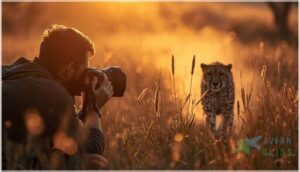
Most photographers assume you have to choose between control and convenience, but with wildlife, you don’t.
Manual Mode paired with Auto ISO gives you the best of both — locked exposure settings with a camera that adjusts to shifting light on its own.
Here’s what you need to know to make this combination work in the field.
How Auto ISO Works and When to Use It
Auto ISO takes care of one of the trickiest parts of wildlife photography for you — keeping exposure steady as light shifts. Your camera reads the scene through its metering mode, then silently adjusts ISO while your shutter speed and aperture stay fixed.
This feature is especially useful when animals move between sun and shade, or when dawn light drops fast across several frames.
Setting a Minimum Shutter Speed With Auto ISO
Once Auto ISO is active, the real control comes from setting a minimum shutter speed. This single camera setting acts as your floor — the camera won’t drop below it, raising ISO instead. For deer or slow mammals, 1/500 second works well. For birds in flight, push to 1/1600 or 1/3200.
Here’s a practical breakdown:
- Slow wildlife — Set minimum shutter speed around 1/500 second for sharp, clean results.
- Fast or erratic birds — Use 1/1600 to 1/3200 second to freeze wing motion.
- Zoom lenses — Enable focal length-based Auto ISO settings so minimum speed shifts automatically as you zoom.
- Low light — Lower your minimum speed slightly at dawn to keep ISO thresholds manageable.
Why Manual Mode Beats Aperture and Shutter Priority
Manual mode gives you total command that aperture priority and shutter priority simply can’t match.
With manual mode, you can even save entire configurations—focus method, metering, drive mode, and more—as covered in this guide to bird-in-flight camera settings, so switching scenarios takes just one click.
In aperture priority mode, the camera picks shutter speed — and in tricky backlit scenes, that choice often blows out your sky or underexposes your subject. Manual mode with Auto ISO locks your creative freedom in place: you set the exposure control, the depth, the motion — and ISO quietly fills the gap.
Manual mode with Auto ISO locks your creative freedom in place while ISO quietly fills the gap
Shutter Speed Settings for Sharp Wildlife Images
Shutter speed is what separates a sharp image from a blurry one, especially when your subject won’t sit still.
Getting it right means knowing how fast is fast enough for the situation in front of you.
Here’s what you need to know for two of the most common scenarios you’ll encounter in the field.
Fast Shutter Speeds for Birds in Flight
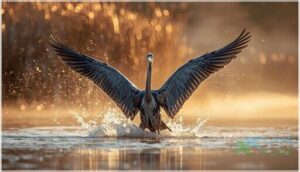
Birds in flight don’t wait for you to figure things out. For most species, you’ll want a shutter speed between 1/1600s and 1/4000s — with 1/3200s being a reliable all-around target.
Small, fast birds like swallows can demand up to 1/8000s. Balancing ISO and aperture around f/6.3 or f/7.1 keeps more of the bird sharp without sacrificing speed.
Recommended Shutter Speeds for Stationary Vs. Moving Animals
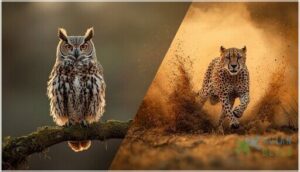
Not every animal calls for the same shutter speed. Stationary subjects like a resting owl or perched hawk are forgiving — 1/200 to 1/400 second covers most situations.
Motion blur control becomes critical when the animal starts moving.
- Walking mammals: 1/500–1/800s
- Running or chasing predators: 1/1000–1/2000s
- Subtle movement (ear flicks, breathing): 1/250–1/400s
Aperture Settings That Make Subjects Stand Out
Aperture does more than control light — it shapes how your subject separates from the world behind it.
A wide aperture can turn a cluttered forest background into a soft, painterly blur, putting all the focus exactly where it belongs. Here’s what you need to know to use it well.
Using Wide Apertures Like F/2.8 and F/4 for Bokeh
Wide apertures like f/2.8 and f/4 are your go-to aperture control tools for background blur in wildlife photography.
At f/2.8, bokeh techniques turn cluttered foliage into soft color washes, giving you clean subject isolation without moving closer. Pair that with a telephoto lens, keep your autofocus sharp on the eye, and the depth management practically takes care of itself.
Balancing Depth of Field With Subject Sharpness
Shooting wide open isn’t always the answer. In wildlife photography, depth control comes down to knowing when to stop down.
For camera settings for wildlife, consider these aperture limits:
- Focus placement on the near eye keeps depth of field working for you
- f/5.6–f/8 hits the sharpness optimization sweet spot on most lenses
- Sensor size and subject distance shift apparent depth noticeably
Autofocus and shutter speed seal the rest.
Choose a Metering Mode for Proper Exposure
Metering determines how your camera reads light across the frame, and choosing the wrong mode can throw off your exposure entirely.
Most cameras offer several options, each suited to different lighting conditions and subjects. Here’s what you need to know about each one.
Matrix Vs. Center-Weighted Vs. Spot Metering
Your metering mode is the foundation of exposure control in wildlife photography. Matrix metering reads the entire frame across 1,000-plus zones, making it reliable in even, consistent lighting conditions.
Center-weighted metering favors the central 60–80 percent, which works well for larger subjects. Spot metering locks onto just 1.5–5 percent of the frame — ideal for precise camera settings for wildlife in high-contrast situations.
When to Use Highlight-Weighted Metering
Highlight-weighted metering is built for one job: highlight protection. It scans the frame for the brightest areas and exposes to keep them from clipping — which makes it the right metering mode for tricky wildlife lighting situations.
It’s worth switching to this exposure control setting when you’re dealing with:
- White or pale birds like egrets moving through mixed sun and shade
- Wet animals after rain, where bright spots on fur or feathers blow easily
- Wildlife near reflective water, snow, or wet rocks
- Rim-lit animals at dawn or dusk, where preserving edge glow matters
Pair it with RAW format and auto ISO in your camera settings, and you can recover shadow detail in post while keeping feather texture intact.
Using Exposure Compensation to Fine-Tune Results
Even with the right metering mode locked in, your camera’s exposure reading isn’t always perfect. That’s where exposure compensation earns its place in your camera settings.
Dialing in minus 0.3 EV protects highlights without darkening the whole frame, while plus 1 EV lifts a backlit subject out of shadow. In wildlife photography, small EV adjustments to image brightness often save a shot that metering modes alone can’t.
Mastering Autofocus Modes for Moving Animals
Getting your autofocus right can be the difference between a sharp eye and a blurry mess, especially when your subject won’t hold still.
Wildlife moves fast, and your camera needs to be set up to keep pace. Here’s what you need to know to make your autofocus work for you, not against you.
Choose an Autofocus Area for Wildlife
Choosing the right autofocus area is one of the most practical camera settings decisions you’ll make in wildlife photography. A single focus point gives you precise control for still subjects, while AF clusters like group or zone AF improve animal tracking when things get unpredictable.
For mastering autofocus, pairing a zone area with eye detection autofocus modes keeps your focus point locked on what matters most.
Continuous AF Vs. Single AF for Different Subjects
Once your autofocus area is dialed in, the mode you pair it with determines whether you actually keep up with animal behavior in the field. For static subject focus, Single AF locks once and holds — reliable for a perched hawk.
Moving subject tracking is where Continuous AF earns its place:
- Birds in flight stay sharp because focus keeps updating with every wingbeat
- Running deer or unpredictable hunters need constant distance correction, not a held lock
- Focus lock behavior in Single AF can miss small head turns even on “still” animals
- Accuracy in wildlife photography improves when you default to Continuous AF and fine-tune from there
Mastering autofocus means trusting Continuous AF as your baseline across most camera settings and wildlife photography situations.
Eye-Detection AF for Animal Subjects
Animal eye tracking is one of the most useful advances in modern camera settings for wildlife photography. The camera’s subject detection modes — set to Animal or Bird on Sony, Canon, or Nikon — let real-time focus lock onto an eye automatically, improving autofocus accuracy without manual point selection.
| Camera Brand | Eye AF Setup |
|---|---|
| Sony Alpha | Subject Detection → Animal/Bird |
| Canon Mirrorless | SERVO AF + Animal Eye Detection |
| Nikon Z | Auto-area AF + Animal Detection |
| All Brands | Firmware update may be required |
Know the eye AF limitations: small subjects, backlit animals, or cluttered scenes can break the lock. Mastering autofocus means knowing when to trust the system — and when to override it.
How to Set Up Back-Button Focus for Better Control
Back-button focus is one setup change that quietly transforms how you control autofocus. By assigning AF-ON or AE-L/AFL through Custom Button Assignment, you decouple autofocus from the shutter entirely — your thumb starts focus, your finger fires the shot.
This improves Camera Ergonomics and allows for reliable Focus Locking Techniques across Manual Mode, Aperture Priority Mode, and Shutter Priority Mode, giving you sharper results on unpredictable wildlife.
White Balance and RAW Format for Color Accuracy
Color accuracy in wildlife photography comes down to two decisions you make before you even press the shutter. Getting these right means less time fixing muddy greens or blown-out skies in post, and more time shooting.
Here’s what you need to know about white balance and RAW format.
Why Shooting in RAW Gives More Flexibility for Color Correction
RAW files give you a real editing advantage that JPEGs simply can’t match. A 14-bit RAW holds up to 16,384 tonal steps per channel — compared to just 256 in JPEG — so your color depth stays intact when you push exposure or pull shadows.
Non-destructive RAW editing lets you adjust white balance freely after the shot, and flexible grading with adaptive range recovery keeps image quality clean from start to export.
When to Use Auto White Balance Vs. Manual Settings
Auto white balance manages most open-sun scenes well, keeping color temperature accurate between roughly 5200 and 6500 K without any manual input.
But it starts working against you in golden hour — auto correction neutralizes warm reds and oranges that give those shots their character. Switch to a Cloudy or Shade manual preset when light stays consistent, and lock your white balance settings so exposure settings and color stay predictable across the whole burst.
How to Quickly Adjust Settings Based on Changing Light
Light shifts fast in the field — clouds, canopy gaps, and golden hour can flip your exposure in seconds.
That’s where Auto ISO earns its keep. Lock your aperture and shutter speed, then let ISO float within your defined range.
Use Exposure Lock on a mid-tone before reframing, and ride exposure compensation to protect range without rebuilding your entire exposure settings from scratch.
Choosing The Right Lens for Wildlife Photography
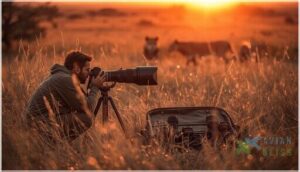
Your lens choice shapes everything — how close you can get, how sharp your subject looks, and how much light you’re working with.
Wildlife photography has a few go-to options depending on what you’re shooting and how far away your subject is.
Here’s what to know before you pick up your next lens.
Telephoto Lenses for Distant Subjects
For distant subjects, a telephoto lens starting at 300mm is your baseline in wildlife photography.
At 400mm to 600mm, you get real reach — small birds fill the frame without heavy cropping. Lens stabilization keeps hand-held shots sharp at longer focal lengths, while image compression from telephoto focal lengths simplifies cluttered backgrounds beautifully.
Add a 1.4x teleconverter for extra reach when animals push farther away.
Prime Vs. Zoom Lenses for Wildlife Scenarios
Once you’ve settled on focal length options, the prime vs. zoom decision shapes your entire kit.
- Prime Lens Sharpness — Telephoto primes like 400mm f/2.8 deliver 10–20% better center sharpness and cleaner low-light performance than most zooms.
- Zoom Lens Flexibility — A 150–600mm covers shifting distances without swapping gear, a real advantage in unpredictable wildlife photography scenarios.
- Lens Weight Comparison — Fast primes cost considerably more, but variable-aperture zooms force higher ISO at full reach.
Optical quality differences narrow considerably with modern glass.
Using Burst Mode Alongside Your Lens Choice for Best Results
Lens selection shapes how you use burst mode, not just what you can reach. With a 600mm prime and steady subjects, short controlled bursts at 10 frames per second give sharp wing angles without flooding your card.
At extreme telephoto techniques, frame rate control matters — faster bursts help when birds launch suddenly, and autofocus optimization keeps continuous autofocus locked through each sequence.
Frequently Asked Questions (FAQs)
What settings should I use for wildlife photography?
Start with Manual mode, Auto ISO, a wide aperture like f/4, and continuous autofocus. Adjust shutter speed for action — around 1/1000 for general wildlife, faster for birds in flight.
What F stop should I use for wildlife photography?
For most wildlife photography, f/6 to f/8 is your reliable range. It keeps subjects sharp, facilitates fast autofocus, and still delivers enough background blur for clean subject isolation without sacrificing depth of field.
How does weather affect wildlife photography camera settings?
Weather rewrites your camera settings fast. Rain calls for high ISO and 1/1000s. Fog needs exposure compensation. Wind-blown subjects demand 1/1000s or faster. Cold battery care keeps you shooting longer.
What accessories improve stability for wildlife shooting?
A sturdy tripod system, gimbal head, or monopod stabilizes heavy telephoto lens setups.
Bean bags work well from vehicles. Built-in image stabilization manages handheld situations, making this photography gear essential for sharp results.
How do you photograph wildlife in low-light conditions?
Low-light shooting comes down to one balance: open your aperture wide, push ISO above 3200, and keep shutter speed fast enough — around 1/500s — to freeze even slow-moving animals cleanly.
How do you stay ethical while photographing wild animals?
Stay far enough back that animals keep acting naturally. Avoid baiting, flash at night, or flushing subjects. Animal welfare comes before any shot — that’s the foundation of ethical wildlife photography.
Conclusion
The shot you almost miss tomorrow will be decided by the groundwork you lay today. Understanding camera settings for wildlife photography isn’t a one-time lesson — it’s a practice that sharpens every time you’re in the field.
Lock in your exposure triangle, trust your autofocus system, and let your settings run quietly in the background. When that lion steps into golden light again, your hands will already know what to do.
- https://www.kevinpepperphotography.com/shutter-speeds-for-wildlife-photography
- https://learnandsupport.getolympus.com/learn-center/photography-tips/wildlife/optimizing-camera-settings-for-wildlife-photography
- https://www.annalisekaylor.com/blog/mastering-noise-in-wildlife-photography
- https://www.paolosartoriphotography.com/blog/2025/4/ultimate-autofocus-trick-use-servo-and-one-shot-af-at-the-same-time
- https://www.pangolinphoto.com/photo-tips-shutter-speeds-for-wildlife-photography