This site is supported by our readers. We may earn a commission, at no cost to you, if you purchase through links.
 Birds pack incredible adaptations that’ll blow your mind when unique bird characteristics are explored.
They see ultraviolet patterns invisible to you, navigate using Earth’s magnetic fields, and some sleep with half their brain awake.
Their feathers aren’t just for show—they’re engineering marvels that reduce drag by 40% and provide waterproofing.
From tool-using crows to penguins adapted for aquatic life, these 10,000 species showcase nature’s most creative solutions to survival challenges.
You’ll discover their hollow bones cut weight by 50% while maintaining strength, and their four-chambered hearts pump at 400 beats per minute during flight.
Table Of Contents
Key Takeaways
- You’ll discover birds’ hollow bones reduce their skeleton weight by 50% while maintaining strength through internal struts, creating the perfect balance for efficient flight
- You’ll find birds possess extraordinary sensory abilities including ultraviolet vision that reveals invisible patterns and magnetic field navigation using quantum proteins in their eyes
- You’ll learn that birds’ four-chambered hearts pump at 400 beats per minute during flight, supporting metabolic rates twice that of mammals with continuous oxygen delivery through specialized air sac systems
- You’ll see how birds’ asymmetrical flight feathers and specialized barb arrangements reduce drag by 40% while their syrinx vocal organ lets them produce complex dual-tone songs by controlling each side independently
Exceptional Adaptations and Specialized Features
You’ll discover that birds possess some of the most remarkable structural adaptations in the animal kingdom, from hollow bones that reduce weight by 50% to specialized respiratory systems that outperform mammalian lungs.
Nature engineered birds as the ultimate flying machines, combining hollow bones with high-performance hearts for aerial mastery
These extraordinary features represent millions of years of evolution fine-tuning every aspect of avian anatomy for survival, flight, and ecological success.
Hollow and Fused Bones
You’ll discover that birds achieve flight through remarkable bone structure innovations.
Hollow bones reduce skeleton weight by 30% while maintaining strength through internal struts.
Skeletal adaptations include bone pneumatization, where air-filled cavities create lightweight limbs without sacrificing durability.
Fused vertebrae form rigid structures like the synsacrum, providing stability during flight maneuvers while keeping overall mass minimal.
The unique characteristics of birds can be attributed to their evolutionary bird adaptations that enable them to thrive in various environments, showcasing their evolutionary and adaptive traits.
Keeled Sternum for Muscle Attachment
You’ll notice your bird’s sternum isn’t flat like yours—it features a prominent keel structure that juts outward like a ship’s hull.
This keeled sternum provides essential muscle attachment points for powerful flight muscles, which can comprise up to 35% of a bird’s total body weight.
The sternum shape directly correlates with flight ability: stronger fliers possess more pronounced keels for enhanced flight muscle attachment in their avian anatomy.
Synsacrum and Skeletal Rigidity
You’ll find that the synsacrum represents nature’s engineering masterpiece in avian skeletal structure.
This fused vertebrae system creates incredible spinal rigidity by joining multiple vertebrae into one solid unit.
The vertebral fusion provides unmatched skeletal support while maintaining lightweight bone density through pneumatized bones.
These skeletal adaptations work alongside the keel to create a rigid framework that handles flight’s demanding forces without compromising the bird’s aerodynamic efficiency.
Four-Chambered Heart and High Metabolism
Birds’ four-chambered hearts pump blood at extraordinary rates, reaching 400 beats per minute during flight.
This cardiac efficiency supports metabolic rates twice that of mammals, with oxygen delivery systems perfectly tuned for energy production.
Your feathered neighbors maintain body temperatures around 104°F, fueling their incredible aerial performances through optimized heart function and circulatory system adaptations.
Unique Respiratory System With Air Sacs
You’ll be amazed at how birds’ respiratory systems work like turbocharged engines.
Bird respiratory systems operate like biological superchargers, delivering oxygen with unmatched efficiency
Unlike mammals, their air sac system creates unidirectional airflow through specialized avian lungs, ensuring continuous oxygen exchange during both inhalation and exhalation.
This respiratory efficiency supports their high metabolism and unique adaptations for flight, delivering constant fuel for their energy-demanding lifestyle, which is made possible by their highly efficient oxygen exchange system, allowing for a high metabolism.
Aerodynamic Features for Efficient Flight
Birds achieve their incredible flying abilities through four key aerodynamic features that work together like a perfectly engineered machine.
You’ll find that their streamlined bodies, lightweight hollow bones, specially shaped feathers, and drag-reducing structures create the ultimate flying experience that puts human aircraft to shame, with aerodynamic features being the key to their success.
Streamlined Body Shape

You’ll notice how evolution shaped birds into perfect flying machines through their sleek body contours.
These aerodynamic forms create slim profiles that slice through air with minimal resistance.
Their streamlined shapes optimize airflow around their bodies, reducing drag by up to 40% compared to non-aerodynamic forms.
This weight reduction strategy, combined with their body’s natural airfoil design, maximizes thrust generation during flight.
The study of aerodynamic bird models helps researchers understand the complex relationships between shape, air resistance, and flight efficiency.
Lightweight, Pneumatized Skeleton
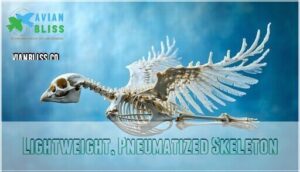
Within every bird’s framework lies a remarkable engineering marvel that defies gravity’s pull.
You’ll discover that their pneumatized skeleton features hollow bones filled with air sacs, reducing weight by up to 50% while maintaining incredible strength.
This lightweight frame represents millions of years of skeletal adaptations, where bone pneumatization creates the perfect balance between durability and flight efficiency that makes soaring possible.
Asymmetrical Flight Feathers
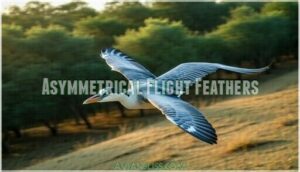
Beyond their lightweight design, you’ll discover that flight feathers showcase remarkable asymmetry that revolutionizes Flight Mechanics.
The outer vane stays narrower than the inner vane, creating specialized aerodynamic surfaces that boost lift production by 27% compared to symmetrical designs.
Here’s how asymmetrical flight feathers enhance performance:
- Reduced drag – Wing Structure analysis shows 15% less air resistance during flight
- Enhanced maneuverability – Predatory birds achieve superior aerial control and precision
- Increased lift generation – Aerodynamic Lift improves substantially through optimized airflow management
- Better energy efficiency – Migratory species maintain sustained speeds with less effort
- Flight stability – Feather Structure prevents turbulence during high-speed maneuvers
This Feather Aerodynamics breakthrough separates flying birds from flightless relatives, with genetic controls ensuring proper development.
Feather Barb Arrangement for Reduced Drag

Feather aerodynamics work like nature’s wind tunnel, with each barb creating microscopic airflow channels.
The intricate barb structure forms aerodynamic surfaces that slice through air, reducing drag by up to 40% compared to solid wings.
This sophisticated arrangement generates ideal lift while maintaining flight efficiency across different feather types.
Understanding the principles of feather color patterns is essential for recognizing various bird species and their adaptations.
| Feather Component | Drag Reduction Method | Flight Benefit |
|---|---|---|
| Primary barbs | Channel airflow smoothly | Reduced turbulence |
| Secondary barbules | Create micro-vortices | Enhanced lift generation |
| Asymmetrical design | Optimize pressure differences | Improved maneuverability |
| Flexible rachis | Adjust to wind conditions | Stable flight control |
| Interlocking hooks | Maintain surface integrity | Consistent aerodynamics |
The table highlights the role of each feather component in achieving efficient flight, from reduced turbulence to improved maneuverability.
By studying these components and their functions, researchers can gain a deeper understanding of bird flight and its underlying mechanisms.
Diverse Wing and Feather Designs
You’ll discover that bird wings come in remarkable shapes and sizes, from the massive 11-foot wingspan of wandering albatrosses to the tiny hummingbird wings that beat 80 times per second.
Each species displays specialized feather types that serve distinct purposes, including waterproof outer contour feathers, insulating down feathers, and precisely engineered flight feathers that create the perfect airfoil for their unique flying needs, which is a result of unique flying adaptations.
Wing Shapes and Sizes Across Species

You’ll discover that wing morphology varies dramatically across bird species, with each design perfectly suited to specific flight patterns and survival needs.
Different wing shapes create unique aerodynamic lift characteristics that determine how birds navigate their environments.
- High aspect ratio wings – Albatrosses achieve gliding efficiency over oceans with wingspans exceeding 3.5 meters
- Low aspect ratio wings – Forest birds like sparrowhawks use short, rounded designs for rapid maneuverability through dense vegetation
- Long, pointed wings – Swifts and falcons maximize speed with streamlined airfoil design for hunting and diving
- Short, broad wings – Ground birds generate powerful takeoff bursts with wide wing spans for vertical escapes
- Extreme wing sizes – Hummingbirds hover with 5.5cm wings while condors soar on 3-meter spans, showcasing feather flexibility adaptations
Contour, Down, and Flight Feathers

You’ll discover three distinct feather types that work together for flight and survival.
Contour feathers shape your bird’s sleek outline and provide the colorful plumage you see, while flight feathers create the aerodynamic surfaces needed for lift and control.
Down feathers trap air close to the skin, offering incredible insulation that keeps birds warm even in freezing temperatures.
The structure and function of these feathers are influenced by their bird feather characteristics.
Molt Patterns and Feather Renewal

You’ll witness nature’s ultimate makeover as birds systematically replace their entire feathered wardrobe through precise molt cycles.
This Feather Regrowth process guarantees peak flight performance and insulation throughout seasonal changes, with each species following distinct Avian Molting schedules.
- Molt Cycles vary dramatically – songbirds complete Plumage Renewal twice yearly, while eagles molt over several years
- Feather Shedding follows strategic patterns – flight feathers drop in sequence to maintain aerial capability during replacement
- Molt patterns reflect lifestyle demands – migratory species time feather renewal before long journeys for peak performance
- Plumage evolution drives timing – breeding adults molt after nesting season to avoid compromising parental duties
Waterproof and Insulating Feathers

You’ll find waterproof feathers work like nature’s raincoat through specialized coatings.
Ducks apply oil from their preening gland, creating water-repelling barriers. Down feathers trap air for thermal regulation, while contour feathers shed moisture effectively.
| Feather Structure | Insulation Types |
|---|---|
| Down feathers create air pockets | Thermal regulation through trapped air |
| Contour feathers form outer barrier | Wind resistance and moisture control |
| Barbule hooks maintain shape | Structural integrity during weather |
| Oil distribution keeps coating fresh | Waterproof maintenance through preening |
Sensory and Behavioral Marvels

You’ll discover that birds possess sensory abilities far beyond human perception, using ultraviolet vision and magnetic navigation systems that seem almost supernatural.
Their behavioral adaptations include sleeping with half their brain awake and using tools with remarkable intelligence.
Ultraviolet and Polarized Light Vision
You’ll discover a hidden world when you learn that birds possess Ultraviolet Sight beyond human perception.
Their Visual Acuity extends into the ultraviolet spectrum, revealing patterns invisible to us.
Birds utilize UV vision mechanisms to enhance their foraging and mating behaviors.
- Spectral Sensitivity ranges from 360-426 nm, with smaller birds transmitting more UV light through their eyes
- Light Detection helps identify ripe fruits, prey markings, and mate fitness signals through UV reflectance
- Polarized Vision assists navigation, though true polarization discrimination remains limited in most species
- Cryptochrome proteins work alongside UV-sensitive cones for enhanced color discrimination and magnetic field reception
Magnetic Field Navigation
Birds navigate using quantum physics through cryptochrome proteins in their eyes.
These proteins detect magnetic fields through quantum entanglement, creating visual patterns overlaid on their environment.
Magnetite receptors in their beaks work like biological compasses.
This dual system enables precise migration patterns across thousands of miles.
| Navigation Component | Function |
|---|---|
| Cryptochrome Proteins | Create visual magnetic field patterns |
| Magnetite Receptors | Act as biological compass sensors |
| Trigeminal Pathways | Relay magnetic data to brain |
| Geomagnetic Imprinting | Maps field gradients for navigation |
The combination of cryptochrome proteins and magnetite receptors allows birds to navigate with remarkable accuracy, making use of the Earth’s magnetic field to guide their flights.
Beak Sensitivity and Specialized Foraging
Beyond navigation, your feathered friends possess remarkable beak sensitivity that transforms them into living metal detectors.
Specialized sensory receptors called Herbst corpuscles turn bills into precision instruments for food detection, while unique bill morphology creates species-specific foraging tactics.
Understanding proper beak care techniques is essential for maintaining their overall health.
- Kiwis detect earthworms through ground vibrations using beak structure adaptations
- Sandpipers probe mudflats with pressure-sensitive tips for hidden prey location
- Ducks filter-feed efficiently using lamellae structures for aquatic food sorting
Unihemispheric Slow-Wave Sleep
While beak sensitivity helps birds navigate their environment, their sleep patterns reveal another remarkable adaptation.
You’ll discover that many bird species use unihemispheric slow-wave sleep, allowing half their brain to rest while the other half stays alert for predators.
This unique rest behavior enables continuous vigilance during sleep cycles, with brain function alternating between hemispheres throughout dream activity periods.
Tool Use and Problem-Solving
While you’re sleeping soundly, many birds showcase remarkable Tool Use and Problem-Solving abilities that rival some primates.
These intelligent creatures demonstrate Adaptive Learning through Creative Foraging techniques, manipulating objects to access food sources.
The use of bird tool kits is a key aspect of their problem-solving behavior.
- Crows fashion wire hooks to extract insects from tree bark crevices
- New Caledonian crows craft stepped tools from leaves for grub extraction
- Egyptian vultures drop stones on ostrich eggs to crack them open
Species Diversity and Unique Traits

You’ll discover that birds represent one of nature’s most diverse animal classes, with over 10,000 species showcasing remarkable adaptations across every habitat on Earth.
From the tiniest hummingbird’s specialized syrinx producing complex songs to massive flightless ostriches retaining essential avian traits, each species demonstrates unique evolutionary solutions to survival challenges, highlighting the diverse nature of birds.
Taxonomic Classification of Birds
Scientists organize all feathered creatures into Class Aves, the formal classification system that groups over 10,000 species worldwide.
You’ll find birds arranged through taxonomic hierarchy from genus to species, with major orders like Passeriformes containing songbirds and Anseriformes housing waterfowl.
Classification systems use anatomical features and evolutionary relationships to create these taxonomic keys that help researchers identify and categorize different Aves species.
Syrinx and Complex Vocalizations
You’ll discover that birds possess nature’s most sophisticated vocal instrument. The syrinx anatomy sits where the trachea splits, letting birds control each side independently for dual-tone songs.
This unique structure enables vocal learning abilities that rival human speech development, creating avian dialects across populations. The avian vocal organ, known as the syrinx, is located where the trachea divides into the bronchi.
- Songbirds produce internal duets by operating left and right syrinx sides simultaneously
- Complex vocalizations in parrots include lifelong mimicry skills surpassing other animals
- Sound localization helps birds navigate territories through acoustic landmarks
- Avian mimicry capabilities allow species like starlings to copy environmental sounds perfectly
Specialized Beaks and Claws
From above and below, you’ll notice how Beak Morphology reflects each species’ unique lifestyle demands.
Bird beak shapes showcase remarkable Feeding Strategies—hummingbirds sport needle-thin bills for nectar extraction, while hawks possess hooked beaks for tearing flesh.
Claw Adaptations mirror these patterns perfectly.
Raptors develop razor-sharp talons for prey capture, whereas woodpeckers feature sturdy claws for vertical climbing.
This Habitat Influence shapes both specialized bill structure and Defense Mechanisms across species.
Flightless Birds and Their Adaptations
Unlike their aerial cousins, flightless birds like ostriches, kiwis, and cassowaries have embraced Terrestrial Locomotion through remarkable adaptations.
Ratite Evolution eliminated keeled sternums, while penguins developed dense bones for underwater prowess.
These species occupy unique Ecological Niches—from desert runners to forest foragers.
Unfortunately, Lost Flight often correlates with vulnerable Conservation Status, as flightless birds face mounting pressures in isolated habitats worldwide.
Unusual Nesting and Parental Care Strategies
Beyond traditional pair bonds, you’ll find birds employing remarkable cooperative breeding strategies where multiple adults assist with raising young.
Brood parasitism showcases nature’s cunning – some species trick others into incubation duties by depositing eggs in foreign nests.
Nest material selection varies wildly, from spider silk to stolen treasures, and fledgling dependence periods range dramatically across species, shaping unique mating rituals and nesting behavior studies.
Frequently Asked Questions (FAQs)
How do birds regulate their body temperature?
Don’t ruffle your feathers over temperature control.
You’ll observe birds using behavioral adaptations like panting, seeking shade, and altering blood flow.
They also rely on their high metabolic rate and efficient circulatory system to maintain their body temperature around 100-110°F, which is a result of their efficient circulatory system.
What makes bird eggs so structurally strong?
Bird eggs achieve remarkable strength through their calcium carbonate shell structure.
You’ll find microscopic crystal layers arranged in a dome shape that distributes weight evenly, while tiny pores allow gas exchange without compromising structural integrity, which contributes to the overall strength.
Why do some birds migrate while others dont?
Migration patterns reflect energy trade-offs and survival strategies.
You’ll find that birds migrate when seasonal changes threaten food availability or breeding success, while non-migrants have adapted to year-round resource stability in their territories, which reflects complete concepts of adaptation to survival strategies.
How do birds produce such varied sounds?
You’ll hear birds create diverse sounds through their syrinx, a specialized vocal organ.
Unlike your single larynx, birds can control two sound sources independently, producing complex melodies, calls, and even mimicking other sounds with remarkable precision.
What determines a birds lifespan in wild?
You’ll find lifespan depends on size, predation pressure, and habitat quality.
Larger birds like eagles live decades, while small songbirds face higher mortality from predators and harsh weather, typically surviving just a few years in nature, due to predation pressure.
Conclusion
Like a masterfully assembled puzzle, these unique bird characteristics explored reveal nature’s ingenious solutions to survival challenges.
You’ve discovered how hollow bones reduce weight by 50%, four-chambered hearts pump at incredible rates, and specialized feathers provide both flight efficiency and waterproofing.
From ultraviolet vision to magnetic navigation, birds showcase remarkable adaptations that continue fascinating researchers worldwide.
These extraordinary creatures demonstrate evolution’s creative power through their diverse forms and functions, highlighting the remarkable ability of birds to thrive in various environments with their unique characteristics, including magnetic navigation.
- https://academy.allaboutbirds.org/features/all-about-feathers/what-is-unique-to-birds.php
- https://veterinarykineticsrehab.com/basics-of-musculoskeletal-anatomy-in-birds/
- https://johnrcammidge.com/bird-behavior-the-extraordinary-abilities-of-birds/
- https://www.birdsofpei.info/p/interesting-behaviors_20.html
- https://www.birdlife.org/news/2018/06/27/migration-marathons-7-unbelievable-bird-journeys/