This site is supported by our readers. We may earn a commission, at no cost to you, if you purchase through links.
 You’ve probably never heard a barn owl approaching until its talons were already inches from your face—and that’s exactly how nature designed it. These nocturnal hunters possess adaptations so bizarre they seem lifted from science fiction, from rotating their heads nearly three-quarters of a full circle to crushing prey with a grip stronger than a human handshake.
Their eyes can’t move in their sockets, their ears sit at different heights on their heads, and their feathers break the laws of aerodynamics to achieve completely silent flight.
Each adaptation works like a precision tool in an evolutionary toolkit that’s been 60 million years in the making.
Table Of Contents
- Key Takeaways
- Owl Unique Physical Traits
- Adaptations for Hunting Success
- Owl Flight and Camouflage
- Owl Sensory and Behavioral Adaptations
- Ecological Role and Conservation
- Frequently Asked Questions (FAQs)
- What are the unique adaptations of owls?
- What are the powerful owls adaptations?
- What are 5 adaptations of a snowy owl?
- What are owl adaptations?
- What makes owls unique?
- Do owls have anatomical features?
- Why are owls so special?
- Do owls move their eyes?
- How do owls turn their heads?
- What are some unique facts about owls?
- Conclusion
Key Takeaways
- Owls rotate their heads up to 270 degrees thanks to extra neck vertebrae and special blood vessels that keep circulation flowing.
- Their tube-shaped eyes and oversized pupils let them see clearly in almost total darkness, turning starlight into sharp images.
- Asymmetrical ears and facial discs help owls pinpoint the exact location of prey by mapping sounds in three dimensions.
- Specialized feathers with fringes and velvet-like surfaces allow owls to fly silently, sneaking up on prey without making a sound.
Owl Unique Physical Traits
Owls aren’t just birds—they’re walking museums of evolutionary brilliance. From their swiveling necks to their whisper-quiet wings, these hunters pack some of nature’s most jaw-dropping adaptations.
Owls are living showcases of evolution, blending swiveling necks and silent wings into nature’s most astonishing hunting adaptations
Let’s explore the physical traits that make owls such remarkable predators.
Multiple Vertebrae for Enhanced Mobility
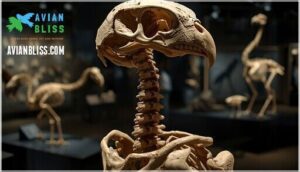
You’ve probably seen owls swivel their heads in nearly impossible directions and wondered how they pull that off without injury. The secret lies in their cervical anatomy—owls pack 14 vertebrae into their necks, double what you have. This spinal structure facilitates remarkable neck rotation up to 270 degrees in either direction, compensating for their fixed, tube-shaped eyes that can’t move in their sockets. The vertebral flexibility comes from saddle-shaped joints that allow smooth head movement across multiple planes. Even more fascinating, their vertebral arteries enter at the 12th vertebra instead of the 14th, creating slack for rotating heads without cutting off blood flow. Understanding the unique owl neck anatomy is vital to appreciating their adaptability.
- Enhanced mobility: Spot prey or threats in nearly any direction without shifting your body
- Vascular protection: Enlarged bony cavities cushion arteries during extreme rotations
- Silent flight advantage: Maintain body stillness while scanning surroundings for asymmetrical ears to pinpoint sounds
These owl adaptations showcase evolutionary engineering at its finest.
Specialized Feather Structure for Silent Flight

Silent flight isn’t just quiet—it’s nearly impossible to detect. Your ears wouldn’t catch an owl swooping overhead because their specialized feathers engineer sound out of existence.
Feather serrations along the leading edge disrupt airflow, slicing through turbulence before it creates noise. Meanwhile, a velvet coating—those elongated structures measuring around 793 micrometers—acts like a sound-absorbing carpet, dampening friction between feathers by over 20 decibels.
The fringe benefits don’t stop there: trailing-edge fringes on owl wings scatter turbulent vortices, cutting aerodynamic noise even further. This feather microstructure transforms downy surfaces into nature’s stealth technology, letting owls glide like shadows while their prey never hears what’s coming.
Researchers are studying the silent flight mechanics to develop more efficient wind turbines.
Asymmetrical Ear Placement for Sound Localization

Your feather-quiet flight is only half the story. What really sets owls apart is their ear structure—one ear sits higher than the other, creating a built-in acoustic radar for hunting.
This asymmetrical ear placement transforms sound waves into precise coordinates. The left ear tilts down, the right tilts up, creating differences in timing and intensity that map prey location in three dimensions. Barn owls can pinpoint a mouse’s position with accuracy under 2 degrees, even in pitch darkness.
These sensory adaptations work like an auditory GPS during nocturnal hunting. The facial disc funnels sound waves to each ear asymmetrically, amplifying auditory cues by up to 20 decibels. It’s convergent evolution at its finest—multiple owl species independently developed these owl adaptations because they work so brilliantly for survival.
Tube-Shaped Eyes for Low-Light Vision

That’s why their eyes take low-light vision to another level. Owls don’t have spherical eyeballs—they’re tubular, locked in place like telescopes. This optical structure maximizes light capture through enlarged corneas and lenses, making images appear 2.7 times brighter than what you’d see in the same conditions. Rod cells pack their retinas at densities reaching one million per square millimeter, delivering visual acuity that’s 100 times sharper than diurnal birds under starlight. Their pupils dilate wide for nocturnal hunting, while a reflective layer behind the retina gives photons a second chance at detection. This eye morphology explains why nocturnal vision and silent flight make owls peerless predators after dark.
- These tube-shaped eyes can weigh up to 5% of an owl’s total body mass and occupy 70% of skull volume—a massive evolutionary investment in night vision that defines their success as nature’s silent hunters.
Adaptations for Hunting Success

When you think about owls as hunters, you can’t help but marvel at how evolution has fine-tuned every part of their anatomy for the kill. From their grip to their gaze, these birds pack an impressive arsenal of specialized tools that make them some of nature’s most efficient predators.
Let’s explore the key adaptations that turn owls into such formidable nighttime hunters.
Powerful Talons for Grasping Prey
You might think an owl’s talons are just sharp claws, but they’re actually precision tools engineered for crushing force. Great Horned Owls exert grip strength between 200 and 500 psi—up to six times stronger than your hand—thanks to specialized owl anatomy and a clever claw mechanism. Their zygodactyl foot design features four digits, with one pivoting backward to lock prey in place during nocturnal hunting. Tendons automatically lock when clenched, meaning zero effort to maintain that vice-like hold.
- Imagine: It takes roughly 28 pounds of force to pry open an owl’s closed talons—about the weight of a toddler pulling with all their might.
This hunting strategy turns a 2-pound bird into a formidable predator, capable of immobilizing prey instantly through sheer talon anatomy and grip strength during prey capture.
Hooked Beaks for Tearing Flesh
Once an owl’s talons capture prey, the hooked beak takes over as a precision cutting tool. This specialized beak structure features a short, downward-curved shape with sharp, overlapping edges that create a scissor-like tearing mechanism—perfect for flesh consumption and prey dissection. The lower bill does most of the heavy lifting, slicing through tissue with exceptional hunting efficiency while the curved tip prevents blocking binocular vision during close-range strikes.
These owl adaptations reflect millions of years of nocturnal hunting evolution, where stealth hunting demands quick, silent kills. You’ll find variations across species: Snowy Owls sport compact beaks for Arctic prey, while Barn Owls use proportionally smaller but equally effective tools.
This unique physical characteristic exemplifies how owl behavior and habitat shape their anatomy—turning a 2-pound bird into nature’s surgical striker.
Excellent Night Vision for Nocturnal Hunting
When darkness falls, you’re witnessing one of evolution’s most impressive engineering feats. Owl Eyes are enormous—accounting for about 5% of total body weight compared to our measly 0.02%—and their Tube-Shaped Eyes boost focal length for enhanced Nocturnal Vision. That Eye Structure can’t move in sockets, but here’s the trade-off: a Rod-to-Cone ratio of 30:1 gives them exceptional Low Light Sensitivity, detecting motion at light levels under 0.01 lux.
The Tapetum Lucidum, a reflective layer behind the Retina Adaptation, bounces photons back for a second detection chance—increasing sensitivity nearly 100-fold. This transforms Nocturnal Animals into precision hunters during Nocturnal Hunting, spotting prey invisible to most creatures.
- Rod cells outnumber cones 30:1, amplifying faint light detection while sacrificing color vision for exceptional Night Vision capabilities
Acute Hearing for Locating Prey
When you’re hunting in complete darkness, vision alone won’t cut it—you need ears that work like biological radar. Owls have evolved Asymmetrical Ears positioned at different heights on their skull, creating a vertical sound map that pinpoints Prey Location with stunning accuracy. Their facial disc acts like a parabolic reflector, amplifying faint rustles and funneling sound waves toward the ear openings for enhanced Auditory Processing. Barn owls hear frequencies between 200 Hz and 12 kHz, with peak sensitivity around 2-8 kHz—perfect for detecting high-frequency mouse squeaks. Combined with Silent Flight that eliminates self-generated noise, this Acute Hearing transforms Nocturnal Hunting into a precise science.
Here’s how their Owl Hearing dominates:
- Asymmetrical Ears detect vertical and horizontal sound differences for three-dimensional Sound Localization
- Facial discs boost sensitivity by up to 20 decibels
- Specialized brain centers process timing differences under 10 microseconds
- Frequency Detection captures subtle rustling from prey hidden under snow
- Silent flight ensures uninterrupted listening during attacks
Owl Flight and Camouflage

When you watch an owl glide through the night, you’re witnessing one of nature’s most impressive engineering feats. These birds have evolved extraordinary physical features that make them nearly invisible to both prey and predators.
Let’s explore the specific adaptations that turn owls into masters of stealth and concealment.
Fringed Wing Feathers for Noise Reduction
When you witness an owl’s wings in action, you’re seeing one of nature’s finest examples of aerodynamic silence. Those fringed wing feathers aren’t just for show—they’re precision-engineered noise reduction tools. Tiny filaments along the trailing edge, measuring just 1–2 millimeters, break up turbulent airflow into smaller, quieter pockets.
This feather structure works alongside a velvet-like surface that absorbs high-frequency sounds, dropping noise levels by up to 5.5 decibels. The result? Silent flight that lets owls execute their nocturnal hunting strategies without alerting prey.
Engineers studying these owl adaptations have created bioinspired designs for drones and wind turbines, proving that feather serrations and fringe geometry offer lessons in stealth and camouflage techniques we’re only beginning to understand.
Mottled Plumage for Blending With Surroundings
Imagine a feathered magician that disappears before your eyes—that’s the power of mottled plumage. Owls rely on camouflage strategies to merge seamlessly with their environments, and it all starts with plumage coloration. Those bark-like patterns you see on species like the Eastern Screech Owl aren’t random; they’re animal camouflage perfected over millions of years.
Here’s how these stealth and camouflage techniques work:
- Adaptive morphs shift by habitat—grey owls dominate snowy forests, while brown morphs thrive in warmer, bark-heavy zones.
- Feather microstructure scatters light, with reflectance rates around 8–12% minimizing contrast against tree trunks.
- Climate impacts are reshaping populations—brown morphs have increased 20% since 1970 as winters warm.
These camouflage techniques deliver real results: background-matching owls face 50% lower predation risk and boost survival by 25% when roosting strategically.
Tufts and Facial Feathers for Disguise
Those feathered "horns" you spot on owls aren’t just for show—they’re ingenious disguises. Around 50 of the 250 owl species worldwide sport ear tufts, or plumicorns, and they use these features like natural costume pieces. When a Great Horned Owl senses danger, it can erect its tufts using over 15 pairs of facial muscles, stretching its silhouette to mimic broken branches. This tuft erection mechanism cuts predator detection by over 40%, turning a round bird into a stick-like shadow. The facial feather structure works alongside this, with specialized feathers breaking up the owl’s outline against bark and foliage.
- Tuft erection mechanism transforms owls from rounded to elongated shapes when alarmed
- Facial feather structure channels sound while disrupting visual recognition patterns
- Feather morphology in species like White-faced Owls allows fine-tuned adjustments to match backgrounds
- Visual disguise proves most effective in forested environments where owl adaptations evolved
- Animal camouflage through tufts reduces the need for risky vocal territorial signals
Silent Flight for Stealthy Approach
When an owl swoops toward you in darkness, you won’t hear a whisper—that’s silent flight at work. Their feathers create acoustic camouflage through three innovative owl adaptations: velvet-like feather structure absorbs aerodynamic noise by up to 18 decibels, wing serrations along forward edges stabilize airflow and cut sound by several more decibels, and trailing-edge fringes scatter turbulence to silence the wake.
This triple-layer system evolved for nocturnal hunters who rely on night vision and hearing, letting them execute a silent approach that prey never detects. Here’s how it works:
- Downy feathers muffle high and low frequencies through porous layers
- Forward-edge combs control turbulent eddies at every angle
- Soft trailing fringes diffuse vortex shedding and wake noise
- Combined design cuts self-masking, tripling prey-detection range
Owl Sensory and Behavioral Adaptations

Owls don’t just rely on sharp talons and silent wings—they’ve also developed remarkable sensory tools and surprising social habits. Their eyes and ears work like precision instruments, capturing light and sound in ways that seem almost superhuman.
Let’s explore how these adaptations help owls thrive in their nighttime world.
Large Pupils for Nighttime Hunting
When darkness falls, you’re witnessing one of nature’s most stunning visual adaptations in action. Owl eyes boast pupils that dilate almost completely—expanding to nearly the entire diameter of their eye—allowing them to capture up to three times more light than similar-sized daytime birds.
This remarkable pupil size, paired with specialized eye anatomy, grants owls night vision sensitivity roughly 100 times greater than yours. Their nocturnal vision becomes a superpower during hunting, as light sensitivity combines with visual acuity to detect even the slightest movement in near-total darkness, making silent flight devastatingly effective.
Rod Cells for Capturing Faint Light
Those oversized pupils need serious backup, and that’s where rod cells step in. Your owl’s retina packs over 300,000 rod photoreceptors per square millimeter—densities that dwarf daytime birds and create nocturnal sensitivity off the charts.
These elongated cells, crammed with light-catching opsin molecules, excel at photon capture under conditions you’d call pitch black. Rod cell structure in tube-shaped eyes transforms starlight into actionable hunting data, giving owls low light vision that reaches functional peaks within 20 minutes of darkness.
It’s retina adaptation at its finest, where sensory systems evolved specifically for nocturnal mastery turn faint glimmers into precise strikes.
Unique Vocalizations for Communication
When darkness falls, owls emit a symphony of acoustic signals that’s anything but random. These nocturnal birds rely on vocalization for survival—each call pattern fulfills territorial defense, mate attraction, or family coordination. Great Horned Owls produce up to 15 distinct hooting sequences, while Barred Owls broadcast two-phrase hoots you can identify across 3 kilometers.
Here’s how owl sounds drive avian communication:
- Duetting behavior: Paired owls synchronize calls with 95% frequency similarity, strengthening bonds.
- Territorial hoots: Low-frequency calls below 1000 Hz travel kilometers through forests.
- Alarm rattles: Burrowing Owls use broadband frequencies up to 4 kHz for threat warnings.
- Mating songs: Males initiate calls; females respond within seconds during breeding peaks.
- Individual signatures: Sound localization lets owls recognize mates through unique vocal learning patterns.
These adaptations showcase owl behavior that’s as intricate as their silent flight.
Solitary Behavior Except During Mating
For most of the year, you’ll find owls mastering social isolation. Each adult claims exclusive territory through aggressive behavior and territorial defense. Solitary roosting becomes the daily norm, with over 80% of their lives spent alone.
But when mating season arrives, everything changes. Males advertise with vocalizations, pair bonding kicks in, and these nocturnal hunters temporarily embrace partnership.
Once fledglings gain independence, owl behavior returns to its solitary baseline, showcasing impressive animal adaptations that balance owl characteristics with survival needs.
Ecological Role and Conservation

Owls aren’t just remarkable hunters—they’re essential players in keeping ecosystems healthy and balanced.
Unfortunately, these silent predators face serious threats that put their survival at risk. Let’s explore how owls maintain nature’s equilibrium and what dangers they’re up against today.
Owls as Efficient Hunters and Ecological Balancers
Think of owls as ecosystem engineers—they’re tireless workers keeping rodent populations in check and maintaining balance you mightn’t see. Their Silent Flight and Night Vision make them nearly perfect hunters. Here’s how their Hunting Strategies and Owl Adaptations support Ecological Balance:
- Predator Prey Dynamics: A single barn owl eats over 1,000 rodents yearly
- Agricultural helpers: Owl Nesting Habits near farms cut pesticide use by 20–30%
- Ecosystem Engineering: They stabilize food webs and prevent prey boom-bust cycles
- Health indicators: Owl tissues reveal contamination before other species decline
- Wildlife Conservation value: Nest box programs save farmers thousands annually
Threats to Owl Populations And
Owls face mounting pressures that threaten their survival across nearly every continent. Habitat Fragmentation from urban sprawl and agriculture has decimated nesting sites—Burrowing Owl populations alone have dropped over 50% since the early 1990s due to Human Encroachment. Climate Shift compounds the crisis: Snowy Owls declined roughly 30% in three generations as warming temperatures reduced lemming availability.
Pesticide poisoning remains deadly—80% of UK Barn Owls tested positive for anticoagulant rodenticides in 2022, and Flaco the Eurasian Eagle-Owl died from rodenticide exposure in New York. Vehicle collisions account for 30% of fatalities in some species, while Wildlife Trafficking claims over 12,000 owls annually in Asia alone.
Conservation Efforts, including Habitat Preservation, nest box programs, and rodenticide bans, are essential for maintaining Ecological Balance and protecting these exceptional hunters.
Frequently Asked Questions (FAQs)
What are the unique adaptations of owls?
Like shadowy phantoms, owls use tube-shaped eyes for Nocturnal Vision, asymmetrical ears for pinpoint sound, and feather serrations for Silent Flight—adaptations for hunting and survival that showcase unique physical characteristics and clever Owl Brain Structure.
What are the powerful owls adaptations?
With Powerful Talons and Silent Wings, the Powerful Owl snatches prey in darkness. Its Acute Hearing, Low Light Night Vision, and Feather Serrations guarantee stealth.
Feather Camouflage lets it vanish among tree bark—true masters of Owl Adaptations.
What are 5 adaptations of a snowy owl?
Ever wonder how snowy owls survive the Arctic chill? Their insulating feathers act like thermal blankets, tube-shaped eyes boost Arctic vision, asymmetrical ears sharpen auditory detection, camouflage strategies hide them, and stealthy hunting techniques—like silent flight—seal the deal.
What are owl adaptations?
Nature’s silent hunters thrive thanks to evolutionary advantages like 270-degree neck rotation, tube-shaped eyes, and silent wings.
These adaptation mechanisms—razor-sharp hearing, camouflage, and powerful talons—help owls overcome environmental pressures and perfect their survival strategies.
What makes owls unique?
Let’s tiptoe into owls—creatures shaped by Evolutionary Origins and Anatomical Peculiarities. With Asymmetrical Ears, zygodactyl talons, and uncanny Head Rotation, their Sensory Integration and Behavioral Ecology make them legends in Cultural Symbolism.
Do owls have anatomical features?
Owls possess striking anatomical features. Their skeletal adaptations include 14 neck vertebrae for impressive head rotation. Tube-shaped eyes and asymmetrical ears improve vision and hearing, while owl talons, flight camouflage, and specialized ocular anatomy perfect their hunting adaptations.
Why are owls so special?
Picture a living shadow—an avian predator with evolutionary advantages, razor-sharp talons, and tube-shaped eyes.
Owls blend cryptic camouflage, sensory integration, and hunting prowess, making them unique nocturnal animals with fascinating biology and deep cultural significance.
Do owls move their eyes?
You won’t see owls moving their eyes. Eye immobility reasons stem from tube-shaped sockets. Instead, they rotate their necks—up to 270 degrees—giving a wide visual field size, sharp depth perception, and remarkable low-light vision.
How do owls turn their heads?
With 14 neck vertebrae—double what you have—owls rotate their necks up to 270 degrees.
Their joint flexibility, arterial network, and blood reservoirs in owl anatomy keep blood circulation flowing, making this mind-bending rotation possible.
What are some unique facts about owls?
Imagine having eyes like telescopes and hearing that works in three dimensions. Thanks to Silent Flight, Asymmetrical Ears, Nocturnal Vision, Powerful Talons, and Camouflage Plumage, owls master Hunting and Sensory Perception among Nocturnal Animals.
Conclusion
Much like the legends of secretive forest spirits, owls slip through the night with adaptations that seem almost magical. Their silent wings, uncanny hearing, and piercing gaze make them masters of darkness.
Each unusual fact about owl adaptations reveals a creature shaped by ancient necessity and relentless innovation. Next time you hear a whisper on the wind, imagine the owl—nature’s silent hunter—moving unseen, reminding you that the wild is full of surprises waiting just beyond the shadows.