This site is supported by our readers. We may earn a commission, at no cost to you, if you purchase through links.

A bird you’d never spot at your feeder might show up the moment add water to your yard.
Warblers, thrushes, and wrens don’t eat seeds—but they bathe.
That single fact changes everything about how you attract birds.
Most feeders pull maybe a dozen species.
A well-placed birdbath with moving water can draw three times that, including birds that most backyard birders never see up close.
Depth, texture, placement, and flow all determine which species stop by and how often.
Get those details right, and your yard becomes the neighborhood’s most popular rest stop.
Table Of Contents
Key Takeaways
- Adding a birdbath pulls in birds like warblers, thrushes, and bluebirds that never visit seed feeders, easily tripling the species count in your yard.
- Moving water — even a simple drip from a punctured jug — signals freshness and safety, drawing up to 60% more visits than a still basin.
- Depth, slope, and texture aren’t extras: keep edges at 1–2 inches, add a rough or graveled surface, and most backyard species will feel confident enough to land.
- Placement seals the deal — position the bath 10–15 feet from shrubs (escape cover, not ambush cover), in partial shade, with clear sightlines so birds can spot trouble before they step in.
Why Birdbaths Attract Birds
Birds need water just as much as food — sometimes more.
A fresh, clean birdbath can make your setup complete — here’s how to build a bird feeding station that covers water, food, and shelter.
A birdbath does something a feeder simply can’t: it pulls in species that never touch seeds, from bluebirds to migrating warblers.
Here’s why water is such a powerful draw, and what makes certain setups work better than others.
Drinking and Bathing Needs
Birds need fresh clean water every day — for drinking and bathing, not just survival. Hydration timing matters most in early morning, when temperatures are moderate and water freshness is highest.
Shallow water between 1 and 2 inches, with the right depth and slope, gives birds confident footing.
Water temperature, water movement appeal, and bathing frequency all rise when you refresh water daily.
Why Water Draws Non-feeder Species
Seed feeders only bring in certain species. But a water source pulls in a whole different crowd — wrens, warblers, thrushes, tanagers — birds you won’t see near a feeder.
Insectivore thirst is real: bugs don’t provide enough moisture. Fruit eater hydration is the same story.
During migration stopovers, these visitors need shallow water fast. Urban water gaps make your birdbath their only option.
Birds also look for quick escape routes when selecting a bath location.
How Moving Water Increases Visits
still water is easy to overlook. But add an audible splash — from a water pump, commercial dripper, or simple drip irrigation effect — and birds notice it fast.
Moving water creates an aerated clarity that signals freshness. The cool surface temperature lingers longer, inviting birds to stay. Ripples also produce a light insect mist, drawing foragers in.
And flowing sound? It works as predator masking, making birds feel safer drinking.
Seasonal Reasons Birds Seek Water
Seasons shift the reasons birds drink — and how urgently they need to.
- Winter Hydration pulls birds to your bath when frozen ground cuts off natural sources.
- Summer Heat Relief matters when high temps drain moisture fast through normal activity.
- Breeding Season Water saves adult birds time while they’re shuttling food to nestlings.
- Molt & Feather Care drives bathing visits as birds replace old feathers and preen.
Birds can also drink from dripping icicles provide water.
Birds Commonly Attracted to Birdbaths
A birdbath doesn’t just attract one or two species — it can pull in a surprisingly wide range of birds, from tiny finches to larger visitors like doves and jays.
The key is knowing who’s likely to show up so you can set things up to welcome them.
Here are the birds you’ll most commonly find splashing around.
Robins, Bluebirds, and Thrushes
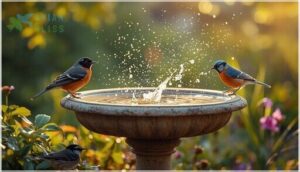
Three backyard favorites — robins, bluebirds, and thrushes — are among the most rewarding birdwatching attractions you’ll encounter at any birdbath design. Each uses a distinct splash technique: robins vigorous-dunk, bluebirds wing-dip, thrushes gradually submerge. The drip sound lure draws all three, especially during morning frost visits when ground water disappears.
| Bird | Water Preference |
|---|---|
| Robin | 2–3 inches, rough surface |
| Bluebird | Under 1 inch, pedestal bath |
| Thrush | 1–2 inch edges, shade temperature preference |
| All three | Predator sight lines kept clear |
Make sure shallow water is provided, ensure predator protection, and let seasonal water supply do the rest.
Sparrows, Finches, and Chickadees
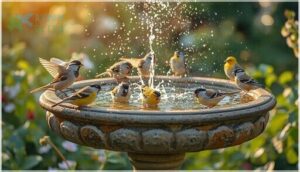
Sparrows, finches, and chickadees visit birdbaths more reliably than almost any other backyard species. Their beak morphology — stout for seed‑cracking, slender for gleaning — means they’re highly active year‑round, adjusting their seasonal diet between insects and seeds. What draws them to water:
- Shallow water (1–2 inches) matches their small frame
- Natural stone texture gives secure footing
- Flock dynamics make one arrival trigger several more
Doves, Jays, and Starlings
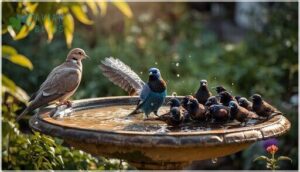
Doves, jays, and starlings bring a whole different energy to the birdbath.
Mourning Doves prefer ground-level access and wide, open water where ground dominance dynamics play out in their favor — though Blue Jays often push them aside.
Starlings arrive in groups, making bath size preferences and water depth for songbirds critical.
During seasonal water competition, providing water for backyard birds with a wider basin keeps visits peaceful.
Hummingbirds and Other Small Songbirds
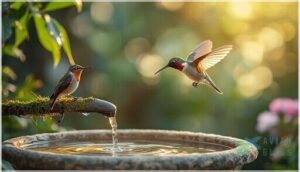
Hummingbirds don’t bathe like other birds — they dart through fine mist or hover under drippers to attract birds with moving water. Their Hover Feeding Mechanics demand shallow water with a gentle slope, barely an inch deep. Keep these details in mind for small songbirds:
- Shallow with a gentle slope suits their tiny frames
- Moving water and drippers to attract birds work better than still basins
- Sun and shade balance keeps water cool and inviting
- Microhabitat Perches nearby support Territorial Song Displays between visits
Seasonal Migration Patterns bring ruby-throated hummingbirds through predictably — a shallow dish with a dripper is all it takes.
Ground-feeding Birds and Larger Visitors
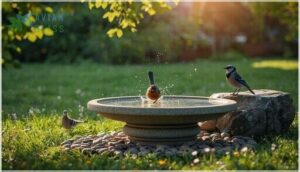
Robins, doves, and blue jays are natural ground-level visitors — they already forage low, so a ground-level bath feels familiar.
Shallow Basin Width matters here: a wide, shallow design with a gentle slope lets several birds drink at once.
Add a large flat rock for Rock Perch Placement, keep depth reasonable at 2–3 inches, and maintain Predator-Free Zones at least 10–12 feet from Cat Deterrent Strategies, such as dense shrubs where cats hide.
Birdbath Features Birds Prefer
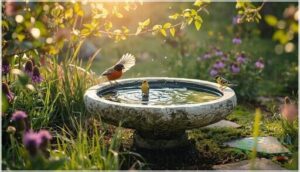
Birds aren’t picky about fancy setups, but they do have a few non-negotiables regarding birdbath design. Get these details right, and you’ll see a noticeable difference in how often birds stop by.
Here’s what actually matters to them.
Ideal Depth for Small and Medium Birds
Depth makes or breaks a birdbath. edge depth at 1–2 inches, rising to no more than 3 inches at the center gradient. slope ratio matters — most small bird species won’t step into a bath exceeding 4 inches.
Here’s the ideal range by size:
- Sparrows and finches — 1 inch
- Chickadees — 1–1.5 inches
- Bluebirds and thrushes — 2–3 inches
- Robins — 2–3 inches
- Doves and jays — 3 inches max
Bath dimensions around 18 inches wide with this depth variation facilitates healthy bird bathing behavior across species.
Gentle Slopes and Easy Entry
Getting the slope right matters just as much as the depth. Shallow slope design lets birds ease in at their own pace — the gradual edge gradient drops from a dry rim landing into water no deeper than an inch at the edges.
Cornell Lab confirms birds prefer this low profile basin approach. It mirrors a natural puddle, making bird bathing behavior feel safe and familiar.
Textured Surfaces for Secure Footing
Slope gets birds in — texture keeps them steady.
Slippery basins send birds scrambling, so surface design matters.
Grooved decking channels water away, while pitted micro-depressions and crosshatch grip patterns give feet something to hold.
Conical nib textures bite into wet surfaces; randomized roughness spreads grip evenly.
For textured birdbath materials, unglazed terracotta and textured matte finish concrete offer safe grippable surfaces without sharp edges.
Rocks, Gravel, and Perching Spots
Texture gets birds in, but the right stones keep them coming back.
Pea gravel and flat stones create Natural Stone Ramps that let small birds wade in gradually.
Mixed Stone Levels give different species options — a sparrow and a jay don’t share the same footing.
Stable Basin Placement matters too; wobbly rocks make birds nervous.
Flat Rock Perches let them pause, look around, then step in confidently.
Ground-level Vs Pedestal Designs
Once your stones are set, the bath’s position off—or on—the ground shapes everything else.
Pedestal baths offer height visibility and natural predator deterrence, keeping wary birds safer. Ground-level baths blend right into borders and attract robins and ground feeders instinctively.
Choose based on your garden:
- Stability factors favor ground-level on soft soil
- Cleaning convenience improves with removable pedestal bowls
- A pedestal acts as a visual focal point near seating
Best Placement for More Visitors
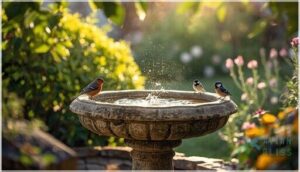
Where you put your birdbath matters just as much as what it looks like. Birds are cautious by nature — they need to feel safe before they’ll stop for a drink or a bath.
These five placement tips will help you find the sweet spot that keeps more species coming back.
Nearby Shrubs and Escape Cover
Birds need an escape route just as much as they need water.
Place your birdbath 10–15 feet from native shrubs so birds can make a short flight to safety without giving predators hiding spots nearby.
| Shrub Feature | Why It Helps |
|---|---|
| Native shrub density | Provides quick, reliable cover |
| Thorny hedge protection | Slows ground predators |
| Layered vegetation heights | Hosts more species |
| Perch‑adjacent planting | Lets birds scan before bathing |
| Seasonal cover rotation | Keeps shelter useful year‑round |
Evergreen shrubs maintain shade and nest habitat even in winter.
Open Sight Lines From Predators
Clear sight lines matter more than most people realize. A cat or hawk uses forward-facing eyes and sharp depth perception to judge distances within 1–5 meters — that’s predator vision range working against your birds. Keep open ground between the bath and dense cover to increase edge visibility and blind spot minimization.
- Avoid placing the bath against fences or walls that create predator hiding spots
- Position it where birds have escape route visibility in every direction
- A safe perch nearby — like a bare branch — lets them scan first, then drink
Predator avoidance near birdbaths starts with design by design.
Partial Shade and Cooler Water
Where you set the bath makes a real difference in water quality. Morning‑Afternoon Shade keeps water cooler longer, slowing both Evaporation Reduction and Algae Suppression before you even grab a scrub brush.
| Placement Condition | Effect on Water |
|---|---|
| Full sun | Heats fast, evaporates quickly |
| Partial shade | Temperature‑Stable Water, longer use |
| Deep shade | Feels enclosed, fewer visits |
| Afternoon shade | Best balance for summer heat |
Light‑Reflective Materials also help — pale basins absorb less heat than dark ones.
Quiet Areas With Easy Flight Access
Think of your birdbath as a small landing strip — birds need a clear flight path of 4 to 6 feet to exit without stress.
A low noise buffer, like a soft ground cover of mulch or native plantings, cuts disturbance noticeably.
Add perching spots within 3 to 5 feet, a wind‑break shelter nearby, and contrast markers so birds spot the water fast.
Safe Distance From Cats and Hazards
Cats turn a ground-level bath into a hunting blind. Keep your setup safe with three rules:
- Use a Cat‑Safe Pedestal — raised 2–3 feet, it cuts predator access sharply.
- Maintain an Open Perimeter and Predator‑Free Buffer of 10–15 feet from dense shrubs.
- Stay outside the Window Collision Zone — place your Stable Non‑Slippery Base beyond 30 feet from glass.
How to Attract More Species
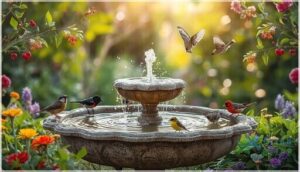
Getting more birds to visit isn’t complicated, but a few small changes make a real difference.
The right setup — water movement, nearby plants, seasonal tweaks — can double the variety you see in a week.
Here’s what actually works.
Refreshing Water Often
Stale water is a quick way to empty your birdbath. Birds won’t drink from murky pools, and warm stagnant water breeds algae and mosquitoes fast.
Refresh water every one to two days — daily when temperatures climb above 30°C.
Scrub the basin weekly to handle algae control and mineral buildup management.
Fresh water daily keeps visits consistent and birds healthy.
Adding Drippers, Bubblers, or Fountains
Fresh water helps, but moving water is what really pulls birds in. Fountains increase visits by up to 60 percent over still water — birds spot ripples and hear the sound from a distance.
Moving water outperforms still by 60 percent — birds follow the ripples and the sound
- Dripper Flow Control — Adjustable valves shift from a steady drip to a light trickle
- Bubbler Sound Benefits — Submerged pumps mimic a gurgling stream
- Solar Fountain Power — Battery-backed panels run on cloudy days
- DIY Dripper Setup — A punctured jug hung above the bath works fine
Clean pump tubing weekly to keep flow consistent.
Pairing Birdbaths With Plants and Feeders
Moving water draws birds in, but plants and feeders seal the deal. Ring the bath with nectar-rich borders and aromatic herb rings like lavender or salvia within three feet. Evergreen groundcovers reduce soil glare and add winter cover.
For feeder-plant spacing, keep seed feeders at least three feet away. This garden design for birds layers native plants, habitat enhancement, and birdwatching attraction into one cohesive setup.
Seasonal Adjustments for Summer and Winter
Seasons change your birdbath’s job description.
In summer, bump up Summer Water Levels slightly and stick to twice‑daily Summer Refilling Frequency during heat spells — evaporation is faster than you’d think. Partial shade manages summer garden care naturally.
Come winter, a heated bird bath prevents ice, and Winter Ice Prevention keeps visits steady. Move the bath closer to evergreens for Winter Shelter Placement, and don’t forget Seasonal Pump Maintenance before temperatures drop.
Common Mistakes That Reduce Bird Visits
small setup errors quietly drive birds away.
Unsafe Placement near dense shrubs hands predators an easy ambush.
Dirty Water and Stagnant Water signal danger quickly — birds won’t touch a murky basin.
Excessive Depth and Smooth Surfaces keep cautious small birds from landing at all.
Skip chemical use entirely; soap strips feathers.
Fix bad placement and improper depth first — everything else follows.
Frequently Asked Questions (FAQs)
Why put a tennis ball in your bird bath?
A floating tennis ball is a cost‑effective warmth trick for winter. Its buoyancy safety keeps water moving, breaking light ice so birds drink easily.
It also acts as a visual cue juveniles spot fast.
Do birds use birdbaths more in dry weather?
Yes — drought-driven visitation spikes noticeably.
When ponds dry up, your birdbath becomes the only reliable water source for birds managing heat‑stress relief and daily hydration needs. Expect considerably more visitors during dry stretches.
How do I stop birds from fighting at the bath?
Set up two or more separate baths at different heights and locations. Remove any reflective surfaces nearby, add multiple perches, and run a dripper to ease competition without crowding.
Can multiple bird species share one birdbath?
Absolutely — multiple species can share one birdbath.
Wider basins, shallow water depth, and perching spots reduce crowding. Species hierarchy and temporal partitioning mean birds naturally take turns, supporting real bird species diversity.
Do birds visit birdbaths at night?
Most birds are diurnal, so nighttime visits are rare. Twilight drinking happens briefly at dusk, but full-dark bathing almost never occurs — predator risk keeps them roosting safely after dark.
How long before birds discover a new birdbath?
Discovery usually happens within one to three days. Visibility cues, water motion, and seasonal timing all speed things up.
Smart placement and clean water, expect your first feathered visitor sooner than you’d think.
Conclusion
Water works wonders—and wildlife follows. Once you understand birds are attracted to birdbaths, every small adjustment you make starts paying off in species you’ve never seen up close before.
Get the depth right, add a little movement, position it where birds feel safe, and refresh it regularly.
You’re not just filling a basin. You’re filling a gap in your yard’s ecosystem, one visitor at a time.
- https://dl.allaboutbirds.org/water-notes-2024
- https://extension.psu.edu/water-for-wildlife-bird-baths-and-backyard-ponds
- https://www.housedigest.com/1831798/attract-variety-birds-yard-different-height-tall-feeder/
- https://theconversation.com/birdbath-food-or-water-how-to-attract-your-favourite-birds-to-your-garden-70258
- https://www.garden-fountains.com/pages/birdbaths-101