This site is supported by our readers. We may earn a commission, at no cost to you, if you purchase through links.

You’ve found binoculars with impressive magnification and crisp optics, but after ten minutes of stargazing or birdwatching, your eyes ache and the image keeps cutting off at the edges. The culprit isn’t the quality of the glass—it’s eye relief, a specification most buyers overlook until they’re squinting through discomfort.
Eye relief determines the distance your eye can sit from the eyepiece while still capturing the complete image, and this single measurement separates comfortable extended viewing from constant frustration. For glasses wearers, insufficient eye relief makes binoculars nearly unusable, forcing an impossible choice between clear vision and a full field of view.
Understanding what eye relief means in binoculars and matching it to your specific needs ensures you’ll actually enjoy using your optics instead of wondering why expensive equipment feels so wrong.
Table Of Contents
Key Takeaways
- Eye relief measures the distance in millimeters between your eye and the eyepiece where you can still see the complete image, with glasses wearers requiring at least 15-16mm to avoid vignetting and edge cutoff.
- Insufficient eye relief causes physical discomfort during extended viewing sessions, including eye strain, headaches, and peripheral vision loss, making proper specification matching essential for practical use.
- Higher magnification binoculars demand more precise eye positioning despite not changing the actual eye relief measurement, while adjustable eyecups allow customization for both glasses wearers and those without corrective lenses.
- Roof prism designs typically offer shorter eye relief than Porro prism configurations due to their compact optical paths, though models like the Pentax DCF ED 8×43 with 22mm demonstrate that generous eye relief remains achievable across different architectures.
What Does Eye Relief Mean in Binoculars?
Eye relief is the distance between your eye and the binocular’s eyepiece lens where you can still see the complete image clearly. Expressed in millimeters, this measurement determines how far back you can position your eye while maintaining full viewing access.
If you wear glasses or prefer more comfortable viewing sessions, models with longer eye relief—especially those with image stabilization features for birding—typically offer 15mm or more.
Understanding what eye relief means and how it’s measured helps you choose binoculars that match your specific vision requirements.
If you wear glasses, look for binoculars designed for eyeglass wearers that offer at least 15mm of eye relief for comfortable viewing.
Eye Relief Definition
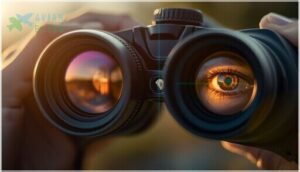
Eye relief is the optical distance from your eyepiece’s outer lens surface to where your eye can capture the full field of view without vignetting. This measurement, typically expressed in millimeters, determines your viewing comfort by defining how far back you can position your eye while maintaining complete field clarity.
Longer eye relief becomes especially valuable when choosing binoculars for bird watching in forests, where quick target acquisition and comfortable extended viewing sessions are essential.
Understanding eye relief helps you select binoculars that align with your vision needs, ensuring the exit pupil delivers peak performance for extended observation sessions.
For birders on a budget, many affordable binoculars under $300 combine generous eye relief with excellent exit pupil design for comfortable, bright views during dawn and dusk outings.
How Eye Relief is Measured
Manufacturers determine eye relief distance by calculating where the exit pupil forms behind the eyepiece design—that optical sweet spot where your eye captures the complete image cone. Understanding eye relief measurement methods helps you verify specifications and choose wisely.
The measurement process involves several optical verification approaches:
- Measuring from the eyepiece’s outer lens surface to the eye point where full field visibility occurs
- Calculating focal length relationships between objective diameter and magnification to predict exit pupil size
- Observing a distant light source while moving the binocular away until vignetting appears at the binocular eye relief boundary
- Accounting for eyecup extension that affects actual eye relief distance from your eye surface
- Applying ISO 14133-2 standards allowing measurement tolerance of -0.5 mm for specification accuracy
Considering the importance of proper eye relief for glasses wearers, it’s vital to research and understand the concept of long eye relief to guarantee comfortable viewing.
Typical Eye Relief Ranges
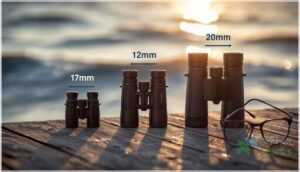
After understanding how eye relief distance is measured, you’ll find most binoculars fall within predictable ranges based on their design priorities. Standard models usually offer 12–20 mm of eye relief distance, with compact designs clustering around 12–15 mm—suitable for non-glasses wearers but challenging otherwise.
Long eye relief binoculars (18–20 mm) dominate wildlife and marine applications, delivering enhanced viewing comfort during extended sessions. Binocular eye relief standards reflect how eyepiece technology balances optical quality against practical usability, directly influencing your field experience.
Why Eye Relief Matters for Viewing Comfort
Understanding eye relief is one thing, but recognizing why it matters transforms how you experience binoculars in the field.
The distance between your eye and the eyepiece directly affects your ability to see clearly and comfortably over extended periods.
Several key factors determine whether your viewing sessions will be pleasant or plagued by frustration.
Impact on Full Field of View
Your eye position determines how much of the binoculars’ field of view you’ll actually see. When your eye sits too far from the exit pupil, vignetting effects darken the image edges, shrinking the usable field size.
If you wear glasses, check out recommended wildlife viewing optics that offer generous eye relief to prevent frustrating edge darkening.
Longer eye relief preserves the full viewing area, especially if you wear glasses. Adjustable eyecups let you dial in the right distance, ensuring best image quality and viewing comfort across the entire field of view.
Reducing Eye Strain and Fatigue
Proper eye relief directly shapes how your eyes feel after an hour of glassing distant ridges. When optical coatings work with the right eye-to-lens distance, you maintain brightness without squinting, a key element of fatigue reduction.
Consider these viewing comfort benefits:
- Reduced need for constant refocusing preserves ocular muscle relaxation
- Stable edge-to-edge clarity minimizes peripheral eye strain
- Ergonomic eyecup design cushions the orbital area during extended sessions
- Balanced convergence across both barrels prevents uneven distortion fatigue
- Comfortable viewing angles eliminate pressure headaches
Eye care starts with smart eye relief choices.
Preventing Vignetting
When shadows creep around the edges of your view, vignetting has entered the picture. This peripheral darkening happens when your eye sits beyond the exit pupil, blocking off-axis light paths.
Proper eye relief adjustment aligns your pupil with the optical design’s sweet spot, maintaining peripheral illumination across the entire field. Eyecups help you find this position consistently, and quality binocular design minimizes vignetting through precise prism alignment and lens coatings that preserve image quality.
Eye Relief for Glasses Wearers
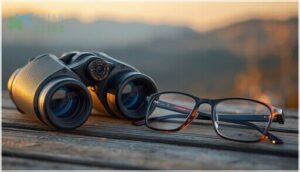
If you wear glasses, finding binoculars with adequate eye relief becomes even more critical to your viewing experience. The distance your frames create between your eyes and the eyepiece changes what you’ll need from your optics.
Understanding the specific requirements for glasses wearers helps you avoid common frustrations and ensures you can see the full image without compromise.
Recommended Eye Relief Distances
If you wear glasses, you’ll need at least 16mm of eye relief to see the full field without cutting off edges—that’s the threshold where glasses compatibility and viewing comfort truly begin. Most eyeglass wearers find 18mm strikes the right balance, while 19-20mm offers ideal distances that eliminate positioning headaches entirely.
Glasses wearers need at least 16mm of eye relief, though 18-20mm eliminates positioning struggles entirely
Non-glasses wearers face fewer constraints, comfortably using binocular specifications ranging from 10-20mm since adjustable eyecups set the proper distance automatically.
Understanding proper eye relief is essential for a comfortable viewing experience.
Challenges With Short Eye Relief
When your binoculars force you to press close, viewing discomfort sets in quickly. Short eye relief creates field limitations that crop peripheral details, while vignetting issues darken edges before you even notice.
Using binoculars with glasses becomes frustrating—you’ll battle optical distortion and inconsistent sharpness as your eye struggles to align properly. Eye strain and headaches follow extended sessions, especially when eyecups can’t compensate for the distance your frames add between lens and eye.
Features Beneficial for Glasses Users
Modern binoculars solve eyeglass compatibility through three engineering features. Long eye relief of 16 to 18 millimeters lets you position spectacles between your eye and the eyepoint without losing peripheral vision.
Adjustable eyecups with multiple click stops fine-tune viewing distance, while diopter adjustment provides prescription compensation for individual eye differences.
Folding eyecups bring the rim flush with the eyepiece lens, maximizing the full specified eye relief when using binoculars with glasses.
Factors Influencing Binocular Eye Relief

Eye relief isn’t just a random specification that manufacturers slap on the box. Several optical and mechanical factors determine how much distance you’ll need between your eye and the eyepiece to see clearly.
Understanding these elements helps you make sense of why different binoculars offer vastly different viewing experiences.
Eyepiece and Prism Design
The optical architecture of your binoculars determines how far your eye must sit from the eyepiece. Eyepiece design sets the viewing distance needed to see the full field without vignetting, while prism systems—Porro versus roof—alter the optical path and affect where the exit pupil forms. Lens coatings reduce glare across varying light conditions, and mechanical tolerances in eyecups directly influence usable eye relief by changing the distance between your eye and the ocular lens.
| Component | Impact on Eye Relief |
|---|---|
| Eyepiece Design | Sets required distance for complete field of view |
| Prism Type | Influences optical path length and exit pupil position |
| Lens Coatings | Enhances comfort by minimizing glare at eye relief distance |
| Field Stop Position | Defines maximum exit pupil for edge-to-edge viewing |
| Eyecup Mechanics | Adjusts physical distance from eye to lens surface |
Magnification and Field of View
Higher magnification shrinks your field of view, compressing what you see into a narrower window. An 8× binocular shows a broader scene than a 10× model, giving you better peripheral awareness when tracking birds or scanning landscapes. Though eye relief doesn’t change with magnification, correct eye placement becomes more demanding at higher powers—misalignment causes vignetting and edge loss.
Consider these trade-offs:
- 8×–10× balances detail with comfortable field width
- Higher powers demand precise eye positioning
- Wider apparent fields compensate for magnification limits
- Linear field specs (feet/1000 yards) enable direct model comparison
Adjustable Eyecups and Customization
You can twist or fold most eyecups to match your preferred eye-to-lens distance, accommodating both naked-eye viewing and glasses. These adjustable eyecups let you maintain a full field of view without vignetting, whether you rotate them down for corrective lenses or extend them for better light shading and consistent optical design alignment.
Rubber and silicone eyecup materials absorb shock while staying flexible, and premium models use memory foam for a custom fit.
Choosing Binoculars With The Right Eye Relief

Selecting binoculars with appropriate eye relief requires understanding your specific vision requirements and how you’ll use the optics. Whether you wear glasses, spend hours tracking wildlife, or need versatility across different viewing conditions, certain considerations will guide you toward the right choice.
The following factors will help you match binocular specifications to your individual needs.
Assessing Personal Vision Needs
Finding the perfect match between your vision correction needs and binocular eye relief begins with understanding your own optical alignment requirements. Start by reviewing your optometrist’s prescription—sphere and cylinder values above ±4 diopters typically mean you’ll need your glasses during viewing, requiring 15–20 mm eye relief for full visual acuity and viewing comfort.
Consider these personal viewing factors:
- Facial anatomy: Deep-set eyes or prominent frames may demand 18–19 mm eye relief to prevent vignetting
- Contact lens wearers: You’ll tolerate shorter eye relief since lenses sit directly on your eye
- Astigmatism correction: Cylindrical errors usually require spectacles, making long eye relief essential
- Interpupillary distance: Measure yours (generally 55–75 mm) to guarantee binocular hinges accommodate your spacing
Test binoculars while wearing your normal eyewear to verify manufacturer specifications deliver genuine comfort and complete field coverage for your unique vision and eye care needs.
Comparing Binocular Models
Once you’ve assessed your vision requirements, systematic model comparisons reveal which binoculars deliver genuine comfort. Eye relief tests show the Pentax DCF ED 8×43 provides 22 mm relief—noticeably longer than average—while the Swarovski NL Pure 8×32 combines 16+ mm relief with wide field views.
Compare optical specifications across manufacturers: Celestron models generally accommodate glasses wearers better than competitors with shorter relief. Check binocular reviews noting actual measured eye relief versus manufacturer claims for reliable binocular selection.
Tips for Birdwatching and Outdoor Use
Successful field observations depend on selecting binoculars matched to outdoor viewing demands. You’ll want generous eye relief—ideally 15–20 mm for glasses wearers—to maintain a full field of view during extended birdwatching sessions.
- Test models in-store wearing your actual glasses to assess comfort and alignment.
- Choose adjustable eyecups that accommodate varying facial geometries and weather conditions.
- Verify eye relief under real eye-cup extension settings before purchase.
- Prioritize binocular maintenance by protecting eyepiece lenses and checking eyecup mechanisms regularly.
Frequently Asked Questions (FAQs)
Can eye relief change over time with use?
Mechanical mishaps matter more than moderate use. Eye relief stays stable through typical wear and tear, but optical drift from damaged eyecups or misalignment affects viewing comfort.
Proper binocular maintenance and care preserve eyepiece durability and best possible optical performance.
Does eye relief affect image brightness or clarity?
Eye relief doesn’t directly change image brightness or optical clarity—those depend on lens quality and aperture. However, insufficient eye relief can cause vignetting effects, reducing brightness perception and sharpness at edges, especially for glasses wearers.
How does eye relief differ between roof and porro prisms?
Roof prisms generally deliver shorter eye relief due to their compact optical path, while Porro prism binoculars often provide longer distances thanks to broader eyepiece geometry.
Though adjustable eyecups help bridge this prism comparison gap.
Are there binoculars with adjustable eye relief distance?
Yes, many binoculars feature adjustable eyecups that let you customize eye relief distance. Rotating or twisting these eyecups changes your viewing distance by 2–5 millimeters, accommodating glasses wearers and enhancing binocular ergonomics for maximum comfort.
What eye relief works best for astronomy viewing?
For astronomy viewing, aim for Eye Relief between 15–20 mm in your Binoculars or Telescopes. This range ensures comfortable Cosmic Viewing, keeps the full Exit Pupil visible, and suits Night Vision needs—especially if you wear glasses.
Conclusion
Sharp optics reveal distant details, but poor eye relief turns premium binoculars into instruments of frustration. Understanding what eye relief means in binoculars transforms your purchasing decision from guesswork into precision, ensuring every observation session delivers comfort alongside clarity.
Glasses wearers require 15mm minimum, while those without eyewear manage comfortably with less. Match this specification to your vision needs, and your binoculars become tools you’ll reach for repeatedly rather than equipment that collects dust between occasional, uncomfortable uses.
- https://www.celestron.com/blogs/knowledgebase/what-is-exit-pupil-and-eye-relief-for-sport-optics
- https://www.birdwatching.com/optics/education/eye_relief.html
- https://www.knivesandtools.com/en/ct/binoculars-glossary-eye-relief.htm
- https://alpenoptics.com/pages/binoculars-and-spotting-scopes-faqs
- https://www.bestbinocularsreviews.com/blog/eye-relief-eyeglasses-binoculars-11/