This site is supported by our readers. We may earn a commission, at no cost to you, if you purchase through links.
You won’t find the perfect magnification for birding. The magnification you need shifts with every habitat, every species, and every moment in the field. A Cooper’s hawk darting through tangled branches demands different optics than a distant peregrine perched on a cliff face.
Most birders settle into the 8x to 12x range, but that spread represents fundamentally different viewing experiences. Your 8x binoculars deliver a panoramic field that tracks fast-moving warblers through dense canopy. Your 10x pair resolves the subtle breast streaks that separate a savannah sparrow from a grasshopper sparrow at 50 yards.
Understanding how magnification power reshapes your field observations—from image stability to identification capability—determines which binoculars actually earn their weight in your pack.
Table Of Contents
- Key Takeaways
- What Magnification is Best for Birding?
- How Magnification Affects Birdwatching
- Recommended Magnification for Different Habitats
- Choosing Binoculars for Birding Magnification
- Key Features to Enhance Magnification Use
- Portability and Comfort Considerations
- Budget and Value in Birding Optics
- Top-Rated Binoculars by Magnification in 2026
- Frequently Asked Questions (FAQs)
- Conclusion
Key Takeaways
- Most birders settle on 8x to 10x magnification because 8x delivers wider fields for tracking fast-moving birds while 10x resolves distant field marks without excessive shake—your habitat and target species determine which power actually works.
- Lower magnifications (8x) dominate dense forests where you need panoramic scanning to catch movement through foliage, while open wetlands and grasslands demand 10x to 12x to resolve shorebird details at 200+ yards without flushing flocks.
- Magnification creates direct tradeoffs you can’t escape: higher power shrinks your field of view, amplifies hand shake, and demands tripod support beyond 12x, making the extra detail worthless if you can’t hold the image steady.
- Your binoculars need fully multi-coated lenses and adequate eye relief (15mm+ for glasses wearers) more than exotic features—optical quality and proper alignment matter more than premium glass types for everyday identification work.
What Magnification is Best for Birding?
Most birders land on 8x to 12x magnification for everyday use. The right choice depends on where you watch birds and what species you’re after.
If you wear glasses, longer eye relief becomes essential—check out binocular options designed specifically for eyeglass wearers to maintain a full field of view.
Let’s break down the standard ranges and what each magnification brings to the field.
For a deeper look at how different optics handle various distances and conditions, check out this complete guide to wildlife viewing optics.
Standard Magnification Ranges Explained
Magnification basics determine how your binoculars for birding perform in the field. Magnification power tells you how many times closer a bird appears—8x magnification brings a distant warbler eight times nearer.
For situations where higher magnifications cause too much shake, binoculars with image stabilization can help you maintain steady views even at 12x or 15x power.
Standard ranges for different birding techniques:
- 8x magnification offers wider views and rock-steady images when tracking fast fliers through dense canopy
- 10x magnification reveals finer plumage details on distant perches without excessive shake
- 12x and higher demands tripod support but unlocks distant identification at wetland edges
Most birders stick with 8x to 10x configurations, balancing optical quality, image stabilization, and real-world usability across mixed habitats.
Pros and Cons of 8x Vs 10x Vs 12x
You’ll encounter magnification tradeoffs as soon as you compare models side by side. Here’s how optical quality, ergonomic design, and image stabilization stack up:
When you’re planning trips to open habitats, grassland birding locations often demand lower magnification since birds appear closer and movement is more frequent.
| Feature | 8x Magnification | 10x Magnification | 12x Magnification |
|---|---|---|---|
| Field of View | Widest—tracks fast fliers easily | Moderate—balances scanning and detail | Narrowest—requires precise aiming |
| Image Shake | Minimal—steady handheld use | Noticeable—manageable with technique | Severe—tripod often necessary |
| Plumage Detail | Good for close birds | Better distant identification | Outstanding long-range clarity |
| Portability | Lightest—ideal for all-day treks | Heavier but still portable | Bulkiest—limits mobility |
Choose magnification power that matches your birding techniques and habitat preferences.
When to Choose Higher Magnification
When you spot distant waterfowl or raptors soaring overhead, pushing magnification beyond 10x unlocks field marks invisible at lower powers. Here’s when to break free from standard ranges:
- Shorebird surveys across open mudflats—12x to 15x resolves bill structure and leg color at 200+ yards without flushing flocks.
- Low-light woodland edges—higher magnification improves contrast for plumage patterns even as image brightness drops.
- Stationary observation with tripod support—spotting scope magnification (20x to 60x) captures eye color and feather detail for confident IDs.
How Magnification Affects Birdwatching

Magnification isn’t just a number on the side of your binoculars—it changes how you experience birds in the field. The power you choose affects what you can see, how easily you track movement, and whether you can lock onto field marks fast enough to confirm an ID.
Magnification transforms your birding experience—it determines what you see, how you track movement, and whether you confirm IDs fast enough
Let’s break down the two main ways magnification shapes your birding sessions.
Field of View and Tracking Birds
Your binoculars’ field of view shrinks dramatically as magnification climbs—8x models usually show wider landscapes than 10x options, giving you faster bird tracking in cluttered habitats. Eye relief and binocular stability matter when following rapid movements through branches.
Many best birding binoculars under 300 balance these optical trade-offs with compact designs that won’t weigh you down on long hikes.
Lower magnification delivers smoother target acquisition, while higher power requires mounting for optical clarity. This balance defines your spotting scope versus handheld choice during intense bird watching sessions.
Detail and Identification Clarity
Resolving subtle field marks unlocks species identification when you’re stuck between similar warblers or distant raptors. Higher magnification—10x to 12x—sharpens plumage detail and surface feather patterns at range, improving image resolution for optical clarity.
Quality binoculars for birding deliver:
- Sharp edge-to-edge image clarity through premium coatings
- Exit pupils that aid bird identification in dim light
- Depth of field matching your focus precision
- Contrast revealing cryptic field marks
- Optical instrument selection balancing power and steadiness
Recommended Magnification for Different Habitats
Your birding environment shapes what magnification works best in the field. Dense woods demand different optics than wide-open marshes or your backyard feeders.
Here’s how to match your magnification to where you actually watch birds.
Forests and Dense Vegetation

In dense woods, you’re hunting for wingbeats and tail flicks through tangled foliage—not flawless portraits. Forest birding demands 8x binoculars for their excellent field of view, letting you track rapid movement through tree canopy gaps and undergrowth viewing lanes.
Dense habitat reduces edge definition, so magnification takes a back seat to scanning speed. You’ll navigate foliage faster and catch more birds with wider glass.
Open Fields and Wetlands

Wide-open meadows and marshes flip the script—you need 10x to 12x magnification to resolve plumage on distant shorebirds and waterfowl patrolling wetland edges 200 to 500 meters out. Habitat diversity drives avian research value here, with migratory flocks peaking at dawn.
- 10x magnification pulls in detail without sacrificing field of view for tracking flights.
- Larger objective lenses (42mm+) capture enough light across open terrain.
- Stable hold matters—brace against posts or use tripod-adaptable bird watching binoculars for extended observation sessions.
Backyard and Urban Birding

Your fence line and feeders draw a surprising mix of residents and migrants year-round, making 8x to 10x magnification ideal for backyard birding and garden birdwatching.
Compact binoculars for birding with good close focus let you resolve plumage details on perched species without fatigue during extended urban bird diversity observation sessions.
Weather-sealed optics handle dew and sudden showers common in city bird conservation zones, while lightweight bird watching binoculars encourage daily backyard habitat monitoring at typical backyard birding distances.
Choosing Binoculars for Birding Magnification
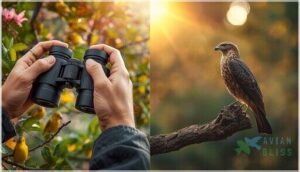
You’ve nailed down the right magnification for your style of birding. Now it’s time to match that choice to the right binocular design.
The three key comparisons below will help you pick optics that deliver the clarity and control you need in the field.
8×42 Vs 10×42 Binoculars
You’ll face magnification tradeoffs when choosing between 8×42 and 10×42 binoculars for birding. The 8x magnification delivers a wider field of view and better image stabilization for tracking fast-moving birds in forests. Meanwhile, 10x magnification brings distant waterfowl closer with sharper detail.
Your bird watching binoculars choice depends on habitat and birding techniques. Binocular ergonomics matter too—8×42 models reduce hand shake during extended scanning.
Spotting Scopes for Long-Distance Viewing
When viewing distance exceeds binocular range, spotting scopes deliver high magnification from 15x to 60x for telescopic observation. Larger objective lenses (60–85 mm) maintain brightness and field of view during long-distance viewing.
You’ll need tripod mounts to stabilize the image at these power levels—hand shake destroys clarity beyond 12x. Image stabilization isn’t standard, so invest in solid support for serious spotting scopes.
Compact Vs Full-Size Models
Compact binoculars weigh 10–16 oz with 25–32 mm objectives, trading light-gathering for portability during urban bird watching. Full-size models at 22–40 oz use 42 mm+ lenses for brighter field of view and enhanced optical quality in low light.
Weight factors and ergonomic design shape your choice—compacts win for backpacking, while full-size optical instruments deliver magnification stability for serious distance work.
Key Features to Enhance Magnification Use
Magnification alone won’t reveal the details you’re after if your optics fall short on critical design elements.
Two features consistently separate field-proven binoculars from models that disappoint when light fades or birds move fast: focus on lens coatings and eyepiece design to optimize what your chosen magnification can actually deliver.
Lens Coatings and Optical Quality
Even the sharpest magnification won’t help if your glass can’t pull light through cleanly and deliver it to your eye without scattering or distortion. Fully multi-coated lenses enhance optical clarity by reducing glare and boosting contrast.
Premium glass quality—like ED or HD elements—sharpens image quality across your field, revealing plumage details that cheaper optics blur. Better coating types mean better optical performance, plain and simple.
Wide-Angle Eyepieces
Wide angle optics transform how you track fast-moving birds through cluttered branches. Eyepieces with field visibility above 120 degrees apparent view give you more situational awareness than standard 110-degree designs—perfect when warblers won’t sit still.
Pair wide-angle eyepiece design with 8x magnification or 10x magnification, and you’ll spot birds faster without the tunnel-vision effect. Some edge softness happens, but quality lens designs with image stabilization keep your field of view sharp where it counts for bird watching binoculars.
Portability and Comfort Considerations

You can have the sharpest optics on the market, but if your binoculars feel like a brick around your neck, you won’t enjoy using them. Comfort and portability directly affect how long you can stay in the field and how effectively you can track birds.
Let’s look at the physical factors that make or break your birding experience.
Weight and Ergonomics
You can’t stay focused on that distant warbler if your binoculars feel like dumbbells. Most full-size models weigh 700–900 grams, while compact options drop below 600 grams. Here’s what matters for all-day comfort:
- Ergonomic design with textured surfaces reduces hand fatigue during long sessions
- Weight distribution affects stability—look for centered focus wheels
- Grip comfort from contoured thumb rests keeps you steady
- Balance factors determine how lightweight binoculars actually feel in action
Eye Relief and Exit Pupil Size
Eye comfort starts with numbers that matter: you need at least 15 mm of eye relief to avoid vignetting effects, especially if you wear glasses. Exit pupil size—calculated by dividing aperture by magnification—directly affects low light performance and optical quality.
An 8×42 delivers about 5.25 mm, while 10×42 drops to 4.2 mm. Larger pupils keep your field of view stable when your eye shifts during long observation sessions.
Waterproof and Fogproof Designs
Modern binoculars use O-ring seals and nitrogen purging to keep moisture out during rain or rapid temperature shifts. You need waterproof ratings that specify immersion depth—1.5 to 3 meters is standard—plus anti-fog coatings on internal lens surfaces to prevent condensation when you move between environments.
- Seal materials: Rubberized O-rings maintain flexibility across temperature ranges, preventing leaks at joints.
- Fogproof tech: Inert gas purge and desiccants deter internal fogging during humid field trips.
- Durability tests: Reputable brands publish certification standards for waterproof and fogproof performance.
Budget and Value in Birding Optics
You don’t need to spend a fortune to get quality birding optics that actually perform in the field. The key is understanding where your money goes at different price points and which features matter most for your magnification choice.
Let’s break down how to get the best value without compromising the clarity you need to identify that warbler in the canopy.
Price Vs Performance at Different Magnifications
Your dollar stretches furthest with 8×42 binoculars—they deliver an excellent field of view at the lowest cost per degree, making bird tracking seamless.
At 10x magnification, you’ll gain sharper detail but sacrifice eye relief and add weight, which impacts comfort during long sessions.
Stepping up to 12x brings diminishing returns for most birders: narrower views, price premiums, and handshake sensitivity rarely justify the investment unless you’re targeting distant raptors exclusively.
Trusted Brands and Warranty Options
Brand loyalty pays off when your binoculars need service—reputable manufacturers back bird watching binoculars with warranties spanning 1 to 25 years, some offering lifetime coverage on optical components. You’ll want to register your purchase immediately; many warranty terms require product registration within a set window.
Look for brands with responsive customer support and authorized repair options. Water damage from compromised seals usually voids coverage, so verify warranty terms before committing. Quality optical instrument maintenance starts with understanding what’s protected.
Essential Vs Premium Features
You don’t need image stabilization or exotic glass to identify warblers—fully multi-coated lens coatings, weather sealing, and solid ergonomic design cover essential needs in 8x magnification or 10x magnification binoculars.
Premium features like extra-low dispersion glass and proprietary coatings deliver crisper detail during dawn patrols, but your optical quality depends more on alignment and edge sharpness than fancy add-ons for everyday bird watching.
Top-Rated Binoculars by Magnification in 2026
You’ve narrowed down your magnification needs, but now you need to know which binoculars actually deliver in the field.
The market in 2026 offers solid choices across all power ranges, from everyday 8x models to specialized high-magnification glass for serious observers.
Here’s what performs best at each magnification level based on optical quality, durability, and real-world birding conditions.
Best 8x Birding Binoculars Reviewed
You’ll find 8×42 models dominate top rankings because they nail the sweet spot between portability and optical quality. Phase-coated roof prisms boost contrast for picking out field marks, while nitrogen purging keeps lenses clear in rain or fog. Look for 16–20 mm eye relief if you wear glasses.
Durable waterproofing and trusted warranties separate gear that’ll outlast your boots from toys.
Best 10x Birding Binoculars Reviewed
When you step up to 10x magnification, you’ll resolve eye rings and feather detail that slips past 8x glass. Field tests show 10×42 binoculars for bird watching deliver exit pupils around 4.2 mm and FOV usually spanning 270–350 feet at 1,000 yards. Top picks balance magnification power with optical quality through phase-corrected prisms and HD coatings.
Watch for:
- Image stabilization to counter handshake
- Close focus under 6 feet for near-field bird species
- Wide apparent FOV for tracking fast movers
Proper stance cuts shake by half, and models with tripod collars extend your sessions without fatigue.
Best High-Power Options for Advanced Birders
High power optics beyond 12x enable long-range viewing that transforms sophisticated birding tips into field reality. Premium binoculars at 15x or 20x demand tripod mounts and optical enhancements like ED glass to maintain sharpness across narrower field-of-view windows. Your bird-watching techniques evolve when magnification reveals molt patterns at 500 yards, though hand-held use becomes impractical.
| Magnification | Field of View | Best Use |
|---|---|---|
| 15×56 | 220–260 ft | Shorebird flocks |
| 20×60 | 180–210 ft | Raptor soaring |
| 25×80 | 130–170 ft | Wetland scanning |
Frequently Asked Questions (FAQs)
Can I use astronomy binoculars for birding?
Astronomy binoculars work for birding, but their higher magnification—often 15x to 20x—reduces your field of view and handheld stability.
Most birders prefer 8x to 10x optics for balancing detail with tracking agility.
Does magnification affect battery life in digital models?
Like a thirsty engine, digital power drains faster as magnification climbs. Higher zoom pushes sensors and processors harder, cutting battery life noticeably—especially at full resolution during extended bird watching sessions.
How does altitude impact binocular magnification performance?
At high altitude, atmospheric turbulence reduces image stability and sharpness.
Thinner air also affects optical performance by diminishing contrast, making field of view tracking harder with 8x–12x magnification power binoculars.
Should children use lower magnification binoculars?
Young birders benefit from 6x to 8x binoculars. Lower magnification means less shake, wider fields, and easier tracking—critical for developing coordination.
Kid-friendly optics build confidence in beginner birding without frustration from junky, jumpy images.
Can I add magnification extenders to binoculars?
Most binoculars don’t support magnification extenders due to compatibility issues and optical risks. Extenders degrade image quality, reduce brightness, and cause distortions. Choose purpose-built high-power binoculars or spotting scopes instead.
Conclusion
The binoculars that expand your world shouldn’t shrink your confidence. What magnification is best for birding depends on where you observe and what you chase.
Your 8x glass captures movement through thick cover. Your 10x resolves field marks at distance. Test both configurations in your primary habitats before committing.
The optics that feel steady in your hands and deliver sharp identification without hesitation—those earn permanent space in your field vest.