This site is supported by our readers. We may earn a commission, at no cost to you, if you purchase through links.

Your bird just flew full-speed into the cage bars—again. That sickening thud means one thing: the cage is too small. Most bird owners don’t realize that a cage’s dimensions directly affect their pet’s physical health and mental health.
A cramped space can lead to obesity, muscle atrophy, and serious behavioral problems like feather plucking and self-mutilation. The standard “wingspan times two” rule gets tossed around online, but it’s dangerously oversimplified.
Different species have vastly different spatial needs based on their natural behaviors, tail length, and social habits. Getting the right cage size isn’t about following generic formulas—it’s about understanding your specific bird’s requirements and ensuring they have room to spread their wings, hop between perches, and live without constant physical restriction.
Table Of Contents
- Key Takeaways
- Key Factors for Choosing Bird Cage Size
- Measuring Your Bird for Proper Cage Fit
- Cage Size Guidelines by Bird Species
- The Role of Bar Spacing in Cage Selection
- Cage Shape and Design Considerations
- Essential Cage Materials for Bird Safety
- Safety Features Every Bird Cage Needs
- Setting Up The Ideal Cage Environment
- Cleaning and Maintaining Your Bird’s Cage
- Top Bird Cages for Various Needs
- Frequently Asked Questions (FAQs)
- How do I determine what size cage to buy for my bird?
- How big does a bird cage need to be?
- How do I determine what size cage to buy for my bird at PetSmart?
- Can I build a custom bird cage myself?
- How often should I replace the entire cage?
- Do outdoor aviaries have different size requirements?
- What temperature range is safe for caged birds?
- Should I cover my birds cage at night?
- Conclusion
Key Takeaways
- Your bird’s cage width needs to be at least 1.5 to 2 times their wingspan measured tip-to-tip, with height allowing 2-3 inches of clearance above perches to prevent head injuries and enough depth for full tail extension plus 6 inches.
- Bar spacing matters as much as cage size—small birds like finches need 1/4 to 1/2 inch gaps, cockatiels require 1/2 to 3/4 inch, and large parrots need 3/4 to 1 1/4 inch spacing to prevent escapes and entrapment injuries.
- Rectangular cages beat round designs because they create clear flight paths, prevent dead zones, maximize usable corner space, and allow consistent bar spacing that protects your bird’s wingspan during movement.
- Stainless steel cages outperform powder-coated metal and especially wood or acrylic options due to superior corrosion resistance, ease of cleaning, chemical safety, and durability against strong beaks and moisture.
Key Factors for Choosing Bird Cage Size
Choosing the right cage size isn’t about guessing—it’s about understanding what your bird actually needs to stay healthy and happy. Your bird’s wingspan and body height determine the minimum space required, but movement, exercise, and social dynamics play equally important roles.
If your bird shows signs of lethargy or reduced appetite, these can signal environmental stress—reading about why parrots stop eating and sleep excessively helps identify whether cage size or enrichment needs adjustment.
Choosing the right cage size means understanding your bird’s wingspan, body height, movement needs, and social dynamics—not guessing
Let’s break down the three key factors that’ll guide you toward the perfect cage dimensions.
Importance of Wingspan and Body Height
Why does wingspan matter more than you’d think? Your bird’s wing measurement and body proportions directly shape cage size calculations.
Here’s what drives the math:
- Wingspan dictates horizontal space – Birds need at least twice their wingspan width to spread wings safely.
- Body height sets vertical clearance – Make certain 2–3 inches above perches to prevent head injuries.
- Species variations demand precision – Bar spacing and enclosure size shift dramatically between finches and macaws, reflecting different flight patterns.
The principles behind underline why these measurements are essential for proper cage sizing.
Space for Movement and Exercise
Beyond basic measurements, your bird’s activity levels and flight patterns determine how much movement space they actually need.
Active species like budgies demand horizontal room to exercise natural agility, while vertical climbers need height for hopping between perches. Bar spacing affects their ability to navigate safely, and enclosure size should match daily exercise needs—sedentary birds tolerate tighter quarters, but athletic flyers suffer without adequate wingspan clearance for short flights.
Accommodating Multiple Birds
When you’re housing more than one bird, you’ll need to rethink cage size entirely. Flock dynamics and bird socialization require serious square footage—not just double the minimum. Here’s your baseline:
- Add 50% extra wingspan clearance per additional bird species
- Install multiple perches at different heights to prevent territorial conflicts
- Create separate feeding strategies with dedicated stations to reduce competition
Visual cage partitioning helps manage stress during introductions, while proper bar spacing prevents escapes during social excitement. For more insights, consider the importance of choosing compatible bird species when housing multiple types together.
Measuring Your Bird for Proper Cage Fit
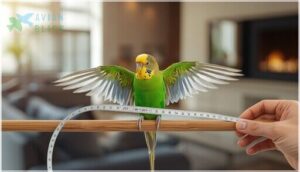
You can’t just eyeball your bird and guess at cage dimensions—accurate measurements make the difference between a safe home and a risky setup.
Knowing how to measure wingspan, body length, and tail clearance gives you the exact numbers you need to choose the right cage. Here’s how to get those measurements right and turn them into minimum cage dimensions your bird can actually thrive in.
How to Measure Wingspan Accurately
Getting an accurate wingspan measurement starts with the right setup. You’ll need a flexible ruler or measuring tape, a calm bird, and ideally a second person to help gently extend the wings. Measure from one wing tip to the other at the primary feathers, taking 2-3 readings and averaging them for precision.
| Wing Measurement Tips | Why It Matters |
|---|---|
| Use flexible rulers | Conforms to natural wing curves |
| Mark wing tips clearly | Ensures consistent reference points |
| Maintain calm bird posture | Prevents flapping that skews results |
| Average multiple readings | Improves accuracy techniques |
This measurement directly determines your minimum cage size and bar spacing needs for your bird species.
Determining Body Length and Tail Clearance
Your bird’s body measurements shape every inch of cage space. Measure from beak tip to tail base for body length, then add tail clearance—at least 2 to 3 inches beyond the tail tip.
Bird posture during perching affects clearance margins, so account for natural head tilts. Wingspan and bar spacing influence cage dimensions, but tail length determines the depth you’ll need to prevent feather damage.
Calculating Minimum Cage Dimensions
How do you turn measurements into real cage dimensions? Start with wingspan—multiply by 1.5 for minimum width. Height needs your bird’s wingspan plus 20 percent for headroom. Depth equals body length plus 6 inches for tail clearance.
For perches and feeding stations, understanding how bird cameras work helps you monitor whether your dimensions allow natural movement and comfortable positioning.
- Width: 1.5 times wingspan for wing expansion
- Height: Wingspan plus extra clearance above perches
- Depth: Body length plus minimum 6-inch tail buffer
- Floor area: Double the resting space for movement
These cage size formulas prevent wing clipping and feather damage during daily activity.
Cage Size Guidelines by Bird Species
Your bird’s species determines exactly how much space they need to thrive.
A finch won’t do well in a macaw-sized mansion, and a macaw can’t survive in a budgie cage.
Here’s what you need to know for the most common pet birds, broken down by size category.
Small Birds (Finches, Canaries, Budgies)
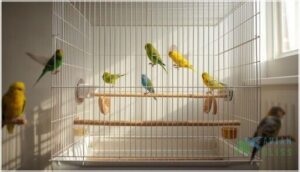
You’ll want a cage size at least 24 inches wide by 18 inches high for finches and canaries, giving them room for those quick bursts of flight they love.
Budgies need similar dimensions but benefit from horizontal bar spacing around 1/4 to 1/2 inch. Your bird’s wingspan matters most—measure it, then double that for cage width. This setup fosters bird socialization, finch behavior, canary health, and small bird enrichment naturally.
Medium Birds (Cockatiels, Parakeets)
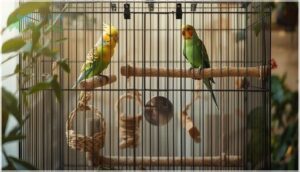
Cockatiels and parakeets need more vertical space than finches—aim for 24 inches wide, 24 inches deep, and 36 inches tall for a single bird. Bar spacing at 1/2 inch prevents escapes while supporting beak health.
Consider these essentials:
- Double horizontal space for two birds to encourage bird socialization
- Include varied perches for feather care and foot exercise
- Place cage away from drafts for ideal cage placement
- Rotate toys weekly to reduce stress
- Balance pellet-based nutrition plans with fresh greens
Large Parrots (Macaws, African Greys)
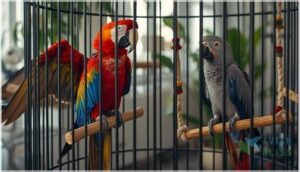
Macaws stretch 30 to 40 inches with those dramatic tails, so you’ll need a cage at least 36 inches wide, 48 inches deep, and 60 inches tall.
African Grey Training and Large Parrot Enrichment demand room for wing flaps and climbing. Bar spacing at 3/4 to 1 inch promotes Beak Health Management while preventing escapes.
Prioritize cage size that matches your bird species’ wingspan for proper Parrot Socialization and a balanced Macaw Diet routine.
The Role of Bar Spacing in Cage Selection
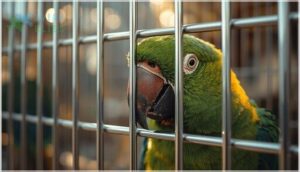
Bar spacing matters just as much as cage size in terms of keeping your bird safe. If the gaps between bars are too wide, your bird can squeeze through or get its head stuck—both scenarios you definitely want to avoid.
Let’s look at how to choose the right bar spacing and what works best for different bird sizes.
Preventing Escape and Injury
Your bird’s bar spacing acts as the first line of defense against escape and injury risks. Secure locks and proper spacing prevent clever beaks from slipping through or getting trapped.
If bars are too wide, small birds can squeeze out or lodge their heads between them—creating birdproofing nightmares. Cage design must balance wingspan access with safe barriers that keep your bird protected.
Bar Spacing Recommendations by Bird Size
Spacing guidelines depend directly on your bird’s measurements and species size. Small birds like finches and budgies need 1/4 to 1/2 inch bar spacing to prevent escape and guarantee beak clearance.
Cockatiels and medium birds require 1/2 to 3/4 inch gaps, while macaws and large parrots need 3/4 to 1 1/4 inch spacing. These cage barriers protect wingspan movement without compromising bird cage size or bar safety.
Cage Shape and Design Considerations

Cage shape isn’t just about looks—it directly impacts how much usable space your bird actually has.
Round cages might seem elegant, but they create dead zones and limit flight paths in ways that rectangular designs don’t.
Here’s what you need to know about choosing the right shape and layout for your bird’s daily life.
Benefits of Square Vs. Round Cages
You’ll notice that cage shape comparison matters more than most people think. Square cage advantages dominate: they fit corners efficiently, create defined zones for perches and toys, and stack neatly for multi-bird setups. Round cage drawbacks include wasted wall space and unpredictable perch placement.
When you’re optimizing bird space, consider these factors:
- Wingspan clearance – Square designs prevent wing clipping against curved bars
- Corner safety – Right angles reduce stress points versus continuous curves
- Bar spacing consistency – Straight sides maintain uniform gaps
- Cage size efficiency – Rectangular footprints optimize usable area
- Cage design flexibility – Flat walls simplify accessory mounting
Importance of Interior Layout for Birds
Once you’ve settled on the right cage shape, interior setup determines whether your bird thrives or just survives.
Bird Room Planning requires flight path optimization—clear routes between perches prevent collisions. Arrange perches at varied heights to support natural climbing while maintaining at least twice your bird’s wingspan in horizontal clearance.
For multiple birds, visual barriers and social zone design reduce aggression during feeding, making cage size and thoughtful perch arrangement equally essential.
Essential Cage Materials for Bird Safety
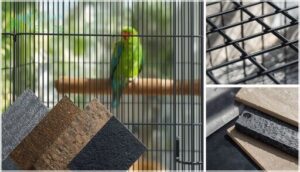
The material you choose for your bird’s cage isn’t just about looks—it directly impacts your bird’s health and safety. Some materials stand the test of time and frequent beaking, while others harbor bacteria or break down quickly.
Let’s break down the most common cage materials so you can make the right choice for your feathered friend.
Stainless Steel Advantages
You won’t find a tougher material than stainless steel for your bird cage. Its corrosion resistance means no rust even in humid rooms, while the smooth surface makes easy cleaning a reality—just wipe and you’re done.
Metal durability translates to years of use without bending or chipping. Plus, chemical safety ensures your bird breathes clean air, and the aesthetic value keeps your home looking sharp.
Powder-Coated Metal Options
Powder-coated metal gives you solid rust prevention at a friendlier price than stainless steel. The hard finish resists scratches and chips, while metal finish options include thousands of colors with impressive color stability.
You’ll appreciate the coating durability—it stands up to cleaners and moisture without fading. Just inspect for chips occasionally, because exposed metal needs touch-ups to maintain chemical resistance and protect your bird’s health.
Drawbacks of Wood and Acrylic Cages
Wood cages trap bacteria in grain crevices, creating sanitation issues that threaten your bird’s respiratory health. Acrylic cages bring their own safety hazards—they crack under strong beaks, show every smudge, and restrict airflow.
Both materials present maintenance challenges that outweigh any aesthetic appeal. When material durability matters for your bird cage, stick with metal options that actually protect your feathered companion.
Safety Features Every Bird Cage Needs
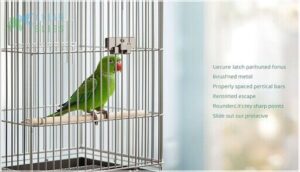
A secure cage isn’t just about size—it’s about keeping your bird safe from everyday hazards like escapes, accidents, and maintenance mishaps. The right safety features protect both your bird and your peace of mind.
Here’s what to look for when evaluating cage security and accessibility.
Secure Door Locks and Bird-Proofing
Your bird’s exceptional mind can work against you—parrots have been known to pick simple latches in minutes. Look for multi-point locking mechanisms that engage at several spots along the door frame, making prying impossible.
Choose key or code-controlled locks over magnetic or toggle latches. Birds can nudge or chew through flimsy hardware, so opt for tamper-proof locks with reinforced strike plates and heavy-duty screws designed specifically for clever escape artists.
Easy Access Doors and Removable Trays
You’ll spend less time wrestling with your bird cage if you choose door mechanisms that swing wide and trays that slide out smoothly. Large access designs let you reach every corner without contorting yourself.
Stainless steel tray materials resist rust and simplify cleaning efficiency. Pair these with solid cage security features—reinforced hinges and tamper-proof latches—so your bird stays safe while you maintain proper cage size and bar spacing effortlessly.
Setting Up The Ideal Cage Environment

Getting the right cage is only half the battle—what you put inside matters just as much. Your bird needs the right perches, toys, and cage placement to stay healthy and happy.
Here’s how to create a setup that works for your bird’s physical and mental well-being.
Perch Variety and Placement
Your bird’s feet aren’t meant for one flat surface all day. Mix natural wood perches with rope and different diameters—0.5 to 1.5 inches works well—to exercise foot muscles and prevent pressure sores.
Stagger heights to create climbing structures that mimic wild habitats. Place perches near enrichment zones but away from the door to reduce stress during cage access.
Safe Toys and Enrichment Accessories
Toys aren’t just decorations—they’re mental workouts that prevent boredom and destructive bird behavior. Choose stainless steel or BPA-free plastics to avoid toxic material risks.
Rotate enrichment techniques weekly: treat-dispensing puzzles one week, foraging mats the next. Safe chew options like untreated natural wood satisfy your bird’s instinct to gnaw.
Inspect toys for frayed rope or sharp edges—bird safety and bird welfare depend on proactive toy rotation strategies that support healthy bird enrichment in any cage size.
Optimal Cage Location in Your Home
Even the perfect cage size won’t support bird welfare if you place it near cooking fumes or drafty windows.
Position your bird’s home in a central family interaction zone at eye level—against a wall for security. This cage location balances light exposure without direct sun, steady air circulation without vents, and noise reduction during sleep hours.
Room placement shapes daily comfort across all bird species.
Cleaning and Maintaining Your Bird’s Cage

A clean cage isn’t just about appearances—it’s the foundation of your bird’s health and longevity. Regular maintenance prevents bacterial buildup, respiratory issues, and stress-related behaviors that can shorten your bird’s life.
Here’s your practical cleaning schedule and what to watch for as your cage ages.
Daily, Weekly, and Monthly Cleaning Tasks
Consistent hygiene practices keep your bird healthy and your home fresh. Daily cleaning involves swapping out cage liners, wiping perches and toys, and replenishing water.
Weekly tasks require washing all cage components with bird-safe soap and scrubbing bars thoroughly. Monthly cage sanitizing means disinfecting metal parts, checking hinges, and replacing worn perches—simple routines that prevent disease and extend your cage’s life.
Inspecting for Damage and Wear
After you clean, grab a flashlight and run a quick cage inspection. You’re looking for five red flags that compromise frame integrity and bird safety:
- Cracks or rust along bars or welds—especially near water bowls
- Bent door latches that won’t lock securely
- Chipped coating exposing bare metal
- Loose perch mounts or wobbly trays
- Bar wear from toys that widens bar spacing beyond safe limits
Catch wire damage early, and you’ll prevent escapes and injuries.
Top Bird Cages for Various Needs
You’ve got your measurements, you’ve checked the safety features, and now you need an actual cage.
The right choice depends on whether you’re traveling with your bird, setting up a permanent home, or looking for something in between.
Here are three solid options that cover different needs and budgets.
1. Capuca Small Bird Travel Cage
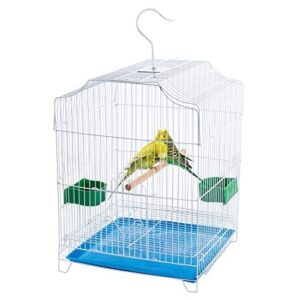
The Capuca Small Bird Travel Cage measures 11.5 inches wide by 13.3 inches deep and 16.5 inches high—perfect for parakeets, lovebirds, and finches during short trips. You’ll appreciate the slide-out tray that makes quick cleanups easy on the road.
This lightweight metal cage fits standard car seats and includes secure latching mechanisms to prevent mid-travel escapes. At 1.81 kilograms, it’s genuinely portable without feeling flimsy. Think of it as your bird’s travel suitcase rather than a permanent home.
| Best For | Bird owners who need a secure, portable cage for short trips with small birds like parakeets, finches, or lovebirds. |
|---|---|
| Material | Metal |
| Dimensions | 17.7 x 13 x 11.8 inches |
| Included Feeders | 2 plastic cups |
| Cleaning Feature | Slide-out tray |
| Portability | Handle on top |
| Ideal For | Small birds (parakeets, finches) |
| Additional Features |
|
- Lightweight at 1.81 kg but sturdy enough to prevent escapes with secure latching mechanisms
- Slide-out tray makes cleaning quick and easy, especially helpful when traveling
- Compact size (17.7 x 13 x 11.8 inches) fits in most car seats without taking up too much space
- Assembly instructions can be unclear, making setup frustrating for some users
- Not suitable for larger birds or housing multiple birds comfortably
- Food and water dishes may not stay secure and can fall into the cage during transport
2. Prevue Parakeet Bird Cage
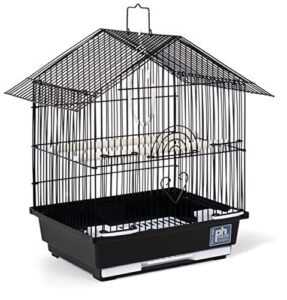
At 12 inches long by 9 inches wide and 16 inches high, the Prevue Parakeet Bird Cage works well for single parakeets or canaries as a starter home. You get powder-coated steel construction with 3/8-inch wire spacing—tight enough to prevent escapes.
The pull-out tray and included cups simplify daily feeding routines. Just don’t expect this as a long-term solution for larger birds or active pairs. It’s house-shaped, lightweight, and priced for budget-conscious bird owners who need functional basics.
| Best For | Budget-conscious bird owners who need a temporary cage for parakeets or canaries during travel, quarantine, or short-term use. |
|---|---|
| Material | Metal, Plastic |
| Dimensions | 12 x 9 x 16 inches |
| Included Feeders | 2 plastic cups |
| Cleaning Feature | Pull-out tray |
| Portability | Handle for carrying |
| Ideal For | Small birds (parakeets, canaries) |
| Additional Features |
|
- Pull-out tray makes daily cleaning quick and easy
- Includes two cups and perches right out of the box
- Lightweight with a carry handle for portability
- Too small for permanent housing or larger birds
- Flimsy metal construction won’t hold up long-term
- Food and water door latches can be frustrating to open
3. AideeGrowth Portable Bird Cage
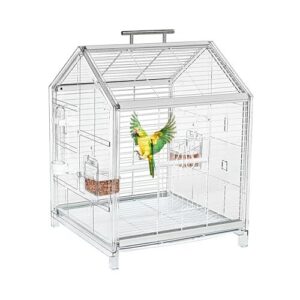
When you’re heading to the vet or weekend cabin, the Portable Bird Cage (15.5 by 12.5 by 20.5 inches) gives small parrots and parakeets a travel-ready setup. Its aluminum alloy frame and stainless steel top keep weight down to five pounds while resisting rust from droppings.
You get two feeders, a water bottle, and a top handle for one-handed carrying. The slide-out tray speeds cleanup between trips. Just expect assembly headaches—instructions don’t label parts clearly.
| Best For | Bird owners who travel frequently or need a secondary cage for vet visits and short trips with small to medium-sized birds like canaries, lovebirds, and parakeets. |
|---|---|
| Material | Aluminum alloy, iron, plastic |
| Dimensions | 15.5 x 12.5 x 20.5 inches |
| Included Feeders | 2 feeders, 1 water bottle |
| Cleaning Feature | Slide-out tray |
| Portability | Handle on top |
| Ideal For | Small to medium birds (lovebirds, canaries) |
| Additional Features |
|
- Lightweight aluminum frame (just 5 lbs) with a top handle makes it easy to carry with one hand
- Comes with everything you need—two feeders and a water bottle included right out of the box
- Slide-out tray lets you clean up quickly between trips without much hassle
- Assembly instructions are confusing and don’t label the parts, so putting it together takes patience
- Too small to work as a permanent home for most birds—really just a travel option
- Food and water containers are on the small side, so you’ll need to refill them often on longer outings
Frequently Asked Questions (FAQs)
How do I determine what size cage to buy for my bird?
Wondering if that cage is big enough? Measure your bird’s wingspan tip to tip, then choose a cage at least 5 to 2 times that width for comfortable wing flapping.
How big does a bird cage need to be?
A bird cage needs to be at least 5 times your bird’s wingspan in width and twice its body height, with enough floor area for hopping and moving comfortably between perches.
How do I determine what size cage to buy for my bird at PetSmart?
Start by measuring your bird’s wingspan at home and doubling that number to find the minimum cage width.
Then check PetSmart’s bar spacing and interior dimensions to match your species’ needs.
Can I build a custom bird cage myself?
You can build a cage for small birds like finches if you have metalworking tools and use stainless steel mesh.
Large parrots need professionally fabricated cages to withstand their 300+ PSI bite force.
How often should I replace the entire cage?
Replace your bird’s cage every seven to ten years, or sooner if you spot rust, damaged welds, peeling coatings, or door latches that won’t close securely after repairs.
Do outdoor aviaries have different size requirements?
Yes. Outdoor aviaries demand at least three times your bird’s wingspan in flight length.
Vertical movement requires 6 feet or more for medium to large species, providing continuous, unobstructed space for full wing extension.
What temperature range is safe for caged birds?
Your bird thrives between 65 and 80 degrees Fahrenheit. Avoid sudden temperature swings beyond 5 to 10 degrees daily, and keep the cage away from drafts or direct sunlight.
Should I cover my birds cage at night?
Covering your bird’s cage at night helps block ambient light and noise, encouraging 10 to 12 hours of restful sleep and reducing early morning outbursts in busy households.
Conclusion
Think of your bird’s cage as their home base—not a holding cell. What size cage does my bird need? One that lets them stretch, climb, and move without constant collision.
You’ve learned wingspan isn’t everything; tail length, species behavior, and bar spacing matter just as much. Measure carefully, choose quality materials, and prioritize space over aesthetics.
Your bird’s physical and mental health depend on getting this right. Give them room to thrive, not just survive.
- https://birdtricksstore.com/blogs/birdtricks-blog/selecting-the-right-cage-for-your-bird?
- https://blackoutcurtain.com.au/812091/Aluminum-Alloy-Frame-Parrot-Cage-With-Stainless-Steel-Top-Cover
- https://wingspanparrotsanctuary.com/standards-of-care-1
- https://windycityparrot.com/birds-cage-size-matters-less-think-2/
- https://askavet.com/blogs/news/setting-the-perfect-bird-cage-a-vet-s-2025-guide-%F0%9F%90%A4