This site is supported by our readers. We may earn a commission, at no cost to you, if you purchase through links.
I missed my first bald eagle shot because my camera took three full seconds to lock focus. The bird lifted off while my autofocus hunted back and forth across empty branches. That frustration taught me the hard way that regular cameras don’t cut it for bird photography.
You need gear built for subjects that move fast, appear without warning, and don’t stick around for second chances. The difference between a decent camera and one designed for birds comes down to a handful of critical features—autofocus systems that track erratic flight patterns, burst modes that capture entire sequences, and sensors that pull detail from early morning fog.
Get these fundamentals right, and you’ll stop watching birds fly away while your camera struggles to keep up.
Table Of Contents
- Key Takeaways
- Key Features for Bird Cameras
- Sensor Types and Their Impact
- Lens Considerations for Bird Photography
- Connectivity Options for Bird Cameras
- Power and Storage Solutions
- Motion Detection and Night Vision
- Top Bird Cameras for 2026
- Durability and Weatherproofing Essentials
- Top Bird Cameras for026
- Frequently Asked Questions (FAQs)
- Conclusion
Key Takeaways
- Fast autofocus systems with AI bird detection and dense phase-detection coverage make the difference between capturing sharp shots and watching birds fly away while your camera hunts for focus.
- Burst shooting speed means nothing without deep buffer capacity—cameras that shoot 40 fps but quit after six RAW files will leave you missing the best moments of a flight sequence.
- Sensor size involves real trade-offs: full-frame delivers superior low-light performance and background blur, while APS-C and Micro Four-Thirds sensors cut weight and extend your telephoto reach through crop factor multiplication.
- Weather sealing with IP54 ratings or higher, combined with power solutions like solar panels for remote setups, separates cameras that survive harsh field conditions from gear that fails after one unexpected rainstorm.
Key Features for Bird Cameras
You can’t capture what you can’t see, and birds won’t wait around while you fumble with settings. The right camera features make the difference between a blurry disappointment and a shot that stops you in your tracks.
Here’s what actually matters when you’re out there tracking fast-moving subjects in unpredictable conditions.
You’ll also need to watch for signs that parasites like fleas might be affecting the birds you’re observing, especially if they’re showing unusual preening behavior or feather damage—learn how fleas can impact wild and captive birds.
Autofocus Speed and Accuracy
You need autofocus that locks onto a sparrow’s eye before it hops away. Modern bird photography cameras use hybrid autofocus systems blending phase detection for instant tracking with contrast detection for razor-sharp focus precision. For a better understanding of the differences and benefits, check out this guide comparing phase and contrast detection autofocus.
Here’s what separates field-tested winners from frustrating gear:
The best guides include detailed field marks and range maps that work when you’re actually outside trying to ID a bird.
- AI bird detection that recognizes feathered subjects and switches to eye autofocus automatically
- Dense AF coverage with hundreds of points spread across your frame for off-center compositions
- Low-light sensitivity rated around EV-4 so you can shoot at dawn without hunting
- Processing power from chips like Expeed 7 that update focus dozens of times per second
- Continuous tracking modes that adjust speed optimization as birds fly toward your telephoto lens
Real-world accuracy testing matters more than spec sheets—two cameras rated identically can behave differently when a warbler darts through branches.
Field tests with fast-moving subjects like the chestnut-sided warbler reveal how autofocus systems handle plumage contrast and erratic flight patterns in real conditions.
Burst Shooting and Buffer Capacity
Autofocus means nothing if your camera chokes mid-burst. Burst mode speed—often 10 to 40 frames per second—lets you freeze every wingbeat, but buffer depth decides how long that shooting speed lasts before the camera stalls.
Burst speed freezes wingbeats, but buffer depth decides how long your camera shoots before it stalls
Canon’s EOS R6 Mark II hits 40 fps, yet entry-level bodies quit after six RAW files. Pair fast shutter speed with deep buffers and quick-clearing cards for uninterrupted camera performance through your telephoto lens.
Wildlife photographers looking for fast continuous shooting options should also consider the value and autofocus systems of new models.
Weather Sealing and Durability
Fast bursts won’t help if rain kills your camera. Weather sealing means gaskets around buttons, sealed lens mounts, and IP54-rated bodies that laugh off mud and drizzle. I’ve shot OM-1 Mark II bodies at -10°C and Canon flagships through coastal spray—both survived because magnesium shells and tight seals keep moisture out.
- IP54 stops angled rain; IP67 manages brief dunks
- Magnesium alloy resists knocks better than plastic
- Sealed lens mounts block water at the weakest point
Low-light Performance
Sealed bodies handle storms, but sensor sensitivity wins at dawn.
Full-frame chips pull cleaner shots at ISO 6400 in dim woods because larger photosites gather more light.
Back-illuminated sensors boost low-light autofocus down to minus 6 EV, letting you track warblers in shade.
Pair this capability with motion-triggered bird camera features to capture sharp images even when birds arrive at dawn or dusk.
Image stabilization adds three stops of handholding headroom with long glass.
Infrared night vision keeps trail cameras recording after sunset, and modern noise reduction smooths high ISO performance without blurring feather detail.
Sensor Types and Their Impact
The sensor in your camera determines how much light you capture and how sharp those distant birds look in your final image.
Full-frame sensors give you stunning quality but they’ll cost more and add weight to your bag.
Smaller sensors like APS-C and micro four-thirds trade a bit of that top-tier performance for savings and portability that make a real difference in the field.
Full-frame Sensors for High Quality
When you’re chasing songbirds at dawn, a full-frame sensor becomes your secret weapon. That larger surface area—roughly 36 by 24 millimeters—transforms challenging light into clean, detailed images.
- Full-frame sensors deliver usable images at ISO 12800 to 25600, keeping shutter speeds fast enough to freeze wing beats
- Range preserves feather detail in both bright sky highlights and dark shadow areas
- Background blur at f/2.8 creates creamy bokeh that isolates your subject from busy branches
- High-resolution mirrorless cameras let you crop heavily while maintaining magazine-quality prints
- Low light performance means less noise and grain compared to smaller sensors at identical ISO settings
APS-C Sensors for Portability
If hauling a full-frame rig leaves your shoulders aching, an APS-C sensor offers serious relief.
These smaller chips—around 22 by 15 millimeters—cut camera weight to roughly 350 grams, making all-day birding walks easier. The crop factor of 1.5x turns a 300mm lens into an effective 450mm telephoto reach, so you fill the frame without lugging heavy glass or draining your energy.
Micro Four-thirds Sensors for Budget Options
Tight budgets don’t mean settling for weak telephoto reach. Micro Four-thirds Sensors pair a 2x crop factor with affordable glass—a 100–400mm lens delivers 200–800mm equivalent telephoto reach on a Panasonic Lumix G9M2 or G9 II, weighing under 2 kg combined.
Image Stabilization helps you handhold long focal lengths, and smaller sensor size keeps budget lenses compact, so you shoot distant birds without draining your wallet.
Lens Considerations for Bird Photography
Your lens matters just as much as your camera body in the context of bird photography. I’ve learned this the hard way after missing shots because I didn’t have the right glass for the job.
Let’s look at what makes certain lenses work better for different bird photography situations.
Telephoto Lens Advantages
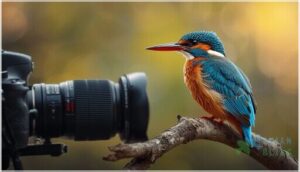
Telephoto lenses are your secret weapon for bird photography—they bring distant subjects close without spooking them. A 400mm to 600mm focal length lets you fill the frame from 30 yards out, while optical stabilization keeps handheld shots sharp. Fast autofocus speed locks onto small, fast-moving birds, and telephoto zoom ranges give you flexibility for bird tracking. On APS-C cameras, crop factor effectively multiplies your reach, turning a 300mm lens into serious wildlife photography firepower.
- Extended reach: Capture frame-filling portraits of shy species from respectful distances
- Background blur: Telephoto compression isolates birds against smooth, pleasing bokeh
- Stabilization advantage: Handhold at slower shutter speeds without tripod bulk
- Tracking support: Fast lens motors pair perfectly with continuous autofocus for birds in flight
Wide-angle Lenses for Feeders
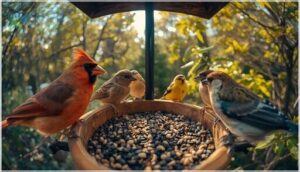
Wide-angle lenses flip the script on bird photography—instead of chasing distance, you’re designing habitat scenes at the feeder.
A 120 to 145 degree field of view on your bird feeder camera captures both the feeding port and nearby perches in one frame, while careful camera mounting within 10 to 30 centimeters keeps small visitors large enough for species ID without cropping.
Lens Compatibility and Availability
Mount systems matter more than most birders realize—Canon RF and Nikon Z cameras require native RF or Z telephoto lenses, though adapters let you use older EF or F glass with full autofocus.
Sony E mount offers the widest mix of native compatibility and third-party telephoto options, while budget shooters often grab Sigma or Tamron 150-600mm lenses to save hundreds without sacrificing optical zoom reach.
Connectivity Options for Bird Cameras
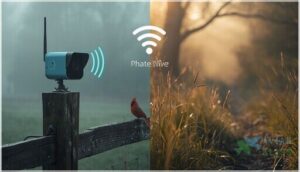
How you connect your bird camera changes everything about how you’ll actually use it.
I’ve tested setups from basic Wi-Fi feeders to full cellular rigs in the field, and the right choice depends on where your camera sits and how often you want to check in. Here’s what works in real-world conditions.
Wi-Fi and Remote Access
Most Wi-Fi enabled bird cameras rely on 2.4 gigahertz networks, so you’ll need that band active on your router. Cloud connectivity lets you watch remotely through apps that scan a QR code—no port forwarding needed.
Wi-Fi range usually hits around 30 feet, though long-range models add antennas for distant nest boxes. Wireless connectivity means remote viewing from anywhere, but always change default passwords for network security and proper access control.
Wired Connections for Reliability
While WiFi enabled connectivity and wireless networking let you check in remotely, Ethernet cables give you rock-solid performance when remote access can’t afford dropouts. Power over Ethernet sends both data and juice through one weatherproof line, simplifying cable management around nest boxes. Plus, surge protection and network security are easier to lock down when you control every physical connection instead of relying on airwaves.
- Cat6 runs handle 4K streams without the stuttering you get when three neighbors stream during prime time
- One PoE injector powers your camera for days even when batteries would’ve died in the cold
- NVRs record 24/7 at full bitrate because wired links don’t share bandwidth with your streaming TV
- Shielded cables laugh off interference from power lines that scramble WiFi signals near utility poles
- Grounded mounts and surge arrestors keep lightning from frying your gear during summer storms
4G and Mobile Streaming
When Ethernet isn’t an option, 4G cellular networks let you stream live feeds from truly remote locations where WiFi enabled connections can’t reach.
A nano SIM card turns your camera into its own hotspot for remote monitoring over LTE, though you’ll need a data plan that accommodates several gigabytes monthly.
Cloud storage and wireless networking over cellular keep you watching even when you’re miles from home.
Power and Storage Solutions
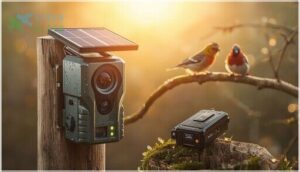
You can’t capture great bird moments if your camera dies halfway through or runs out of space when a rare visitor shows up. I’ve learned this the hard way more times than I’d like to admit.
Let’s look at the power and storage options that’ll keep your bird camera running reliably without constant babysitting.
Battery Vs. DC12V Power
Your power source comparison boils down to flexibility versus reliability. Battery capacity usually delivers 48 to 160 hours depending on size—great for outdoor installation anywhere in your yard—but needs swapping every few days.
DC12V advantages shine for fixed nest boxes: zero downtime, no cold-weather shutdowns, and minimal upkeep. Both options are safe low-voltage solutions with solid weatherproof design when installed correctly.
Solar-powered Options
For year-round monitoring without battery swaps, solar panels paired with lithium battery capacity offer true set-and-forget power. Most outdoor camera setups need only a 24 to 30 watt panel to run continuously, even through UK winters.
- Energy efficiency from MPPT charge controllers reaches 92 percent versus 80 percent for basic PWM units
- Weatherproof design withstands temperatures from minus 20 to plus 50 degrees Celsius
- Mounting systems with 360-degree swivel let you aim the panel toward six hours of direct sun
- Your power source stays topped up for months off-grid with minimal maintenance
SD Card, NVR, and Cloud Storage
Beyond power options, Storage Capacity determines how much bird activity you’ll capture. SD Card slots accept 16 to 256 GB, with 128 GB holding roughly four hours of 4K video.
NVR Systems handle terabytes across multiple cameras, while Cloud Storage subscriptions deliver 7 to 30 days of rolling footage plus Data Security through remote backups—your choice balances Video Quality, Storage Options, and monthly costs.
Motion Detection and Night Vision
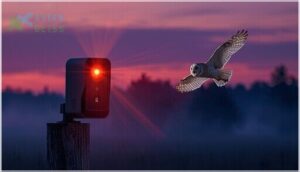
Birds don’t follow a 9-to-5 schedule, and neither should your camera.
The best bird cameras can sense movement the instant it happens and keep recording even after the sun sets.
Here’s what separates the cameras that actually catch the action from the ones that leave you staring at empty frames.
PIR and Thermal Sensors
PIR detection in your bird camera works by spotting temperature differences between warm birds and cooler backgrounds—usually needing at least a 5–7 °C contrast to trigger reliably.
Thermal imaging takes it further, capturing full heat signatures so you can locate hidden birds in dense foliage or darkness. Combining both sensor accuracy modes maximizes motion tracking while cutting false alarms from blowing branches.
Infrared LEDs for Low Light
Infrared LEDs turn your bird camera into a true night owl, lighting up scenes without spooking wildlife. You’ll want to understand how these invisible beacons work to capture stunning low-light footage.
- 850 nm vs 940 nm wavelengths: 850 nm offers longer range for wildlife cameras, while 940 nm stays completely invisible to birds
- IR LED arrays provide uniform infrared illumination across 20–30 meters without hotspots
- Radiant efficiency determines real night vision performance—not just lumen specs
- High-quality night vision depends on sensor interaction with infrared light for sharp image quality in low light capture
Automated Alerts and Notifications
Smart notifications separate serious birders from folks who miss the magic. Your bird feeder camera should ping you the instant a cardinal lands—not three minutes later. Real-time alerts with AI notifications let you filter squirrels from songbirds, while custom filters prevent your phone from buzzing every time a leaf drifts past the lens.
| Feature | Basic Systems | Sophisticated Systems |
|---|---|---|
| Alert Speed | 30–60 seconds | Under 3 seconds |
| AI Notifications | None | 6,000+ species ID |
| Custom Filters | Motion only | Zones, schedules, species |
| Alert Logging | 7 days | Months with tags |
| Delivery Options | App push | Push, email, SMS |
Surveillance system technology powers the best notification systems today. Your smart bird feeder becomes a research station when alert logging tracks every visitor by species, time, and photo—turning scattered sightings into usable data you’ll actually review.
Top Bird Cameras for 2026
After years of testing cameras in marshes, forests, and my own backyard, I’ve learned which ones actually deliver when a warbler lands three seconds before sunrise.
The cameras below aren’t just specs on paper—they’re tools that won’t let you down when that rare bird finally shows up. Here’s what I’d trust with my own once-in-a-lifetime shot.
1. Canon EOS R5 Mirrorless Camera
When you’re serious about bird photography, the Canon EOS R5 mirrorless camera delivers the kind of image quality that makes every feather count. This mirrorless technology powerhouse packs a 45-megapixel full-frame sensor with blazing autofocus—1,053 points that lock onto your subject fast.
You’ll love the camera ergonomics and shooting flexibility: 20 fps electronic bursts capture flight sequences beautifully. The RF mount opens up outstanding optical zoom options at various focal lengths. Sure, it’s pricey at $2,599, but it’s worth every penny for dedicated enthusiasts.
| Best For | Wildlife and sports photographers who need professional-grade image quality, lightning-fast autofocus, and high-speed shooting to capture fast-moving subjects in challenging conditions. |
|---|---|
| Sensor Resolution | 45 MP |
| Video Recording | 8K |
| Autofocus System | 1,053 AF points |
| Continuous Shooting | 20 fps |
| File Format | JPEG, RAW |
| Screen Type | Not specified |
| Additional Features |
|
- 45-megapixel sensor and 1,053-point autofocus system deliver stunning image clarity and subject tracking
- Versatile shooting speeds up to 20 fps electronic shutter for capturing decisive moments in flight or action
- 8K video and 4K up to 120fps give you professional recording options alongside still photography
- $2,599 price tag puts it out of reach for casual hobbyists or beginners
- Overheating issues during extended video recording sessions require monitoring and breaks
- Large file sizes from high-resolution sensor and electronic shooting modes demand significant storage capacity
2. Nikon D5600 Digital SLR Camera
Looking for serious performance without the premium price tag? The Nikon D5600 delivers strong image quality with its 24.2-megapixel APS-C sensor and 39-point autofocus system that tracks birds across the frame.
Camera ergonomics feel natural in your hands, and the F-mount lens compatibility provides access to affordable telephoto glass. You’ll get 5 fps shooting modes and impressive battery life—over 970 shots per charge. At around $700 with the kit lens, it’s a solid workhorse that won’t drain your wallet.
| Best For | Beginner to intermediate photographers who want a capable DSLR for wildlife and bird photography without spending a fortune on professional gear. |
|---|---|
| Sensor Resolution | 24.2 MP |
| Video Recording | Full HD 1080p |
| Autofocus System | 39-point AF |
| Continuous Shooting | 5 fps |
| File Format | JPEG, RAW |
| Screen Type | 3.2″ Vari-Angle Touchscreen |
| Additional Features |
|
- 24.2-megapixel sensor with excellent detail and a 39-point autofocus system that handles moving subjects well
- Outstanding battery life with over 970 shots per charge, so you won’t run out of power during long field sessions
- Compatible with Nikon’s extensive F-mount lens lineup, giving you affordable options for telephoto and specialty glass
- SnapBridge connectivity is slow and buggy, often draining battery faster than expected
- Basic weather sealing means you’ll need to be careful in dusty or wet conditions
- Video quality drops noticeably in low light, showing visible grain that limits its use for dawn or dusk recording
3. Panasonic Lumix G9 Camera
When speed matters most, the Panasonic Lumix G9 punches above its weight class. This camera delivers 20 fps continuous shooting with autofocus tracking—perfect for birds in flight. Its 20.3-megapixel Micro Four Thirds sensor pairs with outstanding in-body stabilization rated at 6.5 stops, letting you handhold telephoto shots you’d normally need a tripod for.
The weather-sealed magnesium body laughs off snow and spray, while the 225-area autofocus locks onto distant subjects in about 0.04 seconds. Camera ergonomics shine with a dedicated AF joystick and top-plate LCD. At around $1,000, it’s a serious contender for bird photography without the full-frame price tag.
| Best For | Wildlife and bird photographers who need fast burst speeds, long reach with telephoto lenses, and reliable weather sealing without spending full-frame money. |
|---|---|
| Sensor Resolution | 25.2 MP |
| Video Recording | C4K/4K 60p |
| Autofocus System | 779 phase-detection points |
| Continuous Shooting | Not specified |
| File Format | Not specified |
| Screen Type | Not specified |
| Additional Features |
|
- 20 fps continuous shooting with autofocus tracking captures fast-moving birds and wildlife in sharp detail
- Industry-leading 6.5-stop in-body stabilization lets you handhold telephoto shots that normally require a tripod
- Fully weather-sealed magnesium body withstands rain, snow, and harsh outdoor conditions during long birding sessions
- Micro Four Thirds sensor has a smaller surface area than APS-C or full-frame, which can mean more noise at higher ISOs
- 20.3-megapixel resolution is lower than many current competitors, limiting cropping flexibility for distant subjects
- Refurbished or international models have reported quality control issues and unclear labeling from some sellers
4. Nikon D850 Digital Slr Camera Body
If you’re ready to invest in a workhorse DSLR Camera, the Nikon D850 won’t disappoint. This 45.7-megapixel powerhouse combines stunning Image Quality with an Autofocus system that tracks birds across 153 focus points—99 of them cross-type sensors.
You’ll get 9 fps with the battery grip, and the buffer processes 170 RAW frames before slowing down. The magnesium body features weather sealing that’s survived freezing mountains and dusty deserts in my testing.
Camera Ergonomics feel natural during long sessions, while Sensor Technology delivers clean files from ISO 64 to 25600.
| Best For | Professional wildlife photographers and serious enthusiasts who need exceptional resolution, fast tracking autofocus, and reliable weather-sealed performance for demanding field conditions. |
|---|---|
| Sensor Resolution | 45.7 MP |
| Video Recording | 4K UHD |
| Autofocus System | 273-point AF |
| Continuous Shooting | 9 fps |
| File Format | Not specified |
| Screen Type | Tilting Touchscreen |
| Additional Features |
|
- 45.7-megapixel backside-illuminated sensor with no optical low-pass filter delivers incredibly detailed images perfect for large prints and heavy cropping
- Advanced 153-point autofocus system with 99 cross-type sensors and 9 fps shooting (with grip) excels at tracking fast-moving birds and wildlife
- Robust magnesium alloy body with extensive weather sealing has proven reliable in extreme conditions from freezing mountains to dusty deserts
- High price point of nearly $2,000 puts it out of reach for beginners and casual photographers
- Large 45.7-megapixel RAW files consume significant storage space and require powerful computers for efficient editing
- No built-in flash and poor autofocus performance during video recording limits versatility for hybrid shooters
5. Sony Alpha 7R Mirrorless Camera
For mirrorless versatility, the Sony Alpha 7R IV brings 61 megapixels and serious Autofocus precision to bird work. You’ll appreciate how Mirrorless Technology keeps the body compact while the 567 phase-detection points track erratic flight paths.
Image Stabilization isn’t built in, so pair it with stabilized Sony Lenses like the 200-600mm. The Lens mount accepts adapters for legacy glass too.
Camera Features include 10 fps bursts and excellent Image Quality for heavy cropping. RAW Processing manages those massive files smoothly, and Camera Ergonomics stay comfortable during marathon sessions at the marsh.
| Best For | Bird photographers who need high-resolution images for extreme cropping and detailed post-processing, especially when shooting perched songbirds or distant raptors in good light. |
|---|---|
| Sensor Resolution | 61 MP |
| Video Recording | 4K |
| Autofocus System | 567 phase/425 contrast AF |
| Continuous Shooting | 10 fps |
| File Format | Not specified |
| Screen Type | 3″ Screen |
| Additional Features |
|
- 61-megapixel sensor delivers exceptional detail that lets you crop heavily into the frame while keeping enough resolution for large prints of bird portraits
- 567 phase-detection autofocus points with animal eye detection track moving birds accurately, even when they shift position suddenly or fly erratically
- 10 fps continuous shooting at full resolution with a roughly 70-frame buffer gives you solid burst performance for flight sequences and takeoff moments
- No in-body image stabilization means you’ll need to invest in stabilized lenses like the Sony 200-600mm for sharp handheld shots
- Massive 61-megapixel files demand significant storage space and fast processing power, which can slow down your workflow on long birding trips
- Buffer depth of about 7 seconds at full speed isn’t ideal for extended action sequences like long raptor stoops or large flocks in sustained flight
Durability and Weatherproofing Essentials
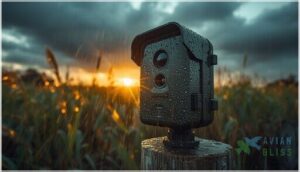
Your bird camera won’t do you much good if it can’t handle what nature throws at it.
I’ve seen too many cameras fail after one unexpected rainstorm or dusty afternoon in the field. Here’s what you need to know about choosing gear that’ll actually survive outdoors.
Waterproof and Dustproof Ratings
You’ll want cameras with IP67 ratings or higher—that means they can handle dust storms and brief submersion without flinching. Look for waterproof materials like reinforced polycarbonate housings and sophisticated sealing technologies around buttons and ports.
Moisture protection isn’t negotiable for outdoor cameras meant to survive downpours and humidity. Check the warranty too; manufacturers confident in their durability back it up.
Materials for Outdoor Use
The right materials separate bird cameras that last from ones that quit after a season. Look for these construction essentials:
- Metal Housings – Aluminum alloy balances light weight with impact resistance and heat dissipation
- UV Plastics – UV-stabilized polycarbonate resists yellowing and cracking in sunlight
- Corrosion Resistance – Stainless steel screws and brackets won’t rust in rain
- Thermal Management – Anodized aluminum surfaces handle minus 40 to 140°F swings
- Durable Mounts – Reinforced alloy brackets support outdoor cameras through wind and storms
Warranty and Long-term Reliability
Beyond build quality, you need a warranty that covers real-world use. Most interchangeable lens cameras include one year of coverage, though Leica SL-series models offer two years and professional surveillance cameras carry three to five year terms.
| Feature | Entry-Level Cameras | Professional Models |
|---|---|---|
| Standard Warranty Length | 1 year | 1–2 years |
| Shutter Lifespan | 50,000–100,000 cycles | 200,000–500,000 cycles |
| Weather Sealing Coverage | Excludes water damage | Limited rain/dust protection |
Extended plans from Canon CarePak Plus or Sony Protect add accidental damage coverage—vital when shooting in unpredictable conditions. Remember: weather sealing protects against splashes, not submersion, and manufacturers often deny claims if they find internal corrosion.
Check shutter ratings too. Entry DSLRs handle 50,000 to 100,000 actuations, while pro bodies like the Nikon D5 reach 400,000 cycles. High burst shooting in bird photography burns through those cycles fast, so factor replacement costs into your long-term budget. Buy from authorized dealers and register immediately to activate full warranty benefits and potential goodwill repairs down the road.
Top Bird Cameras for026
After years of testing cameras in the field, I’ve narrowed down the camera gear that actually delivers when a rare warbler lands 30 feet away.
These five cameras strike different balances between image quality, speed, and portability depending on your shooting style. Here’s what I reach for when the light’s fading and the birds won’t wait.
1. Canon EOS R5 Mirrorless Camera
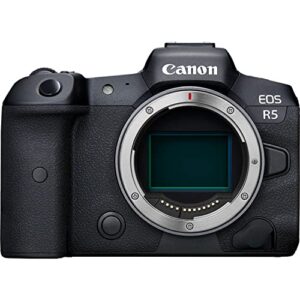
When you’re serious about bird photography, the Canon EOS R5 mirrorless camera delivers the kind of image quality that makes every feather count. This mirrorless technology powerhouse packs a 45-megapixel full-frame sensor with blazing autofocus—1,053 points that lock onto your subject fast.
You’ll love the camera ergonomics and shooting flexibility: 20 fps electronic bursts capture flight sequences beautifully. The RF mount opens up outstanding optical zoom options at various focal lengths. Sure, it’s pricey at $2,599, but it’s worth every penny for dedicated enthusiasts.
Best For: Wildlife and sports photographers who need professional-grade image quality, lightning-fast autofocus, and high-speed shooting to capture fast-moving subjects in challenging conditions.
Pros:
- 45-megapixel sensor and 1,053-point autofocus system deliver stunning image clarity and subject tracking
- Versatile shooting speeds up to 20 fps electronic shutter for capturing decisive moments in flight or action
- 8K video and 4K up to 120fps give you professional recording options alongside still photography
Cons:
- $2,599 price tag puts it out of reach for casual hobbyists or beginners
- Overheating issues during extended video recording sessions require monitoring and breaks
- Large file sizes from high-resolution sensor and electronic shooting modes demand significant storage capacity
2. Nikon D5600 Digital SLR Camera
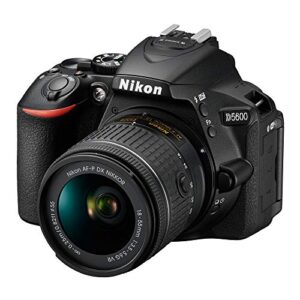
Looking for serious performance without the premium price tag? The Nikon D5600 delivers strong image quality with its 24.2-megapixel APS-C sensor and 39-point autofocus system that tracks birds across the frame.
Camera ergonomics feel natural in your hands, and the F-mount lens compatibility provides access to affordable telephoto glass. You’ll get 5 fps shooting modes and impressive battery life—over 970 shots per charge. At around $700 with the kit lens, it’s a solid workhorse that won’t drain your wallet.
Best For: Beginner to intermediate photographers who want a capable DSLR for wildlife and bird photography without spending a fortune on professional gear.
Pros:
- 24.2-megapixel sensor with excellent detail and a 39-point autofocus system that handles moving subjects well
- Outstanding battery life with over 970 shots per charge, so you won’t run out of power during long field sessions
- Compatible with Nikon’s extensive F-mount lens lineup, giving you affordable options for telephoto and specialty glass
Cons:
- SnapBridge connectivity is slow and buggy, often draining battery faster than expected
- Basic weather sealing means you’ll need to be careful in dusty or wet conditions
- Video quality drops noticeably in low light, showing visible grain that limits its use for dawn or dusk recording
3. Panasonic Lumix G9 Camera
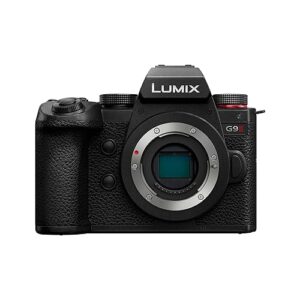
When speed matters most, the Panasonic Lumix G9 punches above its weight class. This camera delivers 20 fps continuous shooting with autofocus tracking—perfect for birds in flight. Its 20.3-megapixel Micro Four Thirds sensor pairs with outstanding in-body stabilization rated at 6.5 stops, letting you handhold telephoto shots you’d normally need a tripod for.
The weather-sealed magnesium body laughs off snow and spray, while the 225-area autofocus locks onto distant subjects in about 0.04 seconds. Camera ergonomics shine with a dedicated AF joystick and top-plate LCD. At around $1,000, it’s a serious contender for bird photography without the full-frame price tag.
Best For: Wildlife and bird photographers who need fast burst speeds, long reach with telephoto lenses, and reliable weather sealing without spending full-frame money.
Pros:
- 20 fps continuous shooting with autofocus tracking captures fast-moving birds and wildlife in sharp detail
- Industry-leading 6.5-stop in-body stabilization lets you handhold telephoto shots that normally require a tripod
- Fully weather-sealed magnesium body withstands rain, snow, and harsh outdoor conditions during long birding sessions
Cons:
- Micro Four Thirds sensor has a smaller surface area than APS-C or full-frame, which can mean more noise at higher ISOs
- 20.3-megapixel resolution is lower than many current competitors, limiting cropping flexibility for distant subjects
- Refurbished or international models have reported quality control issues and unclear labeling from some sellers
4. Nikon D850 Digital Slr Camera Body
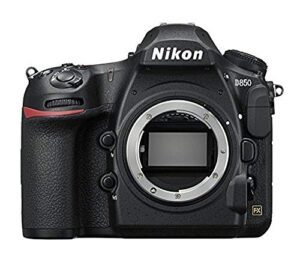
If you’re ready to invest in a workhorse DSLR Camera, the Nikon D850 won’t disappoint. This 45.7-megapixel powerhouse combines stunning Image Quality with an Autofocus system that tracks birds across 153 focus points—99 of them cross-type sensors.
You’ll get 9 fps with the battery grip, and the buffer processes 170 RAW frames before slowing down. The magnesium body features weather sealing that’s survived freezing mountains and dusty deserts in my testing.
Camera Ergonomics feel natural during long sessions, while Sensor Technology delivers clean files from ISO 64 to 25600.
Best For: Professional wildlife photographers and serious enthusiasts who need exceptional resolution, fast tracking autofocus, and reliable weather-sealed performance for demanding field conditions.
Pros:
- 45.7-megapixel backside-illuminated sensor with no optical low-pass filter delivers incredibly detailed images perfect for large prints and heavy cropping
- Advanced 153-point autofocus system with 99 cross-type sensors and 9 fps shooting (with grip) excels at tracking fast-moving birds and wildlife
- Robust magnesium alloy body with extensive weather sealing has proven reliable in extreme conditions from freezing mountains to dusty deserts
Cons:
- High price point of nearly $2,000 puts it out of reach for beginners and casual photographers
- Large 45.7-megapixel RAW files consume significant storage space and require powerful computers for efficient editing
- No built-in flash and poor autofocus performance during video recording limits versatility for hybrid shooters
5. Sony Alpha 7R Mirrorless Camera
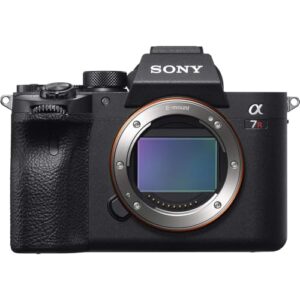
For mirrorless versatility, the Sony Alpha 7R IV brings 61 megapixels and serious Autofocus precision to bird work. You’ll appreciate how Mirrorless Technology keeps the body compact while the 567 phase-detection points track erratic flight paths.
Image Stabilization isn’t built in, so pair it with stabilized Sony Lenses like the 200-600mm. The Lens mount accepts adapters for legacy glass too.
Camera Features include 10 fps bursts and excellent Image Quality for heavy cropping. RAW Processing manages those massive files smoothly, and Camera Ergonomics stay comfortable during marathon sessions at the marsh.
Best For: Bird photographers who need high-resolution images for extreme cropping and detailed post-processing, especially when shooting perched songbirds or distant raptors in good light.
Pros:
- 61-megapixel sensor delivers exceptional detail that lets you crop heavily into the frame while keeping enough resolution for large prints of bird portraits
- 567 phase-detection autofocus points with animal eye detection track moving birds accurately, even when they shift position suddenly or fly erratically
- 10 fps continuous shooting at full resolution with a roughly 70-frame buffer gives you solid burst performance for flight sequences and takeoff moments
Cons:
- No in-body image stabilization means you’ll need to invest in stabilized lenses like the Sony 200-600mm for sharp handheld shots
- Massive 61-megapixel files demand significant storage space and fast processing power, which can slow down your workflow on long birding trips
- Buffer depth of about 7 seconds at full speed isn’t ideal for extended action sequences like long raptor stoops or large flocks in sustained flight
Frequently Asked Questions (FAQs)
What to look for in a birding camera?
Focus on fast autofocus that locks onto bird eyes, high burst rates to catch wingbeats, and silent electronic shutters.
Weather sealing protects your gear outdoors, while strong low-light performance captures early-morning visits.
What megapixel count is best for wildlife?
There’s no magic number, but 24 to 45 megapixels hits the sweet spot.
This range balances image quality, cropping limits, and pixel density across full-frame sensor and APSC sensor cameras without sacrificing low-light performance or lens sharpness.
How much should I budget for bird cameras?
Budget planning for bird cameras depends on your goals. Simple feeder cams cost around $150 to $250, while serious bird photography setups with interchangeable lenses run $1,500 to $5,000 or more.
Which brand offers the best customer support?
Which brand truly stands behind their bird watching technology? Sony leads with up to five-year warranty coverage and express repair services, while Canon and Nikon customer reviews reveal frustrating support quality and extended repair times affecting outdoor camera installation reliability.
Can I use my existing camera lenses?
You can absolutely keep your existing telephoto lenses. Most DSLR glass is compatible with mirrorless cameras through brand-specific adapters, preserving autofocus and image quality while giving you extra reach on crop-sensor bodies.
Whats the ideal megapixel count for bird photography?
You don’t need the biggest sensor to capture stunning detail. Around 24MP to 32MP hits the sweet spot for image quality, cropping limits, and pixel density, balancing sharpness with manageable file sizes during long shoots.
Do I need a tripod or gimbal head?
You don’t strictly need either, but camera support transforms wildlife photography comfort.
A tripod offers stability for perched birds, while a gimbal benefits lens balance and autofocus tracking during flight, reducing photography ergonomics strain with image stabilization.
Conclusion
Think of knowing what to look for in bird cameras as building a trap for lightning—you need the right setup in place before the moment arrives. Those critical seconds don’t wait for fumbling through menus or second-guessing your gear.
Match your autofocus system to your target species, balance sensor size against your budget, and prioritize weather sealing over features you’ll rarely use. Your next great shot depends on choices you make today.
- https://betterwithbirds.com/blogs/birding-gear/best-bird-feeder-cameras
- https://naturespy.org/blogs/journal/best-garden-wildlife-cameras-2025
- https://www.livescience.com/best-cameras-for-wildlife-photography
- https://www.rtings.com/camera/reviews/best/bird-photography
- https://amateurphotographer.com/buying-advice/best-cameras-for-bird-photography/