This site is supported by our readers. We may earn a commission, at no cost to you, if you purchase through links.

You point your new binoculars at a hawk circling overhead, but instead of crisp feathers and piercing eyes, you get a blurry brown blob wobbling in your field of view. That $40 impulse buy just became an expensive paperweight. The gap between budget optics and quality glass isn’t just about price—it’s the difference between spotting a rare warbler’s wing bars at 50 yards and squinting at shadows.
What to look for when buying binoculars comes down to understanding how magnification power, lens diameter, prism type, and coating quality work together to deliver sharp images. The specifications stamped on every model tell a precise story about light transmission, exit pupil diameter, and edge-to-edge clarity.
Once you decode these numbers and match them to your intended use—whether that’s backyard birding, stadium seats, or backcountry hunting—you’ll invest in optics that actually perform when it matters.
Table Of Contents
Key Takeaways
- Binocular specs like 8×42 decode as magnification power (8x) and objective lens diameter (42mm), with higher magnification narrowing your field of view while larger lenses capture more light for better low-light performance but add weight.
- Premium optical quality comes from BaK-4 prism glass with fully multi-coated lenses that transmit 90-95% of light compared to 50-70% in budget models, plus phase correction coatings on roof prisms to prevent the color fringing that kills sharpness.
- Birders should target 8x to 10x magnification with 6.5 to 8.5 degrees field of view and 15-20mm eye relief for glasses wearers, while waterproof models with IPX7 ratings and nitrogen purging handle weather without fogging.
- Mid-tier binoculars ($300-$500) often deliver the best value by balancing optical performance with durability features like rubber armoring and manufacturer warranties spanning 5-25 years, avoiding both cheap glass and overpriced flagship models.
Key Features to Consider in Binoculars
Before you hand over your hard-earned cash for a pair of binoculars, you need to understand the specifications that separate superior optics from mediocre ones. Each number and rating on the product label tells a specific story about how those binoculars will perform in the field.
If you wear glasses, choosing binoculars designed for eyeglass wearers becomes even more crucial since factors like eye relief directly impact your viewing comfort.
Let’s break down the four critical features that directly impact your viewing experience.
Magnification Power

Magnification Power determines how much closer distant subjects appear through your binoculars. Most general-use models range from 8x to 10x—balancing optical performance with a steady image.
Pairing the right magnification with proper bird watching clothing helps you stay comfortable during longer observation sessions in the field.
When evaluating magnification, consider three critical trade-offs:
- Higher magnification (10x–12x) narrows your field of view and amplifies hand shake
- Image stabilization compensates for fatigue at high magnification
- Power versus portability: lower magnification pairs well with compact designs for extended carry
Objective Lens Diameter

The second number in binocular specs—such as 8×42—represents objective lens diameter in millimeters. Larger lenses (40–42 mm) capture more light, delivering better image brightness and low light performance at dawn or dusk.
For a full breakdown of how magnification and aperture work together, check out this beginner’s guide to binocular specifications.
Exit pupil size, calculated by dividing objective lens diameter by magnification power, directly impacts optical clarity. Wider objectives boost optical performance but add weight, so balance portability against your lighting conditions.
Field of View
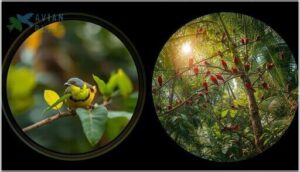
Field of view measures the angular width of the scene you can observe, generally expressed in degrees of real field or feet at 1,000 yards. Binoculars with 7.0 degrees or higher offer wide-angle coverage, ideal for tracking fast-moving birds or scanning dense habitat.
Pairing wide-angle optics with the right magnification—such as 8×42 configurations for birding—ensures you capture both breadth and detail without sacrificing stability.
Higher magnification power narrows field diameter, while lower power expands apparent view. For birding, prioritize 5.5 to 8.5 degrees to balance detail with scanning efficiency.
Understanding the optical field of view is essential for selecting the right binoculars for specific applications.
Eye Relief
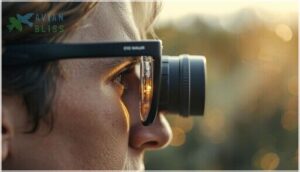
Beyond field of view, eye relief determines how far your eye sits from the eyepiece while capturing the complete image—critical for glasses wearers. Eye relief standards recommend 15–20 mm for comfortable viewing with spectacles, preventing vignetting at the frame edges.
- Exit pupil distance interacts with magnification power and diopter adjustments to position the optical instruments correctly.
- Eyecup designs fold down or twist to accommodate prescription lenses.
- Shorter relief forces uncomfortable proximity, blocking peripheral clarity.
How Binocular Specifications Affect Performance
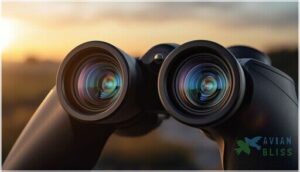
You’ve seen binocular labels with numbers like 8×42 or 10×50, but those specs tell a bigger story about how the optics actually perform in the field.
The magnification and lens diameter work together with the prism type—roof prism versus porro prism designs handle light differently, which affects brightness and clarity.
The prism design, lens coatings, and numerical ratings directly control what you see through the eyepieces—from brightness in low light to edge-to-edge sharpness.
Here’s how each specification shapes your viewing experience.
Understanding Model Numbers
You’ll see binocular model numbers like 8×42 or 10×50 everywhere, and code interpretation is straightforward: the first digit shows magnification power, while the second reveals objective lens diameter in millimeters.
Model decoding gets trickier with brand variability—suffixes often indicate prism types, lens coatings, or waterproofing features. These codes also hint at exit pupil size and eye relief, so always verify specs against manufacturer documentation before purchasing.
Prism Types (Roof Vs. Porro)
Your choice of prism type fundamentally shapes image contrast, portability, and cost. Roof prism binoculars deliver compact straight-barrel designs with excellent durability, though they require phase correction prism coatings to maintain sharpness—driving up manufacturing expense.
Porro prism optics provide wider three-dimensional depth perception and lower price points, but their offset optical path creates bulkier profiles that sacrifice packability for budget-conscious adventurers.
Lens Coatings and Materials
Optical glass quality and lens coatings determine whether you’ll watch sharp eagles or blurry smudges. The multicoating process applies thin chemical layers—magnesium fluoride and enhanced aluminum oxide—to every air-to-glass surface, boosting light transmission from 50% to over 95%.
Glass quality and lens coatings separate sharp eagles from blurry smudges—multicoating boosts light transmission from 50% to over 95%
- ED glass minimizes color fringing at object edges
- Fully multicoated optics outperform single-layer treatments
- BaK-4 prism type delivers brighter exit pupils than BK-7
- Coating materials protect against moisture and scratches
Premium optical quality costs more, but crisp images justify the investment.
Phase Correction Coatings
Roof prism binoculars need phase correction coatings to fix light wave misalignment that blurs your view.
These specialized prism coatings compensate for phase shift that happens when light splits through roof prism technology, directly improving edge sharpness and color fidelity.
You’ll notice the difference in optical clarity when spotting high-contrast targets—phase shift correction delivers sharper resolution than uncorrected optics and design.
Choosing Binoculars for Bird Watching

Bird watching demands binoculars that can keep up with fast-moving targets while delivering sharp detail across varying light conditions. You’ll need a specific combination of magnification, field coverage, and weather protection to track warblers in dense canopy or shorebirds across open wetlands.
The following specifications separate effective birding optics from general-use models.
Optimal Magnification for Birding
Most birding guides steer you toward 8x to 10x magnification because these optics deliver the balance you need in the field. An 8×42 model gives you adequate image stability without a tripod, maintains solid low-light performance with a 5.25 mm exit pupil, and provides field views wide enough to track warblers through canopy gaps.
- 8x magnification: Best for handheld birding scenarios with minimal shake and brighter images in dawn conditions
- 10x magnification: Offers extra detail for distant raptors but requires steadier grip or tripod support
- 12x–16x range: Magnifies shake considerably, reducing practical usability without stabilization or mounting
- Compact 8×25 models: Sacrifice brightness for portability, viable for casual daytime bird watching only
Wide Field of View
Field of view dictates how much scanning you’ll do before spotting that target bird. A wider angle—usually 6.5 to 8.5 degrees depending on magnification and optical design—lets you track flitting subjects with minimal pan movements and better peripheral vision.
Binoculars offering 8x magnification usually deliver broader fields than 10x models, improving image stability and reducing eyestrain during prolonged field scanning sessions with adequate objective lens diameter and eye relief.
Waterproof and Weather Resistance
Weather sealing protects your optics when morning dew settles or sudden squalls roll in. Waterproof binoculars use O-ring seals meeting IPX7 standards—surviving 1.5-meter submersion for 30 minutes—while fog resistance relies on nitrogen purging to eliminate internal moisture during temperature swings.
Consider these protective features:
- Seal materials preventing water ingress at lens junctions
- Moisture management through nitrogen or argon purging
- Rubber coating absorbing impacts and improving wet-weather grip
Eye relief remains comfortable even with protective eyecups engaged.
Assessing Optical Quality and Clarity
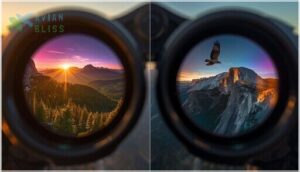
High-quality glass and lens coatings determine whether you’re viewing crisp, true-to-life images or struggling with blurred edges and washed-out colors. Lens clarity starts with the prism material—BaK-4 glass delivers sharper edge-to-edge resolution than cheaper BK-7 alternatives. You’ll notice this when scanning across your entire field of view; premium optics maintain sharpness from center to edge, while budget models blur noticeably at the periphery.
Light transmission directly affects image brightness in dawn or dusk conditions. Fully multi-coated lenses transmit 90-95% of available light, compared to 50-70% in uncoated models. Check for phase correction coatings on roof prism designs—these prevent color fringing that degrades optical sharpness.
Test color accuracy by comparing binoculars side-by-side outdoors. Quality optics render greens without yellow casts and maintain neutral tones across your entire field of view. Exit pupil diameter and generous eye relief contribute to comfortable, strain-free viewing during extended observation sessions.
Durability and Comfort Factors
You’ve sorted out magnification and optics, but binoculars that fog up on a cold morning or feel like dumbbells around your neck won’t last past the first hike.
Durability features protect your investment from drops and weather, while comfort factors determine whether you’ll actually want to use them for hours at a time.
Here’s what separates binoculars that survive the field from those that stay in the closet.
Waterproof and Fog-proof Features
When you’re facing unpredictable conditions, waterproof and fogproof binoculars become essential. Look for models with O-ring seal integrity and dry nitrogen purging to prevent moisture resistance failures. Key indicators include:
- IPX or JIS waterproof testing ratings for submersion protection
- Fog proofing through internal gas fills that handle temperature shifts
- Exit pupil clarity maintained across field of view after exposure
These features guarantee your optics perform when weather turns harsh.
Rubber Armoring
Beyond waterproof and fogproof protection, you need impact resistance from a rubber coating that wraps your binoculars in a textured, flexible layer. This armoring material delivers shock absorption through polymer construction that withstands durability tests under real outdoor conditions.
The raised surface improves grip during wet weather while safeguarding internal optics from drops and bumps—giving you confidence when binocular selection matters most in challenging terrain.
Weight and Size Considerations
Portability factors become critical when you’re carrying binoculars through varied terrain during extended sessions. Compact designs weighing 500–700 grams balance magnification and lens size without overloading your pack, while lightweight materials like magnesium frames reduce fatigue.
Size variations affect how models fit in backpacks—full-size units measuring 170–190 mm offer premium optics but demand more space. An ergonomic grip ensures control when weight distribution matters most.
Adjustable Eyecups for Glasses
Eyecup adjustments transform your viewing experience when you wear glasses—twist-up or flip-down mechanisms position your eyes precisely at the optical center. Most models offer intermediate stops that accommodate different facial geometry needs while maintaining a full field of view.
- Extended eye relief (15–20 mm) prevents eyelash contact with lenses during extended sessions
- Rubber construction compresses slightly to match your unique facial contours
- Multi-position stops let you dial in exact ocular comfort for prescription eyewear
- Side light blocking reduces glare infiltration that degrades contrast in optical instruments
- Exit pupil alignment ensures you capture the complete image without vignetting edges
Budgeting and Comparing Binocular Brands
You don’t need to break the bank to get quality binoculars, but you do need a clear financial plan before you start shopping. Understanding what different price points deliver—and which manufacturers stand behind their products—helps you make a confident purchase decision.
The following factors will guide you toward binoculars that deliver real value for your specific budget and needs.
Setting a Realistic Budget
Before you start comparing features and specifications in any binocular buying guide, determine your financial limits based on how often you’ll use the optics and where. Budget planning starts with honest cost analysis: casual hikers perform well with $100-$200 models, while serious birders benefit from $300-$500 roof prism designs offering exceptional performance and quality.
Your spending strategy should prioritize optical clarity and durability over unnecessary features when choosing the right binoculars through careful price comparison.
Manufacturer Warranty and Support
A manufacturer’s warranty functions as your insurance policy against defects in binoculars and outdoor gear. Look for coverage spanning 5 to 25 years with clearly documented warranty claims procedures and accessible service networks through support channels like email or regional repair centers.
Verify international coverage if you travel abroad, and confirm the brand offers genuine replacement parts for binocular maintenance, protecting your investment in essential accessories and features.
Value Vs. Price
Price doesn’t always reflect true value in binoculars—you need cost analysis weighing optical performance against budget planning. Premium BAK-4 glass and multi-coatings justify higher prices through excellent magnification clarity and light transmission, while sturdy binocular design with phase correction coatings enhances outdoor activities performance.
Quality evaluation reveals that mid-tier models often deliver excellent value assessment compared to flagship offerings, balancing budget and value for your specific needs.
Frequently Asked Questions (FAQs)
Can I use binoculars with contact lenses?
Like slipping on a second skin, contact lenses pair seamlessly with binoculars—just verify adequate eye relief (15mm minimum) to prevent strain and maintain sharp image quality across your full field of view.
How do I properly clean binocular lenses?
Proper binocular maintenance starts with optical care: use a blower to remove dust, then gently wipe lenses with a microfiber cloth and lens cleaning solutions. Never apply fluids directly—protect those precision optics for lasting image quality.
Whats the difference between fixed and zoom binoculars?
Fixed focus binoculars lock onto one unchanging focal plane, while zoom models let you dial magnification up or down—but that flexibility brings optical tradeoffs in brightness, weight, and edge sharpness you’ll notice instantly in the field.
Do binoculars need regular maintenance or calibration?
You won’t need regular maintenance schedules or calibration needs if you handle your binoculars carefully.
Focus on lens cleaning when dirty, proper storage conditions, and check optical alignment only after impacts.
Can binoculars be repaired if damaged?
When gear fails you mid-adventure, it stings. Binoculars can be repaired, though repair costs sometimes exceed replacement value for budget optics. Manufacturers offer warranty servicing, and independent specialists handle collimation, lens work, and waterproof seal restoration.
Conclusion
Think of binoculars as an investment in every view you’ll never want to miss—from that fleeting osprey dive to stadium game-changers. Knowing what to look for when buying binoculars transforms confusing spec sheets into a clear decision path.
Match magnification to your activity, prioritize quality glass over gimmicks, and don’t skimp on coatings. The right pair becomes second nature in your hands, delivering sharp images exactly when opportunity strikes.
Choose wisely, and you’ll stop shopping.
- https://imaging.nikon.com/sport-optics/guide/binoculars/basic/basic_08/
- https://www.allaboutbirds.org/news/choosing-binoculars-field-of-view-and-close-focus/
- https://shopping.rspb.org.uk/page/understanding-binoculars
- http://www.eagleeyeuk.com/how-binoculars-work-the-basics-of-magnification-and-field-of-view/
- https://www.agmglobalvision.com/Scope-Binocular-Field-of-View-Explained