This site is supported by our readers. We may earn a commission, at no cost to you, if you purchase through links.

Each autumn, billions of birds vanish from backyards, forests, and wetlands across the Northern Hemisphere, embarking on journeys that can span entire continents. A ruby-throated hummingbird weighing less than a nickel will cross 500 miles of open Gulf water without stopping, while Arctic terns traverse from pole to pole—the longest migration on Earth.
These seasonal movements aren’t random wanderings but precisely timed responses to shifting daylight, plummeting temperatures, and disappearing food sources. Understanding where birds go in winter reveals a complex system of flyways, stopover sites, and wintering grounds that sustains species survival.
From the wetlands of Central America to the coastal regions of Africa, migratory birds follow ancient routes guided by celestial cues, magnetic fields, and inherited instincts.
Table Of Contents
- Key Takeaways
- Why Do Birds Leave in Winter?
- Where Do Birds Go in Winter?
- How Far Do Birds Migrate Each Winter?
- What Are The Main Migration Routes?
- How Do Birds Navigate During Migration?
- What Winter Habitats Do Birds Use?
- How Do Birds Survive Harsh Winter Conditions?
- Which Birds Stay Instead of Migrating?
- What Threats Do Birds Face in Winter?
- How Can You Help Birds in Winter?
- Frequently Asked Questions (FAQs)
- Where do birds go in winter in the USA?
- Where do birds go in the winter if they don’t migrate?
- Do all birds from one species migrate together?
- Can birds change their migration destination over time?
- How do young birds learn their first route?
- Do migrating birds sleep while flying long distances?
- What happens if birds arrive too early?
- Do all bird species migrate at night?
- How do baby birds learn migration routes?
- Can birds change their migration patterns over time?
- Conclusion
Key Takeaways
- Birds migrate in response to precise environmental triggers—shrinking daylight, plummeting temperatures, and disappearing food sources—rather than random instinct, with photoperiod cues initiating hormonal changes that build fat reserves and drive migratory restlessness.
- Migration distances vary dramatically by species, from short hops of a few hundred miles to record-breaking journeys like the Arctic Tern’s 70,000-kilometer annual trek, with these distances shaped by food availability, body size, and breeding location.
- Birds navigate using multiple built-in systems working together—sun position during daylight, star patterns at night, Earth’s magnetic field for course correction, and learned landmarks passed down through generations—creating a sophisticated natural GPS that works without technology.
- Winter survival depends on both wild habitats like wetlands and coastal areas and human-modified environments, where simple backyard actions like maintaining unfrozen water sources, providing high-energy seeds, and installing roosting boxes can significantly improve bird survival rates during harsh conditions.
Why Do Birds Leave in Winter?
Every autumn, something pulls birds away from the places they’ve called home all spring and summer. It’s not random — there are real, biological reasons behind the timing.
Scientists have mapped out detailed bird species migration patterns that show how different species respond to these seasonal signals in surprisingly distinct ways.
Here’s what actually drives them to leave.
Food Scarcity and Temperature Drops
When temperatures drop, food becomes the first casualty of cold weather. Frost locks seeds beneath snow, and cold stress reduces insect activity by nearly half — cutting off reliable food sources almost overnight. Winter foraging gets harder as frozen ground blocks access to invertebrates.
That’s why bird migration patterns shift early: birds follow food, not just warmth, making energy conservation a core winter survival strategy.
Breeding and Survival Needs
Migration isn’t just about escaping the cold — it’s deeply tied to reproductive health and fledgling care. Birds leave to protect future generations:
- Wintering grounds offer reliable food sources that fuel breeding condition.
- Habitat quality shapes nesting opportunities and genetic diversity in offspring.
- Strong nesting strategies improve hatch success and winter survival strategies.
Bird migration patterns ultimately serve reproduction.
Daylight and Hormonal Triggers
Beyond reproduction, daylight itself drives bird migration. As days shorten in late summer, photoperiod cues trigger a hormonal cascade that reshapes bird behavior from the inside out. Hormone regulation shifts metabolism, builds fat reserves, and awakens migratory restlessness.
These daylight signals fine-tune migration timing with striking precision, syncing seasonal movement to food availability across migration routes — a core principle of avian ecology and seasonal adaptation. The process is intricately linked to that regulate hormone production in response to changing light conditions.
Specialized photoreceptor cells in the avian brain detect these light changes, initiating the hormonal shifts that power birds changing habitats seasonally across continents.
Where Do Birds Go in Winter?
When winter sets in, birds don’t just disappear — they follow routes that have been traveled for thousands of years, landing in places that keep them fed and alive. The destinations vary a lot depending on the species, the continent, and how far a bird is willing to fly.
Here’s a closer look at where they actually end up.
Southern Migration Destinations
When bird migration begins in fall, most species follow well-established migration routes toward warmer southern habitats. Florida, Texas, and Georgia rank among the top wintering grounds, drawing millions of birds to coastal flyways rich with food and shelter.
Flyway conservation efforts help protect these southern habitats, ensuring winter survival strategies remain effective as migration patterns shift with changing climates.
Major Wintering Regions by Continent
Across every continent, wintering habitats form a global safety net for bird species following ancient migration routes. These regional stopovers aren’t random — they’re shaped by food availability, climate, and geography.
- North America: Gulf Coast wetlands from Florida to Texas host massive waterfowl congregations
- South America: Andean foothills and Amazonian fringes shelter warblers and tanagers
- Africa: The Sahel belt acts as a critical corridor for trans-Saharan migrants
- Asia: Southeast Asian mangroves and India’s coastal plains welcome wintering shorebirds
Understanding these global routes reveals just how interconnected bird migration truly is. Conservation efforts depend on recognizing the impact of when protecting essential wintering areas.
Protecting these areas requires addressing the effects of habitat loss on birds, from deforestation and urban sprawl to climate-driven ecosystem shifts that threaten migratory stopovers worldwide.
Common Migratory Bird Examples
You’ll spot some of the most dramatic migration routes when you track individual bird species. The Barn Swallow leaves North America for sub-Saharan Africa, while the Snow Goose travels from Arctic breeding grounds to southern wintering habitats across Mexico.
Warblers like the Blackburnian head to Caribbean islands, demonstrating how migratory birds use diverse strategies and flocking behaviors to reach their winter destinations.
How Far Do Birds Migrate Each Winter?
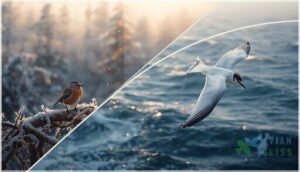
Not all birds travel the same distance when winter arrives. Some species only move a few hundred miles to find milder weather, while others cross entire hemispheres in journeys that span thousands of miles.
Migration distance depends on factors like food availability, body size, and how far north a bird breeds during summer.
Birds that stay closer to home year-round often face different survival pressures than long-distance migrants, and understanding where specific birds live helps reveal how species adapt to seasonal changes across their ranges.
Short-, Medium-, and Long-Distance Migration
Not all migrations follow the same script. Short-distance migrants move within a few hundred kilometers, hopping to slightly warmer zones where food remains accessible.
Medium-distance journeys span several hundred to a few thousand kilometers, often tracing coastlines or mountain ranges along established flyways.
Long-distance migrants cross continents or oceans, relying on stopover ecology and precise navigation methods to refuel and conserve energy throughout their epic flights.
Longest Journeys by Species
Some of the longest journeys in the animal kingdom belong to birds chasing endless summer. Their record journeys include:
- Arctic Terns – 70,000 km annually from Arctic to Antarctic, traveling 1.5 million miles over 30 years
- Sooty Shearwaters – 65,000 km across Pacific and Atlantic Oceans
- Wandering Albatrosses – 120,000 km yearly while foraging
- Bar-tailed Godwits – 12,000 km nonstop flights from Alaska to Australasia
- Amur Falcons – 22,000 km from Siberia to southern Africa
Factors Affecting Migration Distance
Bird migration distances aren’t set in stone—they shift with climate change, food availability, and geographic barriers. Physiological readiness determines when birds can tackle long journeys, while topographic factors like mountains reshape migration routes and flyways.
Rising temperatures push some species to shorten trips to wintering grounds closer to home, while habitat loss forces others into longer, riskier paths.
What Are The Main Migration Routes?
Birds don’t just wander aimlessly across continents when winter arrives—they follow established routes that have been fine-tuned over thousands of generations. These pathways, called flyways, act like invisible highways in the sky, guiding millions of birds between their breeding and wintering grounds each year.
Understanding these routes reveals the extraordinary organization behind what might otherwise seem like chaos.
North American Flyways

You’ll find four major flyways channeling bird migration across North America: the Atlantic, Mississippi, Central, and Pacific routes. Each flyway funnels millions of birds between Arctic breeding grounds and southern wintering sites.
The Mississippi Flyway follows the river basin, while the Atlantic corridor hugs the eastern coast.
Species tracking shows over half of North America’s waterfowl use these pathways, making flyway conservation and habitat preservation essential for migration patterns.
Global Migration Pathways

Beyond North America, global routes connect breeding grounds to wintering sites across continents. You’ll see African-Eurasian pathways linking Europe to Sub-Saharan destinations, while East Asian flyways channel species from Siberia to Southeast Asia and Oceania.
Bird species migration follows these corridors based on habitat preservation needs and historical patterns. Bird navigation conforms to regional geography, with flyway conservation efforts protecting migration routes that span multiple nations and climates.
Key Stopover Sites
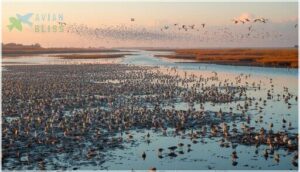
Along these migration routes and flyways, you’ll find critical resting sites where birds refuel between legs. Coastal refuges like marshes and estuaries host shorebirds feeding on invertebrates, while forest stopovers provide insects and shelter from predators.
These refueling hubs cluster near migration corridors—river deltas, wetlands, and protected shorelines—allowing birds to replenish fat stores before continuing toward wintering grounds.
How Do Birds Navigate During Migration?

Birds cross thousands of miles without GPS, relying instead on an extraordinary set of built-in tools and environmental cues to find their way.
Birds navigate thousands of miles using built-in tools and environmental cues instead of technology
Scientists have identified several navigation methods that work together like instruments in a cockpit, each serving a distinct purpose during the journey. These methods include celestial navigation, magnetic sensing, and behavioral strategies passed down through generations.
Sun and Celestial Navigation
How do birds track their path across thousands of miles? Migratory species rely heavily on solar navigation and celestial maps to guide their journeys. During daylight, they measure the sun’s altitude and position, using these celestial cues as a compass.
At night, many birds read star patterns to maintain accurate migration routes—an avian navigation technique refined across countless generations of bird behavior.
Magnetic Fields and Landmarks
When the sun sets, you’ll find migrating species switching to magnetic navigation. They detect the Earth’s geomagnetic field—sensing declination and inclination—to calibrate their internal compass.
Crustal anomalies act as magnetic landmarks, helping confirm position along migration routes. This avian navigation technique combines celestial cues with magnetic mapping, allowing birds to hold course even when stars disappear behind clouds or daylight fades entirely.
Innate and Learned Behaviors
You’re witnessing a blend of genetic predisposition and experiential learning when birds navigate. Innate navigation gets them started—fixed action patterns trigger migration timing—while learned migration refines their journey:
- Young birds follow experienced adults, adopting proven stopover sites through social learning
- Repeated seasonal exposure strengthens spatial memory of routes and landmarks
- Trial and error during early flights improves behavioral adaptation for future trips
This ecological adaptation combines inherited instinct with practical knowledge.
What Winter Habitats Do Birds Use?

Once birds reach their wintering grounds, they don’t just settle anywhere—they seek out specific habitats that offer food, shelter, and protection from the elements. These environments range from wild, untouched landscapes to areas shaped by human activity.
Understanding where birds spend the winter reveals how adaptable these species can be when survival depends on it.
Wetlands, Forests, and Coastal Areas
When winter pushes birds south, wetlands, forests, and coastal ecosystems become their lifelines. Salt marshes filter pollutants while mangrove forests stabilize shorelines—both critical wintering grounds for migratory species.
Seagrass beds in marine wildlife zones provide nursery habitat, and waterlogged wetland soils support unique plant communities.
These habitats maintain ecological balance, making wetland conservation and ecological conservation essential for bird migration success.
Urban and Suburban Habitats
Cities and suburbs create surprising winter refuges when you add bird feeders, birdhouses, and heated birdbaths to your green spaces. Urban planning shapes suburban wildlife by linking parks with tree-lined corridors.
Garden habitats in your yard support chickadees and sparrows through backyard bird conservation.
Bird-friendly cities now integrate pollinator plantings and winter bird feeding stations, proving metropolitan areas can sustain diverse species year-round.
Adaptation to Human Environments
You might spot a cardinal pecking at your patio when natural forests stand miles away—that’s adaptive behavior in action. Urban nesting thrives when you support backyard bird conservation through these bird-friendly steps:
- Install collision-reducing window screens that cut strikes by 90 percent
- Plant native shrubs for year-round berries and insect prey
- Position bird feeders away from windows to lower predation risk
- Maintain a heated birdbath for hydration during freezing spells
- Add birdhouses with predator guards for cavity-dwelling species
Human impact reshapes urban ecology daily, so winter bird feeding and thoughtful landscaping help birds exploit cities as reliable refuges.
How Do Birds Survive Harsh Winter Conditions?

Birds that face winter head-on need more than just luck to make it through the cold. They rely on a combination of physical adaptations, smart group behaviors, and surprising energy-saving tricks that scientists have studied for decades.
Here’s how these strategies work together to keep birds alive when temperatures drop and food becomes scarce.
Feather Insulation and Fat Storage
You can think of a bird’s down feathers as nature’s sleeping bag—they trap air to create insulation layers that block heat loss. Meanwhile, fat reserves stored beneath the skin do double duty: they fuel long flights and add a thermal buffer for cold weather bird behavior.
Birds rely on feather structure and fat metabolism to power winter survival through effective thermal regulation and energy reserves.
Flocking and Behavioral Strategies
You’ll see flocking serve as both a survival tactic and a communication system when cold weather bird behavior intensifies. Birds use group coordination and adaptive behavior to navigate threats and locate resources. Here’s how flock dynamics support wildlife survival strategies during bird migration:
- Birds establish temporary leadership, allowing quick followers to align with trusted neighbors within a few body lengths
- Social learning spreads information about wind, thermals, and obstacles through the group in fractions of a second
- Synchronized turning confuses predators while rapid splits create multiple moving targets
- Velocity matching helps flocks ride air currents efficiently, conserving energy reserves
- Bird communication through visual cues and wingbeat patterns signals danger and resource locations
Torpor and Energy Conservation
Beyond flocking, some small birds tap into a physiological ace: torpor. This cold adaptation allows birds to drop their body temperature and metabolic rate for hours, cutting energy use by 10 to 80 percent. Hummingbirds and passerines rely on the benefits of torpor when nighttime temperatures plummet and food runs short, balancing energy savings against predator risk.
| Torpor Benefits | Energy Savings | Cold Adaptation |
|---|---|---|
| Drops body temp actively | 10–80% reduction | Triggered by low temps |
| Slows heart rate, breathing | Net energy balance optimized | Requires fat reserves |
| Lasts hours to overnight | Rewarming costs energy | More common in small birds |
| Extends survival in cold snaps | Allows marginal habitat use | Influenced by daylight cues |
| Reversible when conditions improve | Conserves essential functions | Affects foraging decisions |
Which Birds Stay Instead of Migrating?

Not all birds pack their bags when winter rolls in. Some species have evolved to tough it out through freezing temperatures, relying on unique adaptations that let them survive without heading south.
Let’s look at which birds stay put, how they manage the cold, and which ones you’re likely to spot in your own backyard.
Non-Migratory Species
Not every bird packs its bags when winter rolls around. Year-Round Habitat specialists like chickadees, cardinals, and nuthatches stay put, thriving in their familiar territories. These Nonmigratory birds rely on Local Adaptations that let them brave cold weather without heading south.
Some common Resident Birds you’ll spot at your bird feeders include:
- Black-capped chickadees
- Northern cardinals
- White-breasted nuthatches
- American crows
Their Nonmigratory Behavior depends on steady Winter Foraging and shelter from birdhouses.
Adaptations for Local Survival
Staying local during cold weather demands real ingenuity. Year-round residents rely on adaptations like Feather Insulation, which traps air near their skin, and Fat Reserves that fuel their heightened metabolism—some species pack on over twenty percent of their body weight in autumn. Roosting Strategies, such as huddling in dense shrubs, conserve heat overnight. These Metabolic Adjustments improve Cold Tolerance, letting resident birds exploit Food Sources near Bird Feeders when natural options freeze.
| Adaptation Type | How It Aids Winter Survival |
|---|---|
| Feather layering | Reduces heat loss through trapped air pockets |
| Fat storage | Provides energy during prolonged cold spells |
| Group roosting | Shares body warmth on freezing nights |
Common Backyard Winter Birds
Once you’ve grasped how adaptations work, you’ll spot these nonmigratory birds thriving in your backyard all winter:
- Black-capped chickadees defend seed patches in flocks of three to six, favoring sunflower seeds and suet at bird feeders.
- Northern cardinals prefer safflower and cracked corn year-round.
- Dark-eyed juncos forage beneath shrubs for fallen seeds.
- Blue jays cache extra nuts during cold snaps while visiting birdhouses for shelter.
What Threats Do Birds Face in Winter?

Winter survival isn’t guaranteed for birds, even those perfectly adapted to the cold. Whether migrating thousands of miles or staying put in familiar territory, birds encounter dangers that can overwhelm even the strongest fliers.
These threats fall into three main categories: vanishing habitats, brutal weather patterns, and encounters with predators or human-made obstacles.
Habitat Loss and Fragmentation
Habitat Loss and Fragmentation threaten the very patches you expect birds to find. Forest cover declined by ten percent in many temperate regions over the last decade, while wetlands and grasslands shrank steadily.
Patch Loss isolates populations, making breeding and wintering sites harder to reach. Edge Impacts raise predation and invasive species pressure, pushing specialists out.
Habitat Conservation efforts must reconnect these fragments to preserve viable migration corridors for future generations.
Severe Weather and Climate Change
Climate Shifts and Weather Extremes force birds off their familiar routes, causing Bird Displacement and threatening Winter Survival. Extreme Temperatures during Cold Weather strain energy reserves, while Habitat Destruction from ice storms and droughts reduces safe stopover sites.
Climate Change accelerates these pressures, mismatching insect emergence with Bird Migration schedules. Wildlife Conservation efforts must address these compounding stressors to protect vulnerable populations facing unpredictable conditions.
Predators and Human Hazards
Beyond storms and shifting seasons, Predator Prey encounters and Human Impact create daily survival challenges at Wintering Grounds. Urban Hazards and Environmental Threats compound natural risks during Bird Migration.
- Cats and raptors hunt vulnerable birds near feeders and roosts, killing millions annually
- Window collisions and power lines cause fatal injuries in urban corridors
- Light pollution disorients nocturnal migrants, disrupting navigation
Bird Conservation Efforts and Habitat Preservation reduce these pressures through Wildlife Conservation strategies.
How Can You Help Birds in Winter?

You don’t need a PhD in ornithology to make a real difference for birds struggling through winter’s harshest months. Simple actions in your own backyard can provide the food, shelter, and safety that wintering birds desperately need to survive.
Here are three practical ways you can support birds when they need it most.
Providing Food and Water
You can support wintering birds by filling bird feeders with sunflower seeds, millet, and nyjer to guarantee proper winter nutrition and food availability. Provide unfrozen water sources in shallow bird baths, renewing them daily to maintain bird hydration.
Match food supplements to your flock size—larger groups need two to three times the usual portions so food sources remain adequate for all.
Creating Safe Shelter
You can help roosting birds by installing large birdhouses or roosting boxes that accommodate multiple individuals huddled together for warmth. Position these nesting sites facing south to capture winter sun, and guarantee shelter design includes drainage holes to prevent moisture buildup.
Bird feeders mounted near protected avian shelter and habitat reduce exposure time, improving wildlife survival strategies during harsh conditions.
Supporting Conservation Initiatives
You can boost wildlife protection efforts by joining community engagement programs that monitor local bird populations and share data with conservation groups.
Your financial support drives habitat restoration projects that reestablish native plants and create protected corridors for safer migration.
Eco tourism participation generates conservation funding while raising awareness, and volunteering at habitat preservation sites directly strengthens biodiversity conservation where birds need it most.
Frequently Asked Questions (FAQs)
Where do birds go in winter in the USA?
When temperatures plummet, millions of migratory birds across North America follow ancient migration routes toward southern states like Texas and Louisiana, coastal wintering grounds along the Gulf of Mexico, or warm bird sanctuaries throughout Central America.
Where do birds go in the winter if they don’t migrate?
Nonmigrant species shelter in dense trees, cavities, and thick shrubs during cold weather.
You’ll find these bird species at local roosting sites, urban habitats, and winter feeding areas that supply stable food sources for cold adaptation.
Do all birds from one species migrate together?
Not all birds from one species migrate together. Many species split into subgroups, with juveniles departing later than adults, males and females migrating separately, and distinct populations using different routes and wintering grounds.
Can birds change their migration destination over time?
Yes, you’ll find that bird species migration destinations shift across generations as climate adaptation and changing food availability reshape their seasonal movements.
Migration flexibility allows individual birds to adjust wintering strategies when route changes yield better survival outcomes.
How do young birds learn their first route?
You’ll find that young birds rely on innate navigation and magnetic cues from Earth’s field. Vector learning helps them adjust course at stopovers, while social guidance from experienced adults refines their avian migration patterns over time.
Do migrating birds sleep while flying long distances?
You might picture a bird closing both eyes mid-flight, but migration strategies are more nuanced.
Some avian species use unihemispheric sleep—resting one brain hemisphere while the other maintains flight navigation and in-flight rest efficiency.
What happens if birds arrive too early?
Early arrival risks mistiming breeding—you’ll find peak food isn’t available yet, leading to nesting failures and lower chick survival.
Energy costs increase, cold weather slows growth, and migration routes become less predictable.
Do all bird species migrate at night?
Not all migratory birds travel at night. Many small songbirds favor nocturnal flight for safer passage, while large raptors often migrate during daylight hours, using thermal currents to soar efficiently across vast distances.
How do baby birds learn migration routes?
Young birds rely on innate navigation encoded in their genes, social learning from parents during first journeys, and environmental cues like stars and landmarks to master migratory routes and stopover sites.
Can birds change their migration patterns over time?
Yes, birds adjust migration patterns through climate adaptation. North American species now arrive at breeding grounds one to two days earlier per decade, showing route changes and timing shifts as habitat conditions evolve.
Conclusion
Every year, more than 5 billion birds move between continents during migration—one of the largest biomass transfers on the planet. Understanding where birds go in winter reveals not just migratory routes, but the delicate ecosystems that sustain them.
From backyard feeders to protected wetlands, your role in supporting these journeys matters. The birds that disappear each autumn don’t vanish—they’re following an ancient rhythm that connects hemispheres, habitats, and the choices you make today.
- https://ttnature.com/blogs/birdman-should-know/bird-migration-us-guide
- https://www.birdful.org/when-and-where-do-birds-migrate/
- https://www.birds.cornell.edu/home/record-breaking-night-of-bird-migration/
- https://www.statista.com/chart/17958/longest-annual-migration-distances-recorded-for-bird-species/?srsltid=AfmBOooI_2BL_WpIfyoE5lTDK5oNwKXPddL04uDmaZfEbdeGbhpMTOKt
- https://www.massaudubon.org/news/press-room/2025/new-study-finds-delayed-long-distance-bird-migration-due-to-climate-change