This site is supported by our readers. We may earn a commission, at no cost to you, if you purchase through links.
 Each spring, a Bar-tailed Godwit lifts off from Alaska and doesn’t touch ground again until it reaches New Zealand—11,000 kilometers later, completed in a single nonstop flight that pushes the boundaries of what seems physiologically possible.
This feat represents just one thread in a global tapestry of bird migration, where billions of birds traverse continents along ancient routes shaped by genetics, geography, and resource availability. Understanding where different birds migrate reveals patterns that span from Arctic breeding grounds to Antarctic wintering sites, connecting ecosystems across hemispheres.
These journeys follow four major North American flyways and countless international corridors, each serving distinct species with unique habitat requirements and timing strategies that have shifted noticeably in recent decades.
Table Of Contents
- Key Takeaways
- Bird Migration Patterns
- Where Do Different Birds Migrate
- Migration Routes and Flyways
- Long Distance Migration
- Regional Migration Patterns
- Habitat Specific Migration
- Frequently Asked Questions (FAQs)
- Where do some birds migrate to?
- Where do birds go in the winter in the USA?
- Do birds migrate from North America to South America?
- How do birds decide where to go?
- What triggers bird migration every year?
- How do birds navigate during migration?
- Do all birds migrate in flocks always?
- Can birds migrate alone at night safely?
- Why do some birds migrate only locally?
- How do birds know when to start migrating?
- Conclusion
Key Takeaways
- Bird migration follows four major North American flyways (Pacific, Mississippi, Central, and Atlantic) that connect Arctic breeding grounds with wintering sites as far south as South America and Antarctica, with routes shaped by genetics, geography, and resource availability that have remained consistent over millennia.
- Long-distance migrants like the Bar-tailed Godwit and Arctic Tern accomplish extraordinary feats—flying up to 11,000 km nonstop or covering 44,000-59,000 miles annually—using navigation tools including Earth’s magnetic field, star patterns, and inherited mental maps of stopover sites.
- Climate change has already shifted migration timing by 1-2 weeks per decade and pushed some species’ breeding ranges over 500 km south since 1990, while habitat loss at critical stopover points has caused shorebird population declines of 20-40% over three generations.
- Different bird groups follow habitat-specific strategies: waterfowl depend on wetland chains along flyways, hummingbirds bulk up 25-40% in body weight before 500-mile ocean crossings, and warblers like Blackpoll Warblers fly 2,770 km nonstop over the Atlantic using established routes refined through genetic programming.
Bird Migration Patterns
Bird migration isn’t random—it follows predictable patterns shaped by seasons, geography, and the search for resources. Understanding these patterns reveals how birds time their journeys, where they concentrate during travel, and which habitats become critical stopover points.
Let’s look at the key elements that define how migration unfolds across the year.
Seasonal Migration Routes
In spring, you’ll see birds traveling north from February through May, covering migration routes they’ve memorized since fledging, while fall brings the reverse journey between August and November. These seasonal migration patterns connect breeding and wintering grounds along major migration flyways shaped by climate impacts and resource availability.
Migratory routes demonstrate impressive navigation strategies, with species showing striking flyway conservation—returning to the same stopover sites year after year. Migration timing has shifted recently, though, as changing conditions force route adaptations. For instance, some species now arrive at breeding grounds up to six days later than a decade ago, responding to altered temperatures and food availability along their flyway routes.
Millions of birds use specific migration flyways across the U.S. every year.
Key Migration Hotspots
Along major migratory routes, you’ll find key migration hotspots where millions of birds pause to refuel. Nebraska’s Platte River hosts hundreds of thousands of Sandhill Cranes annually, while the Mississippi Flyway sustains over 50% of North America’s waterfowl through critical stopover habitats.
These forests are considered primary stopover hotspots along the eastern U.S. Flyway connectivity depends on these sites, yet habitat degradation and climate impacts threaten species dependence on places like Alabama’s coastal forests and the Appalachian corridor, making stopover conservation increasingly urgent.
Major Habitats Used by Migrating Birds
Migrating birds rely on diverse stopover habitats to refuel during their journeys. Coastal wetlands along the Gulf of Mexico support over half of North America’s migrants, while deciduous forest stopovers across the eastern U.S. attract warblers and thrushes. You’ll find birds using:
- Grassland habitats where prairie-dependent sparrows stage before crossing agricultural barriers
- Inland wetlands like the Mississippi River corridor, drawing millions of waterfowl annually
- Urban landscapes including city parks that offer temporary refuge despite collision risks
These natural habitats and breeding areas connect to distant wintering grounds through established flyways.
Where Do Different Birds Migrate
Birds don’t pick random destinations—they head to specific regions where food and nesting sites are abundant. Around 4,000 species undertake seasonal migrations annually, with routes shaped by habitat connectivity and climate impacts. Migration destinations vary dramatically: waterfowl like Snow Geese target river delta wetlands, while warblers overwinter in the Amazon Basin.
Species distribution follows major migratory routes connecting breeding and wintering grounds. For instance, the Ruby-throated Hummingbird crosses 800 km of ocean to reach Central America, while Arctic Terns travel 80,000 km between polar regions. Route variations depend on food availability and inherited navigation patterns, with flyways serving as the highways that guide these journeys.
| Migration Type | Example Destinations |
|---|---|
| Short-Distance | Lower elevations, southern states |
| Medium-Distance | Coastal areas, warmer regions |
| Long-Distance | Central/South America, sub-Saharan Africa |
Migration Routes and Flyways
Migratory birds don’t just wander aimlessly across continents—they follow specific aerial highways called flyways. These routes have been shaped over thousands of years, connecting breeding grounds with wintering habitats across vast distances.
Let’s look at the four major flyways that guide millions of birds across North America each year.
Pacific Flyway Migration

Every winter, over 5 million waterfowl transform the Pacific Flyway into one of North America’s most important migration routes, stretching 15,000 kilometers from Alaska’s Arctic tundra to South America’s southern tip. You’ll find waterfowl abundance concentrated in California’s Central Valley, where habitat restoration efforts have yielded significant results—breeding mallards at Tule Lake and Klamath refuges increased by 50% between 2024 and 2025. Climate effects and delta impacts continue reshaping these major migratory routes, making conservation efforts essential for sustaining the species that depend on this corridor.
- Watch the Yukon-Kuskokwim Delta send one-third of California’s wintering waterfowl south each fall
- Experience 60% of Pacific Flyway waterfowl converging on Central Valley wetlands during peak migration
- Witness Pacific Brant and Northern Pintail navigate North American flyways their ancestors have followed for millennia
Central Flyway Migration

From the Prairie Provinces of Canada down to Mexico, the Central Flyway carves through more than half of the continental United States, channeling over 50% of North America’s waterfowl migration. You’ll witness sandhill cranes and white-fronted geese traversing this U.S. Flyway corridor, relying on stopover habitats like Nebraska’s Platte River and Texas Panhandle playas to refuel during their journey.
Recent breeding conditions have shifted migration patterns—North Dakota’s late-summer rainfall in 2025 boosted productivity for teal, gadwall, and shoveler populations, though blue-winged teal numbers dipped slightly from 4.6 million in 2024 to 4.4 million.
These migratory routes face pressure from changing weather patterns, making habitat protection along these North American flyways essential for sustaining the millions of birds that depend on this corridor twice yearly.
Mississippi Flyway Migration

Stretching over 5,000 km from northern Canada to the Gulf of Mexico, the Mississippi Flyway channels roughly 325 bird species along the River Basin Ecology of the Mississippi River corridor. You’ll find migration routes peaking during winter storm impact events—December cold fronts push massive flocks southward into warmer zones.
Here’s what defines these migratory routes:
- Dominant species include mallards, gadwalls, teal, canvasbacks, and snow geese
- High-density zones concentrate in central Missouri and Kentucky wetlands
- Habitat retention sustains populations through critical stopover periods
- Bird migration routes extend into Central and South America beyond the Gulf
Atlantic Flyway Migration

Spanning 8,000 km from the Canadian Arctic to the Caribbean, the Atlantic Flyway is an essential migration corridor for coastal habitat specialists. You’ll witness species concentration in Great Lakes basins and tidal estuaries, where black ducks, Canada geese, and snow geese dominate.
Migration projections for 2025 show strong fall movements driven by:
- Stable to wet breeding success in northern wetlands
- Enhanced seed and tuber productivity from seasonal rains
- Increased hatch rates matching previous year’s success
These migratory routes depend on wetland conditions that support bird migration routes from Arctic nesting grounds to southern wintering areas.
Long Distance Migration

Some birds don’t just travel a few hundred miles—they cross entire continents and oceans in journeys that push the limits of endurance. Long-distance migrants can cover thousands of miles between their breeding and wintering grounds, orienting by stars, landmarks, and instinct.
Here’s a look at some of the most impressive long-distance travelers in the bird world.
Arctic Tern Migration
You’re watching the Arctic Tern claim the title of long-distance migration champion, covering an astonishing 44,000 to 59,000 miles annually between Arctic breeding locations and Antarctic wintering grounds. This bird migration marvel follows seasonal flyways across both Atlantic and Pacific routes, with some individuals logging over 86,000 km in a single year.
The Arctic Tern flies up to 59,000 miles yearly between Arctic breeding grounds and Antarctic winters—Earth’s ultimate long-distance migration champion
Environmental drivers like wind patterns and food availability shape these flyway routes, while climate change threatens prey distribution.
Despite local declines, the species maintains a stable conservation status globally, though protecting migration routes across four continents remains critical.
Shorebird Migration Patterns
Shorebirds undertake some of the most extreme migrations on Earth, with species like the Bar-tailed Godwit flying 11,000 km nonstop from Alaska to New Zealand. You’ll find these travelers following four major flyways across North America—Pacific, Atlantic, Mississippi, and Central—each connecting Arctic breeding grounds to coastal wintering habitats. Migration timing splits by age, with adults departing as early as June while juveniles follow about four weeks later, stopping at critical refueling sites where they can double their body weight.
Unfortunately, population declines of 20–40% over three generations reflect the urgent need for flyway conservation and stopover ecology protection:
- Key stopover points like Delaware Bay, Fraser River Delta, and coastal wetlands face severe habitat loss, threatening migration routes that depend on these strategic refueling stations.
Research initiatives including the Migratory Shorebird Project now track migratory routes across 13 nations, revealing how habitat investments reduce extinction rates for species at protected stopover sites.
Songbird Migration Routes
Songbirds undertake impressive long-distance journeys across major flyways, following routes shaped by genetic influence and flyway connectivity. Species like warblers and orioles traverse the Pacific, Central, Mississippi, and Atlantic flyways—migratory routes spanning from Canadian breeding grounds to South America. Recent radar data from 2013–2022 reveals that western migrants peak in late April, while northeastern populations arrive in mid-May, demonstrating clear route flexibility across regions.
Climate impacts have shifted breeding ranges over 500 km south since 1990, as tropical rainfall patterns alter survival rates at wintering sites. Conservation strategies now focus on protecting stopover ecology along these migration routes, where nocturnal travelers refuel during their continent-spanning flights.
| Migration Feature | Key Detail |
|---|---|
| Timing Consistency | Individual birds depart within days of previous years |
| Nightly Travel Distance | Up to 200+ km during peak migration |
| Flyway Routes Used | All four major bird flyways across North America |
Regional Migration Patterns
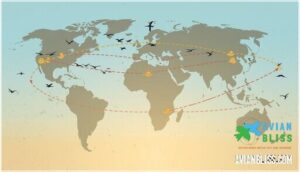
Bird migration isn’t a one-size-fits-all phenomenon, and different regions around the world host their own unique patterns shaped by geography, climate, and available resources. Whether you’re watching warblers pass through North America, tracking swallows across South America, or observing storks navigate African skies, each continent tells its own migration story.
Let’s break down how birds move across three major regions and what makes each pattern distinct.
North American Bird Migration
Across nearly 5,000 miles of terrain, North American bird migration connects Arctic breeding grounds with tropical wintering sites through four Continental Flyways. You’ll witness more than 450 species on the move, with over 4 billion birds crossing the continent annually. BirdCast radar tracking has recorded peak nights when 1.2 billion migrants filled the skies—three times the typical seasonal volume.
These routes face increasing Migration Challenges:
- Pacific Flyway – maintains over 1 billion waterfowl along western wetlands from Alaska to Chile
- Mississippi Flyway – hosts the densest traffic, with 400 million birds on peak fall nights
- Atlantic Flyway – channels 350+ species from Greenland down the eastern seaboard
- Central Flyway – funnels cranes and geese through the Great Plains
- Gulf Coast stopover zones – provide critical refueling before ocean crossings
Climate Impacts now shift arrival times by 1–2 weeks per decade, disrupting food synchronization. Conservation Efforts targeting North South American Flyways have stabilized some waterfowl populations, though 229 species still require urgent intervention.
South American Bird Migration
South American bird migration unfolds across intra-continental migration routes and Neotropical flyways linking continents. The Andean corridor guides migrants along mountainous spines, and northern Colombia acts as a refueling hub before Caribbean crossings. Equatorial stability in wind patterns creates steadier movement—17 nights versus North America’s eight.
Fork-tailed Flycatchers journey 4,100 km between southern breeding grounds and northern tropics, while Swainson’s Hawks cross from North America to Argentina.
Amazon deforestation threatens 230 species dependent on these migratory pathways for survival.
African Bird Migration Patterns
While South America’s flyways keep birds closer to home, Africa anchors the world’s busiest transcontinental migration corridors. The Africa-Eurasia flyway funnels billions of birds across the Mediterranean and Sahara crossing twice yearly, connecting breeding grounds in Europe and Asia with African wintering sites. You’ll find migration corridors threading through the Rift Valley, where raptors and storks ride thermal updrafts, while the East Atlantic Flyway guides waterfowl to West African wetlands like Banc d’Arguin.
- Sahara crossing tests endurance limits during April-May northbound and September-October return journeys
- Species routes vary dramatically—turtle doves fly directly south while rollers take southeastern paths to Southern Africa
- Climate impacts have reduced Lake Chad’s viability and threatened 87% of critical stopover sites
- Conservation efforts focus on protecting over 2,600 essential habitats spanning three continents
Habitat Specific Migration

Different bird species don’t just follow the same paths—they’ve adapted their journeys to match where they live and what they need to survive. Waterfowl, hummingbirds, and warblers each have their own unique migration strategies shaped by their habitats and food sources.
Let’s look at how these three groups navigate their seasonal travels.
Waterfowl Migration Habits
Waterfowl depend on wetlands like prairie potholes and coastal marshes throughout their journeys across major bird flyways. You’ll find them concentrated along four main flyway routes—Pacific, Mississippi, Central, and Atlantic—each shaped by geography and habitat availability.
Recent data shows climate impacts are shifting these migratory routes, with some dabbling ducks now wintering farther north than they did in the 1960s. Wetland dependence makes them vulnerable during drought years, when reduced pond levels force flocks into smaller areas.
Conservation efforts focus on protecting stopover sites, as distribution shifts continue to reshape traditional migration routes of birds across North America.
| Flyway | Key Species |
|---|---|
| Pacific | Mallards, widgeon, northern shovelers |
| Mississippi | Millions of ducks and geese seasonally |
| Central | Pintails, teal, white-fronted geese |
Hummingbird Migration Patterns
How do hummingbirds cross vast stretches of open water during migration? These tiny birds bulk up by 25–40% in fat reserves before attempting the 500-mile Gulf crossing, which demands 18–22 hours of nonstop flight.
Ruby-throated hummingbirds follow the Mississippi and Central flyway routes northward, while Rufous hummingbirds use the Pacific Americas Flyway in a clockwise circuit—traveling north along the coast in spring, then south through the Rockies in fall.
Migration speed averages 20–30 mph, covering up to 100 miles daily. Climate impacts are shifting route flexibility, with some populations now overwintering along the Gulf Coast instead of continuing south.
Warbler Migration Routes
Among North America’s most notable migrants, warblers navigate thousands of miles between breeding and wintering grounds using established flyways. You’ll find these songbirds following migratory routes that demand exceptional endurance and precision.
Consider these impressive facts about warbler migration:
- Transoceanic flights: Blackpoll Warblers cover up to 2,770 km non-stop over the Atlantic Ocean
- Stopover ecology: Critical rest sites along the eastern seaboard and South America provide essential refueling opportunities
- Climate impacts: Spring migration has progressed by one day per decade since 1965 for some species
- Habitat loss: Declining stopover points and wintering sites threaten population survival
These migratory pathways demonstrate notable route evolution, with some populations showing altered timing and bird migration routes in response to environmental changes.
Frequently Asked Questions (FAQs)
Where do some birds migrate to?
If you’re trying to understand bird migration, you’ll discover most species head to the tropics and subtropics of Central and South America, the Pacific Coast, or the Eastern Seaboard.
These wintering habitats and stopover locations along major bird flyways offer abundant food and temperate climates essential for survival.
Where do birds go in the winter in the USA?
You’ll find most wintering birds concentrated along four major flyways: Atlantic, Mississippi, Central, and Pacific. These routes funnel migrants to warmer southern states, the Gulf Coast, and regions with accessible food sources.
Though climate impacts have shifted wintering grounds northward by over 200 miles for many species in recent decades.
Do birds migrate from North America to South America?
Like rivers flowing south with the seasons, countless birds trace ancient migratory routes from North America to South America each year.
Over ten species, including Blackpoll Warblers and Arctic Terns, undertake these striking journeys along major flyways—the Pacific, Atlantic, Mississippi, and Central corridors—covering migration distances between 5,000 and 8,000 kilometers to escape harsh winters and find abundant food sources.
How do birds decide where to go?
Birds decide where to go using genetic predisposition and environmental cues like temperature shifts and day length, navigational tools including Earth’s magnetic field and celestial patterns, their physiological state, and social learning from experienced flocks along established flyways.
What triggers bird migration every year?
Lengthening daylight signals your body’s internal clock, stirring hormonal regulation that kickstarts migration. Photoperiod cues trigger changing day length awareness, while climatic triggers like dropping temperatures and dwindling food availability push you toward departure.
Genetic programming, hardwired over generations, combines with energy reserves you’ve stored, creating an irresistible urge to move. These environmental cues work together, orchestrating one of nature’s most noteworthy journeys.
How do birds navigate during migration?
During migration, you rely on a complex toolkit: magnetoreception through eye proteins detects Earth’s magnetic field, celestial cues like star patterns and sun position guide your path, olfactory navigation using windborne scents creates mental maps, and visual landmarks such as coastlines confirm your route—all integrated seamlessly.
Do all birds migrate in flocks always?
Picture the classic V formation etched across autumn skies—iconic, yet not universal. While around 84% of North American species favor flocking for energy conservation and predator avoidance during migration, others like hummingbirds, woodcocks, and certain raptors journey solo, trading social benefits for specialized navigation methods and hunting strategies that suit their ecological needs.
Can birds migrate alone at night safely?
Yes, you’ll find many birds migrate alone at night quite safely, relying on star patterns, Earth’s magnetic field, and cooler air currents for efficient navigation along established flyway routes.
However, light pollution and weather vulnerability can create nocturnal predation risks and navigational challenges.
Why do some birds migrate only locally?
Think of it like choosing a corner store over a cross-country road trip—why travel far when everything you need is close by? Some birds migrate only locally because adequate food and suitable breeding grounds remain within reach, eliminating the need for long-distance journeys.
Local migration drivers include microclimate advantages, resource availability, and reduced winter severity, making short-distance migration or altitudinal migration more efficient.
These partial migration strategies offer residency benefits, as birds avoid the high energetic costs and mortality risks of long-distance travel while still accessing temperate climates and seasonal resources that support survival and reproduction.
How do birds know when to start migrating?
Your internal clock reacts to changing day length, the primary signal that tells you when to go.
As photoperiod shifts, hormonal triggers like corticosterone and prolactin rise, driving metabolic preparation and fat storage—environmental cues and genetic rhythms working together to time your departure perfectly.
Conclusion
Could every bird species actually follow invisible highways written into their DNA? That’s exactly what happens when billions of migrants navigate where different birds migrate—from Arctic breeding grounds to Antarctic shores, they’re reading ancestral maps refined over millennia.
Your backyard visitor might winter in Costa Rica while your neighbor’s robin heads to Mexico, each following routes as distinct as their plumage.
These pathways connect ecosystems across hemispheres, proving that migration isn’t just movement—it’s the planet’s circulatory system in action.
- https://translatesciences.com/wp-content/uploads/2025/01/8_EastAsia_Australasia_NEW.pdf
- https://community.fabric.microsoft.com/t5/Contests-Gallery/May-2025-Habeeb-Bird-Global-Migration-Patterns/m-p/4702100
- https://news.cornell.edu/stories/2025/09/record-breaking-night-bird-migration-detected-radar
- https://www.nps.gov/articles/000/arctic-warblers.htm
- https://seabirdinstitute.audubon.org/news/research-reveals-incredible-migratory-journey-arctic-terns