This site is supported by our readers. We may earn a commission, at no cost to you, if you purchase through links.
 You’ll find grassland birds living across North America’s vast prairies, meadows, and open grasslands, stretching from southern Canada through the central United States into northern Mexico.
These specialized birds thrive in environments dominated by native grasses, where they hunt insects, build ground nests hidden among stems, and navigate expansive landscapes with few trees.
The Great Plains serves as their stronghold, though you’ll also spot them in prairie remnants scattered throughout agricultural regions.
From bobolinks in tallgrass prairies to burrowing owls in shortgrass plains, each species has carved out its niche in these rolling seas of grass.
Understanding their specific habitat needs reveals fascinating survival strategies.
Table Of Contents
- Key Takeaways
- Grassland Bird Habitats
- Where Grassland Birds Live
- Grassland Bird Distribution
- Threats to Grassland Habitats
- Conservation of Grassland Birds
- Frequently Asked Questions (FAQs)
- Do birds live in grasslands?
- What habitat do most birds live in?
- What do birds eat in the grasslands?
- What is the habitat of the grasslands?
- How do grassland birds find water sources?
- What nesting materials do grassland birds use?
- How high do grassland birds typically fly?
- When do grassland birds typically wake up?
- How do grassland birds communicate with mates?
- Conclusion
Key Takeaways
- You’ll discover grassland birds across a massive range spanning southern Canada through the central United States to northern Mexico, with the Great Plains serving as their primary stronghold where over 100 species thrive in diverse prairie habitats.
- You’ll find these specialized birds living in four main grassland types – tallgrass prairies with towering stems, mixed grasslands in intermediate zones, shortgrass plains in arid western regions, and montane meadows at high elevations.
- You’ll need to understand that grassland birds face critical threats from habitat loss (with fewer than 40% of original prairies remaining), agricultural conversion, invasive species, and climate change that’s disrupting their breeding cycles and food sources.
- You can help protect grassland bird populations by supporting habitat restoration efforts, participating in citizen science projects, and choosing bird-friendly agricultural products that preserve the rolling grassland homes these species desperately need.
Grassland Bird Habitats
You’ll find grassland birds thriving across North America’s vast prairies, from southern Canada through the central United States to northern Mexico.
These specialized birds have adapted to live in open landscapes that include tallgrass prairies, mixed grasslands, shortgrass plains, and montane meadows, where fire and grazing naturally maintain their preferred habitat conditions.
Types of Grasslands
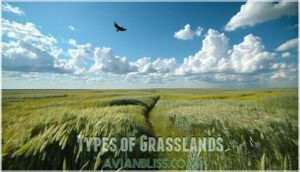
You’ll encounter four main grassland types where birds make their homes.
Tallgrass Prairies stretch across eastern plains with towering stems, while Mixed Grasslands blend medium-height species in intermediate zones.
Shortgrass Plains dominate arid western regions, and Montane Meadows thrive at high elevations.
These temperate grasslands create diverse prairie ecosystems, each supporting unique bird communities perfectly adapted to their specific habitat conditions.
These areas are critical for bird migration corridors.
Importance of Grassland Ecosystems
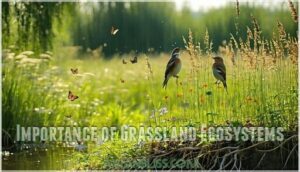
Over 320 million acres of grassland ecosystems provide essential services that support both wildlife and human communities.
Grasslands serve as nature’s powerhouse, supporting millions of acres that sustain both wildlife and communities.
These habitats excel at carbon sequestration, storing atmospheric carbon underground through deep root systems.
Grasslands also perform water filtration, cleaning runoff before it reaches streams, and soil stabilization that prevents erosion.
They offer pollinator support for bees and butterflies, while serving as critical bird migration corridors across continents.
Role of Fire and Grazing

Fire and grazing work together as nature’s maintenance crew for grassland bird habitat.
Without these natural processes, woody plants invade and transform grasslands into forests.
Fire regimes clear accumulated plant material, while grazing intensity creates the patchy landscape that birds need.
Management practices using controlled burns and rotational grazing boost habitat diversity and ecosystem resilience, giving grassland birds the varied environments they crave.
Where Grassland Birds Live
You’ll find grassland birds living in some of North America’s most expansive open spaces, where their habitat preferences shape everything from where they build their nests to how they hunt for food.
These prairie bird locations span across southern Canada, the central United States, and northern Mexico, creating a massive corridor of interconnected grassland bird habitat.
When it comes to nesting sites, different species have developed unique strategies. Burrowing owls make their homes underground in abandoned burrows, while Western meadowlarks build ground nests near shrubs. Short-eared owls prefer dense vegetation that offers camouflage, and Northern bobwhites form monogamous pairs that stick together through most of the year.
Microhabitats within grasslands provide specialized niches. Savanna bird range includes everything from wet sedge meadows to dry shortgrass plains, each supporting different species based on food availability and territory size requirements. Open field birds like ferruginous hawks need large hunting territories across plains and shrublands, while grasshopper sparrows thrive in smaller patches where insects are abundant.
Protecting these areas involves restoring degraded habitats to bolster bird populations.
Grassland Bird Distribution
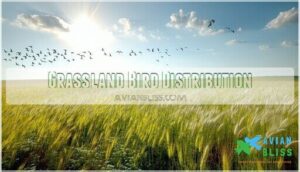
You’ll find grassland birds distributed across a massive area spanning southern Canada, the central United States, and northern Mexico, with their core range covering over 320 million acres of diverse prairie habitats.
These birds don’t just stick to one type of grassland though, as they’ve adapted to live in everything from towering tallgrass prairies in the east to short, scrubby plains in the arid west, showcasing their ability to thrive in various diverse prairie habitats.
Core Distribution Areas
Across continents, grassland birds establish population strongholds in specific core areas where habitat connectivity remains intact.
The Northern Great Plains serve as North America’s primary breeding ground, supporting 36 native species through tallgrass, mixed-grass, and shortgrass prairie bird locations.
Meanwhile, South America’s Cerrado and Africa’s savannas create regional endemism hotspots.
Climate impacts threaten species overlap zones, making these open field birds increasingly dependent on remaining grassland bird habitats.
These areas are crucial for the survival of the species, and preserving them is essential to maintain biodiversity.
Regional Variations
You’ll discover grassland bird habitats vary dramatically across North America’s diverse regions.
The Great Plains supports Mixed Grasslands, while eastern areas feature Tallgrass Prairies with towering stems.
Western regions showcase Shortgrass Plains adapted to arid conditions, and mountainous areas contain Montane Meadows at high elevations.
Each grassland habitat type supports different bird species based on vegetation height, climate, and available resources throughout the Americas Heartland.
These birds have suffered from significant population declines since 1970, which is a critical issue in the Americas Heartland.
Migration Patterns
Beyond regional differences, grassland bird migration patterns reveal nature’s remarkable clockwork.
Over 75% of North American grassland birds undertake journeys exceeding 2,500 kilometers, following major flyways like the Central and Mississippi corridors.
Migration triggers include photoperiod changes and temperature drops, while stopover ecology depends on remnant prairie patches.
Climate impacts have advanced spring departures by ten days since 1980, and flyway connectivity determines survival rates, making migratory adaptations essential for species persistence.
Threats to Grassland Habitats
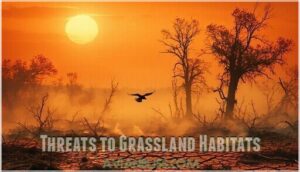
You’ll discover that grassland habitats face serious threats that put bird populations at risk across North America.
North America’s grassland birds are losing their homes fast, with fewer than 40% of original prairies still standing.
These challenges include habitat loss from farming, invasive species, climate change, and urban development that fragments the landscapes these birds need to survive, particularly due to climate change.
Habitat Loss and Fragmentation
Agricultural conversion stands as the primary culprit behind habitat loss, transforming vast grassland expanses into cropland at alarming rates.
You’ll find that fewer than 40% of North America’s original 550 million grassland acres remain intact, with tallgrass prairies suffering an 89% reduction.
Fragmentation effects create isolated patches that can’t support healthy bird populations, breaking up the continuous landscapes these species desperately need for survival.
Invasive Species and Climate Change
Invasive species spread and climate change impacts create a double threat that’s crushing grassland bird populations.
When smooth brome and Kentucky bluegrass take over native plants, they reduce nesting success by up to 40%, while warming temperatures throw off breeding schedules.
Pesticide use further endangers bird populations.
- Invasive Species Spread: Dense invasive growth reduces habitat diversity, making grasslands unsuitable for specialized birds
- Climate Change Impacts: Temperature shifts cause mismatches between breeding seasons and peak food availability
- Habitat Degradation: Combined stressors accelerate population decline, with some areas showing 50% larger decreases during droughts
- Future Projections: Conservation strategies must address both threats simultaneously to prevent local extinctions in vulnerable populations
Agricultural Expansion and Urbanization
Farmers’ plows turn prairie into corn rows, eliminating grassland bird habitats through habitat conversion.
Agricultural intensification brings pesticide impact, poisoning insects that birds depend on for food.
Meanwhile, cities spread outward, creating urban fragmentation that breaks apart remaining grasslands.
Development pressure transforms open spaces into shopping centers and subdivisions, forcing land conversion that leaves birds nowhere to nest or feed.
Conservation of Grassland Birds
You can help protect grassland birds through proven conservation efforts that are already showing success across North America.
These collaborative programs combine habitat restoration, smart land management, and species-specific initiatives to reverse decades of population decline.
Collaborative Conservation Efforts
Through collaborative partnerships, you can join a growing network of conservationists working to protect grassland bird habitats.
These conservation efforts bring together diverse groups to tackle the challenges facing our feathered friends.
Key collaborative partnerships include:
- Private land managers working with government agencies on Ranch Certification programs
- Indigenous Nations sharing traditional knowledge for effective grassland restoration
- Conservation partnerships between NGOs and ranchers across multiple states
- Incentive Programs that reward landowners for bird-friendly practices
- Scientists and practitioners collaborating to fill critical research gaps.
These grassland bird conservation initiatives prove that teamwork makes the dream work, creating lasting change across millions of acres.
Habitat Restoration and Management
Successful grassland restoration requires strategic land management that mimics natural processes.
You’ll need to implement rotational burning, manage grazing patterns, and control invasive species through targeted removal programs. Native seeding helps establish diverse plant communities, while restoration monitoring tracks progress over time.
Many projects require specialized seed mixes for best results.
| Management Practice | Implementation | Bird Benefits |
|---|---|---|
| Grazing Management | Rotational systems, deferred timing | Creates habitat diversity, maintains grass height variation |
| Fire Regimes | Prescribed burns every 3-5 years | Removes woody encroachment, stimulates native growth |
| Invasive Control | Mechanical removal, herbicide treatment | Restores native plant communities for nesting |
| Native Seeding | Local ecotype seeds, proper timing | Provides food sources, nesting materials |
| Restoration Monitoring | Annual bird surveys, vegetation assessment | Tracks species recovery, guides adaptive management |
Species-Specific Conservation Initiatives
Targeted species conservation programs focus on specific grassland birds facing critical population declines.
Burrowing Owl Recovery efforts concentrate on habitat restoration in western states, while Meadowlark Habitat initiatives protect nesting areas through rotational grazing.
Bobwhite Partnerships with farmers increase native bunchgrass plantings, and Sparrow Conservation projects monitor breeding success through citizen science networks, creating customized solutions for each species’ unique needs.
These efforts are essential, as agricultural expansion threatens remaining habitats.
Frequently Asked Questions (FAQs)
Do birds live in grasslands?
Yes, you’ll find many birds thriving in grasslands! These open habitats support over 100 species across North America, from burrowing owls to western meadowlarks, each adapted to grassland life.
What habitat do most birds live in?
You’ll find feathered creatures calling every corner of Earth home, from towering forests and wetlands to deserts, mountains, and urban areas.
Different species thrive in specific environments based on their unique adaptations and needs.
What do birds eat in the grasslands?
You’ll find grassland birds eating insects, spiders, seeds, berries, and small mammals.
Western meadowlarks hunt bugs, while grasshopper sparrows control insect populations.
Bustards consume everything from leaves to small vertebrates.
What is the habitat of the grasslands?
Grasslands feature diverse ecosystems including tallgrass prairies with towering stems, mixed grasslands in intermediate zones, shortgrass plains in arid regions, and montane meadows at high elevations across North America’s plains.
How do grassland birds find water sources?
You’ll find water by following bird flight patterns to streams, ponds, and wetlands. Bustards gather around water sources seasonally, while other species travel daily between nesting sites and reliable water.
What nesting materials do grassland birds use?
You’ll discover these resourceful architects transform the prairie into their personal home depot, weaving together dried grasses, plant fibers, feathers, and small twigs to craft cozy ground nests perfectly camouflaged.
How high do grassland birds typically fly?
You’ll spot grassland birds flying low, typically staying within 10-30 feet of the ground while hunting, migrating, or displaying their territorial behaviors across open prairie landscapes.
When do grassland birds typically wake up?
You’ll notice grassland birds wake up around dawn, typically 30-60 minutes before sunrise. They’re early risers, catching insects when they’re most sluggish and temperatures are cooler for hunting.
How do grassland birds communicate with mates?
Prairie chickens produce sound with specialized air sacs, creating booms you’ll hear two miles away.
You’ll find grassland birds using visual displays, distinctive calls, and elaborate courtship dances to attract mates and defend territories effectively.
Conclusion
Understanding where do grassland birds live becomes essential as these specialized species face mounting pressures from habitat loss, climate change, and agricultural expansion.
You’ll find success in supporting grassland bird conservation by participating in citizen science projects, advocating for native prairie restoration, and choosing bird-friendly agricultural products.
These magnificent creatures, from meadowlarks to bobolinks, depend on your awareness and action to preserve their rolling grassland homes for future generations, which is crucial for their survival and conservation.
- https://pubmed.ncbi.nlm.nih.gov/37424364/
- https://ace-eco.org/vol20/iss1/art23/
- https://www.kacd.net/userfiles/File/Grassland-birds.pdf
- https://www.washcoll.edu/learn-by-doing/rafc/crffrs/natural-lands-project/grassland-birds.php
- https://digitalcommons.unl.edu/context/usgsnpwrc/article/1029/viewcontent/Igl_AUK_2001_Area_requirements.pdf