This site is supported by our readers. We may earn a commission, at no cost to you, if you purchase through links.
You step outside at 2 a.m. for some quiet, and instead you’re greeted by a full bird chorus, as if dawn arrived six hours early. It’s disorienting, maybe even a little unsettling, especially when you know most birds should be asleep.
But nighttime chirping isn’t random noise or a sign something’s gone wrong in nature. Birds chirp at night for the same core reasons they do during the day—claiming territory, attracting mates, and responding to their environment—but the triggers and species involved shift once the sun goes down.
Light pollution, hormonal cycles, and even urban noise can turn nocturnal hours into prime singing time for certain species. Understanding what drives these after-dark concerts helps you make sense of the symphony outside your window and, if you’re a bird owner, recognize when nighttime vocalizations signal something worth addressing.
Table Of Contents
- Key Takeaways
- Why Do Birds Chirp at Night?
- Which Bird Species Sing After Dark?
- How Mating and Territory Influence Night Chirping
- Does Light Pollution Affect Nighttime Chirping?
- Can Health or Stress Cause Birds to Chirp at Night?
- How to Manage and Reduce Night Chirping
- Frequently Asked Questions (FAQs)
- What does it mean when you hear birds chirping at night?
- What kind of bird chirps all night?
- Why are there birds singing at 2am?
- Is it normal for birds to be active at night?
- Are Nuttall’s woodpeckers rare?
- What are the best places to spot Nuttall’s woodpeckers?
- Can I attract Nuttall’s woodpeckers to my yard?
- What is the difference between a downy woodpecker and a Nuttall’s woodpecker?
- Where are Nuttall’s woodpeckers found?
- What is the difference between a nuttall’s woodpecker and a downy woodpecker?
- Conclusion
Key Takeaways
- Birds chirp at night primarily to claim territory, attract mates, or respond to environmental triggers like light pollution, which disrupts their circadian rhythms and tricks them into thinking it’s daytime.
- Common nighttime singers include Northern Mockingbirds, Common Nightingales, and European Robins, while some daytime birds like American Robins extend their singing into nocturnal hours during breeding season or migration.
- Artificial lighting in urban areas causes birds to sing earlier and more frequently at night, with short-wavelength blue and white LEDs having the strongest impact on their sleep cycles and vocal behavior.
- For pet birds, nighttime chirping can signal health problems, anxiety, or poor sleep conditions, so you’ll want to provide 10-12 hours of darkness, minimize noise disturbances, and watch for signs like labored breathing or lethargy that require veterinary care.
Why Do Birds Chirp at Night?
When the sun goes down and you hear birds singing outside your window, you’re not imagining things.
Many evening songsters are actually more active at dusk, and why birds sing different songs often depends on temperature, light levels, and seasonal weather patterns.
Birds chirp at night for several clear-cut reasons, and understanding these patterns can help you make sense of what’s happening in your backyard.
Let’s look at the main triggers that get birds vocalizing after dark.
Nighttime Communication and Mating
When you hear nighttime serenades, you’re often catching male birds at their most determined—showcasing vocal territoriality and nocturnal courtship in full swing. These mating songs carry farther after dark, when calm air and fewer competing sounds let complex pitches travel clearly.
Male birds often sing at night to claim territory and attract mates, their songs traveling farther in calm, quiet air
Many nocturnal birds use this quiet window to advertise mate quality, blending bird communication and mating rituals that evolved to amplify attention during breeding season. Some species have even evolved adaptive sleep loss for mating, allowing them to stay active and vocal throughout the night.
Territorial Calls and Warnings
Beyond courtship, male birds defend their territory all night long, broadcasting warning calls that announce ownership and deter rivals. Territorial calls project hundreds of meters, using low-frequency notes that slice through darkness and define territorial boundaries.
When intruders appear, you’ll hear harsh, rapid defensive strategies—vocal territoriality at its sharpest. These warning signals remind neighbors that this patch is claimed and worth fighting for.
Recent research highlights the survival value of warning calls in group-living birds.
Environmental and Biological Triggers
While territorial calls explain some night singing, environmental influences and hormonal cycles also drive nocturnal bird vocalizations. Light pollution disrupts circadian rhythms, fooling birds into thinking it’s daytime, and moonlit nights boost singing when rivals become more visible. Breeding season hormones keep males vocal after dark, and nighttime foraging near insect-rich zones triggers social calls—acoustic ecology shaped by nocturnal adaptation and bird migration timing.
- Artificial lighting extends perceived daylight, prompting post-sunset songs in urban areas
- Temperature drops shift insect activity, increasing nightly choruses in some habitats
- Hormonal surges during breeding prolong courtship songs into nighttime hours
Which Bird Species Sing After Dark?
You might be surprised by which birds break the silence after sunset, and some of them aren’t even nocturnal by nature. From true night owls to daytime singers who’ve adapted to moonlit hours, the lineup includes familiar backyard visitors and a few unexpected performers.
Let’s look at the species most likely to serenade you while the rest of the world sleeps.
Common Nocturnal Singers
If you’re curious about nocturnal bird songs, the Northern Mockingbird tops the list—it can mimic car alarms and other urban singers well into the night.
The Common Nightingale produces elaborate nocturnal bird vocalizations with richer phrases after dusk, while European Robins use nighttime chirping near streetlights. These nighttime vocalizers showcase extraordinary nocturnal singing that’s adapted to birds chirping at night.
Beyond their melodious songs, nightingales and robins can also emit sharp alarm calls to warn other birds of nearby predators.
Diurnal Birds Active at Night
You might notice American Robins and Red-winged Blackbirds delivering dawn blasts well before sunrise, especially during breeding season. These diurnal birds often extend dusk singing into moonlit hours when migration overlaps with their nesting range.
Crepuscular behavior lets them exploit quieter air for territorial calls, and some species use nocturnal adaptations like low-frequency notes that carry farther than daytime songs.
Unique Nighttime Vocalizations
When you hear nocturnal vocalizations after dark, you’re catching birds using acoustic adaptations that set nighttime frequency apart from daytime sounds. Some species broaden their syllable types and insert extra notes, layering calls with overlapping frequencies to create sonic territoriality.
These unique nighttime vocalizations often feature greater tonal purity, letting nocturnal singing travel farther through still air while birds chirping at night incorporate mimicry or environmental cues.
How Mating and Territory Influence Night Chirping
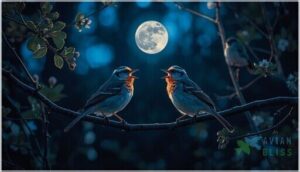
When you hear birds chirping after dark, there’s a good chance they’re either looking for love or defense. Male birds use nighttime songs to attract mates and warn rivals to back off, especially during breeding season.
The timing and intensity of these calls shift throughout the year, depending on when birds are most focused on reproduction and territory.
Male Birds’ Breeding Songs
When breeding season kicks in, male birds pull out all the stops with their most elaborate songs to win over females. These nocturnal singing sessions showcase vocal learning and song complexity that signal a male’s fitness.
You’ll notice three key strategies:
- Longer songs with varied syllable types
- Faster trill rates during peak mating season
- Complex phrases that demonstrate cognitive ability
This mate attraction strategy works because females can judge quality through birdsong alone.
Territorial Defense at Night
Once darkness falls, territorial defense kicks into high gear with strategic border calls and nocturnal vigilance. You’ll hear owls use high-pitched notes to mark defended perches, while ruffed grouse drum with tail feathers to advertise ownership. These night patrols rely on defensive strategies like rapid, sharp chirps when intruders cross established lines—a clear display of avian territorial behavior that warns rivals to back off.
| Species | Territorial Signal | Defense Purpose |
|---|---|---|
| Owls | High-pitched calls | Mark defended perches |
| Ruffed Grouse | Tail feather drumming | Advertise territory ownership |
| Clark’s Nutcrackers | Repetitive notes near roosts | Reinforce foraging zone boundaries |
| Night Sentries | Rapid, sharp chirps | Alert to border intrusions |
Seasonal Patterns in Nighttime Singing
You’ll notice seasonal shifts dramatically reshape nocturnal singing as breeding cycles unfold. Night song peaks align with egg laying and nest building phases, then taper off during incubation.
Nocturnal rhythms intensify in spring when longer nights and warmer temperatures trigger earlier vocalization patterns. By late summer, shorter days push nocturnal bird vocalizations toward dusk, revealing how seasonal bird activity and migration patterns govern reasons for nighttime chirping year-round.
Does Light Pollution Affect Nighttime Chirping?
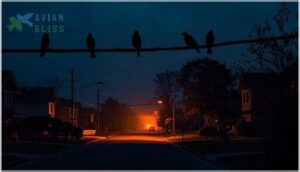
Artificial light can throw birds completely off their natural rhythm, tricking them into thinking it’s still daytime when they should be settling down for the night.
Streetlights, porch lights, and even the glow from your windows can confuse both nocturnal and diurnal species, leading to more chirping after dark. Let’s look at how light pollution impacts bird behavior and what you can do to help restore their nighttime peace.
Impact of Artificial Lighting
Artificial light pollution turns night into an endless twilight, and birds respond by treating it like daytime. When streetlights, window glow, or bright business signs flood their roost sites, they often start singing hours earlier or chirp right through the dark.
Here’s how artificial illumination disrupts their natural rhythms:
- Short wavelength light (blue and white LEDs) has stronger biological effects than warm amber tones, triggering earlier vocal activity
- High intensity lighting suppresses melatonin production in birds, altering their sleep and circadian cycles
- Skyglow from widespread urban lighting reduces natural darkness cues, extending perceived daylight
- Proximity to streetlights correlates with earlier onset of nighttime singing in some species
- Chronic light exposure raises stress hormones, affecting overall health and reproductive timing
You’ll notice the ecological consequences most clearly in cities, where migratory species become disoriented by illuminated structures and resident birds adjust their daily activity windows. The impact of light pollution on birds extends beyond just nocturnal disruption—it affects feeding opportunities, mate choice signals, and collision risks. Dimmer, warmer lighting with downward-facing fixtures can reduce these light pollution effects substantially.
Urban Versus Rural Bird Behavior
City birds and rural birds live in completely different acoustic worlds, and that changes everything about nocturnal bird behavior.
Urban habitat forces birds to adjust their timing—they often start singing earlier, sometimes hours before dawn, because light pollution tricks their circadian clocks.
Rural landscapes let birds stick closer to natural rhythms, with darker skies preserving traditional dawn choruses and territorial warning calls tied to actual sunrise.
Ways to Reduce Light-Induced Chirping
You can break the cycle of light-induced nocturnal singing by rethinking how artificial light pollution reaches bird habitats.
Dark skies initiatives and bird-friendly urban planning reduce nocturnal bird vocalizations dramatically, and simple changes work fast:
- Install downward-facing fixtures with warm 2700K bulbs to minimize sky glow
- Use timers that shut off outdoor lights by 10 PM
- Plant dense buffer zones or hang outdoor screens to absorb stray light near roosting sites
Can Health or Stress Cause Birds to Chirp at Night?
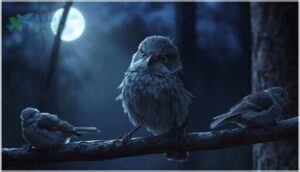
Sometimes a bird’s nighttime chirping isn’t about mating or territory at all, it’s a red flag that something’s wrong with their health or mental state.
Just like you might toss and turn when you’re anxious or in pain, birds can lose their normal sleep rhythm when they’re stressed, sick, or injured.
Recognizing these distress signals can help you figure out whether your feathered friend needs extra care, a calmer environment, or a trip to the vet.
Signs of Discomfort or Illness
When discomfort strikes, your bird’s nighttime chirping often reveals what daylight hides. Breathing issues like wheezing or rapid respiration signal respiratory distress, while feather loss and flaky skin problems point to infection or parasites. Behavioral changes—lethargy, hiding, or aggression—can mean pain is keeping them awake.
Regular health checks help you catch these red flags early, ensuring nocturnal singing stays natural, not a cry for help.
| Physical Signs | What They Mean |
|---|---|
| Labored breathing, clicking sounds | Airway obstruction or infection |
| Dull feathers, bald patches | Systemic illness or parasites |
| Isolation, reduced activity | Pain or fear response |
Anxiety and Sleep Disruption in Birds
Stress and bird anxiety don’t vanish when the sun sets—they actually worsen overnight, triggering fragmented sleep patterns and frequent wake-ups.
Your bird’s nocturnal stress can spike from sudden noises, increasing wakefulness by up to 40 percent and shortening restorative sleep. These nighttime habits turn into avian insomnia, where vocalization triggers reveal deeper discomfort that even nocturnal birds rarely experience naturally.
When to Seek Veterinary Advice
Sometimes unusual nocturnal vocalizations signal that your bird emergency requires immediate vet care, not just behavioral adjustments.
Avian health experts identify these medical signs demanding urgent attention:
- Labored breathing or wheezing lasting over a minute
- Refusing food for 24 hours straight
- Blood in droppings or repeated vomiting
- Sudden lethargy, collapse, or trauma like active bleeding
Bird communication changes dramatically when discomfort strikes—don’t dismiss nighttime distress as simple nocturnal animal behavior.
How to Manage and Reduce Night Chirping
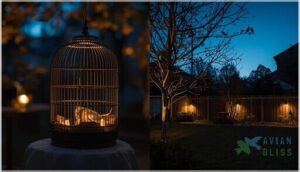
If you’re dealing with a pet bird that won’t settle down at night, you can make some simple changes to help restore peace and quiet.
Wild birds are harder to control, but you can still reduce disturbances by adjusting outdoor lighting around your property.
Here are a few practical steps that work for both captive and free-ranging birds.
Creating a Calm Nighttime Environment
You can tackle night chirping by setting up a predictable sleep routine that gives your bird 10–12 hours of darkness, which balances hormones and quiets stress-related calls.
A breathable cage cover blocks visual noise disturbances and aids bird relaxation during quiet hours. Adding steady background sound, like a fan, masks sudden bumps that trigger nocturnal bird differences in vocal behavior, creating a calm environment that respects natural bird communication rhythms.
Adjusting Lighting and Cage Placement
Light placement directly inside or above the cage ensures 5,000–10,000 lux at perch level, which stabilizes circadian rhythms and minimizes artificial light confusion that fuels nocturnal bird vocalizations and night chirping.
To control light pollution and support visual comfort, you can:
- Position the cage away from streetlights and windows
- Use dimmable fixtures for gradual dawn-dusk transitions
- Install timers for consistent daily cycles
- Shield outdoor glare with neutral curtains
- Switch to dim red lights at night
These cage positioning and dimming options reduce noise reduction stress triggers.
Supporting Bird Health and Wellbeing
Balanced nutrition, vet checkups, and a quiet sleep environment form the foundation of bird health that minimizes stress-driven nighttime vocalizations. Daily exercise and foraging enrichment support natural behaviors, while reducing artificial light pollution and habitat disruption helps both captive and wild birds.
These wildlife conservation practices address environmental impact on wildlife, creating conditions where birds rest peacefully.
| Health Priority | Action |
|---|---|
| Nutrition | Offer pellets, fresh vegetables, calcium sources |
| Veterinary Care | Schedule annual exams and weight monitoring |
| Sleep Routine | Provide 10–12 hours of darkness nightly |
| Exercise | Allow supervised flight or climbing sessions |
| Stress Reduction | Maintain consistent routines and clean housing |
Frequently Asked Questions (FAQs)
What does it mean when you hear birds chirping at night?
When night falls, hearing chirping is like receiving a coded message about mating, territory, or migration.
Nocturnal bird calls signal communication during breeding season, while some diurnal species simply extend their avian sleep patterns.
What kind of bird chirps all night?
Northern Mockingbirds, night singers, and European Robins are the most persistent night singers, delivering complex songs for hours during breeding season, while owls and thrushes add melodic calls that carry through calm, quiet evenings.
Why are there birds singing at 2am?
When darkness should bring silence, artificial lighting tricks birds into thinking dawn has arrived, disrupting their sleep patterns and triggering territorial songs—urban species especially extend nocturnal bird vocalizations under streetlights.
Is it normal for birds to be active at night?
Yes, it’s normal for many species.
Some birds are nocturnal by nature, while others become active during migration or breeding season, relying on outstanding hearing and night vision to navigate darkness.
Are Nuttall’s woodpeckers rare?
You’ll find Nuttall’s woodpeckers fairly common within their California oak woodlands, with over 100,000 individuals and stable population trends.
Though habitat loss in some areas can affect local conservation status and woodpecker behavior patterns.
What are the best places to spot Nuttall’s woodpeckers?
You’ll spot Nuttall’s Woodpeckers most often in oak woodlands across northern California, riparian habitats along streams, foothill regions with mixed vegetation, canyon interfaces where oaks meet chaparral, and urban parks featuring mature oak trees.
Can I attract Nuttall’s woodpeckers to my yard?
You’ll absolutely want to roll out the red carpet with suet feeders near mature oaks, since these woodpeckers can’t resist high-fat treats and natural foraging spots that mimic their favorite habitat.
What is the difference between a downy woodpecker and a Nuttall’s woodpecker?
You can distinguish these species by their plumage patterns: Downy woodpeckers show a clean white back, while Nuttall’s woodpeckers display bold black and white barring across their wings and back for easier species identification.
Where are Nuttall’s woodpeckers found?
You’ll encounter Nuttall’s Woodpeckers in oak woodlands from northern California down to northwestern Baja California, Mexico. They stick to elevations between sea level and roughly 5,500 feet year-round.
What is the difference between a nuttall’s woodpecker and a downy woodpecker?
You can tell them apart by checking back patterns—Nuttall’s shows bold black-and-white barring across its back, while Downy displays a mostly plain white back, plus Nuttall’s bill length appears noticeably longer.
Conclusion
Like Sherlock Holmes piecing together clues in the dark, you now know why birds are chirping at night—whether it’s streetlights mimicking dawn, territorial squabbles, or breeding season’s relentless energy. Wild birds follow rhythms shaped by light and instinct, while your pet’s midnight serenade might signal stress or poor sleep conditions.
Armed with this understanding, you can distinguish natural behavior from problems worth solving, turning that 2 a.m. chorus from mystery into manageable reality.
- https://www.bing.com/ck/a?!&&p=27403b44f4af589f3362e9b75735098f207555b6acd904295f889fe6363c10e7JmltdHM9MTc1NjY4NDgwMA&ptn=3&ver=2&hsh=4&fclid=1929bbe3-d37a-6178-26e5-adf9d22060e5&psq=When+To+Consult+A+Vet+If+your+bird+is+chirping+at+night%2c+it+might+be+trying+to+tell+you+something.+Sometimes%2c+this+behavior+is+normal.+Other+times%2c+it+could+mean+your+bird+is+unwell+or+stressed.+Knowing+when+to+see+a+vet+can+help+keep+your+bird+healthy+and+happy.+Watch+for+signs+that+need+professional+help.&u=a1aHR0cHM6Ly9iaXJkc2ludGhldHJlZS5jb20vd2h5LWRvZXMtbXktYmlyZC1jaGlycC1hdC1uaWdodC8
- https://windycityparrot.com/the-complete-guide-to-understanding-sleeping-birds/
- https://birdsupplies.com/blogs/news/5-ways-to-help-your-bird-feel-safe-during-fireworks
- https://www.meditationsoundspodcast.com/8-hours-of-incredibly-calming-sound-of-rain-and-birds-chirping-in-the-forest/
- https://flypaper.soundfly.com/discover/how-nature-sounds-calm-the-mind-and-its-role-in-music/