This site is supported by our readers. We may earn a commission, at no cost to you, if you purchase through links.

Watch a bird work through a birdbath sometime—the splash, the pause, the shake, then another round of splashing—and you’ll notice it looks less like play and more like a deliberate routine. That’s because it is.
Birds splash and bathe in birdbaths for reasons that go well beyond a quick rinse, touching on temperature control, parasite removal, and feather health all at once.
A clean, well-maintained feather coat isn’t just about looking good; it affects how well a bird flies, stays warm, and survives.
Understanding what drives this behavior helps explain why the right birdbath setup can turn your yard into a reliable stop for dozens of species year‑round.
Table Of Contents
- Key Takeaways
- Why Birds Use Birdbaths
- Birds Splash to Clean and Cool
- How Bathing Supports Healthy Feathers
- When Birds Bathe Most Often
- What Makes a Birdbath More Appealing
- Frequently Asked Questions (FAQs)
- Should birds be deprived of a bath?
- How to maintain a bird bath in winter?
- Do birds bathe?
- Do Misters make a good bird bath?
- Why do birds splash around in bird baths?
- Do different bird species bathe in groups?
- Can birdbath design affect local bird diversity?
- How does bathing influence a birds social status?
- Do birds bathe differently after long flights?
- How does rainfall affect birdbath usage patterns?
- Conclusion
Key Takeaways
- Birds don’t splash just to get clean — every flap and shake serves a real purpose, from knocking parasites loose to cooling down through evaporation, since they can’t sweat.
- After a bath, the real work begins: wet feathers soften so a bird can realign each tiny barbule and spread fresh preen oil, which keeps plumage waterproof, flexible, and flight-ready.
- A birdbath works best when it’s set up thoughtfully — two to three inches deep, near shrubs for quick escape, with fresh water twice daily, and a heated option in winter.
- Birds time their baths around survival needs, bathing most at dawn and dusk, ramping up visits during heat waves, and adjusting through seasons based on temperature, daylight, and species habit.
Why Birds Use Birdbaths
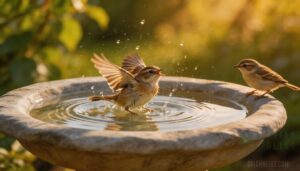
When you watch a bird at your birdbath, you’re seeing more than just a quick splash—it’s purposeful behavior tied to survival.
Every splash and preening ritual follows instinct—much like the fascinating routines of backyard birds of Ohio, whose habits reveal just how deliberate bird behavior really is.
Birds use water for drinking, cooling down, and keeping their feathers in working order. Here’s a closer look at the key reasons birds are drawn to birdbaths in the first place.
Bathing Versus Drinking Behavior
When you watch a bird at a bird bath, you might notice it doesn’t just drink — it does both, often in the same visit. This sip-bath sequence is natural and purposeful. Birds balance water intake with feather cleaning, sometimes alternating between splashing and sipping to manage bird hydration and grooming at once.
- Bathing often comes before drinking, rinsing debris away first
- Mineral sensing through damp feathers may support grooming instincts
- Hydration prioritization shifts depending on heat and activity level
- The bathing-drinking tradeoff reflects smart water source availability use
Why Shallow Water Feels Safer
Shallow water isn’t just a preference — it’s a survival strategy. Low submersion means stable footing and quick observation of the surroundings, so a bird can spot a threat and make an immediate escape without hesitation.
Limited exposure at the right bird bath depth keeps their wings free and their body ready. That’s why bird bath placement and water depth matter more than you’d think.
Splashing as Part of Natural Grooming
Splashing isn’t random — it’s grooming in action. When a bird hits the water, that vigorous bird, splashing, triggers wing muscle activation, pushing water deep into the plumage.
This sensory stimulation helps loosen dirt, dislodge early parasite detection targets like mites, and prep feathers for preening.
It’s nature’s version of a good scrub, and feather maintenance depends on every wet, chaotic moment of it.
How Birds Assess Risk Before Bathing
Before a bird ever touches the water, it’s already running a quiet safety check. You’ll notice it pause nearby — scanning for predators, reading wind-driven water motion, and listening for conspecific alarm cues from neighbors.
Before touching the water, a bird runs a quiet safety check — scanning, listening, and reading every signal around it
Escape route proximity matters too; birds strongly prefer baths tucked near shrubs.
Notably, regular human disturbance tolerance builds over time, so familiar yards get visited faster and more often.
They also provide an essential water source that promotes metabolic health.
Birds Splash to Clean and Cool
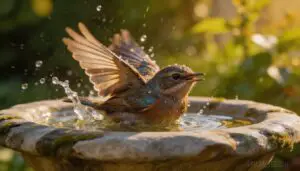
When bird splashes around in a birdbath, it’s doing a lot more than just playing in the water. That brief flurry of wings and droplets actually provides several real, practical purposes that keep a bird healthy and flying strong.
Here’s a closer look at what’s really going on each time a bird hits the water.
Removing Dirt, Dust, and Debris
Every time a bird splashes in a birdbath, something surprisingly thorough is happening beneath those flying droplets. That vigorous motion drives the Debris Flushing Mechanism — water impact loosens fine dust, pollen, and grit from deep within the plumage cleaning layers.
Choosing the right basin shape and depth can make this whole process even more effective, so it’s worth exploring which birdbath designs birds actually prefer before you set one up.
The Feather Microstructure Cleaning that follows during preening only works well when bathing first lifts that surface grime free.
- Dust Particle Dislodgment happens as wing motion sweeps particles toward the water surface
- Surface Grit Elimination protects delicate barbules from slow abrasive wear
- Pollen Removal Process reduces skin irritation and prevents buildup on facial feathers
- Water bathing and avian grooming work together, making each preening session far more effective
Loosening Excess Oil and Skin Flakes
Bathing does more than rinse surface dirt — it also breaks down excess oil and loosens dry skin flakes clinging to feather shafts.
Water bathing lowers surface tension, a process called Surface Tension Modulation, which triggers Oil Film Disruption and begins Emulsifying Lipids so preen oil spreads evenly during preening.
Water Temperature Optimization matters too, since warmer water loosens buildup more effectively without harming skin.
| What Bathing Loosens | Why It Matters |
|---|---|
| Excess oil buildup | Prevents sticky, clumped feathers |
| Dry skin flakes | Facilitates Skin Flake Lifting for cleaner barbules |
| Old preen oil | Refreshes feather cleaning coverage |
| Surface debris film | Restores smooth oil redistribution |
Dislodging Mites, Lice, and Other Parasites
Water bathing does something clever against avian parasites — it works through shearing forces that knock mites and lice loose from feather shafts.
Quick neck flicks spread turbulent water into hard-to-reach spots, triggering parasite migration toward the surface where preening can finish the job.
Feather crest cleaning improves noticeably after a good splash, and regular water bathing outperforms dust bathing alone for consistent parasite control.
Cooling The Body Through Evaporation
Since birds don’t sweat, evaporative heat loss is how they beat the heat. Here’s how thermoregulation through bathing actually works:
- A feather water film conducts heat away from the skin instantly.
- Wing fluffing cooling fans air through damp plumage.
- Microcurrent water spread ensures even coverage for uniform body cooling.
- Ambient wind enhancement carries vapor away, accelerating heat dissipation.
- Thermoregulation via evaporative cooling drops core temperature within minutes.
Why Splashing Wets More of The Plumage Quickly
Splashing isn’t random — it’s remarkably efficient. When a bird flaps and shakes vigorously, centrifugal water spray flings droplets outward while capillary feather channels pull moisture inward through droplet cascade dynamics, driving feather interstice saturation deep between layers.
Rapid moisture transfer wets plumage far more evenly than gentle dipping ever could, improving water distribution and supporting better feather condition throughout wetting and drying.
| What Happens | Why It Matters |
|---|---|
| Centrifugal spray disperses droplets widely | Reaches feathers a simple dip misses |
| Capillary channels draw water inward | Ensures deep, even plumage saturation |
| Interstice gaps fill with moisture | Softens feathers for effective preening |
| Rapid moisture transfer speeds coverage | Shortens time spent vulnerable at the bath |
How Bathing Supports Healthy Feathers
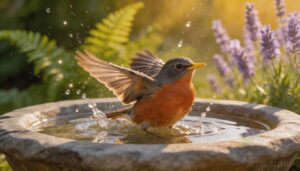
Splashing around is only half the story — what happens after the bath is just as important for a bird’s health. A good soak sets the stage for a full grooming routine that keeps feathers strong, flexible, and ready for flight.
Here’s a closer look at exactly how bathing helps that process.
Bathing Before Preening
Think of a bath as the first step in a two-part routine. Before a bird can properly preen, it needs moisture to trigger the barbule rehydration process — softening stiff, dirty plumage so the beak can realign each fiber.
This bath-induced feather flexibility is what makes the preening sequence timing work. Clean water and good bird bath maintenance directly support that feather condition.
Redistributing Oil From The Uropygial Gland
Once a bird’s feathers are wet and softened, the real work begins. Near the base of the tail sits the uropygial gland — a small, bilobed structure that produces waxy preen oil rich in fatty acids and wax esters. During preening, the bird rubs its bill against this gland, then spreads the oil across its plumage. This oil distribution process does several things at once:
- Coats each feather with a hydrophobic layer for water resistance
- Keeps feather shafts flexible so they don’t crack during flight
- Delivers antifungal compounds that protect against microbial buildup
- Lubricates the beak and skin for easier movement
- Releases scent compounds tied to scent signaling and social recognition
That’s why bathing matters so much — it clears away old, excess oil and skin flakes first, giving fresh preen oil a clean surface to bond to.
Realigning Feather Barbs and Barbules
Once fresh preen oil is in place, your bird needs those feathers to actually work together. Each feather is made of tiny barbs, and those barbs have even tinier barbules with hooklets that lock everything into a smooth surface.
Water-induced flexibility lets damp feathers bend without breaking, so preening pressure can guide barbule sheath spacing back into place, restoring proper barb alignment and keratin realignment throughout the vane.
Improving Insulation and Water Resistance
Once those barbs lock back together, real protection kicks in. Proper feather layering strategies mean your bird’s plumage traps tiny air pockets between layers, and that air pocket retention is what drives both feather insulation and temperature regulation. Higher barbule hook density creates microchannel water shedding across the surface, so preen oil from the oil gland seals the rest.
Molting cycle timing refreshes worn barbules, restoring full feather waterproofing seasonally.
Supporting Smoother, More Efficient Flight
Clean, well-maintained feathers do more than look tidy — they directly shape how a bird moves through air. Feather micro-roughness and boundary layer control work together to reduce drag, while wing tension modulation and camber adjustment fine-tune lift during flight. Regular bathing and preening support this lift-to-drag optimization naturally.
- Smoother feathers mean less energy spent on every wingbeat
- Better aerodynamic efficiency helps longer, steadier flight
- Strong feather hygiene and preening habits protect overall flight performance
When Birds Bathe Most Often
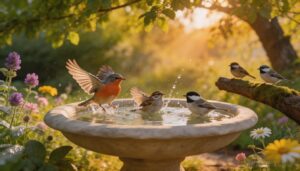
Birds don’t follow a random schedule regarding bathing — their timing is shaped by temperature, season, and even the habitat around them. If you watch a birdbath long enough, you’ll start to notice real patterns in when the splashing happens.
Here’s a look at the key factors that influence how often and when birds show up to bathe.
Morning and Dusk Bathing Patterns
Most garden birds follow a reliable twice-daily rhythm shaped by Dawn Light Cues and Circadian Hormone Signals — visiting their bird bath within the first 30 minutes after sunrise, then returning during the Dusk Temperature Drop before roosting.
Wind Speed Influence also matters; calmer air encourages longer stays.
This Bathing Rhythm Synchrony, with birds splashing vigorously at both ends of the day, reflects a deeply ingrained biological schedule.
Increased Bathing During Hot Weather
When summer heat peaks, birds shift into full thermoregulatory behavior, visiting your birdbath far more often than usual. Because they can’t sweat, evaporative cooling becomes their main heat stress mitigation tool — water simply evaporates from wet feathers and carries heat away.
You’ll notice birds actively practicing microclimate selection, choosing shaded, shallow water for quick dips. Cooler water temperature preference drives these repeated visits throughout the hottest afternoon hours.
Reduced but Important Winter Bathing
Winter doesn’t stop birds from bathing — it just changes how they do it. Cold weather, ice, and shorter days cut back bathing frequency, but a heated bird bath keeps ice-free bathing accessible when birds need it most.
Short bath durations help with energy conservation and feather oil retention. Nearby microclimate shelter lets birds dry quickly, keeping their insulation intact.
Seasonal Changes in Birdbath Activity
Each season reshapes how birds interact with your birdbath in ways you might not expect.
- Spring visitation spikes as nesting activity rises and birds need more water for drinking and preening.
- Summer evaporative cooling drives peak bathing, making daily water changes essential.
- Autumn leaf accumulation means more frequent cleaning to keep water inviting.
- Winter ice mitigation with a bird bath heater sustains critical access when natural sources freeze.
How Species and Habitat Affect Bathing Frequency
Not every bird follows the same bathing schedule — species and habitat shape those habits more than you’d think.
urban habitats offer surprisingly rich urban water sources like sprinkler runoff, so urban birds bathe more often than their rural counterparts. Desert birds manage water scarcity carefully, sipping brief drips when available.
Warblers and macaws have distinct species bathing needs, while island birds depend almost entirely on island rainfall dependency.
What Makes a Birdbath More Appealing
Not every birdbath gets used, and the difference often comes down to a few small details that birds actually notice.
If you want more visitors splashing around in your yard, the setup matters more than you might think.
Here’s what makes a birdbath genuinely hard for birds to resist.
Ideal Depth for Safe Splashing
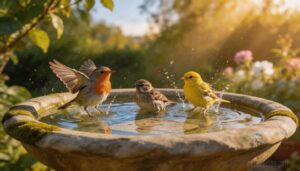
Depth matters more than you might think. Birds won’t splash in deep water — it feels dangerous. Follow these Depth Range Guidelines for confident bathing:
- Keep water 2–3 inches deep, never three inches deep at the center
- Use a gradual Edge Ramp Slope for safe entry
- Guarantee Footing Stability with a flat bottom
- Allow a 6–9 inch Splash Zone Width
- Make Seasonal Depth Adjustments as activity increases
Shallow pools invite more visitors.
Textured Surfaces and Added Stones
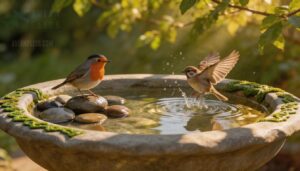
Shallow water draws birds in, but what they land on matters just as much. Textured bath surfaces with slip-resistant edges give birds something real to grip.
Porous stone drainage helps water dissipate quickly instead of pooling. Toss in a few stones for perching spots, and you’ve created a space birds genuinely trust.
Stone inlay designs and texture contrast aesthetics also make your bath look naturally inviting year-round.
Placement Near Shrubs and Partial Shade
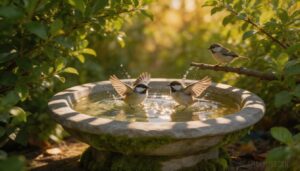
Where you place your birdbath matters more than most people realize.
Positioning it within two to six feet of shrubs or trees gives birds predator cover, proximity they instinctively need before stepping into the water.
Native plants work especially well here — they create a natural shrub microclimate benefit, offering shade temperature regulation that keeps water cooler and perching branch access for cautious arrivals.
Keeping Water Clean and Fresh
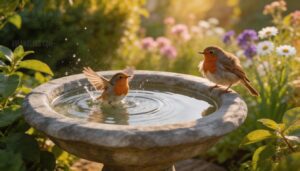
Clean water does more for birds than you might think — it’s the difference between a birdbath that helps and one that harms.
Refresh water twice daily in summer to support parasite control through bathing and prevent mosquito breeding. Scrub the basin weekly with diluted vinegar to stay ahead of algae growth. A simple cleaning routine, combined with basic water circulation, keeps health risks of contaminated birdbath water low.
Winter Heating and Summer Maintenance
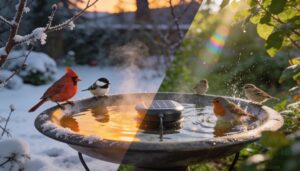
Year-round access matters more than most people realize.
A heated birdbath with a built-in Winter Freeze Guard keeps water liquid when temperatures drop, giving birds a reliable source for drinking and feather care.
In summer, a solar pump circulates water naturally, slowing algae growth without chemicals. UV-stable materials hold up through both seasons, making seasonal maintenance of bird baths genuinely simple.
Frequently Asked Questions (FAQs)
Should birds be deprived of a bath?
Depriving birds of bathing causes real harm. Experimental studies on captive starlings show bathing deprivation triggers stress hormones, immune suppression, and behavioral abnormalities — ultimately increasing mortality.
Bird bathing isn’t optional; it’s essential.
How to maintain a bird bath in winter?
Winter care for bird baths starts with a heated bird bath to keep clean water accessible.
Monitor water levels daily, insulate the stand, and install a windbreak to block freezing winds.
Do birds bathe?
Yes, birds do bathe — regularly and purposefully.
Bird bathing facilitates feather maintenance and preening, parasite control through plumage cleaning, and temperature regulation and cooling mechanisms, making it an essential part of daily avian health and survival.
Do Misters make a good bird bath?
A water mister makes an excellent bird bath.
Solar powered misters offer energy efficiency, and adjusting the mist flow rate keeps water temperature control gentle, supporting bird bathing, feather maintenance, and preening, and temperature regulation and cooling mechanisms naturally.
Why do birds splash around in bird baths?
Birds splash to clean feathers, cool down through evaporation, and dislodge parasites — all part of natural feather hygiene.
Splashing also aids thermoregulation, social interaction, and even subtle courtship display and territory marking behaviors.
Do different bird species bathe in groups?
Yes, different bird species often share a communal bird bath, drawn together by social cues and habitat-driven grouping.
Mixed-species gatherings reflect natural temporal synchrony, where watching others bathe quietly signals safety to newcomers.
Can birdbath design affect local bird diversity?
Absolutely — bird bath design and placement guidelines shape which species visit.
Multi-Level Zones, material selection, color visibility, and predator perception all influence bird species diversity, turning a simple basin into genuine habitat enhancement.
How does bathing influence a birds social status?
Bathing signals fitness. A bird with sleek, well-preened plumage after a bath communicates health and dominance to rivals and potential mates, quietly shaping its standing within the flock’s social hierarchy.
Do birds bathe differently after long flights?
After a long migration, the last thing you’d expect a tired bird to do is jump straight into a bath — yet that’s often exactly what happens, driven by flight fatigue and the urgent need to restore feather health.
How does rainfall affect birdbath usage patterns?
Rain-triggered visitation often spikes after showers, as birds rinse off wind-carried dust and pollen. Post-rain cleaning feels urgent to them, and the freshened water draws more species to bathe.
Conclusion
In a way, birds’ daily birdbath rituals are a proof of their notable adaptability. By understanding why birds splash and bathe in birdbaths, you’re not just learning about their behavior—you’re gaining insight into their very survival.
A well-designed birdbath setup, complete with fresh water and a safe environment, can be a haven for these creatures. As you create a welcoming space, you’re supporting natural grooming and temperature control needs, and fostering a deeper connection with nature.