This site is supported by our readers. We may earn a commission, at no cost to you, if you purchase through links.
A parrot left alone without stimulation doesn’t simply sit quietly and wait—it unravels.
Feathers get plucked, screaming escalates, and behaviors that seem “behavioral problems” are actually symptoms of a mind with nowhere to go.
Birds evolved in complex, varied environments where foraging, problem-solving, and social interaction filled every waking hour, and a bare cage strips all of that away.
Toys aren’t accessories or entertainment—they’re cognitive tools that directly influence stress hormones, emotional resilience, and long-term health.
Understanding why birds need toys for mental stimulation means understanding what happens to an intelligent animal when its brain goes unused.
Table Of Contents
- Key Takeaways
- Why Do Birds Need Toys for Mental Stimulation?
- How Bird Toys Support Cognitive Development
- Types of Toys That Stimulate Bird Minds
- Choosing and Rotating Toys for Maximum Benefit
- Signs Your Bird is Mentally Stimulated
- Frequently Asked Questions (FAQs)
- How do I mentally stimulate my bird?
- What is the 60/40 rule for birds?
- How often should I replace my birds toys?
- Can birds become overstimulated by too many toys?
- Do birds prefer toys that make noise?
- Should birds play with toys independently or supervised?
- Can homemade toys be as effective as store-bought?
- Conclusion
Key Takeaways
- A bird left without mental stimulation doesn’t just get bored — it develops real physical and behavioral symptoms like feather plucking, screaming, and aggression, all of which are distress signals, not personality quirks.
- Toys aren’t optional extras; they’re cognitive tools that directly reduce stress hormones, support emotional resilience, and keep your bird’s brain functioning the way it was built.
- Wild parrots spend the majority of their waking hours foraging and problem-solving, so replicating that variety at home — through puzzle feeders, shreddable materials, and rotating toy selections — meets a genuine biological need.
- Rotating toys every one to two weeks, matched to your bird’s species and size, prevents habituation and keeps enrichment effective long-term rather than becoming background noise, your bird ignores.
Why Do Birds Need Toys for Mental Stimulation?
far more cognitively complex than most people realize, and that real needs come with real needs.
When those needs go unmet, the effects show up quickly — in their behavior, their mood, and their health.
A bored bird can spiral fast, so stocking up on foraging toys that keep birds mentally stimulated is one of the simplest ways to turn things around.
Here’s a closer look at what’s actually happening in your bird’s mind, and why toys matter more than you might think.
The Role of Avian Intelligence
Bird intelligence runs deeper than most people realize. Avian cognition isn’t just instinct — it’s complex neural architecture built for tool innovation, memory mapping, and social learning. New Caledonian crows bend wire into hooks; scrub jays remember thousands of cache locations.
- Problem Solving — Multi-step puzzle navigation
- Memory Mapping — Spatial recall across months
- Social Learning — Observing and mimicking peers
- Tool Innovation — Crafting objects to achieve goals
Crows and parrots demonstrate planning and causal reasoning comparable to primates, as detailed in tool‑using bird cognition.
Effects of Mental Stimulation on Bird Well-Being
Mental stimulation directly shapes your bird’s physical and emotional health in ways that go far beyond simple entertainment. When you provide consistent enrichment strategies, you’re actively supporting stress hormone reduction, which keeps cortisol levels balanced and promotes better feather quality over time.
Birds that engage regularly with toys show measurable cognitive longevity, stronger social bonding with their owners, and a noticeably calmer, more resilient temperament.
Providing regular enrichment helps prevent boredom and stress.
Consequences of Boredom and Lack of Enrichment
When enrichment is absent, the consequences show up fast. Feather plucking becomes a coping mechanism — African Grey parrots and cockatoos are especially vulnerable, with some studies noting feather destructive behavior in up to 40% of understimulated birds.
Without enrichment, up to 40% of understimulated parrots resort to feather plucking just to cope
You’ll also notice stereotypic pacing, vocal distress through excessive screaming, and aggressive biting. Chronic bird boredom drives real health decline, including weight loss and weakened immunity.
How Bird Toys Support Cognitive Development

Toys do a lot more for your bird than just keep them busy — they’re actively shaping how your bird thinks, adapts, and feels.
The way you arrange toys in your bird’s cage can make the difference between a bored bird and one that’s genuinely mentally stimulated.
right toy can challenge memory, awaken instincts, and even build emotional steadiness over time.
closer look at how that actually works.
Encouraging Memory and Problem-Solving Skills
Your bird’s brain is more capable than most people realize — and the right toys can actively sharpen it. Foraging toys, in particular, build genuine cognitive development by engaging spatial recall, sequence training, and problem solving skills simultaneously. Consider how these puzzle-based tools support memory capacity:
- Lever Logic toys train cause-and-effect recognition
- Multi-step Puzzles reinforce sequential thinking
- Color Matching activities strengthen pattern memory
- Spatial Reasoning improves through rotating foraging toys
- Foraging toys reward persistence with meaningful outcomes
Fulfilling Natural Instincts Through Play
Wild parrots spend up to 60 percent of their waking hours engaged in foraging instincts — searching, chewing, climbing, and calling.
When you replicate that environment complexity at home through foraging tools, shreddable materials for beak exercise, movement toys for flight simulation, nesting fibers for nest building, and sound‑based objects for social vocalization, you’re meeting your bird’s natural behaviors where they already live.
Promoting Emotional Resilience in Birds
Resilience isn’t something birds are born with in full — it’s something they build through daily experience. The right toys actively support your bird’s emotional regulation by reducing cortisol, calming anxious behaviors, and creating positive reinforcement loops through reward-based interaction. Consider how toys directly support bird mental health:
- Stress coping: Shredding toys release endorphins, lowering anxiety during tense moments.
- Mood regulation: Swings stabilize heart rate through rhythmic, soothing motion.
- Confidence building: Puzzle-solving rewards reinforce your bird’s sense of competence.
- Attachment strengthening: Shared play deepens your bond, reducing separation anxiety considerably.
Cognitive enrichment through varied, engaging toys isn’t optional — it’s foundational to emotional resilience.
Types of Toys That Stimulate Bird Minds
Not all bird toys are created equal, and the type you choose matters more than you might think.
Some toys tap into your bird’s natural drive to forage and problem-solve, while others satisfy the urge to chew, shred, and manipulate objects with their beaks and feet.
Here are the key categories worth knowing about.
Foraging Toys for Mental Engagement

Foraging toys are, without question, one of the most effective forms of cognitive enrichment you can offer your bird. In the wild, parrots spend up to 80 percent of their day searching for food — foraging toys replicate those Hidden Food Challenges at home.
Rotating options through a Rotational Toy Schedule, using Foraging Material Variety like palm leaves, paper, and vine balls, enhances mental stimulation, stress reduction, and overall bird welfare through Flexible Difficulty Scaling and Sensory Enrichment.
Puzzle and Interactive Toys
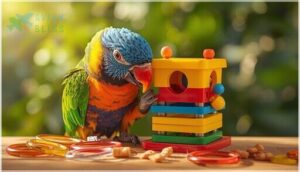
Puzzle and interactive toys take mental stimulation a step further by demanding sequential thinking. Multi-stage Puzzles require your bird to complete one task before unlocking the next, while Touchscreen Challenges and Color Matching Games sharpen visual discrimination and Reward Timing awareness.
Look for:
- Cognitive development through layered problem-solving
- Durable Materials that withstand strong beaks
- Interactive toys that respond immediately to reinforce learning
Shreddable and Manipulative Toys

Shreddable and manipulative toys address a fundamental behavioral need — your bird’s instinct to tear, grip, and dismantle.
Safe materials like untreated pine, cotton rope, and plain cardboard support Beak Strengthening and Foot Grip while offering rich Sensory Textures that sustain engagement.
Destructible Mechanics reduce bird stress by channeling frustration productively.
With consistent Enrichment Monitoring and regular rotation, these shreddable toys and manipulative toys deliver meaningful cognitive development and lasting mental stimulation.
Choosing and Rotating Toys for Maximum Benefit

Not every toy works for every bird, and that’s actually the point.
Knowing your bird’s species, size, and preferences is the starting line for building an enrichment setup that actually holds their attention.
Here’s what to keep in mind when choosing and rotating toys for the best results.
Species-Specific Toy Selection
Not every bird is the same, and neither are their toys.
Hookbill chewing needs to drive parrot and conure species toward durable wood and acrylic, while macaw foraging demands oversized, multi-compartment feeders.
Conure climbing toys with ropes and ladders match their active nature, budgie mirrors satisfy their social curiosity, and finch swings support movement-based play.
Always match bird specific toys to your bird’s species first.
Importance of Variety and Novelty
Once you’ve matched toys to your bird’s species, the next step is keeping things fresh.
Birds habituate quickly — often within one to two weeks — so toy rotation benefits your bird by preventing that mental flatline. Rotational schedules every three to ten days, combined with sensory variety and enrichment diversity, support consistent cognitive engagement while introducing novelty to keep engagement fresh and preventing bird boredom and stress.
Safe Materials and Toy Design
Freshness matters, but so does safety. Quality bird toys should use stainless steel chains, untreated hardwood, and nontoxic dyes — materials that won’t leach harmful chemicals when your bird chews or licks them.
Welded construction and size-specific design prevent entrapment injuries, while easy-clean surfaces simplify weekly disinfection.
Bird toy safety isn’t an afterthought; it’s the foundation of smart, sturdy bird toy design.
Signs Your Bird is Mentally Stimulated

Once you’ve introduced the right toys and kept things fresh with regular rotation, you’ll start to notice real changes in how your bird acts day to day.
A mentally stimulated bird doesn’t hide it — the signs show up in their behavior, their mood, and how they interact with you.
Here’s what to look for.
Positive Behavioral Changes
One of the clearest signs your bird is mentally thriving is a shift in daily behavior.
Feather plucking reduction, screaming decrease, and exploratory activity boosts all signal effective behavioral enrichment at work.
You’ll notice a calm demeanor, increased physical activity, and stronger cognitive potential emerging through consistent play.
Positive reinforcement through foraging and puzzle toys drives meaningful stress reduction across species.
Increased Social Interaction and Playfulness
Beyond behavior shifts, you’ll often notice your bird reaching toward you with a toy — a clear body cue signal that it wants cooperative toy routines and shared play.
Fostering social interaction through play strengthens your bond through:
- Owner-Bird Games like peekaboo or bell ringing
- Flock mimicry through side-by-side play
- Vocal play during talking sessions
- Turn-taking around foraging toys
- Increased front-of-cage presence during environmental enrichment
Reduced Stress and Undesirable Behaviors
When your bird is genuinely mentally stimulated, you’ll see it in the quiet — less screaming, less pacing, less feather plucking.
Consistent enrichment activities address aggression control and anxiety reduction by channeling instinctive behaviors into purposeful play.
Foraging and shredding toys support cortisol management and stress reduction, steadily reducing behavioral issues that stem from frustration.
Pacing elimination follows naturally when your bird’s mind stays engaged.
Frequently Asked Questions (FAQs)
How do I mentally stimulate my bird?
Mentally stimulating your bird combines foraging toys, puzzle feeders, sensory challenges, and daily training sessions with interactive play and social bonding, supporting cognitive development and avian enrichment through consistent environmental enrichment and mental stimulation with varied bird toys.
What is the 60/40 rule for birds?
Think of it as the golden mean of bird care: 60 percent stable routine, 40 percent fresh novelty through toy rotation and foraging challenges, keeping your bird secure yet mentally stimulated every day.
How often should I replace my birds toys?
Inspect toys weekly and replace worn or damaged ones immediately.
Rotate every one to two weeks for novelty, and discard anything showing rust, fraying, or sharp edges to avoid health risks.
Can birds become overstimulated by too many toys?
Yes, birds can absolutely become overstimulated by too many toys.
Overstimulation indicators like pinned eyes, sharp screeches, and sudden aggression signal that toy density limits have been exceeded, and play session duration needs shortening.
Do birds prefer toys that make noise?
Many birds show a clear noise preference, gravitating toward bells and chimes for auditory engagement, though species variance means some individuals avoid loud toys entirely due to overstimulation risks — so balance matters.
Should birds play with toys independently or supervised?
Both supervised and independent play matter, but you should supervise initially. Safety monitoring and hazard prevention come first — tailor to your bird’s size and habits before trusting solo sessions.
Can homemade toys be as effective as store-bought?
Homemade toys can absolutely match store-bought options in mental stimulation, material safety, and DIY customization — often costing 70–90% less while giving you full control over what your bird interacts with daily.
Conclusion
Like a river that stagnates without movement, bird’s mind deteriorates without purposeful challenge.
Toys aren’t indulgences—they’re the current that keeps cognition flowing.
Understanding why birds need toys for mental stimulation means recognizing that enrichment directly shapes behavior, emotional health, and quality of life.
Rotate the options, match them to your bird’s instincts, and pay attention to how they engage.
A stimulated bird doesn’t just survive captivity—it genuinely thrives within it.
- https://squawkboxes.com/blogs/news/why-does-my-bird-need-toys-expert-tips-for-happier-healthier-pet-birds
- https://talis-us.com/blogs/blog-176/discover-essential-bird-toy-types-a-comprehensive-guide
- https://oneloveanimals.org/blog-birds/do-birds-get-bored-why-mental-stimulation-is-a-must/
- https://bonkabirdtoys.com/blogs/default-blog/signs-your-bird-is-bored-and-what-toys-can-help
- https://busy-bird.com