This site is supported by our readers. We may earn a commission, at no cost to you, if you purchase through links.
 Birds sing songs primarily to attract mates and establish territories.
You’ll find that male songbirds use their specialized voice box, called a syrinx, to create complex melodies that showcase their health and genetic fitness to potential partners.
These vocal performances also serve as "no trespassing" signs, warning other males to stay away from claimed territory.
Birds can produce continuous songs thanks to unique respiratory air sacs that keep air flowing even while they breathe.
Young birds actually learn these songs during critical development periods, much like human children learning language.
Different regions even develop distinct "dialects" within the same species.
The intricate anatomy behind these musical performances reveals fascinating secrets about how birds master their craft.
The process is highly complex, involving both genetic and environmental factors, making each bird’s song a unique expression of its genetic fitness and health.
Table Of Contents
Key Takeaways
- You’ll hear birds singing mainly during breeding season – they use their specialized voice box (syrinx) to attract mates and warn competitors away from their territory, with males showcasing their genetic fitness through complex melodies.
- Birds can sing continuously thanks to unique respiratory air sacs that maintain steady airflow even while breathing, allowing them to produce extended vocal performances that mammals simply can’t match.
- Young birds learn songs during critical development periods just like you learned language as a child, creating regional dialects within species that get passed down through generations.
- Each song reveals the bird’s health and fitness – you’re actually witnessing nature’s dating profile in action, where song complexity, pitch control, and sustained performance signal genetic quality to potential mates.
Birds Singing Behavior
When you hear birds singing outside your window, you’re witnessing one of nature’s most sophisticated communication systems in action.
These feathered performers possess specialized anatomy that allows them to create complex melodies through their unique voice box called the syrinx.
Songbirds Possess Specialized Voice Box
You’ll find that songbirds possess a remarkable specialized voice box called the syrinx, located where the trachea branches into the lungs.
This unique vocal organ enables intricate sound production through vibrating tissues called labia.
Unlike human vocal cords, the syrinx structure allows independent muscle control on each side, letting birds create complex melodies and even produce two different notes simultaneously through sophisticated trachea function and bird anatomy.
Birds basically sing duets with themselves—their unique vocal anatomy lets each side work independently.
Respiratory Air Sacs Enable Continuous Singing
You’ll marvel at how birds maintain their melodious performances without gasping for breath.
Unlike mammals, songbirds possess specialized respiratory air sacs that create a continuous airflow system. These sacs store oxygen-rich air, allowing uninterrupted song duration even during extended vocal displays.
The trachea anatomy connects seamlessly with expanded lung capacity, enabling superior bird vocalization. This breathing mechanics advantage supports complex avian acoustics, letting birds sing longer than their mammalian counterparts could ever manage.
The unique ability of birds to produce birdsong functions is closely tied to their respiratory system and overall anatomy, which is crucial for their ability to sing longer than mammals.
Syrinx Allows Independent Muscle Control
Unlike other animals, you’ll find that birds possess remarkable vocal muscle precision within their syrinx.
This specialized organ allows independent trachea control on each side, enabling simultaneous sound production of different frequencies.
Through sophisticated syrinx function, birds achieve complex bird vocalization patterns impossible with simpler vocal systems.
This dual-channel avian communication system makes their bird song learning abilities extraordinarily versatile for territorial displays.
Why Do Birds Sing Songs
When you hear that familiar morning chorus outside your window, you’re witnessing one of nature’s most sophisticated communication systems. Over 4,000 bird species worldwide use vocalizations as part of their daily behavior, creating a complex network of avian communication that serves multiple critical functions.
Bird songs aren’t random melodies—they’re strategic tools for survival and reproduction. Song intensity and frequency vary throughout the day, peaking at dawn when sound travels furthest. This timing maximizes the reach of their vocal learning abilities, allowing messages to spread across territories with remarkable efficiency.
The primary purposes behind bird vocalizations include mate attraction, territory defense, and social signaling. Males typically sing louder and more frequently during breeding season, showcasing their fitness through song evolution patterns. This bird communication system demonstrates incredible species diversity, with each species developing unique vocal signatures.
Seasonal singing patterns correlate directly with breeding periods and territory establishment, revealing how bird behavior adapts to environmental needs. Studies confirm these bird song functions extend beyond simple communication, incorporating complex social dynamics that have shaped avian communication over millions of years through sophisticated vocal learning processes. The ability to produce bird song melodies is a key factor in avian communication and mate attraction.
Birdsong Anatomy
You might wonder how birds produce such complex melodies that can fill entire forests with sound.
The secret lies in their remarkable vocal anatomy, specifically a specialized organ called the syrinx that works fundamentally differently from human vocal cords.
The Syrinx Branches Into Two Tubes
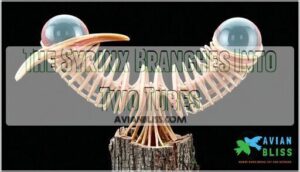
The syrinx’s unique dual-tube design gives birds remarkable vocal abilities you won’t find elsewhere in nature.
This specialized vocal organ splits at the trachea’s base, creating two separate pathways that function independently for complex sound production.
Here’s what makes this bird anatomy so extraordinary:
- Independent control – Each tube operates separately for simultaneous sounds
- Dual pathways – Left and right branches enable complex avian vocalizations
- Muscular precision – Dedicated muscles control each side’s tension and airflow
- Species advantage – Wood Thrushes use both tubes for rising/falling notes together
- Evolutionary edge – No other animal possesses this sophisticated vocal organ structure
This tube formation allows birds to basically sing harmony with themselves, producing two distinct notes simultaneously through coordinated trachea function and syrinx structure manipulation.
The study of Syrinx Models helps researchers understand the intricacies of bird vocalization.
Air Flows Over Vibrating Membranes

When you examine how birds produce their melodies, air pressure drives the process through the syrinx’s vibrating membranes.
These specialized tissues act like vocal cords, creating sound waves as airflow passes through.
The membrane vibration generates distinct frequencies that form bird vocalizations.
| Component | Function |
|---|---|
| Labia (membranes) | Vibrate to create sound waves |
| Air sacs | Maintain steady air pressure |
| Syrinx chambers | Shape sound production |
| Airflow direction | Controls membrane tension |
| Vibration frequency | Determines pitch range |
This syrinx function allows precise sound production through controlled air pressure and membrane vibration, enabling the complex bird song analysis researchers study today.
Understanding bird communication methods is essential for deciphering the intricacies of bird vocalizations and avian communication.
Birds Control Pitch and Volume

Through precise muscle adjustments, you’ll discover how birds create their remarkable vocal range.
The syrinx function relies on vocal muscles that control tension in vibrating membranes, while the respiratory system regulates airflow pressure.
This coordination produces the frequency control needed for complex songbird melodies and varied bird vocalization patterns.
- Tension Control: Vocal muscles adjust membrane tightness to change pitch, creating higher or lower sound waves
- Airflow Regulation: The respiratory system controls pressure and volume for louder or softer notes
- Independent Operation: Each syrinx side operates separately, enabling simultaneous different pitches
- Real-time Adjustment: Birds modify tension and airflow instantly during bird song analysis for complex melodies
Purpose of Bird Songs

You might wonder why birds fill the air with their melodies throughout the day, especially during dawn hours.
The answer lies in two primary survival needs: attracting potential mates and defending valuable territory from competitors.
Mate Attraction and Territory Defense
When defending prime real estate, birds transform into feathered broadcasters, using songs as both romantic serenades and territorial warnings.
You’ll witness males singing from prominent perches to advertise their boundaries while simultaneously attracting potential mates through complex vocal displays.
| Function | Male Strategy | Female Response |
|---|---|---|
| Territorial Marking | Dawn chorus broadcasts | Assesses territory quality |
| Mate Signals | Song complexity display | Evaluates genetic fitness |
| Courtship Behavior | Repetitive mating songs |
Makes mate selection choice.
This dual-purpose strategy maximizes reproductive success—territorial defense secures resources while courtship behavior demonstrates fitness through bird song dialects and vocal performance.
Each melodious note is nature’s dual-purpose broadcast—a romantic serenade and territorial warning rolled into one powerful song.
Signaling Health and Fitness
When you hear a bird’s melodious tune, you’re actually witnessing nature’s fitness exam in action.
Each note serves as genetic signals that reveal the singer’s overall health status and reproductive quality to potential mates.
Consider these health cues embedded in vocal quality:
- Song complexity – Males with larger repertoires demonstrate superior brain development and cognitive abilities
- Accurate pitch control – Precise note production indicates robust immune function and low developmental stress
- Sustained performance – Continuous singing requires exceptional stamina and energy reserves
- Learning precision – Perfect song imitation reflects strong neurological health and memory function
Females use these fitness indicators during mate selection, choosing partners whose bird song complexity suggests the best genes for their offspring.
This process drives mating rituals where vocal quality becomes the ultimate measure of a male’s genetic worth, ensuring only the healthiest individuals pass on their traits through territorial defense displays.
The quality of bird song learning plays a pivotal role in determining female response to male birds.
Warning Rivals and Preventing Costly Fights
Birdsong functions like nature’s "no trespassing" sign, helping you understand how birds avoid dangerous physical confrontations.
When males broadcast their complex melodies, they’re basically telling competitors to back off without risking injury through actual combat.
| Song Type | Territorial Message | Fight Prevention Method |
|---|---|---|
| Dawn Chorus | "Territory occupied – stay away" | Early warning system |
| Aggressive Songs | "I’m strong and ready to defend" | Intimidation display |
| Complex Melodies | "High-quality male lives here" | Status demonstration |
| Repetitive Calls | "Boundaries clearly marked" | Continuous deterrence |
This vocal warning system lets birds establish territorial boundaries while conserving energy for reproduction rather than wasting it on potentially harmful fights.
Learning and Development

You’ll discover that songbirds aren’t born knowing their melodies—they must learn them during a critical developmental window as nestlings.
This learning process creates fascinating regional dialects that pass from generation to generation, much like human languages evolving in different communities, with regional dialects.
Songbirds Learn Songs During Critical Period
Unlike humans who instinctively speak, young songbirds must actively learn their melodies during a narrow critical period.
This essential window typically spans 25-65 days after hatching, when nestling development allows auditory memory formation.
Through vocal imitation of adult tutors, birds acquire species-specific songs essential for bird communication.
Without proper exposure during this critical period, vocal learning fails permanently in most songbird species.
The process of songbird learning involves a critical learning period that’s essential for their development and requires proper exposure.
Young Birds Practice and Refine Songs
Once fledglings leave their nests, they enter an intensive vocal practice phase that resembles human music lessons.
Through song imitation and vocal practice, these young performers experiment with different notes and rhythms. Bird song development involves countless hours of song refining as nestlings perfect their technique.
This bird song learning process continues for weeks or months, with each species following its own timeline.
Song repertoire gradually expands through dedicated bird song practice sessions. Eventually, most birds settle on their signature sound through this careful bird song refinement process.
Trainers use advanced song training tools to help them refine their skills.
Regional Dialects Exist Within Species
After young birds refine their skills, they develop geographic variation in their songs.
Just like you might notice different accents across regions, bird species create local accents that vary by location.
These regional variations emerge through:
- Geographic dialects forming in isolated populations
- Song patterns adapting to local environments
- Dialect formation through neighborhood learning
- Species isolation creating distinct song repertoire differences
Understanding the nuances of bird communication methods is vital in deciphering these variations.
Frequently Asked Questions (FAQs)
Why do birds sing loud songs and why they sometimes don’t?
Surprisingly, you’ll hear birds belting out powerful songs when they’re claiming territory or attracting mates – it’s nature’s way of broadcasting strength and fitness to competitors and potential partners alike.
Do birds sing all year round?
Birds don’t sing year-round.
You’ll hear most songs during breeding season when they’re claiming territory and attracting mates.
Winter brings fewer songs as energy gets redirected toward survival rather than reproduction.
Why do some birds sing at night?
Nocturnal hunters like owls announce territory and communicate with mates through nighttime songs.
You’ll hear them defending prime hunting grounds, attracting partners, or maintaining contact in darkness when visual cues aren’t available, which is crucial for their survival and communication.
Can birds sing without making sound?
Unlike humans, birds can’t actually sing silently.
You’ll find they need airflow through their syrinx to produce any sounds.
However, you might notice young birds practicing by moving their beaks without making noise.
Do baby birds sing in eggs?
Like silent composers rehearsing their symphony, baby birds don’t sing in eggs.
You won’t hear vocalizations from embryos since the syrinx develops after hatching.
They’re busy growing organs needed for future song learning from adult tutors.
Which bird species sing the longest songs?
You’ll find winter wrens produce the longest bird songs.
With these tiny powerhouses delivering incredibly extended, intricate melodies that can last several minutes.
While maintaining rapid, complex patterns throughout their performances.
Conclusion
Beyond mere communication, why do birds sing songs reveals nature’s sophisticated blend of biology and behavior.
You’ve discovered that songbirds use their specialized syrinx to create melodies that attract mates, defend territories, and signal fitness.
These respiratory-powered performances develop through critical learning periods, creating regional dialects that showcase each species’ adaptability.
Understanding bird songs helps you appreciate the remarkable evolutionary pressures that shaped these complex vocal displays into essential survival tools.
- https://www.nature.com/articles/s41467-023-39308-5
- https://pmc.ncbi.nlm.nih.gov/articles/PMC1691117/
- https://nyaspubs.onlinelibrary.wiley.com/doi/10.1196/annals.1298.012
- https://newohioreview.org/2016/01/21/nor-19-39-critical-learning-period/
- https://www.sciencedirect.com/science/article/abs/pii/S0168010218306059