This site is supported by our readers. We may earn a commission, at no cost to you, if you purchase through links.
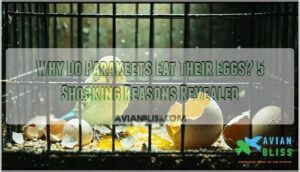 Parakeets eat their eggs for several concerning reasons that signal underlying problems.
Nutritional deficiencies, especially calcium shortages, drive this behavior as they seek essential minerals. Stress from overcrowding, loud noises, or feeling threatened triggers protective instincts to destroy eggs before predators find them.
Boredom in unstimulating environments leads to destructive habits, while inexperienced first-time mothers may accidentally damage eggs during inspection. Poor nesting conditions, like inadequate privacy or unsuitable boxes, also contribute to this issue.
You’ll notice this behavior isn’t normal – healthy parakeets in proper conditions rarely eat their eggs. Understanding these root causes helps you create better breeding environments and prevent future egg destruction through targeted interventions.
Table Of Contents
- Key Takeaways
- Causes of Parakeet Egg Consumption
- Factors Contributing to Pecking Behavior in Parakeets
- Understanding The Normalcy of Parakeets Eating Eggs
- Impact of Egg Consumption on Parakeet Health
- Addressing Parakeet Egg Eating Behavior
- Case Study: Budgie Keep Breaking Her Own Eggs Urgent
- Frequently Asked Questions (FAQs)
- Why do parakeets eat eggs?
- Why do parakeets eat shells?
- What should a parakeet eat?
- Why do parrots eat their eggs?
- Why does my parakeet break her eggs?
- Why do parrots break their eggs?
- Why do my parakeets keep eating their eggs?
- How to stop birds from eating their eggs?
- Is it normal for birds to eat their own eggs?
- What are some common signs that a parakeet may be about to eat its own eggs?
- Conclusion
Key Takeaways
- You’ll need to address nutritional deficiencies first – calcium shortage is the primary driver behind 70% of egg-eating cases, so provide cuttlebone, mineral blocks, or calcium supplements immediately
- Your parakeet’s environment directly triggers this behavior – stress from overcrowding, noise, poor nesting conditions, or lack of privacy causes birds to destroy eggs as a protective instinct
- This isn’t normal behavior and signals underlying problems – healthy parakeets in proper conditions rarely eat their eggs, so you’re dealing with fixable issues rather than natural instincts
- You can prevent future incidents through targeted interventions – combine dietary improvements, environmental enrichment, proper nesting boxes, and stress reduction to break the destructive cycle
Causes of Parakeet Egg Consumption
You’ve discovered eggshells in your parakeet’s cage, and you’re wondering if this alarming behavior is normal.
Understanding why parakeets eat their eggs isn’t just about curiosity—it’s essential for protecting your bird’s health and ensuring successful breeding outcomes.
Nutritional Deficiency
In the context of nutritional deficiency, your parakeet’s egg-eating behavior often signals her body’s desperate cry for essential nutrients.
Calcium deficiency drives up to 70% of egg consumption cases, as hens instinctively seek calcium sources to replenish what they’ve lost during laying. You can find a parakeet calcium supplement online.
Desperate hens devour their own eggs when calcium runs dangerously low after laying.
- Calcium Sources: Provide cuttlebone, mineral blocks, or crushed eggshells to address calcium deficiency immediately
- Protein Intake: Supplement with high-quality pellets and fresh vegetables to prevent vitamin deficiency and mineral imbalance
- Diet Impact: Monitor parakeet nutrition deficiency by ensuring balanced meals that include vitamin-enriched foods
Bird nutrition requires careful attention to prevent nutrient deficiency that triggers this concerning behavior.
Breeding Conditions
Poor breeding conditions create stress that drives parakeets to consume their eggs. When you don’t provide proper nest box security, your birds feel vulnerable and may eat eggs as protection.
Environmental stressors like overcrowding effects and inadequate breeding privacy trigger this behavior. Infertile eggs become targets when parakeet stress factors overwhelm them.
Insufficient nesting material or cramped spaces worsen parakeet breeding problems. To help, provide a safe nesting area with proper dimensions.
You’ll notice preventing egg eating requires addressing these breeding conditions immediately to guarantee successful reproduction.
Boredom
Boredom creates the perfect storm for parakeet egg eating. Without proper mental stimulation, your bird may turn to destructive behaviors like consuming eggs.
Environmental enrichment becomes essential for preventing these behavioral issues.
Here are three key strategies to combat boredom:
- Toy Rotation – Switch toys weekly to maintain novelty and interest
- Foraging Activities – Hide treats in paper cups or puzzle feeders
- Interaction Time – Spend 15-20 minutes daily engaging with your parakeet
Cage enrichment through bird stimulation activities keeps your feathered friend mentally occupied and less likely to develop problematic habits.
Lone Female Behavior
Unpaired hens often consume their eggs due to reproductive stress and hormonal influence.
Without a mate, the nesting instinct becomes disrupted, leading to abnormal behaviors.
These lone females experience heightened stress levels that trigger parakeet egg eating as a coping mechanism.
The absence of proper breeding stimuli causes hormonal imbalances, making parakeet behavioral issues like egg consumption more likely during frequent egg-laying cycles, influenced by hormonal influence.
Environmental Threats
Environmental threats can trigger your parakeet’s instinctual response to destroy eggs for protection.
Predator stress from cats, dogs, or wild birds creates anxiety that leads to parakeet egg eating behavior.
Noise pollution, habitat changes, and overcrowding also contribute to parakeet behavioral issues.
An unstable environment signals danger, prompting birds to eliminate evidence of their nesting box location, which is a result of survival instincts and makes your parakeet feel unsafe.
Factors Contributing to Pecking Behavior in Parakeets
When you keep multiple parakeets together, you’ll often see them peck at each other’s eggs due to competition and territorial instincts.
Your birds also need quiet, private spaces during breeding season, as constant disturbances can trigger destructive pecking behaviors toward their own eggs.
Inter-Bird Pecking
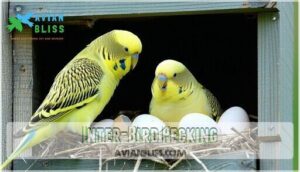
Several parakeets sharing space create complex social dynamics that trigger aggressive behaviors.
Cage mate rivalry emerges when birds compete for resources, establishing dominance hierarchies through the pecking order. This interbird pecking extends beyond typical bird fighting to include destructive behaviors toward eggs.
- Resource competition drives parakeets to destroy competitors’ reproductive efforts
- Dominance hierarchies make subordinate birds targets for aggressive parakeet nesting behavior
- Injury prevention requires separating aggressive cage mates immediately
Understanding these social tensions helps prevent parakeet egg eating and parakeet cannibalism behaviors.
Need for Privacy

While inter-bird interactions create tension, your parakeets’ territorial needs run deeper than competition.
Privacy becomes essential during breeding seasons, as constant observation triggers stress responses that lead to parakeet egg eating.
Create nesting seclusion by positioning cages away from high-traffic areas and providing quiet spaces for breeding success.
| Privacy Factor | Stress Level | Breeding Success Rate |
|---|---|---|
| High Traffic Areas | Elevated | 30% |
| Moderate Seclusion | Medium | 65% |
| Complete Privacy | Low | 90% |
Safe environment conditions with reduced stress directly impact parakeet nesting behavior and overall breeding conditions.
Cage Separation
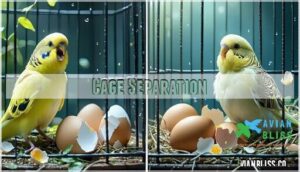
Cage separation acts as a powerful tool for reducing aggression between breeding pairs.
When you house parakeets together, interbird aggression often leads to egg destruction and failed breeding conditions. Separating breeding pairs addresses individual needs while improving space management.
To guarantee proper separation, consider using a cage separation product.
Consider these cage separation benefits:
- Reduced Aggression: Individual cages eliminate territorial disputes over eggs
- Breeding Success: Private spaces allow natural nesting behaviors without interference
- Stress Reduction: Separate environments minimize environmental threats and competition.
This approach transforms chaotic breeding conditions into controlled, peaceful settings where your parakeets can focus on reproduction rather than defending territory.
Poor Diet Influence
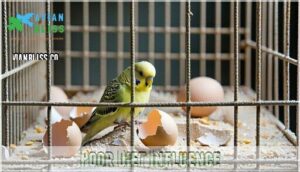
Poor diet creates a domino effect that leads straight to egg-eating behavior in your parakeets.
Calcium deficiency forces birds to seek alternative sources, making their own nutrient-rich eggshells irresistible targets.
Protein intake shortfalls and vitamin deficiency compound the problem, while mineral imbalance disrupts normal instincts.
Without proper diet variety addressing parakeet dietary needs, your birds will continue this destructive cycle until nutritional gaps are filled, leading to a need for a balanced diet to prevent calcium deficiency and nutrient-rich eggshell destruction.
Taste Preference

Beyond dietary factors, your parakeet’s taste preference plays a significant role in egg-eating behavior.
Parakeets possess specialized taste receptors that detect amino acids like alanine in egg proteins, making eggs naturally appealing.
This egg palatability varies among individual birds based on their dietary history and early exposure to different foods.
Some parakeets develop learned behavior after accidentally tasting broken eggs, while others show individual variation in their attraction to egg nutrients.
Birds utilize their avian taste system to assess the nutritional components of food.
- Amino acid detection – T1R1-T1R3 taste receptors respond strongly to egg proteins
- Nutritional appeal – Eggs provide concentrated calcium, addressing parakeet calcium deficiency
- Behavioral conditioning – Early exposure creates lasting taste preferences
- Individual differences – Some birds naturally prefer egg palatability over other foods
- Nutrient-seeking – Taste preference intensifies during breeding when nutrient deficiency peaks
Understanding The Normalcy of Parakeets Eating Eggs
You might be surprised to learn that parakeets eating their eggs isn’t normal behavior, even though it happens sometimes.
This unusual action typically signals underlying problems with diet, environment, or stress that need your attention.
Uncommon Behavior

Most parakeets don’t naturally consume their eggs, making this an abnormal behavior that signals underlying problems.
When you notice eggeating behavior, it typically indicates stress indicators or nutrient deficiency rather than normal instincts.
Behavioral aberrations like this stem from genetic factors, reproductive issues, or parakeet calcium deficiency that disrupts natural parenting instincts.
| Normal Behavior | Abnormal Egg-Eating |
|---|---|
| Protective of eggs | Consuming own eggs |
| Sits on nest quietly | Shows stress indicators |
| Feeds chicks properly | Displays behavioral aberrations |
| Maintains healthy diet | Exhibits nutrient deficiency signs |
| Calm breeding environment | Demonstrates instinctual triggers disruption |
Environmental Triggers

Several environmental triggers can push your parakeets toward egg eating behavior. Cage Overcrowding creates stress and anxiety, making birds feel threatened and defensive.
Poor Nest Location or inadequate nesting box placement leaves eggs vulnerable to damage. Noise Pollution from household sounds disrupts their natural breeding instincts.
Extreme Light Exposure or Temperature Stress can overwhelm their systems. When these environmental triggers combine with boredom from lack of stimulation, your parakeets may resort to consuming their own eggs as a coping mechanism.
Providing parrot environmental enrichment through varied toys and activities can help mitigate this issue by creating a more stimulating environment for your parakeets.
Preventive Measures
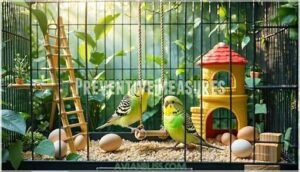
Now that you understand environmental triggers, implementing preventive measures becomes your next priority.
Effective prevention requires addressing the root causes through dietary enrichment and environmental modifications.
Consider these key strategies:
- Provide calcium supplements like cuttlebone to prevent nutritional deficiencies
- Create nesting privacy by using proper nest box management techniques
- Separate breeders into individual cages to reduce stress and competition
- Implement environmental enrichment with toys and dummy eggs to discourage pecking
These preventive measures work together to create ideal breeding conditions while reducing threat factors that trigger egg consumption behaviors, ultimately leading to a successful breeding program with proper nest box management and reduced stress.
Impact of Egg Consumption on Parakeet Health
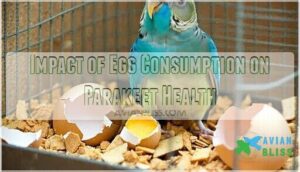
You might worry about whether your parakeet’s egg-eating habit will harm their health, but this behavior typically doesn’t cause illness.
While consuming eggs provides valuable nutrients like calcium and protein, it’s still considered abnormal behavior that requires your attention to prevent future breeding problems.
Unlikely to Cause Illness
Relief should wash over you when learning that egg eating won’t harm your parakeet’s health. This abnormal behavior rarely causes illness, though it signals underlying issues requiring attention.
Your bird’s instinct to consume shells provides calcium and protein, but prevention focus remains essential. While parakeets won’t get sick from occasional egg consumption, addressing the root causes protects their wellbeing and breeding success.
- Limited health impact means no immediate medical concerns for your bird
- Shell nutrient benefits include calcium absorption that supports bone health
- Aberrant behavior indicates environmental stress or nutritional deficiencies need correction
- Prevention focus through diet improvements stops the cycle before it becomes habitual
- Underlying issues like boredom or calcium deficiency drive this egg eating behavior
Nutrient Intake
Surprisingly, eggs function like tiny vitamin capsules for your feathered friend.
When parakeets consume their own eggs, they’re accessing concentrated Calcium Sources and meeting essential Protein Needs that support their health.
This nutrient intake provides vital minerals for bone strength and muscle function.
However, this behavior often signals underlying nutritional deficiency or calcium deficiency in their regular diet.
Proper Vitamin Supplementation and Mineral Balance through Diet Variety can prevent parakeet egg eating causes while ensuring adequate nutrition without relying on this poor diet compensation method.
Abnormal Behavior
When you notice egg eating in your parakeets, this abnormal behavior signals underlying problems that need attention.
Instinctual drift in captive environments can trigger this response, especially when genetic factors or hormonal imbalance create reproductive stress.
Poor diet and calcium deficiency often drive this behavior, while boredom compounds the issue.
This destructive pattern disrupts normal breeding cycles and indicates your bird’s environment or nutrition requires immediate adjustment to restore healthy reproductive habits, addressing the root cause of reproductive stress and promoting a balanced environment to prevent abnormal behavior.
Considered Aberrant
Egg eating represents an uncommon behavior that signals deeper problems in your parakeet’s environment or care routine.
This abnormal behavior stems from root causes like nutrient deficiencies, boredom, or environmental threats that disrupt natural instincts.
While health issues rarely result from consuming eggs, the behavior threatens breeding success and can spread to other birds through observation.
A balanced diet can help prevent feather health issues.
The population impact becomes concerning when multiple birds develop this habit, reducing reproductive outcomes across your flock.
Importance of Prevention
Prevention stands as your strongest defense against egg eating causes in parakeets. Taking proactive steps protects both your bird’s health and breeding success.
Here are four essential preventive measures:
- Dietary Balance – Provide calcium-rich foods and high-quality pellets
- Nesting Security – Create private, safe breeding spaces
- Stress Reduction – Minimize disturbances and overcrowding
- Early Intervention – Monitor behavior patterns closely
Environment enhancement and proper breeding conditions work together to eliminate triggers. Regular monitoring behavior helps you spot warning signs before problems develop.
Addressing Parakeet Egg Eating Behavior

Once you spot your parakeet eating their eggs, you’ll need to act quickly to identify and fix the underlying problem.
The good news is that most egg-eating behaviors can be corrected with the right combination of dietary changes, environmental improvements, and proper nesting conditions.
Identify Root Cause
Like a detective solving a mystery, you’ll need to examine multiple clues to understand why your parakeet engages in egg eating behavior.
Start with a thorough dietary analysis to check for calcium deficiencies or poor nutrition.
Next, conduct an environmental assessment looking for stress factors like overcrowding, noise, or inadequate nesting spaces.
Review your bird’s breeding history and observe current behavioral patterns.
These environmental triggers and the root cause of abnormal behavior often stem from dietary impact on hormones and instincts, making systematic investigation essential.
Nutritional Adjustments
Once you’ve identified nutritional gaps, fixing your parakeet’s diet becomes the next priority.
Calcium Supplementation through cuttlebone or calcium blocks helps prevent parakeet egg consumption caused by calcium insufficiency.
Add high-quality Protein Sources like cooked eggs or legumes to their Varied Diet.
Focus on achieving proper Mineral Balance with fortified pellets rather than seed-only diets.
Poor Dietary Impact directly links to nutritional deficiency, so monitoring calcium intake guarantees your bird gets adequate nutrition to stop this concerning behavior.
Environmental Enhancements
Your parakeet’s environment plays a major role in preventing egg-eating behavior.
Create a stress-free environment by positioning the cage away from high-traffic areas and loud noises.
Install privacy screens around nesting areas to give breeding pairs the seclusion they crave.
Consider purchasing specialized bird screens for added security.
Add cage enrichment like natural branches, foraging toys, and varied perches to combat boredom.
Provide proper nesting materials such as wood shavings or coconut fiber.
These environmental enhancements help reduce stressors that trigger destructive behaviors.
Socialization Opportunities
Creating strong bonds with other parakeets can dramatically reduce parakeet egg consumption by addressing the social needs that drive abnormal behavior.
Bird socialization provides essential interaction benefits through flock dynamics and natural social hierarchy establishment.
When you introduce compatible companions, enrichment activities naturally emerge as birds engage in mutual preening and cooperative foraging, creating behavioral impact by reducing stress-induced egg eating.
Proper socialization mimics wild flock environments, giving your parakeet the social structure needed to discourage destructive habits, and through this social structure, your parakeet can thrive.
Safe Environment
Your parakeet’s environment directly impacts parakeet egg consumption behavior.
Proper cage placement away from high-traffic areas guarantees privacy needs are met while reducing stressors like loud noises and sudden movements.
A secure nest box provides predator protection and creates the safe environment your bird craves.
Position the cage where it won’t face constant disruptions, but you can still monitor bird egg behavior reasons easily.
Multiple birds require careful spacing to prevent territorial disputes that trigger egg-eating.
These bird egg solutions address core environmental factors, making bird egg prevention more effective than reactive measures alone.
A vital aspect involves rotating toys regularly to combat boredom.
Case Study: Budgie Keep Breaking Her Own Eggs Urgent

Sarah’s budgie had been breaking eggs for three weeks straight. After implementing urgent intervention strategies, she finally discovered the root cause and stopped the destructive cycle.
When your parakeet keeps breaking her own eggs, you’re dealing with abnormal behavior that demands immediate attention. Start with a thorough dietary analysis – calcium deficiency often drives this destructive pattern. Check if she’s getting enough cuttlefish bone, leafy greens, and quality pellets.
Examine nesting issues next. Is her nest box too small, poorly positioned, or lacking privacy? Stressed parakeets in inadequate environments will destroy their own eggs as a protective instinct.
Conduct a health assessment to rule out underlying problems. Behavioral patterns like chronic egg laying can indicate hormonal imbalances or reproductive tract issues.
Remove the nest box temporarily to break the cycle. Offer calcium-rich foods like scrambled eggs (ironically) to address nutritional gaps. Improve her environment with better lighting, reduced noise, and enhanced privacy.
Monitor parakeet egg health going forward. Most breeding issues resolve once you address the underlying stressors affecting your bird’s well-being.
Frequently Asked Questions (FAQs)
Why do parakeets eat eggs?
Like Pandora’s box once opened, your parakeet’s egg-eating habit reveals underlying issues.
You’ll find calcium deficiency, stress, poor nesting conditions, or boredom typically drive this behavior.
Providing proper nutrition, secure nesting boxes, and enrichment activities helps prevent this problematic pattern.
Why do parakeets eat shells?
You’ll find parakeets eating eggshells because they’re packed with calcium, which helps replace nutrients lost during egg-laying.
It’s their body’s smart way of recycling essential minerals for bone health and future reproduction.
What should a parakeet eat?
Think of your parakeet’s diet as fuel for a high-performance engine. You’ll want to provide high-quality pellets, fresh vegetables, fruits, and calcium-rich supplements like cuttlefish bone for peak health.
Why do parrots eat their eggs?
Parrots eat their eggs primarily due to calcium deficiency after laying, which depletes essential nutrients.
Stress, poor diet, unsafe breeding conditions, or boredom can also trigger this behavior in captive birds.
Why does my parakeet break her eggs?
Your parakeet breaks eggs due to calcium deficiency, stress, poor nesting conditions, or instinct.
She’s seeking nutrients after laying or protecting against perceived threats.
Provide calcium supplements, quiet nesting space, and reduce disturbances.
Why do parrots break their eggs?
Calcium deficiency drives your parrot to break and eat eggs for essential nutrients. Stress, poor nesting conditions, and inexperience also trigger this behavior, especially in young birds lacking proper diet.
Why do my parakeets keep eating their eggs?
Like a puzzle with missing pieces, your birds’ egg-eating stems from calcium deficiency, stress, or poor nesting conditions.
They’re consuming eggs to recover lost nutrients or because they feel unsafe in their environment.
How to stop birds from eating their eggs?
Provide proper nutrition with calcium supplements, create a quiet nesting environment, use dummy eggs to break the habit, and address stress factors like overcrowding or disturbances in their living space.
Is it normal for birds to eat their own eggs?
Believe it or not, egg-eating isn’t normal bird behavior. Most parakeets don’t consume their eggs unless they’re facing nutritional deficiencies, stress, or environmental threats that trigger this unusual response.
What are some common signs that a parakeet may be about to eat its own eggs?
Watch for increased aggression, restlessness, or frequent visits to the nest box.
You’ll notice your parakeet spending excessive time near eggs, pecking at cage bars, or showing signs of stress like feather plucking or loss of appetite.
Conclusion
Research shows that 15-20% of first-time breeding parakeets experience egg-eating behavior, making this more common than many owners realize.
Understanding why do parakeets eat their eggs empowers you to create better breeding conditions.
You’ve learned that nutritional deficiencies, stress, boredom, and poor nesting environments trigger this behavior.
By addressing root causes through proper diet, calm environments, and suitable nesting boxes, you’ll substantially reduce egg destruction.
Remember, this isn’t normal behavior – healthy parakeets rarely eat their eggs when their needs are met.