This site is supported by our readers. We may earn a commission, at no cost to you, if you purchase through links.

You raise your binoculars to scan a tree line, and the bird you spotted seconds ago vanishes into a tunnel of magnified blur. Your lenses show remarkable detail, but that warbler just hopped two branches over—completely outside your narrow window of visibility. This frustration explains why field of view matters in binoculars more than magnification alone ever could.
Field of view determines how much of the landscape you can observe without moving your binoculars, directly affecting whether you locate your target or lose it in the foliage. The specifications printed on your binoculars tell only part of the story.
Understanding how field of view shapes your entire observation experience—from tracking flight patterns to maintaining comfort during dawn-to-dusk outings—separates adequate gear from equipment that transforms how you connect with wildlife.
Table Of Contents
Key Takeaways
- Field of view determines how much landscape you see without moving your binoculars, directly controlling whether you locate fast-moving birds or lose them in foliage before magnification quality ever matters.
- Higher magnification shrinks your angular field of view proportionally, forcing you to trade wider scanning ability for closer detail while increasing hand shake and reducing image brightness.
- Wider fields of view cut target acquisition time by 2-3x in dense woodland and help beginners build confidence, while experienced birders often accept narrower fields for superior edge sharpness and optical quality.
- Real field of view stays constant as an angular measurement, but the linear width you actually scan expands at close distances and contracts at longer ranges with the same binoculars.
What is Field of View in Binoculars?
Field of view is the actual width of the scene you can see when you look through your binoculars. It’s one of the most overlooked specs on the box, but it directly controls how much of the world you capture in a single glance.
A wider field of view becomes especially important when choosing binoculars designed for eyeglass wearers, since you don’t want to lose peripheral vision just because you wear glasses.
Here’s what you need to know to read those numbers like a pro.
Definition and Basic Concepts

Field of view in binoculars defines how much of the scene you can see through the eyepieces—it’s your viewing angle at work. Optical design and lens calibration determine whether you get a wide or narrow angular scope.
Choosing binoculars that balance wide field of view with strong light gathering makes tracking fast-moving birds much easier, especially in varied lighting conditions.
Manufacturers measure this as angular FOV (in degrees) or linear FOV (width at a set distance). Real field of view shows what’s actually visible; apparent field of view indicates the magnified perspective.
Understanding these measurements helps you choose the right magnification and lens size, which is why knowing what to look for when buying binoculars can make your decision much easier.
Linear Vs. Angular Field of View

Those two measurements—linear and angular—tell you different stories about what you’ll actually see. Linear FoV shows width in meters at 1000 meters; angular FoV gives you the viewing angle in degrees. Eyepiece design and magnification link them mathematically, but angular measurements stay constant regardless of distance.
Understanding both helps you master field calculations and make smart FoV comparisons when choosing binoculars for tracking birds.
How Field of View is Measured
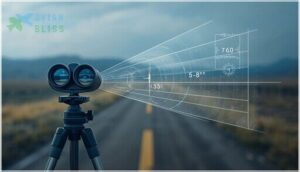
Manufacturers report field of view using angular measurement (usually 5° to 8°) or linear calculation (like 300–420 meters at 1000 meters). FOV standards vary by region, and optics testing follows ISO methods to verify specs.
Real field of view measures the actual angle from the objective lens. Eyepiece design sometimes creates measurement errors, so stated and apparent field of view don’t always match perfectly.
How Field of View Affects Birdwatching

Field of view isn’t just a spec sheet number—it’s the difference between spotting that warbler in the canopy and missing it entirely. A wider field lets you scan more territory at once, track birds as they dart between branches, and actually find your target before it flies off.
Field of view determines whether you spot that warbler before it vanishes or miss it entirely
Whether you’re just starting out or you’ve logged hundreds of hours in the field, understanding how FOV shapes your birdwatching experience gives you real control over what you see.
Locating Birds in Dense Foliage
When you’re scanning thick woods, spotting a warbler tucked against green leaves feels like finding a needle in nature’s haystack. Dense habitat cuts your visual detection by 15–25% thanks to camouflage effects. Here’s why a wider linear FoV transforms your birdwatching:
The right magnification for bird watching binoculars balances field of view with clarity, letting you track movement across branches without losing sight of your subject.
- Reduces search time by 2–3x in woodland settings
- Improves foliage penetration through complex textures
- Enhances close focus scanning without repositioning
- Boosts visual acuity for rapid target acquisition
Your binoculars become search tools, not just magnifiers.
Tracking Fast-Moving or Flying Birds
Raptors and swallows don’t wait for you to catch up. A wider angular field of view slashes your target acquisition time, letting you lock onto agile species before they vanish.
Higher magnification narrows your optical tracking window, forcing constant panning that loses fast-flying birds mid-pursuit.
Choose moderate FOV binoculars—they balance quick detection with recognition detail, giving you command over motion prediction without sacrificing sharpness.
Field of View for Beginner Vs. Experienced Birders
Your experience level shapes which field of view enhances your birding techniques. Beginners gain confidence with wider fields—you’ll spot targets faster and reacquire lost subjects without frustration.
Seasoned observers often demand narrower fields in their birdwatching binoculars, prioritizing optical quality and edge sharpness for detailed field comparison.
Both viewing strategies work—match your user preferences to your current skill and bird watching goals.
Factors Influencing Field of View
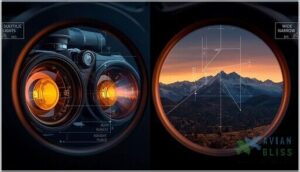
Field of view isn’t random—it’s shaped by specific design choices binocular manufacturers make. Understanding these factors gives you control over selecting optics that actually work for your needs in the field.
Here’s what influences how much of the landscape you’ll see through your lenses.
Magnification and Its Trade-Offs
Higher magnification brings distant birds closer, but it comes with real costs. Here’s what you’re trading:
- Field Reduction – Angular FoV shrinks proportionally as magnification rises, narrowing your visible sweep
- Image Stability – Hand shake magnifies with power, demanding steadier support
- Brightness Loss – Smaller exit pupils dim low-light views
- Eye Strain Factors – Edge distortion increases at higher powers
Magnification limits optical quality in predictable ways. Most birders stick with 8x–10x binoculars for balanced performance.
Eyepiece Design and Assembly
Your binoculars’ eyepiece geometry directly controls apparent field of view and exit pupil diameter. Precision threading and lens assembly determine how smoothly elements focus and align optically.
Modular design lets you swap eyepieces across compatible optical instruments, but tight tolerances matter—poor alignment causes edge distortion and compromises comfort.
When manufacturers nail optical alignment, you get sharp views edge-to-edge with minimal stray light.
Eye Relief and Viewing Comfort
You can’t hold binoculars steady when your brow’s jammed against the eyepiece. Eye relief—the distance from lens to eye—determines viewing comfort and eyewear compatibility.
Models offering 15–18 mm minimize eye strain and vignetting effects for glasses wearers. Short eye relief clips your field of view and triggers viewing fatigue.
Matching eye relief to your facial geometry prevents image quality loss and keeps you tracking targets longer.
Comparing Binoculars by Field of View
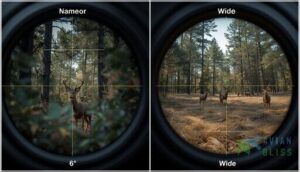
Field of view specs look simple on paper, but they tell you exactly how much world you’ll see through your glass. A 6° binocular versus an 8° model isn’t just numbers—it’s the difference between hunting for your subject and owning the scene.
Let’s break down how to read these numbers, what they mean in the field, and how to pick the FOV that puts you in control.
Interpreting Field of View Specifications
When you’re comparing models, specification standards matter more than you’d think. Field of view appears as angular measurements (degrees) or linear FoV (width at 1000 yards/meters).
Real field of view defines the actual viewing angles through the optic design, while apparent field of view shows the magnified scene.
Field calculation converts between formats—divide linear by 52.5 for angular, or multiply angular by 52.5 for linear at 1000 yards.
Real-World Differences Between Models
Two binoculars at 8x magnification can show dramatically different views. High-end models often sacrifice field of view for sharper edges and brighter images—optical tradeoffs that matter when you’re scanning terrain.
A wider real field of view cuts your search time, helping you reacquire targets faster. User experience depends on how field variance combines with eye relief and weight, not just binocular specifications alone.
Choosing The Right Field of View for Birding
Your choice depends on where you bird and what you’re after. Field testing multiple models reveals how viewing angles and optical quality interact with species tracking needs.
Consider these birding techniques when selecting equipment:
- Open skylines: 8× magnification with moderate FOV balances detail and scanning efficiency
- Dense forests: Wider FOV improves target acquisition in cluttered vegetation
- Mixed terrain: Test real-world edge distortion before committing
Match your binoculars to your routes for better wildlife observation.
Field of View and Overall Observation Experience

Field of view isn’t just a spec sheet number—it shapes how you actually experience every moment outdoors with your binoculars. The right FOV reduces eye strain, keeps you oriented in fast-changing environments, and works alongside other features to match your specific needs.
Here’s how field of view impacts your real-world observation sessions and what you need to keep in mind.
Comfort and Ease of Use
Your field of view design directly impacts eye strain during long observation sessions. Wider apparent fields reduce the head movement you’ll need to track targets, while proper eye relief ensures edge-to-edge viewing comfort.
Pay attention to binocular balance and ergonomic design—poor weight distribution puts unnecessary stress on your neck and shoulders when you’re scanning for extended periods.
Situational Awareness in Outdoor Settings
In the field, your spatial awareness depends on how much terrain scanning you can accomplish without repositioning. A wider field of view lets you monitor environmental changes and track wildlife movement across dense vegetation or open landscapes.
That angular extent you see through your binoculars directly affects outdoor navigation and visual tracking during nature observation—when seconds matter, you’ll catch what others miss entirely.
Balancing Field of View With Other Features
Maximizing your binoculars’ field of view means accepting trade-offs with these critical specs:
- Magnification — Higher power narrows your viewing angle but reveals finer detail.
- Exit Pupil — Larger objective lenses brighten images yet add weight.
- Eye Relief — Longer distances improve comfort for glasses wearers.
- Lens Coatings — Premium treatments improve optical quality and light transmission.
- Ergonomic Design — Balanced weight distribution reduces fatigue during extended observation.
Your perfect binocular balances all factors for your intended use.
Frequently Asked Questions (FAQs)
Does field of view vary with distance to subject?
Your binocular field pulls a clever trick: angular measurement stays locked while linear variation shifts with range.
At close distances, you’ll scan wider ground; farther out, that same binocular field tightens down considerably.
Can accessories like filters reduce field of view?
Yes, filters can reduce your field of view through vignetting and edge obstruction. Misaligned mounts or oversized accessories block marginal light rays, shrinking the usable viewing area—especially at higher magnifications where optical alignment matters most.
How does image stabilization affect field of view?
Optical image stabilization uses lens shift mechanics that can introduce slight vignette effects, marginally narrowing your usable viewing area.
However, most quality optics preserve framing well, so you’ll notice steadier images rather than dramatic optical tradeoffs.
Are wider fields of view harder to focus?
You’d think more viewing space makes things easier, but wide-angle lenses demand stricter eye alignment and steadier positioning.
Focus sensitivity increases because even slight head shifts blur peripheral sharpness, especially with optical distortion near field edges.
Does field of view change when wearing eyeglasses?
Wearing eyeglasses doesn’t shrink the binocular’s intrinsic field of view, but it can affect eye relief and vignetting, making your usable viewing area feel narrower if you don’t adjust eyecups properly.
Conclusion
Don’t put all your eggs in one basket by chasing magnification numbers alone. Why field of view matters in binoculars becomes crystal clear the moment you watch a warbler disappear from your tunnel-vision lens while a wider view keeps the entire canopy accessible.
Your specifications sheet reveals potential, but field experience proves the difference. Master this single metric, and you’ll transform frustrating searches into confident observations that capture every movement across the landscape before you.