This site is supported by our readers. We may earn a commission, at no cost to you, if you purchase through links.
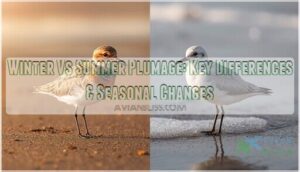
A sanderling in July looks nothing like the one you’ll find on that same beach in December.
The rusty-orange chest and dark-streaked back of breeding season give way to one of the palest shorebirds you’ll ever see—almost ghostly white against wet sand.
That transformation didn’t happen overnight, and it wasn’t random.
Winter vs summer plumage represents one of the most precisely timed biological shifts in the animal kingdom, driven by hormones, daylight, and evolutionary pressure refined over millions of years.
Understanding what changes, why it changes, and when it changes turns every seasonal walk into something far richer than a casual bird count.
Table Of Contents
- Key Takeaways
- What is Winter and Summer Plumage?
- Key Differences Between Winter and Summer Plumage
- Why Birds Change Plumage Seasonally
- Notable Bird Species With Seasonal Plumage
- The Biological Process Behind Plumage Change
- Identifying Birds in Different Plumages
- Frequently Asked Questions (FAQs)
- What is the difference between summer and winter plumage starlings?
- Do birds have winter plumage?
- Is there an actual bird called a snowbird?
- Can birds control the speed of their molt?
- Do all birds of a species molt simultaneously?
- How does pollution affect seasonal plumage quality?
- Do juvenile birds follow the same molt schedule as adults?
- Conclusion
Key Takeaways
- Seasonal plumage isn’t just a color swap—it’s a precisely timed biological system driven by daylight length, hormones, and millions of years of evolutionary fine-tuning.
- Molting happens twice a year and costs a bird up to 25% of its total body protein, making feather replacement one of the most energy-demanding events in its annual cycle.
- Winter feathers aren’t duller by accident—denser insulation, camouflage patterning, and melanin-reinforced tips all serve specific survival functions in cold or exposed environments.
- Beyond color, you can identify birds across seasons by reading structural clues like bill shape, feather wear patterns, flock behavior, and habitat use—often more reliably than plumage alone.
What is Winter and Summer Plumage?
Birds don’t wear the same feathers year-round — and that’s by design. Plumage shifts with the seasons, driven by molting cycles that swap one set of feathers for another.
Tracking these seasonal shifts gets much easier when you have a solid reference like this Nevada backyard bird plumage and molt guide to spot who’s wearing what and when.
Here’s what’s actually happening beneath those color changes.
Definition of Plumage
Plumage — from the Latin pluma, meaning feather — refers to the complete covering of feathers on a bird’s body. It’s more than just color variation in birds; it encompasses feather anatomy, layering, and arrangement.
Each feather, from the insulating down beneath to the contour feathers visible on the surface, fulfills a distinct purpose. Together, these feather layers define a bird’s form, function, and identity.
The annual feather replacement process occurs during molt to maintain healthy plumage.
Overview of Seasonal Changes
Seasonal plumage changes follow a reliable rhythm. As daylight lengthens each spring, photoperiod effects trigger hormonal cascades that push birds into vivid summer plumage — bright colors built for courtship and territory.
When days shorten again, molt timing shifts toward muted winter plumage, favoring camouflage and thermal coloration over display. These aren’t random changes; they’re a finely tuned biological calendar playing out feather by feather.
Winter plumage is not chance — it is a finely tuned biological calendar written feather by feather
Photoperiod triggers hormonal changes drive the bright summer plumage.
Role of Molting in Plumage Transformation
Molting is the engine behind every plumage change you see.
Twice a year, birds shed and regrow feathers through two distinct cycles — prebasic molt replaces all feathers post‑breeding, while prealternate molt partially renews body feathers before breeding season.
These avian molting patterns involve serious Molt Energy Tradeoffs: feather growth timing must avoid overlapping with migration or nesting. Protein Allocation alone can consume up to 25% of a bird’s total body protein.
Key Differences Between Winter and Summer Plumage
Plumage differences between seasons go deeper than a simple color swap.
Birds shift in pattern, feather structure, and physical function depending on the time of year.
Here’s what actually changes and why it matters.
Color and Pattern Variations
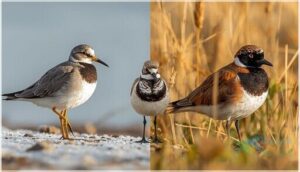
Color tells you more than you think. Seasonal plumage changes flip entire bird appearances through seasonal pigment production tied to breeding cycles. Key color variations in birds to track:
- Belly contrast shifts — dunlins grow black belly patches; sanderlings stay plain white below
- Facial mask changes — grey plovers develop striking black faces in summer
- Wing bar consistency — goldfinch wing bars stay white regardless of season
Camouflage drives the rest.
Feather Structure and Wear

Structure matters as much as color. Winter feathers show higher feather density, with downy insulation layers that trap more air and retain heat.
Beyond just color, these structural changes are explored further in this guide to seasonal bird plumage and feather adaptations, which highlights how winter density directly supports survival in freezing conditions.
The molting process swaps these out as days lengthen. Abrasion patterns do quiet work too — melanin reinforcement in darker tips resists wear, while seasonal growth through feather molt and feather development produces fresh plumage change exactly when birds need it most.
Functional Adaptations
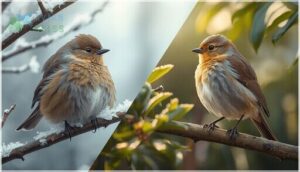
Every feather fulfills a purpose. Seasonal Plumage Changes in Birds balance four core functions at once:
- Thermal Insulation — denser winter feathers trap air, cutting heat loss by 25% or more
- Solar Heat Regulation — lighter plumage reflects sunlight, preventing energy drain on cold clear days
- Camouflage Optimization — muted tones match mudflats, snow, or shoreline
- Energy Conservation — less display means more calories for survival
- Feather Density Variation — drives each adaptation seamlessly
Why Birds Change Plumage Seasonally
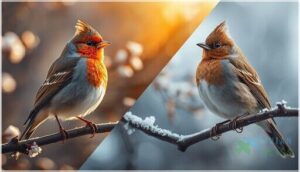
Plumage change isn’t random — there’s real purpose behind every shift in color. Birds time these transformations around the demands of survival, breeding, and the seasons themselves. Here’s why it happens.
Reproductive Signaling and Mate Attraction
Bright summer feathers aren’t just beautiful — they’re a biological résumé.
During breeding season, males advertise fitness through vivid seasonal plumage.
Black-tailed godwits flash terracotta courtship colors; turnstones reveal bold chestnut breast bands.
Iridescent plumage in starlings, ruff collar lek displays in Ruffs, and carotenoid signaling in goldfinches all reflect intense sexual selection.
Sexual dimorphism peaks here — courtship rituals driven by one goal: finding the best mate.
Camouflage and Predator Avoidance
Once breeding ends, survival takes over — and winter plumage becomes a bird’s best defense.
Seasonal camouflage shifts aren’t accidental. Plumage variations driven by seasonal color changes serve one quiet purpose: staying invisible.
- Background Matching — sanderlings turn pale to mirror sandy tidal flats
- Disruptive Coloration — mottled patterns break a bird’s silhouette against rocks or leaf litter
- Silhouette Breaking — streaked flanks dissolve clean outlines from a raptor’s perspective
- Predator Detection Evasion — ptarmigans freeze motionless, trusting snow‑white feathers completely
Seasonal behavior and color variation in birds aren’t random — they’re precision survival tools.
Thermoregulation and Energy Conservation
Feather insulation density tells the real story of winter survival.
Goldfinches grow coats 50 percent thicker than their summer plumage — and ptarmigan feet pack a sixfold rise in feather mass density.
Dark color absorption draws solar warmth directly to the skin.
Add fluffing behavior and extremity tucking, which cuts exposed surface area by a quarter, and you’re watching metabolic rate adjustment made visible.
Seasonal color changes aren’t just cosmetic — they’re avian physiology doing serious work.
Notable Bird Species With Seasonal Plumage
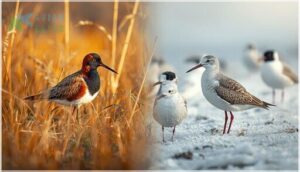
Some birds make seasonal change look almost unrecognizable — same species, completely different bird.
The shift from breeding to non‑breeding plumage can be dramatic or surprisingly subtle, depending on where a species lives and what it needs to survive.
Here are some of the most striking examples across shorebirds, songbirds, Arctic species, and gulls.
Shorebirds (e.g., Sanderlings, Dunlins, Godwits)
Shorebirds are some of the most dramatic shape‑shifters in the bird world. Watch a sanderling in summer — rusty‑red head, mottled back — then see that same bird in winter: pale silver above, white below, nearly invisible against wet sand. That’s Winter Camouflage Patterns doing real work.
Key plumage changes across common shorebirds:
- Sanderling: rusty‑red summer plumage shifts to silvery‑grey and white winter plumage
- Dunlin: brick‑red upperparts and black belly patch fade to plain grey above in winter
- Black‑tailed Godwit: terracotta summer plumage replaced by pale grey and white
- Turnstone: bold patchwork gives way to uniform dark brown and white
- Grey Plover: striking black face and belly in summer, washed‑out grey in winter
Seasonal Migration Routes take these birds between Arctic Breeding Territory Displays — where Courtship Flight Displays and bold colors matter — and coastal wintering grounds, where Predator Detection Strategies favor blending in over standing out.
Songbirds (e.g., American Goldfinch, Lesser Goldfinch)
Songbirds offer a different kind of seasonal drama. The American Goldfinch is a good example — males go from vivid yellow in summer to drab olive-brown in winter, driven by Molt Timing and carotenoid pigments in their diet.
The Lesser Goldfinch follows similar seasonal color changes but stays mostly in western habitats.
Watch for Feather Wear Patterns; black wing markings dull noticeably by late summer.
Arctic Species (e.g., Ptarmigan, Snow Bunting)
Arctic species take seasonal color changes to the extreme.
The Rock Ptarmigan shifts from barred brown summer plumage to pure white winter plumage — textbook Predator Camouflage. Its Feather Insulation nearly triples in density for Arctic cold.
Snow Buntings follow similar molting patterns, wearing white through summer Breeding Displays.
Molt Timing and Habitat Shifts work together here more visibly than almost anywhere else.
Gulls and Plovers
Gulls and plovers show some of the cleanest plumage variations you’ll spot along coastal Migration Routes.
The black-headed gull swaps its chocolate-brown hood for a smudged white head each winter — a dramatic shift driven by Molt Timing tied to Breeding Displays. Grey plovers follow suit, trading black bellies for pale grey. Watch for Habitat Shifts and subtle Wing Bar Patterns when molting patterns blur the lines.
The Biological Process Behind Plumage Change

color shifts you see on birds aren’t random — there’s real biology driving every feather change.
Your understanding of plumage goes deeper once you know what’s actually happening inside the bird.
Three key processes explain it all.
Hormonal Triggers and Molt Cycles
Think of molt as a precisely timed relay race — each hormone passes the baton at exactly the right moment.
Prolactin Decline signals breeding’s end, unlocking molt initiation.
Thyroid-Induced Molt then drives feather regrowth, while Androgen-Molt Interaction ensures showy summer plumage doesn’t linger too long.
Corticosterone Stress Effects can slow new feather growth under pressure.
Melatonin Rhythm Influence ties these hormonal triggers to night length, keeping avian molting patterns reliably seasonal year after year.
Environmental Cues (Daylight, Temperature)
Daylight does the heavy lifting here. Once day length crosses key photoperiod thresholds — generally around 12 to 14 hours — seasonal hormone triggers fire, pushing birds into molt. That’s photoperiodism at work.
Arctic shorebirds experience this shift far more sharply than tropical species.
Temperature-driven molt adds nuance too; cooler conditions actually produce denser feathers.
Together, daylight intensity effects and seasonal color change mechanisms shape every plumage variation you’ll observe.
Timing and Duration of Molt
Molting patterns aren’t one-size-fits-all. Small songbirds finish a complete postbreeding molt in weeks; large gulls can take six months.
Molt overlap with breeding happens too — some warblers start replacing feathers while still feeding nestlings. Sexual timing differences are real: males often molt 9–14 days earlier than females. Molt migration strategies let some birds pause mid-journey for feather replacement, following a precise feather replacement sequence from inner to outer primaries.
Identifying Birds in Different Plumages
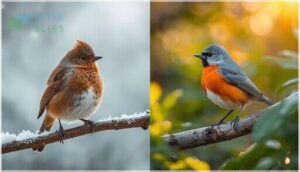
Color is only one piece of the puzzle in the context of spotting birds across seasons. Shape, behavior, and habitat often tell you just as much — sometimes more.
Here’s what to look for when the plumage doesn’t match the field guide photo.
Field Markers Beyond Color
Color isn’t always your most reliable clue. Structural wear, bill shape, and leg feathering often reveal more than plumage variations alone. Look for these field markers:
- Pattern density and feather texture shift with molting patterns, exposing subadult plumages mid‑transition
- Definitive plumage shows cleaner edges; worn alternate feathers look frayed by late summer
- Sexual dimorphism remains visible even in drab winter birds through structural differences
Behavioral and Habitat Clues
Behavior tells the story that bird plumage sometimes can’t. In winter, flock size shifts dramatically — sanderlings and dunlins pack tidal flats in groups of hundreds, a pattern you won’t see on summer tundra.
Vocal contact calls grow more frequent within these flocks.
Territorial song displays, by contrast, signal breeding season.
Foraging habitat preferences and migration stopover sites also reveal avian behavior and seasonal adaptations behind plumage variations.
Tips for Birdwatchers Across Seasons
Start with gear selection — earth-toned clothing and 8×42 binoculars give you the light-gathering power needed to catch subtle shifts between summer plumage and winter plumage. Position yourself with the sun at your back for cleaner views. Field note-taking builds your personal plumage calendar over time.
Seasonal trip planning — coastal wetlands in fall, wooded parks in spring — puts you where bird identification techniques and seasonal adaptations actually click.
Frequently Asked Questions (FAQs)
What is the difference between summer and winter plumage starlings?
Think of the living calendar as a living calendar.
In winter, fresh feather tips create white spots across a dark body.
As spring arrives, feather tip abrasion reveals the iridescent sheen beneath — plus a bill color shift to yellow.
Do birds have winter plumage?
Yes, most birds have winter plumage.
Through avian molting patterns, they shed summer feathers and grow duller, insulating replacements. This plumage change is driven by hormonal control and shortening daylight as seasons shift.
Is there an actual bird called a snowbird?
There is — it’s the dark-eyed junco. Linnaeus classified it in 1758, and early naturalists noted it arrived only with winter snow, earning its lasting snowbird nickname.
Can birds control the speed of their molt?
Birds do have some control over molt speed. Hormonal regulation, nutritional constraints, and environmental triggers like photoperiodism all influence pace.
Short-distance flyers molt roughly 50% faster than long-distance migrants, reflecting clear genetic adaptation.
Do all birds of a species molt simultaneously?
Not quite.
Molt timing varies by sex, age, and latitude.
Males often start earlier, juveniles molt before adults, and some species stagger feathers gradually while others replace all flight feathers at once.
How does pollution affect seasonal plumage quality?
Pollution disrupts bird plumage development through heavy metal accumulation, carotenoid depletion, endocrine disruption, and feather wear — all undermining color variation in birds and creating camouflage mismatch that threatens survival and complicates ecological conservation efforts.
Do juvenile birds follow the same molt schedule as adults?
No, juvenile molt timing differs from adults.
Young birds often keep fresh juvenile feathers longer, developing molt limits contrast and age-specific feather wear before entering full avian molting patterns like mature birds.
Conclusion
Every feather tells a story written in light and time. Learning to read winter vs summer plumage isn’t just an identification skill—it’s a window into the hidden machinery of survival.
The sanderling racing the waves in December isn’t a different bird from its rust‑chested summer self; it’s the same creature, perfectly rewritten for the season. Once you see that, a walk along any shoreline becomes something closer to reading a living field journal.