This site is supported by our readers. We may earn a commission, at no cost to you, if you purchase through links.
 A dense forest at dawn holds more birds than most people realize. Walk through quietly and you might spot a handful of species. But close your eyes and listen—suddenly dozens of voices emerge from the canopy, understory, and forest floor.
This is why birders who master sound identification detect up to 90% more species in thick habitats than those relying on sight alone. Your ears become your most powerful tool for finding birds, especially when leaves, shadows, and distance make visual identification nearly impossible.
Learning to identify birds by their songs and calls transforms every walk into a richer experience, revealing the hidden abundance of life around you. The right techniques, apps, and practice routines can turn confusing chirps into clear signals that tell you exactly which species shares your space.
Table Of Contents
- Key Takeaways
- How Bird Sound Identification Works
- Essential Techniques for Birding by Ear
- Top Bird Sound Identification Apps
- Advanced Tools for Bird Sound Recognition
- Enhancing Birding Skills and Conservation
- Frequently Asked Questions (FAQs)
- Is there a free app to identify bird sounds?
- Can Google detect bird sounds?
- Can I upload a picture of a bird to identify it?
- How can bird songs indicate their behavior?
- Why do birds produce different calls and sounds?
- What tools help record bird sounds effectively?
- How do environmental factors influence bird calls?
- Can bird sounds signal their habitats or seasons?
- What bird species are easiest to identify by sound?
- How do regional dialects affect bird song identification?
- Conclusion
Key Takeaways
- Birders who learn sound identification can detect up to 90% more species in dense habitats than those relying on sight alone, making your ears your most powerful tool when leaves and shadows block visual confirmation.
- Apps like Merlin Bird ID and BirdNET use machine learning trained on millions of recordings to identify over 3,000 species globally, with offline functionality that works without internet and accuracy reaching 90% after downloading regional packs.
- Starting with 5-10 common local birds and using mnemonics (like "po-ta-to-chip" for American Goldfinch) improves song retention by 40% and helps you build skills faster than trying to learn everything at once.
- Your uploaded recordings to platforms like eBird directly fuel conservation research with over 100 million yearly observations that inform $50 million in annual funding decisions and track population declines across 190 countries.
How Bird Sound Identification Works
You can’t always see the birds you’re hearing, and many species are far easier to find by sound than by sight. Learning to identify birds through their vocalizations starts with understanding what makes each species unique.
Before you head into the field with apps and tools, it helps to know why birding by ear works, what to listen for, and how songs differ from calls.
Why Birds Are Identified by Sound
You’ll detect more species by ear than by sight, especially in thick vegetation. Studies show that up to 90% of birds in dense habitats are easier to find through bird sound identification than visual scanning. Acoustic advantages boost detection efficiency by 12% when you use sound alongside sight.
In dense habitats, up to 90% of birds are easier to find by sound than by sight
Bird vocalizations and songs reveal behavioral insights about territory and breeding, while technological integration through apps aids conservation contributions. Bird calls help you identify species you’d otherwise miss. Enhancing your birding skills allows you to appreciate the dawn chorus.
Key Features of Bird Vocalizations
Once you recognize bird sounds, you’ll notice the four key acoustic features. Acoustic frequency determines pitch—larger birds produce lower-frequency vocalizations, while smaller species emit higher tones. Amplitude control affects loudness, helping birds cut through urban noise. Temporal structure shapes rhythm and note repetition speed in bird vocalizations and songs. Timbre quality gives each species its distinctive tonal character, from buzzy to whistled sounds, driven by modulation mechanisms in the syrinx.
Birders often describe songs by their overall song quality, using subjective impressions.
Differences Between Songs and Calls
You’ll quickly notice the difference between song vs. call when learning bird identification skills. Songs run two to ten seconds with complex phrases and acoustic complexity, while calls last under a second with simple tones.
Their functional roles differ too—songs handle territory defense and mate attraction during breeding season, but calls manage everyday tasks like flock coordination and alarm signals.
Seasonal patterns reveal songs peak at dawn during breeding, while calls stay consistent year-round. Species variation means you might hear one or two main songs but over ten distinct call types from the same bird.
Essential Techniques for Birding by Ear
Learning to identify birds by sound takes practice, but a few key techniques make it easier. Focusing on local species first, using memory tricks, and combining what you see with what you hear will help you build your skills faster.
Listening to recorded bird songs regularly helps train your ear to recognize patterns you’ll encounter in the field.
Learning Common Local Bird Voices

You can’t learn every bird at once, so start with 5–10 common backyard birds in your area. Central and Eastern U.S. regions host about 25 dominant species you’ll hear regularly—robins, chickadees, and cardinals among them. Focus on these local vocalizations first.
Bird identification gets easier when you practice in the same outdoor spot for three weeks, improving your accuracy by 20–30%. Regional dialects matter too. Northern Cardinals sound different depending on where you live, with distinct "cheer-cheer" or "tu-WEET" patterns.
Creating Mnemonics for Bird Songs
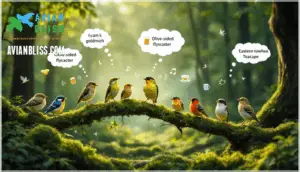
Mnemonics turn tricky bird songs into phrases you’ll remember. Studies show birders who use verbal cues like "po-ta-to-chip" for the American Goldfinch retain bird song recognition 40% longer than those who just listen on repeat.
Here are five mnemonic creation tips for effective bird species identification:
- Match syllable counts – Sync your phrase with the bird’s note pattern for better recall
- Use emotional phrases – The Olive-sided Flycatcher’s "quick-three-beers" sticks because it’s fun
- Personalize based on what you know – Custom mnemonics boost accuracy by 23% in field tests
- Practice rhythm with clapping – Kinesthetic memory helps kids and adults lock in bird behavior patterns
- Test cross-species mnemonics – Comparing similar calls sharpens your bird ID skills faster
Cognitive benefits include dual coding theory at work—pairing sound with words speeds up retrieval. Linguistic influences vary by region, so your "drink your tea" for an Eastern Towhee might differ from another birder’s version.
Combining Visual and Auditory Cues
When bird species identification combines sound and sight, multimodal accuracy improves by up to 20%. Ecological surveys using automated fusion technologies detect 25–40% more birds than single-cue methods.
You should rely on sensory dominance—if you can’t see well, let bird song imitation guide you. Your citizen contributions grow stronger when you pair bird behavior observations with vocalizations, giving conservation researchers better bird ID data.
Practicing With Field Recordings

Regularly, your sound ID retention jumps about 40% when you practice with field recordings paired with spectrogram visualization. Apps like BirdNET and Merlin offer over a million tagged samples for species verification, strengthening your auditory memory.
Local recordings outperform studio clips by 35% in accuracy, helping you master pitch and rhythm differences essential for bird ID and birdwatching success while supporting research on avian species and bird behavior.
Top Bird Sound Identification Apps

Technology has made bird sound identification easier than it used to be. Several apps now use your phone’s microphone to match what you hear with recordings from large databases.
Here’s a look at the most reliable options you can use in the field.
Merlin Bird ID Sound Features
You can identify birds by sound without an internet connection using Merlin Bird ID’s offline functionality. The app recognizes over 450 avian species across the U.S. and Canada through acoustic analysis of recordings you capture with your smartphone.
Its machine learning model improves accuracy by cross-referencing your location with eBird observations, helping you master bird identification while contributing to citizen science.
This tool transforms birdwatching by letting you detect species based on bird behavior and vocalizations alone.
BirdNET’s Sound Recognition Technology
When you’re looking for the most powerful AI in avian research, BirdNET leads with a deep neural network trained on thousands of hours of recordings. This technology identifies global coverage of over 3,000 bird species using 157 layers and 27 million parameters. Here’s what makes it stand out:
- Network Architecture: Uses ResNet-derived convolutional layers optimized for bird behavior studies and short-window spectrograms
- Training Data: Achieved 0.791 precision from 286 hours of annotated soundscapes and 22,960 recordings
- Global Coverage: Expanded from 984 species to worldwide bird identification across Asia, Africa, and South America
- Citizen Science: Engaged 1.1 million participants in 2020, democratizing ornithology for beginners
- Conservation Impact: Processes 33,000+ hours of field recordings to monitor bird species and ecosystem health
Offline and Real-Time Identification Options
You don’t need a signal to analyze bird songs when offline accuracy reaches 90% after downloading regional packs—Merlin covers North America, Europe, and parts of Asia with datasets under 1 GB.
Real-time limitations include brief calls and background noise, which reduce recognition by 25%.
Citizen science uploads sync later, supporting avian species research and birdwatching communities worldwide.
Community-Contributed Recordings and Photos
Your uploads strengthen bird identification apps by filling geographic gaps and improving model refinement. Over 2 billion bird observations sit in the eBird database, with citizen contributions powering data quality checks through expert annotation.
The global birding community feeds roughly 70% of training data used in sound recognition tools, making citizen science central to accurate bird observation worldwide.
Advanced Tools for Bird Sound Recognition

Once you’ve mastered the basics with apps, you can take your skills further with specialized tools. Spectrograms, machine learning platforms, and personal tracking systems help you analyze recordings more deeply and improve your accuracy.
These sophisticated options give you a closer look at what you’re hearing and connect your observations to real conservation efforts.
Using Spectrograms to Analyze Bird Songs
With spectrograms, you can see bird songs as visual patterns. Frequency visualization turns sound into a graph where time runs left to right and pitch runs bottom to top. These acoustic fingerprints help with bird identification by revealing details your ear might miss.
Here’s what spectrograms show you:
- Song Complexity – You can count syllables and measure timing between notes
- Species Recognition – Each bird has unique frequency patterns that act as a visual signature
- Bird Behavior Studies – Researchers track how songs change over time or between populations
- Conservation Applications – Automated systems match spectrograms to detect rare species in field recordings
Bird ID articles often include spectrogram examples because they make identification more precise than listening alone.
Machine Learning in Bird Sound ID
Those visual patterns you just explored reveal something bigger—machine learning algorithms that identify birds automatically. Apps like BirdNET use deep learning models trained on over 300,000 labeled recordings to recognize 6,000+ species.
Here’s how different approaches compare in ornithological content and avian research:
| Method | Accuracy | Application |
|---|---|---|
| XGBoost with acoustic indices | 75% accuracy | Conservation monitoring |
| Custom CNNs (population-specific) | 90%+ precision | Regional bird behavior studies |
| BirdNET (generalist detector) | High coverage | Real-time bird identification |
Feature extraction techniques like MFCC convert audio into patterns machines can classify. Dataset diversity matters—larger, more varied training data improves model performance and accuracy gains.
These tools speed up bird ID articles and support conservation implications by processing recordings faster than manual analysis ever could.
Integrating EBird Observations for Accuracy
Machine learning gets smarter when you connect it to real-world bird data. Merlin Bird ID and eBird share observation records, so sound identifications match species actually reported in your region. This algorithmic alignment improves regional accuracy—the apps know which birds occur where and when.
Data verification relies on uploaded recordings, helping reviewers confirm species and strengthen research reliability. You’re contributing to ornithological content that trains better models, making bird identification more dependable for avian research and bird species information tracking.
Digital Life Lists and Personal Tracking
Beyond identification, app adoption has transformed how birders document encounters. You can build a digital life list by logging every species you see or hear, with apps like Merlin and eBird storing your personal records and data contributions automatically. These platforms track global participation, supporting avian taxonomy research and birdwatching communities worldwide.
- Merlin submissions in the U.S. doubled to 435,227 during the 2025 Great Backyard Bird Count
- BirdNET’s 2.2 million users contribute to the largest avian database at Cornell Lab
- Tech advancements in GPS and IoT drive market growth, projected at USD 5.09 billion by 2034
- Digital lists now include heard-only birds through sound ID features
- Nearly every country participates, with notable increases across China, Colombia, and Kenya
Enhancing Birding Skills and Conservation

Learning to identify birds by sound sharpens your skills and helps scientists protect bird populations. Your observations become valuable data when you share recordings through citizen science platforms.
Here’s how you can master sound recognition and contribute to conservation efforts.
Improving Detection With Sound Mastery
Your ability to identify birds by sound improves steadily with practice. Expert listeners detect up to 45% more species than beginners, and training in vocalization recognition boosts field accuracy by 38%. Structured audio training and refined audio tools sharpen your detection accuracy greatly.
Recording-based surveys in woodlands increased species detection by 24% over visual-only methods. For elusive birds, relying on acoustic survey methods improved detection rates by 30%. Passive monitoring extends your survey time tenfold, helping you build extensive species lists. Digital recordings let you practice repeatedly, boosting song retention by 50%. Even in challenging environmental conditions like urban noise, sophisticated audio tools and filtering raise detection from 48% to 89%.
| Training Method | Improvement |
|---|---|
| Gamified apps (4 weeks) | 60% accuracy gain |
| Formal sound courses | 70% higher proficiency |
| Mnemonic instruction | 35% better recall |
| Spectrogram analysis | 40+ additional species detected |
This makes birding by ear essential for avian research, birdwatching, and becoming a skilled online ornithology resource for bird song identification.
Contributing Bird Sound Data to Research
When you upload recordings to eBird and the Macaulay Library, you’re building training datasets for machine learning models like BirdNET and Merlin Sound ID. Over 100 million eBird checklists now fuel avian research, conservation impact assessments, and species distribution modeling globally.
Your contributions require proper metadata standards—date, location, species ID—and high-quality audio for acoustic monitoring. These citizen science efforts support ornithological research tracking habitat loss and climate effects on bird populations.
Overcoming Challenges in Noisy Environments
Urban habitats and suburban habitats throw serious curveballs at bird identification by sound. Traffic, construction, and crowds can mask up to 70% of low-frequency bird songs, making app innovations like Merlin Sound ID and BirdNET essential—they use ML adaptations trained on noisy datasets to filter interference.
For field recording, try shotgun microphones to cut background noise by 80%, or record at dawn when human activity drops 40%.
User solutions include combining visual confirmation with directional audio, which slashes misidentification by 25% in birdwatching sessions.
Supporting Bird Conservation Through Citizen Science
Your bird sound recordings can fuel conservation efforts when you share them through platforms like eBird integration and Merlin Bird ID. These apps upload your observations to massive databases—over 100 million sightings yearly—that drive data-driven conservation planning and ornithological research across 190 countries.
Here’s how you contribute:
- Support monitoring technologies that track population declines, like the 3 billion birds lost since 1970
- Enable educational engagement through translated materials reaching 120+ countries
- Power conservation outcomes with datasets informing $50 million in annual funding decisions
- Strengthen community engagement in science by joining events like the Great Backyard Bird Count
- Improve bird conservation models that guide habitat restoration for 51+ species
Your recordings become part of conservation efforts that reshape how researchers protect declining populations.
Frequently Asked Questions (FAQs)
Is there a free app to identify bird sounds?
Yes, several free apps identify bird sounds effectively. Merlin Bird ID and BirdNET lead the field, with Merlin supporting over 3 million users and BirdNET recognizing 3,000+ avian species globally using neural networks.
Can Google detect bird sounds?
Google has developed AI sound analysis tools capable of detecting bird sounds, supported by research with Cornell University and machine learning models like MixIT.
These systems can identify avian species but face real-world limitations in noisy environments.
Can I upload a picture of a bird to identify it?
Apps like Merlin Bird ID let you upload photos to identify bird species using AI. Image quality matters—poor lighting or distant shots reduce accuracy.
The technology works well for clear images but struggles with similar-looking avian species.
How can bird songs indicate their behavior?
You can tell a lot about what birds are up to by listening to their vocalizations. Alarm calls reveal predator type and threat level, with chickadees adding more ‘dees’ for dangerous predators.
Territorial songs show fitness and breeding readiness through their complexity.
Contact calls maintain group cohesion during movement and foraging.
Why do birds produce different calls and sounds?
Birds produce different calls and sounds for mating song performance and territorial defense. Environmental factors drive vocalization changes, helping species adapt their communication.
These acoustic variations support bird identification while revealing insights into bird behavior, avian research, and broader ecological impact patterns.
What tools help record bird sounds effectively?
Recording device types like portable audio recorders and smartphones capture bird sounds for analysis software and avian research. Microphone characteristics—parabolic for distance, shotgun for directionality—improve bird identification accuracy.
Automated recording systems support citizen science by collecting data continuously, helping birders contribute to bird research platforms studying bird sounds.
How do environmental factors influence bird calls?
Your surroundings shape what you hear when birds call. Sound attenuation in dense forests reduces call range, while noise pollution forces urban birds to sing louder and higher.
Temperature effects, humidity impact, and wind influence all alter how bird calls travel through different bird habitats.
Can bird sounds signal their habitats or seasons?
Bird sounds reveal both habitat and seasonal patterns. Urban birds sing at higher frequencies to cut through noise, while forest species use lower pitches.
During the breeding season, songs become more complex. Climate change shifts timing—some species now sing earlier due to warmer temperatures and artificial light.
What bird species are easiest to identify by sound?
Northern Cardinals, American Robins, and Black-capped Chickadees top the list of easiest bird species to identify by sound. Their simple songs, repetitive calls, and distinctive melodies make recognition straightforward, even in urban birdsongs and noisy environments.
How do regional dialects affect bird song identification?
Ever noticed how a White-crowned Sparrow sounds different in California versus Washington? Regional dialects challenge birders considerably, complicating identification since variations confuse even experienced observers. Automated system accuracy drops 5-10% in dialectally diverse regions.
Birder learning strategies include attentive listening and studying local recordings. Environmental dialect shaping occurs through habitat fragmentation and urban noise.
Dialect documentation importance grows through citizen science platforms, improving bird identification success.
Conclusion
The difference between hearing five birds and discovering fifty can feel like stepping into an entirely new dimension of the natural world. Your bird identification by sound guide gives you that gateway.
Apps like Merlin and BirdNET turn confusing background noise into recognizable species. Spectrograms reveal patterns your ears can’t catch alone.
Practice with mnemonics and field recordings sharpens your skills faster than observation ever could. Every walk becomes a chance to contribute data that aids conservation and expands scientific understanding. Sound transforms how you experience birds forever.
- https://pmc.ncbi.nlm.nih.gov/articles/PMC9495150/
- https://www.earthspecies.org/blog/introducing-birdaves-self-supervised-audio-foundation-model-for-birds
- https://arxiv.org/abs/2503.15576
- https://digitalcommons.imsa.edu/sir_presentations/2025/session1/12/
- https://www.facebook.com/groups/2482484371766045/posts/24495583700029463/