This site is supported by our readers. We may earn a commission, at no cost to you, if you purchase through links.
Ninety percent of songbird species you’ll ever detect, you’ll hear before you see. A warbler stays hidden in dense canopy, but its song carries 100 meters through the foliage, unmistakable to a trained ear.
That’s the decisive edge experienced birders hold over casual observers: they’ve learned to read sound the way you’d read a field guide. Bird identification based on song turns every walk into an acoustic map, revealing species that binoculars alone would never catch.
Master this skill, and you’ll stop chasing shadows in the leaves. You’ll start knowing exactly who’s singing—and why.
Table Of Contents
- Key Takeaways
- What Makes Bird Songs Unique for Identification?
- Why Bird Song Identification is Essential for Birders
- Step-by-Step Guide to Recognizing Bird Songs in Nature
- Choosing and Using Bird Song Identification Apps
- Advanced Techniques: AI, Spectrograms, and Citizen Science
- Frequently Asked Questions (FAQs)
- How do you identify a bird song?
- How does bird song identifier work?
- Can you learn bird identification using song & calls?
- Can you identify birds by sound?
- What is the best app for identifying birds by song?
- Can Google identify birds by sound?
- Is there a Shazam for birds?
- Is Merlin Bird ID really free?
- What is bird song identification?
- How do you identify birds by their songs?
- Conclusion
Key Takeaways
- Bird songs are learned and complex, running 1–10 seconds with up to 50 note types, while calls are short, instinctive sounds under one second used for immediate needs like alarms or flock coordination.
- Listening often beats looking because sound travels through dense foliage, fog, and low light where visual spotting fails, making song identification key to finding hidden or elusive birds.
- Mastery comes from a deliberate process: learning mnemonics, using habitat clues, training your ear through active listening, and recording songs for later spectrogram analysis.
- Apps like Merlin Bird ID and BirdNET use AI and audio fingerprinting—trained on hundreds of thousands of community-contributed recordings—to identify species in real time, even offline.
What Makes Bird Songs Unique for Identification?

Every bird species carries its own acoustic signature, built from distinct notes, patterns, and purposes. Learning to hear these differences gives you a decisive edge in the field. Here’s what sets one song apart from another.
Once you start noticing pitch, rhythm, and tone as separate clues, identifying birds by their calls becomes less about guessing and more about pattern recognition.
Songs Vs. Calls: Key Differences
Ever wonder why that "chip" note doesn’t sound like a full song? Songs run 1-10 seconds with up to 50 note types—learned, not instinctive. Calls stay under one second, simple, innate.
- Songs: complex, seasonal, breeding-focused
- Calls: brief, functional, year-round
- Contact calls maintain flock togetherness
- Songs signal territory and mate quality
- Calls handle immediate, practical needs
Birds often use specific alarm signals to warn others of approaching predators.
Vocalization Roles in Bird Behavior
Every chirp has a job. Flocking coordination calls keep groups moving together, while territorial songs mark boundaries no rival misses. Males belt out mate attraction signals with trill rates that reveal fitness.
Alarm calls trigger instant predator responses, and subtle acoustic cues even support kin recognition—proof that avian communication is never random noise.
Acoustic Signatures and Species Recognition
Each species carries an acoustic fingerprint—a unique mix of frequency, harmonics, and timing that’s yours to decode once trained:
- Frequency separation (1.5–3.5 kHz) between relatives
- Harmonic structure revealing overtone complexity
- Temporal patterning in note sequencing
- Spectral entropy distinguishing signal density
- Modulation slides marking identity
Combine these cues, and species recognition becomes second nature, not guesswork.
Regional Dialects and Adaptations
Master an acoustic signature, then watch it shift by zip code. Geographic barriers like mountain ranges split populations, letting cultural transmission carve out avian accents—Rufous-sided Towhees prove it, with Eastern birds adding two introductory notes, Rocky Mountain birds one, and West Coast birds none.
This kind of vocal drift, where isolated populations gradually diverge in song structure, is part of a broader pattern explored in this guide to bird song and call variation.
Sedentary species entrench these regional variations generation after generation. Even urban noise adaptation reshapes pitch—city birds shout higher to be heard.
Why Bird Song Identification is Essential for Birders

Once you know what makes a song unique, the next question is simple: why bother learning it at all? Your ears can outperform your eyes in more situations than you might expect. Here’s what song identification gives you that visual spotting never can.
Advantages Over Visual Spotting
Your eyes can only cover so much ground—your ears cover far more. Auditory identification works through dense vegetation, thick canopy, and fog where visual spotting fails entirely. Songs carry over distance in open wetlands, resist low light at dawn, and combat weather that blinds cameras.
Listening also reduces observer fatigue: you scan less, hear more, and identify birds by their songs without straining your vision for hours.
Finding Elusive or Hidden Birds
How do you spot a bird that refuses to be seen? You don’t—you listen. Cryptic birds hiding in reed beds or dense understory reveal themselves through calls alone, not movement.
You don’t spot a hidden bird, you listen, letting its call reveal what movement never will
Stop for listening pauses, note habitat clues, and watch for acoustic shadows bending sound around branches. This is acoustic identification at its best: you locate the invisible by learning to identify birds by their songs.
Enhancing Your Birdwatching Experience
Turning a quiet walk into a full sensory experience is where acoustic identification really pays off. Sharpening your birding ears means every outing reveals more life than your eyes alone ever could.
- Time trips around dawn chorus for peak vocal activity
- Choose gear built for effective field concealment
- Record audio at 44.1 kHz for crisp playback
- Manage ambient noise with wind muffs
- Log habitat details alongside each song heard
Step-by-Step Guide to Recognizing Bird Songs in Nature
Mastery doesn’t happen by accident—it comes from a deliberate process you can practice anywhere. Every walk in the woods becomes a training session once you know what to listen for and how to sharpen that skill. Here’s the four-step approach that will get you there.
Learning Common Songs and Mnemonics

Melody-based encoding turns confusing phrases into sticky ones. "Drink your tea" clicks for towhees; "sweet-sweet-I’m-so-sweet" nails the yellow warbler. Rhythmic lyric crafting matches syllables to notes, so your ear chunks patterns instead of memorizing noise.
Rehearse daily, ten minutes, one species at a time. Test yourself without playback after a week—that’s real retention, not recognition.
While you’re practicing calls, set up a squirrel-proof feeder for attracting songbirds nearby so your test subjects actually stick around.
Using Habitat and Location Clues

Where you stand often tells you what you’ll hear before a single note sounds. Wetland song corridors carry marsh wren buzz across reed beds, while elevation acoustic effects push rock wrens’ buzzy calls off cliff faces.
- Vegetation sound reflection sharpens shrub-dwelling calls
- Tidal cycle calls peak at high tide
- Seasonal singing peaks run April–July
Cross-reference habitat with your field guide’s range maps for faster, more confident IDs.
Sharpening Your Listening Skills

Your ears can outperform your eyes—if you train them. Minimizing auditory distractions matters first: find quiet ground before tuning in.
Practice active listening by isolating pitch, rhythm, and duration in each phrase. Notice hesitations or sudden emphasis; these often decode emotional cues like alarm or courtship.
Repetition sharpens aural recognition skills, building auditory memory until vocal nuances become instantly familiar.
Recording and Analyzing Bird Sounds
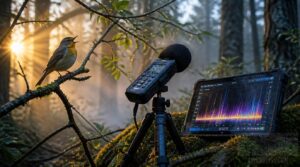
Once your ears catch a phrase, capture it. A portable field recorder with weather sealing and a good windscreen cuts gusty noise by 6–12 dB, preserving clean audio for later review.
Set your device to 44.1–96 kHz, log GPS and weather metadata, and orient the mic toward likely perches.
Acoustic analysis software then extracts spectrograms for review:
- Segment files into 5–10 minute clips
- Add silence buffers before/after
- Record during dawn chorus
- Tag species and confidence
- Cross-check with visual sightings
Choosing and Using Bird Song Identification Apps

Your ears can only take you so far without backup. That’s where sound ID apps come in, turning your phone into a trained acoustic partner. Here’s what to know before picking one and putting it to work in the field.
Overview of Top Sound ID Tools
Sound ID technology borrows heavily from music recognition, and it shows. Audio fingerprinting turns bird songs into digital signatures matched against catalogs spanning millions of recordings.
Merlin Bird ID, trained on 750,000 clips, recognizes over 2,000 species. Real-time recognition speed matters too—clear recordings identify in under 2 seconds. Metadata accuracy, confidence scores, and clean interfaces separate the reliable tools from the rest.
Features, Offline Use, and Accuracy
Trail into the backcountry, and matching speed means little without an offline database stored locally. Local processing keeps identification running without signal, though accuracy hinges on:
- Database size and species coverage
- Microphone quality filtering wind noise
- Battery-conscious low power mode
Regional dialects can still throw off exact matches, even offline.
Real-time Suggestions in The Field
Once your app’s loaded with local reference data, the real magic happens live. Live audio fingerprinting analyzes each song fragment in 1-3 second windows, generating realtime suggestions within 2-5 seconds.
On-device detection speed matters here—MFCCs and spectral contrast build a fingerprint in under 50 milliseconds, ranking possible matches almost instantly. Watch for signal uncertainty badges; they flag weak recordings before you commit to an ID.
Tracking Sightings and Building Life Lists
Confirming a new species by song deserves proper documentation, not just a mental checkmark. Your birdwatching app should log species, date, location, and observation method automatically. Attach photo or audio evidence for lifer verification, then export everything into your life list.
Adjust privacy settings for sensitive habitats, and let your sightings feed citizen science databases—your digital scrapbook grows richer with every logged bird observation.
Advanced Techniques: AI, Spectrograms, and Citizen Science

Mastering bird song by ear will take you far, but technology can sharpen your edge even more. Behind every app suggestion sits a web of neural networks, spectrograms, and millions of recordings shared by birders like you. Here’s what’s actually happening under the hood, and how you can put it to work.
How AI Models Identify Songs
How does an app pinpoint a warbler’s song in seconds? Neural network architectures convert audio into spectrograms, then apply spectral pattern recognition to isolate melodic shapes.
Feature extraction methods pull timbre and pitch contour, while temporal sequence modeling tracks phrases over time. Audio fingerprinting technology cross-checks these signatures against vast databases—delivering identification with a decisive edge in accuracy.
Community-Contributed Training Data
Behind every accurate ID sits thousands of volunteer recordings. Citizen science fuels these classifiers through:
- Crowd moderation workflows flagging misidentifications
- Volunteer annotation quality checks with confidence levels
- Metadata inclusion (location, equipment, timestamps)
- Dataset licensing terms protecting provenance
- Consent-based sharing respecting sensitive habitats
This ethical scaffolding lets classifiers generalize across dialects—turning scattered field recordings into trustworthy species detection at scale.
Spectrogram Analysis for Birders
A spectrogram turns birdsong into something you can actually see: frequency climbing the vertical axis, time marching across the horizontal, and brightness marking amplitude.
Trace the frequency contour—rising, falling, or flat—and count harmonic lines stacked above the main tone. Temporal resolution exposes syllable count and spacing. Even noisy recordings reveal usable shapes, letting you compare acoustic fingerprints against known templates confidently.
Leveraging Citizen Science Platforms
Every recording you upload joins a global effort—your backyard sparrow becomes a data point for conservation science.
Platforms like eBird and Zooniverse turn casual birdwatching into structured research through peer learning and consensus tagging.
- Upload geotagged, timestamped audio to sharpen regional accuracy
- Check confidence scores before submitting identifications
- Join projects spanning six continents
- Help train AI models recognizing songs and calls
Gamified badges keep you motivated, while transparent data licensing ensures your bird observations fuel real conservation decisions worldwide.
Frequently Asked Questions (FAQs)
How do you identify a bird song?
Funny how many birders own binoculars but can’t name a single call. Real mastery starts with your ears: track rhythm and tempo, pitch contour, and timbre. Break each phrase into motifs, note the season, and aural recognition becomes second nature.
How does bird song identifier work?
Machine learning algorithms drive the process: feature extraction methods pull spectral shapes from your recording, then real-time database comparison matches patterns against known vocalizations, generating a confidence score so you can verify the automated detection yourself.
Can you learn bird identification using song & calls?
Absolutely, aural recognition skills develop through consistent ear training. Pairing territorial songs with contact calls builds pattern recognition, letting you distinguish species by pitch, tempo, and rhythm—no visual confirmation needed, just focused listening.
Can you identify birds by sound?
Yes — pitch, tempo, and phrase structure form each species’ acoustic fingerprint. With practice, aural recognition skills let you distinguish overlapping vocalizations by ear alone, turning dense soundscapes into readable clues for confident, sound-based bird identification in the field.
What is the best app for identifying birds by song?
Merlin edges out BirdNET for most users: 2,000+ species, real-time spectrogram display, easy eBird connection, and offline packs for remote fields. BirdNET’s strength lies in its deep learning classifier and crowdsourced accuracy—both apps reward consistent, careful recording practice.
Can Google identify birds by sound?
Picture a hiker on a Pixel phone catching a warbler’s trill mid-trail—Google’s Now Playing flags it instantly.
Yes: on-device sound search analyzes acoustic patterns in real time, offering confidence levels privately, though overlapping calls can still trip up accuracy.
Is there a Shazam for birds?
Merlin’s Sound ID works exactly like that: real-time recognition, offline capability once packs download, and accuracy trained on 750,000 recordings.
BirdNET offers similar power, feeding citizen science databases while helping you master bird songs and calls through instant audio analysis.
Is Merlin Bird ID really free?
Too good to be true? Not here. Merlin’s Sound ID and Bird ID Wizard stay completely free, backed by Cornell Lab’s research mission—no premium tiers, no hidden costs, just full access to identify bird songs and calls anytime.
What is bird song identification?
Every species carries an acoustic signature—a distinct frequency pattern shaped by regional dialects. This sound pattern matching lets you identify hidden birds through hearing alone, no visual confirmation needed, while sharpening your ear for true species recognition mastery.
How do you identify birds by their songs?
Break it down into pitch contour, rhythm, and note duration, then match those patterns against mnemonic aids and verified recordings. Apps like Merlin or BirdNET compare your field recording’s acoustic fingerprint against thousands of confirmed bird songs and calls.
Conclusion
Every forest is a symphony, and you now hold the score. Bird identification based on song transforms scattered notes into names, territories, and unfolding stories in the canopy above you. That hidden warbler you once ignored? Now it’s a data point, a signature, a true neighbor.
Eighty-two thousand hours of citizen recordings sharpened this skill before you arrived. Keep listening closely. The birds were talking all along—you just needed the trained ear to translate them.
- https://www.nature.com/articles/s44384-025-00025-6
- https://arxiv.org/html/2511.19275v1
- https://apps.apple.com/us/app/merlin-bird-id-by-cornell-lab/id773457673
- https://www.cambridge.org/core/journals/behavioral-and-brain-sciences/article/birdsong-dialects-and-humanlanguage-dialects/74914247546381C84540889FC6B6BE5E
- https://merlin.allaboutbirds.org