This site is supported by our readers. We may earn a commission, at no cost to you, if you purchase through links.
Florida runs eleven species of owl — and most people sharing the state with them have no idea. The Great Horned Owl roosting in a suburban live oak. The Barn Owl threading silently over a Panhandle pasture at midnight. The tiny Burrowing Owl standing sentinel outside a sandy burrow on a golf course fairway, watching you as calmly as a neighbor checking the mail.
Owls of Florida range from year-round residents to rare Arctic visitors blown south when lemming populations crash up in the tundra. Knowing which species you’re dealing with changes everything — the habitat, the call, the behavior, the conservation status. Each bird tells you something different about the landscape it chose.
Whether you heard something in the dark last night or spotted a small brown shape perched impossibly still against a tree trunk, what follows gives you the tools to figure out exactly what you saw.
Table Of Contents
- Key Takeaways
- Common Owl Species in Florida
- Rare and Uncommon Owls of Florida
- Identifying Florida Owls: Features and Calls
- Florida Owl Habitats and Behaviors
- Top Owl Guides and Posters for Florida
- Frequently Asked Questions (FAQs)
- Are there owls in Orlando?
- Where do burrowing owls live in Florida?
- How many owls are in Florida?
- Do owls live in Florida?
- Are there Barn owls in Florida?
- What is the tiniest owl in Florida?
- What is the most common owl in Florida?
- Is it good to have an owl in your yard?
- What is the largest owl in Florida?
- How many types of owls are there in Florida?
- Conclusion
Key Takeaways
- Florida supports eleven owl species, ranging from year-round forest residents like the Barred Owl to rare Arctic visitors like the Snowy Owl, each tied to a distinct habitat and ecological niche.
- You can identify most Florida owls by combining three field cues — silhouette shape, eye color, and vocalization — since species like the Barred Owl’s "Who cooks for you?" call and the Barn Owl’s heart‑shaped disc are reliably distinctive.
- The Burrowing Owl stands apart from all other Florida owls by nesting underground, hunting during daylight hours, and holding State Threatened status due to rapid habitat loss from grassland fragmentation.
- Florida’s owls have quietly adapted to urban and suburban environments, with Eastern Screech‑Owls and Barred Owls using nest boxes, street trees, and green corridors to thrive alongside human development.
Common Owl Species in Florida

Florida is home to five owl species you’re likely to cross paths with, whether you’re birding deep in a cypress swamp or just stepping out to your backyard at dusk. Each one has its own look, sound, and habits that make it worth knowing. Here’s a closer look at what makes each species distinct.
If you want a deeper dive into each species’ range and behavior, this guide to owls found in Florida year-round is a great place to start.
Great Horned Owl
Few Florida owls command attention quite like Bubo virginianus, the Great Horned Owl.
Measuring up to 25 inches long with a 57-inch wingspan, it’s built for serious nocturnal hunting — silent flight and talon strength reaching 300 psi make it nearly unstoppable.
You’ll find it statewide, nesting in abandoned raptor nests, its deep resonant hoots carrying for miles on still nights.
They’re a year‑round resident status across the U.S., occupying diverse habitats from forests to urban areas.
Eastern Screech-Owl
Where the Great Horned Owl dominates by size, the Eastern Screech-Owl wins through invisibility. At just 6–10 inches, its bark-mimicking plumage — streaked gray or rufous — makes it nearly impossible to spot against tree bark.
- Nests in tree cavities up to 30 feet high
- Hunts at dusk and dawn, not just midnight
- Its descending whinny call echoes through suburban Florida woodlands
Barred Owl
Step up in size from the Screech-Owl and you’ll find the Barred Owl (Strix varia) — a stocky, round-headed bird with no ear tufts and dark brown eyes. Its horizontal chest bars and streaked belly make it unmistakable.
Riparian corridors and humid forests are its stronghold in Florida. That haunting "Who cooks for you?" call, often heard day and night, signals a fiercely territorial pair defending their cavity nest.
Barn Owl
The Barred Owl’s haunts give way to something ghostly — the Barn Owl (Tyto furcata). That heart-shaped facial disc funnels sound to asymmetrically placed ears, letting this bird pinpoint mice in total darkness. It nests in barns and silos across Florida’s open farmland.
Look for:
- Pale white underparts
- Near-silent feathered wings
- Man-made nesting sites
- Hunts open farmland
- Controls local rodent numbers
Burrowing Owl
Unlike any other owl on this list, the Burrowing Owl lives underground. Long legs suit ground pursuit perfectly, and males line burrow entrances with dung and dry plant material to mask scent from predators.
This State Threatened species defends territory from exposed perches near golf courses and open lots.
Beetles and grasshoppers make up most of its diet.
Rare and Uncommon Owls of Florida

Not every owl you spot in Florida is a year-round neighbor. Some species only pass through during migration or show up as rare strays far outside their normal range. Here’s a look at six owls you might be lucky enough to encounter — if the timing and habitat line up just right.
When you do spot one of these fleeting visitors, their bright yellow eyes make owls easier to identify in the field — a small but reliable clue when you’re watching a rare stray pass through.
Short-eared Owl
The Short-eared Owl turns up in Florida mostly as a winter visitor, drifting south when prey runs thin up north.
You’ll spot it cruising low over open grasslands and marsh edges at dawn or dusk, its pale, round face and dark‑rimmed eyes scan the ground.
Mottled brown plumage makes it nearly invisible at rest — a quiet ghost of open fields.
Long-eared Owl
Quiet and elusive, the Long-eared Owl is one of Florida’s most secretive winter visitors. Its ear tufts aren’t ears at all — just feather clusters that flatten during flight.
During the day, it roosts tightly against tree trunks, its bark-mimicry camouflage makes it nearly invisible.
At night, it hunts rodents using a patient sit-and-wait strategy over forest edges.
Northern Saw-whet Owl
The Northern Saw-whet Owl is easy to overlook — its compact body size tops out around 7 inches, smaller than a robin.
This rare vagrant reaches Florida only during winter irruption patterns, when prey collapses push the birds south from coniferous forests.
Look for its distinctive facial markings: bright yellow eyes framed by a bold white Y between them.
Elf Owl
The Elf Owl holds the title of smallest North American owl — measuring just 5.5 inches and weighing barely more than two sugar packets. In Florida, it’s an extreme rarity.
This desert nesting species favors saguaro cactus cavities in the Southwest, hunting insects nocturnally with near‑silent flight. Its rapid, yapping call is distinctive, but you’re unlikely to hear it here.
Snowy Owl
White as a snowdrift and built for Arctic tundra, the Snowy Owl is about as rare in Florida as frost in July. Weighing up to 3 kg with a 125–150 cm wingspan, it ranks among North America’s heaviest owls.
When lemming populations crash, irruptions push some individuals far south. Sightings here remain unusual — a genuine surprise for any birder.
Ferruginous Pygmy Owl
From Arctic giant to something far smaller — the Ferruginous Pygmy Owl sits at the opposite end of the size spectrum, standing just 15 cm tall with rufous-brown plumage, white-streaked underparts, and a long barred tail.
It favors mesquite and dry woodlands from Texas to Arizona, rarely reaching Florida.
Despite its tiny frame, it hunts lizards, insects, and small birds with surprising efficiency.
Identifying Florida Owls: Features and Calls
Knowing what to look for makes all the difference when you’re trying to put a name to an owl perched in the shadows. Florida’s species each carry a distinct set of clues — from body shape and plumage to the calls they broadcast at dusk. Here’s what to pay attention to across the most useful identification categories.
Visual Identification Techniques

Spotting Florida owls at dusk starts with reading silhouettes. Ear tufts separate the Great Horned Owl instantly, while the Barn Owl’s heart-shaped facial disc glows pale even in weak light.
Eye color helps too — vivid yellow versus deep brown narrows your choices fast. The Eastern Screech-Owl’s plumage camouflage morphs can fool you, so check the wingbeat: short and rapid, not slow.
Distinctive Hoots and Vocalizations
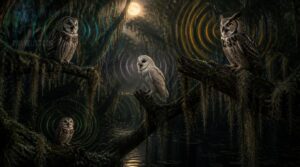
Once you’ve placed the silhouette, sound does the rest. The Barred Owl’s "Who cooks for you?" is unmistakable — a rolling, rhythmic phrase carrying through dense forest night or day.
Great Horned Owls deliver deep, booming sequences of five to eight hoots, while Barn Owls skip hooting entirely, opting for harsh, raspy screeches. Burrowing Owls keep it brief: short, repetitive "coo-coo" calls marking territory across open ground.
Size and Shape Comparisons
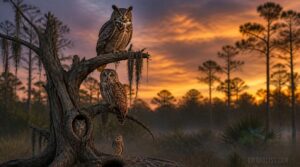
Sound fades at dawn, but size holds up in any light. Florida’s owls span a wide range — from the Great Horned Owl’s 57‑inch wingspan to the Burrowing Owl’s modest 24‑inch.
The Barred and Great Horned look similar, perched, but the Great Horned’s bulkier torso gives it away.
Burrowing and Screech-Owls both run small, though their silhouettes differ sharply.
Plumage Variations and Coloration
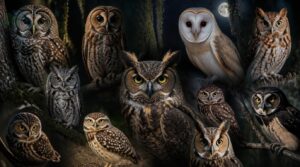
Feather color in Florida owls comes down to two pigments: melanin and carotenoids. Melanin produces the browns, grays, and blacks you’ll see on most species. Carotenoids, pulled from diet, warm up certain patches with yellow or russet tones.
Habitat shapes the rest. Forest owls run darker; grassland birds wear lighter tans. Seasonal molt briefly brightens plumage before daily wear dulls it back down.
Flight Patterns and Behavior

Watch how an owl moves — it’s another reliable ID clue. Flight style varies by species:
- Great horned owls sweep wide, swooping arcs across grasslands
- Barn owls use slow, deliberate wingbeats during dusk dives
- Barred owls lop between tree trunks chasing arboreal prey
- Burrowing owls make short, darting hops between low perches
Silent flight lets most species hunt completely undetected.
Florida Owl Habitats and Behaviors

Florida’s owls don’t all share the same address — each species has carved out its own niche across the state’s surprisingly varied landscapes. Where an owl lives shapes everything from how it hunts to when you’re most likely to spot one. Here’s a closer look at the habitats and behaviors that define Florida’s owl communities.
Forest Dwellers
Florida’s forest canopy hides some of its most devoted owl residents. The Barred Owl thrives in deciduous and coniferous forests, nesting in tree cavities while hunting rodents, amphibians, and even fish below. The Eastern Screech-Owl prefers hardwood stands, tucking into cavities up to 30 feet high.
Both species are quiet indicators of a healthy forest environment worth protecting.
Grassland and Open Area Inhabitants
Open grasslands belong to two clear specialists: the Burrowing Owl and the Short-eared Owl. Burrowing Owls nest underground in flat, open terrain — golf courses, airports, vacant lots — hunting insects and small mammals on foot.
Grassland fragmentation shrinks their territory fast. Managed burns help maintain the open structure these species depend on, keeping woody plants from crowding out critical hunting ground.
Wetland and Swamp Residents
Wetlands host several owls year-round. Barred Owls dominate here, hunting amphibians and rodents through flooded forest corridors connecting larger swamp blocks.
Four species to know:
- Barred Owl — swamp forest canopy
- Barn Owl — open marsh edges
- Great Horned Owl — wetland tree snags
- Eastern Screech-Owl — swamp cavities
Seasonal flooding concentrates prey and habitat, pulling owls into shrinking dry zones along marsh margins.
Urban and Suburban Adaptors
Cities aren’t just for people. Eastern Screech-Owls and Barred Owls have quietly claimed streetlight poles, nest boxes, and hollow fence posts as their own. Heat island effects can shift breeding timing, while suburban green spaces offer a reliable mix of rodents, large insects, and garden-edge prey.
Linear street trees and greenways serve as travel corridors, connecting roosts across neighborhoods with surprising efficiency.
Nocturnal Vs. Diurnal Activity
Most Florida owls hunt after dark, relying on enlarged eyes packed with rods to gather dim light and acute hearing to pinpoint prey movement.
The Burrowing Owl breaks that pattern entirely, foraging actively by day. That separation isn’t purely accidental — temporal niche competition keeps species from crowding the same hunting windows, while nocturnal activity also sidesteps Florida’s punishing daytime heat.
The Burrowing Owl hunts by day while most Florida owls claim the night, splitting hunting windows by instinct, not coincidence
Top Owl Guides and Posters for Florida
Whether you’re heading out at dusk to spot a Barred Owl or trying to learn the Burrowing Owl’s distinctive silhouette, having the right reference at your side makes a real difference.
A solid field guide or poster helps you connect what you see in the field to confirmed species traits, range maps, and vocalizations.
Here are a few resources worth keeping in your birding kit.
1. North America Owls Reference Book
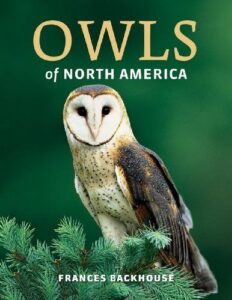
If you want one book that covers the full picture, the North America Owls Reference Book is worth keeping on your shelf. It profiles all 39 owl species found across North America, including Mexico and the Caribbean, with species-by-species accounts covering identification, calls, habitat, and behavior.
At $8.30 for a used hardcover, it’s an accessible reference rather than a glossy photo book. Expect 70 full-color photographs and detailed range maps — practical tools for any birder building their Florida owl knowledge.
| Best For | Birders, naturalists, park rangers, and educators who want a comprehensive, practical reference covering all 23 North American owl species. |
|---|---|
| Subject | North American Owls |
| Color Imagery | 70 full-color photographs |
| Geographic Scope | North America |
| Species Count | 23 species |
| Format | Hardcover book |
| Educational Use | Field reference & raptor programs |
| Additional Features |
|
- Covers all 23 North American owl species with detailed profiles, range maps, and 70 full-color photographs
- Great value at $8.30 for a used hardcover — solid reference without the steep price tag
- Useful across a range of settings, from field identification to classroom raptor programs
- Used condition may come with minor wear, markings, or other signs of previous ownership
- Text-heavy, fact-list format can feel repetitive across chapters
- Not a large-format photo book — imagery supports the information rather than taking center stage
2. Peterson Owls of North America Guide
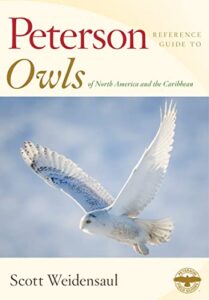
Scott Weidensaul’s Peterson Reference Guide to Owls steps things up a level. Where the previous book covers breadth, this one goes deep — all 40 North American species, hundreds of full-color photographs, and detailed breeding and wintering range maps that serious birders genuinely rely on.
At $28.01, it’s priced for the committed enthusiast.
The included owl vocalization recordings are where it earns its place on the shelf, letting you match a call heard at dusk to a species before the bird vanishes.
| Best For | Serious birders, ornithologists, wildlife managers, and educators who want a deep-dive reference on every owl species found across North America, Mexico, and the Caribbean. |
|---|---|
| Subject | North American Owls |
| Color Imagery | Hundreds of full-color photographs |
| Geographic Scope | North America, Mexico & Caribbean |
| Species Count | 39 species |
| Format | Hardcover book |
| Educational Use | Birders & wildlife managers |
| Additional Features |
|
- Covers all 39 owl species with hundreds of full-color photos and detailed range maps for breeding, wintering, and migration.
- Owl vocalization recordings let you match calls heard in the field to specific species — a huge plus for after-dark identification.
- Written by Scott Weidensaul as part of the trusted Peterson Reference Guide series, making it a go-to resource for serious study.
- It’s a large, heavyweight volume — not something you’ll want to carry into the field on a hike.
- The audio recordings depend on a separate device or internet connection, which isn’t always convenient outdoors.
- Physical dimensions and page count aren’t specified, so it’s hard to know upfront how it’ll fit on your shelf or in your bag.
3. Sibley Eastern Owls Poster
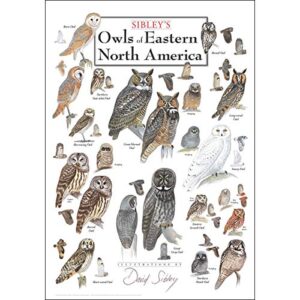
If the Peterson guide is your field companion, the Sibley Eastern Owls Poster is what belongs on your wall. David Allen Sibley illustrates all 13 eastern North American owl species — including Florida’s resident five — with the plumage accuracy serious birders expect.
Printed on fade-resistant 80 lb coated stock at 19 × 27 inches, the detail holds up close. It ships rolled in a protective tube for around $21.95, unframed — a practical, lasting reference you can actually hang.
| Best For | Birdwatchers, ornithology students, and nature enthusiasts who want a detailed, display-worthy reference for eastern North American owls. |
|---|---|
| Subject | North American Owls |
| Color Imagery | Full-color Sibley illustrations |
| Geographic Scope | Eastern North America |
| Species Count | 13 species |
| Format | 19×27 in poster |
| Educational Use | Classroom & nature centers |
| Additional Features |
|
- All 13 eastern owl species illustrated by David Allen Sibley, with plumage accuracy serious birders will appreciate
- Fade-resistant archival inks on 80 lb coated stock ensure lasting, museum-quality detail
- Ships securely in a heavy-walled tube, arriving ready to frame for home, office, or educational display
- Comes unframed, so you’ll need to budget extra for a frame before hanging it
- Brown-toned color palette may not suit every interior style or décor
- Best kept indoors — prolonged direct sunlight can shorten its lifespan over time
4. Western North America Owl Poster
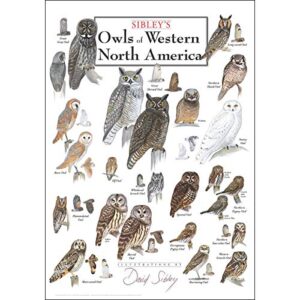
Sibley’s western counterpart covers 17 owl species found across western North America — a different lineup than Florida’s resident birds, but still a worthwhile addition for anyone building a serious reference collection.
The same 19 × 27-inch format and fade-resistant coated stock carry over, with precise feather patterns and posture cues you can compare side-by-side with the eastern poster. It ships in a heavy-walled tube, ready for framing. Think of it as the other half of a complete Sibley owl library.
| Best For | Birdwatchers, educators, and collectors who want accurate, museum-quality owl illustrations from western North America — especially anyone building a paired Sibley reference set alongside the eastern poster. |
|---|---|
| Subject | North American Owls |
| Color Imagery | Full-color Sibley illustrations |
| Geographic Scope | Western North America |
| Species Count | 17 species |
| Format | 19×27 in poster |
| Educational Use | Classroom & nature centers |
| Additional Features |
|
- All 17 western owl species illustrated with Sibley’s signature precision, including detailed feather patterns and posture cues
- Printed on fade-resistant coated stock with high production values, making it a long-lasting display piece
- Ships in a sturdy heavy-walled tube, so it arrives in great condition and is ready to frame
- At 19 × 27 inches, it’s smaller than a standard 24 × 36 poster, which may disappoint anyone expecting a larger format
- Framing or mounting is required for display, adding extra cost and effort beyond the purchase price
- The oversized mailing tube can be a bit unwieldy to handle or store after delivery
Frequently Asked Questions (FAQs)
Are there owls in Orlando?
Yes, owls are alive and well in Orlando. Eastern Screech-Owls, Barred Owls, and Great Horned Owls all call the city home, while Barn Owls and Burrowing Owls turn up in open areas.
Where do burrowing owls live in Florida?
Burrowing owls favor open, treeless areas — grassy lots, golf courses, airports, and pastures. In Florida, Cape Coral and southeast Florida hold the highest concentrations, where sandy soils and short groundcover make ideal nesting sites.
How many owls are in Florida?
Florida hosts five resident owl species year-round, with several rare visitors appearing seasonally. Birding organizations estimate thousands of individual owls occupy the state across forests, grasslands, farms, and urban areas.
Do owls live in Florida?
Owls are year-round residents across Florida. At least ten species call the state home, from dense cypress swamps to open grasslands and suburban backyards — making Florida one of the best places to spot them.
Are there Barn owls in Florida?
Barn Owls are native to Florida, present across open agricultural and rural landscapes. They nest in cavities, barns, and nest boxes, hunting rodents at night with their signature heart-shaped facial disk and eerie screech.
What is the tiniest owl in Florida?
Don’t let the name fool you — the Eastern Screech-Owl doesn’t actually screech. At just 6 to 9 inches tall and barely 4 to 8 ounces, it’s Florida’s tiniest owl.
What is the most common owl in Florida?
The Barred Owl holds the title here, showing up year-round across Florida’s forests, swamps, and streamsides. Its unmistakable "Who cooks for you?" call makes it one of the most heard owls in the state.
Is it good to have an owl in your yard?
Having an owl visit your yard is a real hoot — and a practical bonus. Owls consume dozens of rodents weekly, naturally reducing pest pressure without chemicals, making them quiet, effective allies in keeping your yard balanced.
What is the largest owl in Florida?
The Great Horned Owl is Florida’s largest owl, stretching 18–25 inches long with a wingspan reaching nearly 8 feet — a powerful, year-round resident built for hunting across forests, swamps, and suburban neighborhoods.
How many types of owls are there in Florida?
Like chapters in a field guide, Florida’s owls tell a layered story. The state hosts 11 owl species — five common year-round residents and six rare or occasional visitors that appear seasonally or during irruption years.
Conclusion
Like Merlin pulling meaning from shadow, you now read what most people walk past.
owls of Florida aren’t hiding — they’re waiting for the right set of eyes.
silhouette in a slash pine, a call stitched through warm night air, a small bird standing still on a fairway mound — each one a puzzle you can now actually solve.
Pay attention out there. Florida’s owls have always been watching you first.
- https://ivaenvironmental.com/burrowing-owl-in-florida-a-complete-overview-of-habitat-and-behavior
- https://myfwc.com/wildlifehabitats/profiles/birds/owls/burrowing-owl
- https://www.winterparklibrary.org/blog/court-owls
- https://www.allaboutbirds.org/guide/Great_Horned_Owl/overview
- https://blogs.ifas.ufl.edu/polkco/2019/11/06/commonly-confused-owls-in-florida