This site is supported by our readers. We may earn a commission, at no cost to you, if you purchase through links.
Florida hosts ten owl species — five permanent residents and five seasonal visitors drawn by shifting climates or collapsing Arctic food webs. This diversity includes ground-nesting birds like the Burrowing Owl, which digs six-foot tunnels beneath Cape Coral golf courses, and nocturnal hunters like the Barred Owls echoing across old-growth cypress swamps at midnight.
Such extremes—from ground-nesting birds dodging lawn mowers to Snowy Owls hunting coastal marshes after Canadian lemming crashes—underscore the remarkable adaptability of these predators. Their survival strategies span Florida’s varied ecosystems, from urban edges to pristine wetlands.
Whether you’re chasing a lifer for your birding list or simply curious about strange nocturnal calls near your home, understanding which owls inhabit your region transforms your perspective. Knowing their habits and habitats reveals the hidden dynamics of Florida’s wild spaces.
Table Of Contents
- Key Takeaways
- Native Owl Species in Florida
- Seasonal and Rare Florida Owls
- How to Identify Florida Owls
- Florida Owl Habitats and Behavior
- Top 4 Florida Owl Guides
- Frequently Asked Questions (FAQs)
- What are owls doing in October?
- Is it good to have an owl in your yard?
- What type of owls live in Florida?
- Do owls come out during the day in Florida?
- What do Florida owls eat?
- Are owls in Florida protected by law from hunting?
- How do owls in Florida adapt to extreme weather conditions?
- Can owls in Florida be kept as pets legally?
- What role do owls play in Floridas ecosystem balance?
- How do owls in Florida respond to human presence and noise?
- Conclusion
Key Takeaways
- Florida hosts ten owl species — five year-round residents and five seasonal visitors — each occupying a distinct niche, from the Great Horned Owl’s forest canopy to the Burrowing Owl’s underground tunnels in suburban golf courses.
- You can reliably identify Florida owls by combining five field markers: body size, call type, color pattern, eye color, and whether ear tufts are present or absent.
- Rare visitors like the Snowy Owl appear only when Arctic food sources collapse, while species like the Long-eared Owl are so seldom seen that the last confirmed Florida sighting was back in 2011.
- Florida’s owls face growing threats from habitat loss, rodenticide poisoning, and road strikes, but they’re protected under the Migratory Bird Treaty Act and benefit from active nest box programs.
Native Owl Species in Florida

Florida is home to five owl species you can find them here any time of year. Each one has carved out its own niche — from dense forests to underground burrows — and they’re more different from each other than you might expect.
From the tiny Eastern Screech-Owl hiding in your backyard oak to the commanding Great Horned Owl, you can learn to tell them apart by their calls using this guide to Florida owl sounds and species identification.
Here’s a closer look at all five.
Great Horned Owl
Meet Bubo virginianus — the Great Horned Owl — Florida’s most commanding year-round resident. Its historical range spans the entire state, from cypress swamps to your backyard.
Three things make it unforgettable:
- A five-note hoot that echoes through winter nights during mating displays
- Massive wing morphology built for silent, powerful strikes
- Juveniles dispersing widely before claiming their own territory
Its near‑silent flight adaptation and cryptic plumage enable stealthy ambush hunting. Keep your ears open at dusk.
Barred Owl
If the Great Horned Owl is Florida’s top predator, the Barred Owl is its sociable neighbor — a little smaller, a lot louder, and honestly more fun to spot.
| Feature | Details | Florida Notes |
|---|---|---|
| Size | 17–20 in, ~3 ft wingspan | Females noticeably larger |
| Habitat Preferences | Cypress swamps, hardwood forests | Northern and central Florida |
| Vocalizations | "Who cooks for you?" | Year-round territorial calling |
Its mating displays fill late-winter swamps with dueling hoots between pairs. Territory size stays consistent year-round — these owls don’t migrate.
Barn Owl
The Barn Owl (Tyto furcata) hunts in near-silence, a ghostly figure with a heart-shaped face. Its historical range spans Florida’s open farmlands and marshes, perfectly aligned with its habitat preferences.
Watch for moth-like flight patterns at dusk to identify its presence. Pellet identification beneath roost sites also confirms its activity.
Mating displays feature dramatic aerial swoops, while the installation of nest boxes genuinely boosts local populations.
Eastern Screech-Owl
From that ghostly barn owl, we shift to something smaller — but no less fascinating. The Eastern Screech-Owl is a permanent Florida resident packed into a 6–9 inch frame, available in gray or rufous morphs. Its trembling, whinny-like call makes owl vocalizations easy to recognize after dark.
Nest box optimization genuinely enhances breeding success rates, and light pollution effects increasingly shape where these adaptable little hunters thrive.
Burrowing Owl
Florida’s only ground-nesting owl, the Burrowing Owl, digs into sandy habitat preference — literally. You’ll find this state-threatened species in open grasslands, golf courses, and vacant lots.
Hunting insects by day (daytime activity is rare among owls), males and females show sexual role differentiation in prey selection.
Citizen science monitoring programs track burrow microclimate conditions, making these tiny birds one of the best birdwatching tips for Florida owls enthusiasts.
Seasonal and Rare Florida Owls
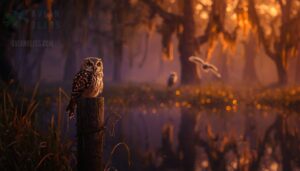
Not every owl you spot in Florida calls the state home year-round. Some show up for the winter, while others wander in so rarely that they cause birders to stop and stare.
Here are the seasonal visitors and rare surprises worth knowing about.
Short-eared Owl
If you’re lucky, you might spot a Short-eared Owl quartering a Florida pasture in December — its moth-like flight low and buoyant, almost hypnotic. This winter migration visitor thrives on vole dependence, following rodent populations through irruptive distribution patterns.
Diurnal activity makes it easier to observe than most owls. Watch open grasslands from November through March for your best chance.
Northern Saw-whet Owl
The Northern Saw-whet Owl is about as rare in Florida as a cold January — possible, but don’t count on it. Most Florida sighting history comes from overshoot migration patterns, where birds drift too far south during fall movements.
Here’s what makes this tiny owl worth knowing:
- Size — Only 17–22 cm long, smaller than a robin
- Sound-based surveys work best; its repetitive "too-too-too" carries through dense woods at night
- Microhabitat preferences lean toward thick coniferous cover and wooded edges
- Citizen science records document most Florida sightings in northeast counties during winter
- Range map shows Florida at the very edge of its occasional winter reach
Snowy Owl
Spotting a Snowy Owl in Florida is like winning the birdwatching lottery. This striking white giant appears through irruptive migration—when Arctic lemming populations crash, young owls push south in unusual numbers. Their diurnal hunting behavior makes them surprisingly visible during winter along coastal beaches and open marshes.
Population decline and human disturbance underscore the need to treat every encounter with serious respect.
Long-eared Owl
The Long-eared Owl is about as close to a ghost as Florida birdwatching gets. This lanky, secretive owl — with its dramatic ear tufts and camouflage-perfect plumage — is considered an accidental visitor here, with the last confirmed sighting at Dry Tortugas in 2011.
Its elusive nature stems from winter roosts, range shifts tied to prey specialization up north, and whisper-quiet habits. These factors make detection challenging, requiring techniques like patient dawn listening as your best bet.
Flammulated Owl
The Flammulated Owl is fundamentally a western stranger—its Western Breeding range sits far from Florida, centered in ponderosa pine mountains. Spring Migration occasionally pushes individuals far off course, making any Florida sighting genuinely accidental. No recent records exist.
Range shifts and Global Conservation concerns make each sighting meaningful. Genetic structure studies hint at isolated, vulnerable populations, underscoring the species’ precarious status.
- Tiny, bark-patterned, and nearly invisible
- Deep hoot surprisingly loud for a 6-inch owl
- Range shifts and global conservation concerns make each sighting meaningful
- Genetic structure studies hint at isolated, vulnerable populations
How to Identify Florida Owls
Spotting an owl in the wild is exciting — but figuring out which owl you’re looking at is a whole other challenge.
Florida’s owls each have their own set of field marks that make identification a lot easier once you know what to look for. Here are the five key features to focus on.
Size and Physical Characteristics

Five Florida owls showcase wildly different builds. The Great Horned Owl dominates, reaching up to 25 inches tall with a 145 cm wingspan and weighing 2.5 kg. In contrast, the Eastern Screech-Owl barely clears 9 inches in height.
| Species | Length & Weight | Wingspan |
|---|---|---|
| Great Horned Owl | 25 in / 2.5 kg | ~145 cm |
| Barn Owl | 16 in / slender build | ~107 cm |
| Burrowing Owl | 10 in / ~150 g | ~61 cm |
Leg length differences significantly influence their appearance. Barn Owls appear surprisingly tall for their size, while Burrowing Owls exhibit a distinctive upright, long-legged stance.
Distinctive Calls and Vocalizations

Once you know the sizes, ears become your next best tool — literally. Each Florida owl has a signature sound you won’t forget.
- Great Horned Owls rumble like a foghorn; females call first in territorial duet patterns
- Barn Owls shriek a distress scream that’ll stop you cold on a night walk
- Burrowing Owls rattle like rattlesnakes — rattlesnake mimicry that actually fools predators
Seasonal call shifts mean owl vocalizations change with breeding cycles, so learning calls year-round sharpens your identification fast.
Color Patterns and Camouflage
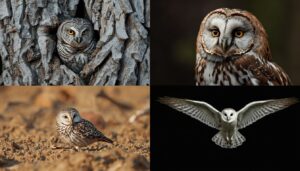
Sound got you this far — now your eyes take over. Florida owls are masters of Background Matching, pressing into bark and shadow until they practically vanish. Disruptive Markings like streaks and bars shatter their body outline at rest.
| Species | Pattern | Camouflage Strategy |
|---|---|---|
| Great Horned Owl | Mottled gray-brown | Forest Camouflage against bark |
| Barred Owl | Brown bars, pale belly | Deep woodland shadow blending |
| Barn Owl | Pale buff underparts | Open Ground Camouflage in low light |
| Eastern Screech-Owl | Gray or reddish-brown morph | Tight trunk-press, bark matching |
| Burrowing Owl | Sandy-brown speckled | Prairie soil and dry grass fade |
Seasonal Plumage stays fairly consistent year-round in Florida — no dramatic molts — but juveniles have softer, muted tones that help them hide near nest sites.
Eye Color and Facial Features
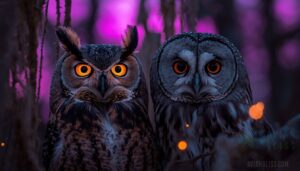
Eye color contrast reveals much when observing owls up close. Yellow eyes—like those of the Great Horned, Eastern Screech Owl, and Burrowing Owls—practically glow at dusk. Conversely, Barred and Barn Owls display dark, near-black eyes instead.
Facial disk shape also serves as a distinguishing feature. Barn Owls boast an unmistakable white heart-shaped disk, while Barred Owls present a rounder, pale frame. These subtle yet striking differences aid in identifying species, especially during low-light conditions.
Ear Tufts and Head Shape
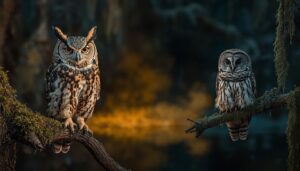
Ear tufts are your fastest field shortcut. That blocky, horned silhouette? That’s the Great Horned Owl — boldest tufts of any Florida owl. The Eastern Screech-Owl shows smaller peaked tufts. The Northern Saw-whet Owl has none at all.
Here’s what Tuft Position Dynamics mean for your identification guide to Florida owls:
- Raised tufts signal alertness — the owl looks taller.
- Flat tufts make a tufted species look round-headed, confusing Tufted vs Round identification.
- Silhouette Identification works best when Head Shape Clues align with size.
Tuft Flexibility Effects can genuinely fool you.
Florida Owl Habitats and Behavior

Florida’s owls aren’t picky — but they do have preferences.
From dense swamp forests to your own backyard, each species has carved out its own niche in the state’s wildly varied landscape.
Here’s a closer look at where they live, how they behave, and what makes each habitat tick.
Forest and Woodland Species
Florida’s woodlands and forest habitats are where two of your best owl encounters happen. Barred Owls dominate mature swamps and hardwood corridors, while Eastern Screech-Owls nest in cavities—though nest cavity competition between them is real.
Territory size, breeding phenology, and climate influence how these species spread across the forest.
Acoustic monitoring is essential for birdwatching Florida owls here.
Open Grassland and Prairie Owls
Regarding open grasslands and prairies, two owls really stand out: the Burrowing Owl and the Short-eared Owl. Both thrive in open habitats where short vegetation lets them spot danger fast.
Burrowing Owls are famous for their nesting habits — their burrow architecture can stretch six feet underground.
Citizen-science monitoring programs track how land-use impacts are shrinking these grasslands, putting both species under real pressure.
Urban and Suburban Owl Habitats
Owls have figured out city life better than you might think. Across Florida’s neighborhoods, mature trees, open lawns, and green corridor connectivity give several species everything they need.
- Great Horned and Barred Owls use parks and quiet suburbs for low‑light foraging
- Eastern Screech‑Owls thrive near wooded yards and artificial perch stations
- Burrowing Owls colonize vacant lots and golf courses
- Rodenticide awareness and citizen science surveys help protect urban and suburban owl presence in Florida cities
Nesting and Roosting Sites
owl sleeps says a lot about how it survives. Tree cavities offer natural predator shielding — dark, tucked-away, and easy to defend.
Barn Owls favor old structures; Screech-Owls thrive with proper nest box design.
Burrowing Owls face real burrow flood risk during heavy rains.
site fidelity means owls return to the same nesting and roosting sites — so protecting those habitat preferences pays off long-term.
Diet and Hunting Behavior
Think of each species as a specialist with a wildly different game plan. Great Horned Owls crush prey — talons exerting 28 pounds of force — while Barn Owls rely on auditory hunting tactics, their heart-shaped faces funneling sound with radar-like precision.
Great Horned Owls crush prey with 28 pounds of talon force, while Barn Owls hunt by sound alone
Pellet diet studies reveal that small mammals dominate most menus.
Burrowing Owls, though, make a daytime hunting shift during breeding, targeting insects mid-flight using nimble perch hunting strategies.
Year-round Residents Vs Seasonal Visitors
Florida has five year-round resident species — great horned, barred, barn, eastern screech, and burrowing owls — each showing strong habitat fidelity and population stability across their established ranges.
Winter shifts the picture. Prey seasonality up north drives short-eared owls and occasional snowy owls south, altering the seasonal distribution of owls in Florida.
Territory dynamics remain local; migration patterns bring the surprises.
Birdwatching Tips for Finding Owls
Dawn listening walks are your best bet — most Florida owls are vocal just after dark and again before sunrise.
Try calm, moonlit searches when wind won’t drown the calls. Watch low to the ground near burrows, scan thick evergreens for roosting shapes, and check beneath roost trees for pellets.
Quiet approach always wins.
Conservation Threats and Protections
Even spotting owls won’t matter for long if we don’t protect them. Florida’s owls face mounting pressure from habitat loss, road mortality, and rodenticide poisoning working through the food chain. Habitat fragmentation leaves fewer safe places to nest and hunt, pushing them toward conservation concerns.
Key threats include:
- Vehicles strike low-flying owls hunting roadside edges at night.
- Pesticide poisoning travels silently from contaminated rodents up to Barn and Great Horned Owls.
- Urban development fragments habitat faster than owls can adapt.
Thankfully, legal protection under the Migratory Bird Treaty Act helps, and nest box programs actively support Eastern Screech-Owls and Barred Owls in suburban areas. However, climate change impact on coastal wetlands adds another layer of pressure — but awareness is the first step toward real change.
Top 4 Florida Owl Guides
Having a solid field guide in your bag makes all the difference when you’re trying to tell a Barred Owl from a Barn Owl at dusk. The right resource won’t just help you identify what you’re looking at — it’ll tell you why it’s there.
Here are four guides worth keeping on your shelf.
1. Owls of North America Book
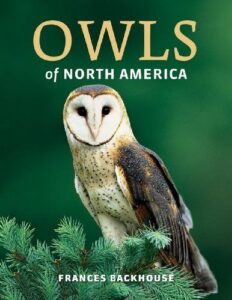
If you want one book that covers every owl you might see in Florida — and then some — Frances Backhouse’s Owls of North America is a solid pick. Published by Firefly Books, it profiles all 23 North American species with range maps, behavioral notes, and around 70 color photos.
At $26.40 for a used hardcover copy, it’s genuinely good value. The book’s practical design allows readers to quickly reference details about specific species, such as the Great Horned or Burrowing Owl, thanks to its clear chapter structure.
| Best For | Birders, naturalists, and students who want a practical, species-by-species reference for every owl found across North America. |
|---|---|
| Format | Hardcover Book |
| Subject | North American Owls |
| Price | $26.40 |
| Language/Origin | English |
| Visual Content | 70 color photos |
| Species Coverage | 23 species |
| Additional Features |
|
- Covers all 23 North American species with range maps and behavioral profiles — handy whether you’re in the field or just curious
- 70 color photos and diagrams make species ID straightforward and visually engaging
- At $26.40 for a used hardcover, it’s solid value for the depth of content you get
- Being a used copy, some wear is expected even in "good condition"
- Information tends to read as fact lists rather than flowing narrative, so it’s more reference book than cover-to-cover read
- Species chapters can feel repetitive, and it’s not a photo-heavy coffee-table book if that’s what you’re after
2. Peterson Guide to North American Owls
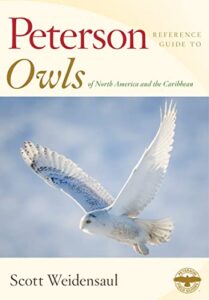
The Peterson Reference Guide to Owls of North America and the Caribbean is the kind of book you keep on your desk, not buried in a backpack. At $20.90, it covers 39 species — including rare tropical ones you won’t find in most guides.
You get detailed range maps, breeding and wintering routes, vocalization recordings, and hundreds of full-color photos.
It’s hefty at 352 pages, but that depth is exactly what makes it worth having when you really want to understand what’s out there.
| Best For | Serious birders, ornithologists, and wildlife educators who want a deep-dive reference on owls across North America, Mexico, and the Caribbean. |
|---|---|
| Format | Softcover Book |
| Subject | North American Owls |
| Price | $20.90 |
| Language/Origin | English |
| Visual Content | Hundreds of photos |
| Species Coverage | 39 species |
| Additional Features |
|
- Covers 39 species with detailed range maps, photos, and the only audio recordings of any North American owl guide
- Packed with research on behavior, habitat, nesting, migration, and conservation — all in one place
- At $20.90, it’s solid value for the depth you’re getting
- At 2.36 lb and 352 pages, it’s more of a home reference than something you’d toss in a field bag
- Audio recordings require an external device or internet access to use
- Only covers North America, Mexico, and the Caribbean — no help if you’re watching owls elsewhere
3. Sibley Eastern North America Owls Poster
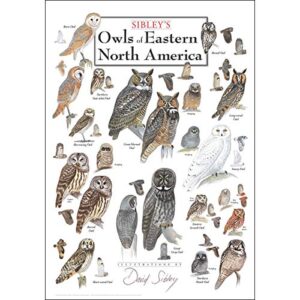
If you’re a visual learner, this poster is a transformational tool. David Allen Sibley—America’s go-to bird illustrator—packed all 13 eastern North American owl species onto a single 19×27-inch sheet, printed on fade-resistant 80-pound coated stock. The poster includes multiple views per species, featuring juveniles and flight poses, making it easier to distinguish a Barred Owl from a Spotted Owl.
At $24.95, it ships rolled in a sturdy tube and is designed to hang beautifully once framed.
Honestly, it’s the kind of thing you’ll actually look at every day.
| Best For | Bird lovers, students, and nature enthusiasts who want a beautiful, practical reference for identifying eastern North American owls. |
|---|---|
| Format | Poster |
| Subject | Eastern NA Owls |
| Price | $24.95 |
| Language/Origin | Made in USA |
| Visual Content | 13 illustrations |
| Species Coverage | 13 species |
| Additional Features |
|
- All 13 eastern owl species in one place, illustrated by David Allen Sibley — one of the most trusted names in birding
- Fade-resistant printing on quality coated stock means it’ll look sharp for years
- At $24.95, it’s an easy buy — arrives rolled in a protective tube and ready to frame
- Sold unframed, so you’ll need to budget extra time and money to get it wall-ready
- The 19×27 size is great, but it won’t work for every wall or small space
- No digital version included, so it’s purely a physical product
4. Western Owls Poster Earth Sky Water
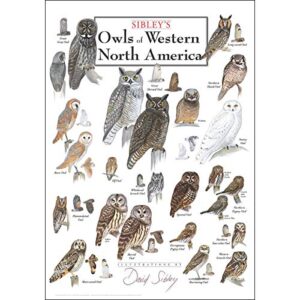
If your curiosity runs west of the Mississippi, this poster belongs on your wall too. Earth Sky + Water’s Sibley’s Owls of Western North America covers 17 species across a gorgeous 19×27-inch print — drawn to scale, grouped by region, and illustrated with Sibley’s trademark scientific accuracy.
While it won’t show Florida owls specifically, understanding western species sharpens your eye for shared traits like facial disk shape and ear tuft patterns. This makes it a smart companion piece for the seriously owl-obsessed.
| Best For | Birdwatchers, educators, and students who want a beautiful, scientifically accurate reference for western North American owl species. |
|---|---|
| Format | Poster |
| Subject | Western NA Owls |
| Price | Not listed |
| Language/Origin | Made in USA |
| Visual Content | 17 illustrations |
| Species Coverage | 17 species |
| Additional Features |
|
- David Allen Sibley’s artwork is as good as it gets — detailed, accurate, and genuinely lovely to look at
- 19×27 inches gives you enough real estate to see the species clearly, and it’s ready to frame right out of the tube
- Printed in the USA on quality coated stock, so the colors hold up over time
- At 19×27 inches, it runs smaller than a standard large poster — worth knowing before you pick out a frame
- No frame or mounting hardware included, so that’s an extra errand on your end
- Only covers western species, so if you’re east of the Rockies, you’ll need a separate poster for your local owls
Frequently Asked Questions (FAQs)
What are owls doing in October?
October is their version of coffee season — owls get loud, territorial, and restless.
Florida’s resident species ramp up nighttime calling, reinforce pair bonds, and scout nesting spots well before breeding begins.
Is it good to have an owl in your yard?
Yes — having an owl in your yard is genuinely good news. They’re natural pest control, quietly hunting mice and rats every night so you don’t have to.
What type of owls live in Florida?
Florida’s wild neighborhoods have quite a few permanent owl residents — five species call the state home year-round, while several others drop in seasonally during winter months.
Do owls come out during the day in Florida?
Most owls are night owls — literally. But yes, some do come out during the day in Florida, especially Burrowing Owls and Short-eared Owls, which are regularly spotted in daylight hours.
What do Florida owls eat?
Picture a silent hunter dropping from a branch — that’s dinnertime for a Florida owl. Most eat rodents, insects, frogs, and small birds, depending on the species and season.
Are owls in Florida protected by law from hunting?
Absolutely — every owl in Florida is protected under the federal Migratory Bird Treaty Act. Hunting them is illegal, full stop.
No season, no license, no exceptions without special federal or state permits.
How do owls in Florida adapt to extreme weather conditions?
They’re tougher than they look. Dense feathers insulate against cold snaps, burrows shield Burrowing Owls from storms, and nocturnal hunting helps all species dodge Florida’s brutal afternoon heat.
Can owls in Florida be kept as pets legally?
It sounds fun, right? However, this is not the case. Native owls are federally protected under the Migratory Bird Treaty Act, making private ownership illegal without special authorization.
Such authorization is typically reserved for rehabilitation, education, or licensed wildlife purposes only.
What role do owls play in Floridas ecosystem balance?
Owls act as nature’s pest controllers. They keep rodent and insect populations in check, prevent any one species from taking over, and signal overall ecosystem health through their presence.
How do owls in Florida respond to human presence and noise?
Florida’s owls are surprisingly adaptable neighbors. Most year-round residents, like burrowing and screech-owls, barely flinch at routine human noise — they’ve simply learned to live alongside you.
Conclusion
They say the night has a thousand eyes — and in Florida, quite a few belong to owls. From Burrowing Owls threading through Cape Coral suburbia to Snowy Owls ghosting coastal marshes after Arctic crashes, owls in Florida reward the curious and the patient alike.
Step outside after dark, tune your ears to the treeline, and let their calls guide you deeper into ecosystems most people never notice. The wild is closer than you think.