This site is supported by our readers. We may earn a commission, at no cost to you, if you purchase through links.
 You’ll find three main oriole birds in California that’ll brighten your backyard like living flames.
Hooded Orioles sport vibrant orange and yellow colors, while Bullock’s Orioles show off their striking black and orange plumage in open woodlands.
Scott’s Orioles prefer desert areas with their bold yellow bodies.
These songbirds aren’t just pretty faces – they’re grape jelly fanatics and will practically knock each other over for orange halves.
Spring brings their return from Mexico, filling California’s trees with their melodic songs.
The trick to attracting them isn’t rocket science, but knowing their favorite foods makes all the difference, as they are living flames and have a preference for orange halves.
Table Of Contents
- Key Takeaways
- Types of Orioles Found in California
- Identifying Hooded Orioles
- Attracting Hooded Orioles to Your Yard
- Hooded Oriole Nesting and Breeding
- Hooded Oriole Migration and Distribution
- Frequently Asked Questions (FAQs)
- What bird is mistaken for an oriole?
- How to attract orioles in California?
- What month do orioles come out?
- What is the difference between an oriole and a Baltimore Oriole?
- Are there any Orioles in California?
- How do you attract California Orioles?
- What is the yellow Oriole in California?
- How long do Orioles stay in Southern California?
- What role do Hooded Orioles play in their ecosystem?
- How do Hooded Orioles communicate with each other?
- Conclusion
Key Takeaways
- You’ll find three main oriole species in California: Hooded Orioles with their vibrant orange-yellow plumage, Bullock’s Orioles sporting black and orange colors with white wing patches, and Scott’s Orioles displaying bold yellow bodies in desert areas.
- Set up grape jelly feeders and orange halves to attract them: These birds can’t resist grape jelly (their absolute favorite) and fresh orange halves – use shallow dishes and maintain a 6:1 water-to-sugar ratio for nectar feeders with larger ports.
- They’re seasonal visitors who arrive in spring: Orioles migrate from Mexico starting in early April, with males arriving about a week before females to establish territories, then stay through mid-August before heading south again.
- You can expect active breeding behavior in your yard: Males defend territories with melodious songs while females build hanging basket nests (often in palm trees), incubate eggs for 12-14 days, and raise nestlings that fledge after another two weeks.
Types of Orioles Found in California
You’ll encounter two main oriole species that call California home during the warmer months: the Hooded Oriole and Bullock’s Oriole.
These bright orange and black beauties arrive from their winter homes in Central America each spring, turning your backyard into a colorful show that’s better than cable TV.
Hooded Oriole
You’ll often spot Hooded Orioles flashing their brilliant orange-yellow plumage variation across California’s palm-studded landscapes.
These adaptable California birds earned the nickname "Palm-leaf Oriole" for their clever urban adaptation – weaving basket-shaped nests beneath palm fronds.
Males showcase striking black throats contrasting with flame-colored hoods, while their melodious song characteristics include clear whistles that’ll make any birdwatching California enthusiast smile.
To attract more birds, consider adding native plants to your yard.
Bullock’s Oriole
Bullock’s Orioles showcase brilliant male plumage with flaming orange bodies and jet-black caps.
These California birds prefer open woodlands and urban parks, making oriole habitat identification straightforward.
Distinguished from Hooded Orioles by their prominent white wing patches, males sing melodious songs from treetops while defending territories.
- Striking jet-black eye-line cuts through bright orange face
- Large white wing patches flash like beacons during flight
- Females display subtle yellow-gray beauty with delicate markings
- Their pendant nests sway gracefully from cottonwood branches
Identifying Hooded Orioles
Spotting Hooded Orioles among California birds requires keen observation of key features. Distinguishing males showcases bright orange plumage variations with black throats and backs, lacking the eye line found on Bullock’s Orioles.
Female identification becomes easier when you notice their yellowish heads and subdued wing bars compared to flashy males. Juvenile markings mirror females but appear duller overall.
Listen for their vocalizations – sweet whistles and warbling songs that echo through palm trees. Bird identification success depends on recognizing that oriole identification involves multiple clues.
General shape and size can further refine species identification. These oriole birds prefer urban areas with palms, making backyard Hooded Oriole spotting quite achievable for patient observers.
Attracting Hooded Orioles to Your Yard
You can turn your backyard into a hooded oriole hotspot by setting up the right feeders and food sources that these colorful birds can’t resist.
With a few simple tricks like grape jelly feeders and fresh orange halves, you’ll have these stunning orange visitors showing up regularly at your yard.
Use Homemade Jelly Feeders With Grape Jelly

Since you want oriole birds to visit your yard, create homemade jelly feeders using grape jelly—their absolute favorite.
These California birds can’t resist this sweet treat, making bird feeders irresistible.
Focus on jelly feeder safety by using shallow dishes and proper feeder placement strategies.
Regular jelly feeder maintenance keeps your oriole diet supplement fresh and appealing.
To further enhance your setup, consider brightly colored feeders to attract these beautiful birds.
Offer Orange Halves or Hummingbird Feeders With Larger Ports

When attracting Hooded Orioles, orange halves work like magnets for these California birds.
Mount fresh orange halves on specialized bird feeders or use nectar feeders with larger feeder port size to accommodate their curved beaks.
These oriole birds can’t resist the sweet citrus juice, making orange half placement essential for attracting more orioles to your yard.
To further entice them, remember to clean feeders regularly to prevent mold.
Maintain a Sugar Concentration of 6:1 (water:sugar by Volume)

When creating nectar for Hooded Oriole feeders in California, mix 6 parts water with 1 part sugar for optimal sweetness.
This concentration matches natural flower nectar that oriole species prefer. Unlike hummingbird solutions, this milder mixture prevents overwhelming these birds’ taste preferences.
Clean your nectar feeders weekly to maintain feeder hygiene. The concentration impact directly affects attraction success for bird feeders.
Avoid Using Orange Halves for Effectiveness

Orange halves won’t cut it for attracting California’s hooded orioles.
These picky eaters prefer concentrated sweets over citrus. Smart bird feeding means ditching the oranges for better alternatives that actually work.
Here’s why orange halves have limitations and what works instead:
- Nectar feeder benefits – Higher sugar concentration keeps orioles coming back
- Jelly feeder advantages – Grape jelly mimics their natural sweet preferences
- Alternative fruit options – Ripe berries and grapes beat oranges every time
- Balanced oriole diet – Multiple food sources support healthy Bullock’s and hooded oriole species
Install Ant Guards to Protect The Feeders

Ants can turn your oriole feeder into their personal buffet, leaving these stunning California birds empty-handed.
Ant guards create an invisible barrier that keeps these pesky invaders away from your grape jelly and nectar.
Think of them as bouncers for your backyard bird restaurant—they let the Hooded and Bullock’s Orioles feast while keeping unwanted guests out.
You can find ant guard oriole products online to help protect your feeders.
| Ant Guard Feature | Best Practice |
|---|---|
| Ant guard types | Moat-style or cone barriers work best |
| Placement is key | Position guards between pole and feeder |
| DIY ant guards | Use petroleum jelly on smooth surfaces |
| Cleaning ant guards | Rinse weekly with warm soapy water |
| Natural ant deterrents | Sprinkle cinnamon around feeder base |
Hooded Oriole Nesting and Breeding
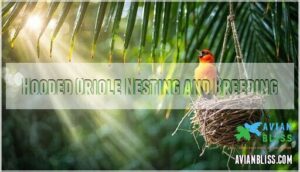
When you spot a male Hooded Oriole belting out his territorial song from a palm tree, you’re witnessing the start of California’s most fascinating backyard breeding drama.
You’ll discover that these orange beauties follow a precise timeline, with females carefully incubating their eggs for about two weeks while males stand guard like feathered security guards.
Males Defend Territories With Song
Hooded oriole males belt out distinctive songs to claim prime real estate during breeding season.
Their song repertoire size directly impacts breeding success rates – the more varied tunes, the better their chances.
You’ll notice male aggression levels spike when rivals approach, with song quality signals broadcasting fitness to potential mates and warning competitors in California’s diverse habitats.
Females Incubate Eggs for 12-14 Days
Once males establish their territories, female Hooded Orioles take over egg-sitting duties.
She’ll spend 12-14 days keeping her clutch warm, rarely leaving except for quick food runs.
This incubation period determines hatching success rates for these oriole species:
- Temperature control – She maintains consistent warmth through body heat
- Egg rotation – Regular turning guarantees even development
- Predator vigilance – Constant awareness protects vulnerable nests
Nestlings Fledge About 14 Days After Hatching
After two weeks in their hanging basket nest, young Hooded Oriole nestlings take their first brave leap into the California sunshine.
Both parents continue Parental Care for several days, teaching Fledgling Behavior and protection from Nestling Predators.
This Post-Fledge Survival period determines whether these oriole species will thrive in California’s diverse habitats.
| Development Stage | Timeline | Key Features |
|---|---|---|
| Fledgling Development | Days 14-21 | Wings strengthen, flight skills improve |
| Parental Guidance | 1-2 weeks post-fledge | Parents teach foraging, territory boundaries |
| Independence | 3-4 weeks total | Young orioles disperse from natal territory |
| Survival Rate | Variable | Depends on predator avoidance, food availability |
Hooded Oriole Migration and Distribution

You’ll find these feathered travelers spending their winters enjoying Mexico’s warm climate before making their spring journey north to breeding grounds across California, Arizona, and New Mexico.
Like clockwork, they arrive in California around early April, with males showing up about a week before the females to claim the best territories.
Winter in Mexico
After breeding season wraps up, these vibrant oriole species set out on their southward journey.
Migration patterns lead them to Mexico’s southwestern regions, where food availability remains abundant through winter months.
You’ll find them thriving in these warmer climates:
- Coastal Mexico – Rich insect populations and tropical fruits
- Desert oases – Reliable water sources and shelter
- Agricultural valleys – Consistent nectar and berry supplies
Spread Into New Mexico, Arizona, and California
Following migration routes like feathered highways, Hooded Orioles showcase impressive range expansion across the Southwest.
Climate influence and resource availability drive their habitat adaptation into California, Arizona, and New Mexico.
Unlike Bullock’s Oriole, these western birds prefer palm-studded suburbs.
Competition effects remain minimal as oriole migration patterns establish new breeding territories in human-modified landscapes.
Frequently Asked Questions (FAQs)
What bird is mistaken for an oriole?
You’ll often confuse Baltimore Orioles with Bullock’s Orioles since they’re closely related and share similar orange-black coloring.
American Robins and Western Tanagers also fool birdwatchers with their orange-red plumage and comparable size.
How to attract orioles in California?
Orange slices work like magic to attract California’s orioles.
You’ll also want grape jelly in shallow dishes, nectar feeders with 6:1 sugar solution, and ripe fruits like cherries or berries in your yard.
What month do orioles come out?
You’ll spot orioles arriving in California during March and early April as spring migration begins.
Males typically show up about a week before females, establishing territories and starting their melodious courtship songs.
What is the difference between an oriole and a Baltimore Oriole?
Baltimore Orioles aren’t found in California—they’re an eastern species.
You’ll see Bullock’s and Hooded Orioles instead.
All orioles share similar bright orange coloring, but each species has distinct markings and ranges.
Are there any Orioles in California?
While East Coast birdwatchers boast about Baltimore Orioles, you’ll find California hosts its own stunning species.
You can spot vibrant Hooded and Bullock’s Orioles throughout the state from March to August during breeding season.
How do you attract California Orioles?
You’ll attract California’s colorful orioles by offering orange slices, grape jelly in shallow dishes, and nectar feeders with 6:1 water-to-sugar ratio.
Place feeders near palm trees where they naturally nest and forage.
What is the yellow Oriole in California?
California’s most dazzling yellow bird is the Scott’s Oriole.
You’ll spot this sunshine-colored beauty with its jet-black head, wings, and tail contrasting brilliantly against its flaming yellow body in desert regions.
How long do Orioles stay in Southern California?
You’ll spot orioles in Southern California from early April through mid-August during their breeding season.
These vibrant birds then migrate south to Mexico for winter, though some stick around year-round at backyard feeders.
What role do Hooded Orioles play in their ecosystem?
Picture these vibrant orange birds weaving through your garden like tiny ecosystem engineers.
You’ll find Hooded Orioles pollinating flowers while sipping nectar, dispersing seeds through their droppings, and controlling insect populations naturally.
How do Hooded Orioles communicate with each other?
You’ll hear male Hooded Orioles singing melodious whistles and trills before sunrise and throughout the day.
Females only sing at their nests, responding to their mates with clear, low whistles that vary between individuals.
Conclusion
**Amazingly, orioles can consume up to 17 grapes worth of jelly daily during peak feeding season.
Now you’re equipped to welcome these vibrant visitors to your California backyard.
Remember that grape jelly and orange halves work like magic, while proper feeder maintenance keeps ants away.
Whether you spot a Hooded Oriole’s golden flash or hear a Bullock’s melodic call, these oriole birds in California will reward your efforts with stunning displays and beautiful songs throughout spring and summer.