This site is supported by our readers. We may earn a commission, at no cost to you, if you purchase through links.
 American robins aren’t just spring’s cheerful messengers – they’re ecological powerhouses with surprising complexity.
These birds construct mud-reinforced nests using precise engineering, with females producing up to three broods annually. Their parenting reveals fascinating gender dynamics: males guard territories while females handle most childcare duties.
Beyond their backyard charm, robins of the USA tell a complicated story of adaptation and survival. They’re essential seed dispersers, moving plants across landscapes, and voracious insect controllers, consuming thousands of invertebrates daily.
However, habitat loss, pesticides, and climate shifts threaten their populations. Their seemingly simple red breast hides intricate behaviors that continue surprising researchers and revealing nature’s hidden connections.
Table Of Contents
- Key Takeaways
- Nesting Behavior
- Hatching and Development
- Parental Roles
- Ecological Importance
- Conservation Challenges
- Frequently Asked Questions (FAQs)
- What are some fun facts about American robins?
- What challenges do American robins face?
- What is the pre-migration phase of American robins?
- What is the myth about the American Robin?
- What is the story behind the robins?
- What is the Old Wives tale about robins?
- How rare is leucism in robins?
- How long do robins typically live in the wild?
- What is the average clutch size for second broods?
- How do robins defend their nests from predators?
- Conclusion
Key Takeaways
- You’ll discover robins aren’t just cheerful backyard birds – they’re ecological powerhouses that control thousands of insects daily and disperse seeds across landscapes, making them essential for maintaining ecosystem balance.
- You’ll find female robins are master architects who construct mud-reinforced nests with spider silk while handling most childcare duties, producing up to three broods annually with precise calcium management for strong eggshells.
- You’ll see robins face serious threats from habitat loss, pesticides, and climate change that disrupt their migration patterns and breeding success, making them important environmental indicators of ecosystem health.
- You’ll notice clear gender roles where males focus on territory defense and security while females handle nest construction and incubation, creating a partnership system that’s evolved for maximum offspring survival.
Nesting Behavior
You’ll discover that female robins construct their nests with remarkable precision, using dead grasses, twigs, and mud reinforced with spider silk to create sturdy homes for their three to five greenish-blue eggs.
The construction process requires careful attention to calcium levels, as females need extra calcium during evening hours to produce strong eggshells that allow proper oxygen exchange for developing embryos, which is crucial for the developing embryos.
Nest Construction
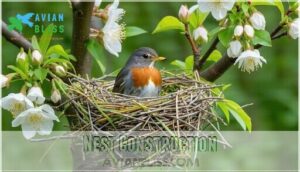
You’ll discover that robins craft intricate nests using carefully selected nest materials including grass, stems, and twigs.
These skilled architects secure their construction with spider silk and add mud reinforcement for durability.
The construction timeline spans several days as females work alone, often choosing prime nest locations they’ll reuse annually.
For supplemental resources, consider exploring robin nesting products.
Calcium importance becomes critical during this phase, as females require extra nutrients for the demanding building process ahead.
Egg Production

Female robins produce three to five greenish-blue eggs made of calcium carbonate. They increase calcium intake during evening hours to strengthen shells.
Each egg requires precise calcium levels for proper development. The blue-green coloration provides camouflage while maintaining shell integrity.
Robins need additional calcium sources for healthy egg production.
- Strong protective barriers against predators
- Ideal oxygen exchange for growing embryos
- Essential nutrients for chick development
- Proper hatching mechanics when ready
Incubation Process

With your eggs nestled safely in the nest, incubation begins immediately.
You’ll spend roughly 12-14 days maintaining consistent temperature regulation through dedicated parental care.
Turn each egg regularly to facilitate proper embryo development, while the calcium carbonate eggshell composition allows essential oxygen exchange.
Stay alert for predators during this vulnerable period, as your vigilant nest protection directly impacts hatching success.
This focused nesting behavior determines whether your clutch will successfully move from eggs to hungry nestlings.
Birds also use vocalizations to deter intruders.
Hatching and Development
After 12-14 days of careful incubation, you’ll witness one of nature’s most remarkable transformations as robin hatchlings break free from their calcium carbonate shells.
These helpless newcomers emerge blind and nearly naked, but their rapid development over the next two weeks will amaze you as they transform from vulnerable nestlings into feathered juveniles ready for their first flight.
Hatching Process

Emergence Timing follows nature’s precise schedule as robin eggs crack open after careful incubation.
You’ll witness hatchling vulnerability at its peak when blind, featherless babies emerge using their temporary egg tooth.
Shell strength determines successful hatching, while parental assistance becomes critical for survival.
Initial feeding begins immediately as parents respond to hungry chirps.
The hatching process reveals nature’s delicate balance:
- Tiny hearts beating – fragile lives beginning their journey
- Helpless chirping – desperate calls for warmth and food
- Protective parents – devoted guardians ensuring survival
- New beginnings – hope emerging from fragile shells
For those interested in controlled environments, consider a robin egg incubator.
Nestling Growth

Nestling growth occurs at a breathtaking pace, transforming helpless hatchlings into flight-ready juveniles within days.
Parents deliver food every 15-20 minutes, fueling rapid feather development and weight gain that doubles their size weekly.
This intense feeding frequency guarantees robust parental care, with each nestling consuming dozens of insects daily.
| Growth Milestone | Timeline |
|---|---|
| Eyes open | Day 5-6 |
| Pin feathers emerge | Day 7-8 |
| Feathers unfurl | Day 10-11 |
| Ready to fledge | Day 13-14 |
The remarkable growth rate prepares these future fliers for successful fledgling development, ensuring they are ready for the challenges ahead with rapid feather development.
Gender Differences
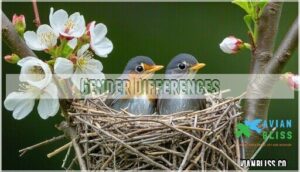
As nestling robins develop, you’ll spot clear gender differences emerging.
Male robin nestlings typically grow larger with brighter, more vivid coloration, while female robin counterparts remain smaller with subdued tones.
These size variations reflect different parental roles and mating behavior strategies.
Observable differences include:
- Male Plumage – Darker heads, brighter rust-colored breasts
- Female Nesting – More focused on nest-site evaluation behaviors
- Song Complexity – Males begin practicing territorial calls earlier
This sexual dimorphism shapes their future parental investment patterns and survival strategies.
Male robins, for example, exhibit more vibrant feathers.
Parental Roles
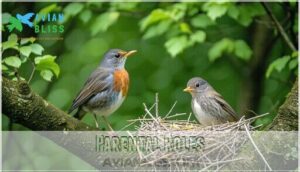
When you watch a robin family during breeding season, you’ll notice each parent has distinct responsibilities that guarantee their offspring’s survival.
The female robin takes on the demanding role of nest construction, egg laying, and incubation, while the male robin focuses on territory defense and providing security for the growing family through vigilant guarding and food gathering.
The male robin’s efforts are crucial as he provides security for the family, ensuring their safety and well-being through his actions.
Female Robin’s Role
You’ll observe the female robin taking complete charge of nest construction, painstakingly weaving twigs, grass, and mud into a sturdy cup.
She handles egg laying and incubation duties alone, requiring extra calcium for strong shells.
During chick feeding, she works tirelessly alongside her mate.
Females also exhibit lighter breast coloration compared to males.
However, she won’t hesitate with nest abandonment if conditions threaten survival, demonstrating remarkable parental roles prioritizing long-term reproductive success over single attempts.
Male Robin’s Role
Understanding territorial defense, male robins take on essential parental roles beyond mating behavior.
These territorial males establish boundaries through song complexity, using their melodious calls for both mate selection and nest defense.
- Territory Defense: Males patrol boundaries, chasing away intruders and potential threats
- Nest Guarding: They maintain vigilant watch while females incubate eggs
- Chick Feeding: Males assist in gathering insects and worms for growing nestlings
- Mate Selection: Their vibrant songs and displays help secure breeding partnerships
Ecological Importance

You’ll find that robins serve as nature’s unsung heroes, working tirelessly to maintain ecological balance through their daily activities.
These common backyard birds control insect populations, disperse seeds across vast distances, and create intricate connections within food webs that support entire ecosystems.
Seed Dispersal
American robins act as nature’s gardeners through seed dispersal, carrying plant genetics across vast distances.
You’ll find their berry-rich robin diet includes chokecherries, dogwood, and sumac, which pass through their digestive system intact.
These traveling seeds land in new locations via droppings, jumpstarting forest succession and plant growth.
This seed germination process creates diverse habitats, maintaining ecosystem harmony through interconnected food web dynamics.
Insect Control
American robins serve as nature’s pest regulation specialists, consuming thousands of insects daily through strategic foraging behavior.
Their diet diversity includes grubs, caterpillars, beetles, and aphids, providing essential natural insect control in urban ecology systems.
Seasonal variation affects their hunting patterns, with spring and summer bringing peak insect consumption rates.
- Foraging impact: A single robin can consume up to 14 feet of earthworms and countless insects per day
- Urban ecology: They patrol lawns, parks, and gardens, reducing pest populations without chemical intervention
- Seasonal variation: Spring breeding season intensifies their insect hunting to feed growing nestlings
Food Web Dynamics
Within food webs, you’ll find robins occupying intermediate trophic levels as both predators and prey.
They consume earthworms and insects while becoming meals for hawks and cats.
Their seasonal diet shifts—from protein-rich invertebrates during breeding to berries in winter—connect multiple food web channels.
This dietary flexibility makes robins essential for maintaining ecosystem health through balanced energy flow.
Robins also contribute to <strong>avian seed dispersal</strong>, influencing plant distribution.
Conservation Challenges

You’ll discover that American robins face mounting pressure from human activities that threaten their survival across the continent.
While these adaptable birds maintain stable populations overall, they’re increasingly vulnerable to habitat destruction, toxic pesticides, and shifting climate patterns.
That disrupt their ancient nesting rhythms.
Habitat Loss
Today’s robin habitat faces unprecedented threats from three main sources: 1) Agricultural expansion converts natural spaces into farmland, 2) Urban development fragments territories through sprawling construction, 3) Deforestation effects eliminate nesting sites.
Urban sprawl creates dangerous fragmentation impacts, forcing robins into smaller, isolated patches.
These habitat loss patterns disrupt migration routes and reduce breeding success, though reforestation efforts show promise for recovery.
Pesticide Use
After habitat loss, pesticide use lands robins in hot water.
Pesticide exposure leads to toxin bioaccumulation, causing population decline as eggs, hatchlings, and adults fall victim to pesticide poisoning.
Since robins are an environmental indicator, their struggles highlight bigger ecological importance.
To tackle these conservation challenges, consider simple mitigation strategies—like reducing chemical use—so insect control doesn’t come at nature’s expense.
Climate Change Impacts
Climate change disrupts robin migration patterns, with birds arriving 12 days earlier than in 1994.
Range shifts and temperature extremes create mismatches between arrival and food availability.
Breeding success declines when nests face late cold snaps or early heatwaves.
Rising temperatures also reduce nestling body size, affecting long-term survival rates.
Long-term monitoring helps track shifts in abundance and other climate impacts.
Frequently Asked Questions (FAQs)
What are some fun facts about American robins?
You’ll find these feathered spring heralds aren’t just pretty faces – they’re earthworm-eating machines.
They consume up to fourteen feet daily while using keen hearing to detect underground movement beneath your lawn.
What challenges do American robins face?
You’ll face pesticide poisoning from lawn chemicals, window collisions, predation by outdoor cats, vehicle strikes, and habitat loss.
Climate change affects their food sources, while diseases spread rapidly through populations, making survival increasingly challenging.
Diseases and climate change are key factors in the struggle for survival.
What is the pre-migration phase of American robins?
During autumn, you’ll notice robins gathering in flocks, shifting from territorial summer behavior to communal roosting.
They’re building fat reserves through increased berry consumption while their hormones trigger restlessness, preparing for winter migration south.
What is the myth about the American Robin?
You’ve likely heard robins can’t see worms but rather feel vibrations—that’s false. They actually use their keen eyesight to spot earthworms moving beneath soil surfaces, not ground tremors.
What is the story behind the robins?
You’ve encountered America’s most culturally complex bird. Robins symbolize spring’s arrival, yet they’re ecological powerhouses controlling insects, dispersing seeds, and serving as environmental health indicators despite facing pesticide threats.
What is the Old Wives tale about robins?
You’ve probably heard that robins signal spring’s arrival, but there’s an old wives’ tale claiming they predict weather changes by their behavior, nesting patterns, and migration timing.
How rare is leucism in robins?
Ever wonder how many robins you’ve seen with unusual white patches? Leucism affects roughly 1 in 30,000 to 100,000 robins, making it quite rare but not impossible to spot in your backyard adventures.
How long do robins typically live in the wild?
American robins typically live 2-3 years in the wild, though some reach 6-7 years. You’ll find their lifespan depends on predators, weather, and food availability affecting survival rates substantially.
What is the average clutch size for second broods?
Like a well-oiled production line, second broods typically contain three to four eggs, though you’ll occasionally see clutches ranging from two to five eggs depending on environmental conditions.
How do robins defend their nests from predators?
Robins defend their nests through aggressive behavior, including dive-bombing intruders, vocal alarm calls, and physical attacks.
Males primarily guard territories while females protect the immediate nest area through distraction displays and coordinated parental vigilance.
Conclusion
Through observation, study, and protection, you can appreciate how robins of the USA a complicated story unfolds in your own backyard.
These remarkable birds demonstrate nature’s intricate balance through their engineering skills, parental dedication, and ecological contributions.
Your understanding of their nesting secrets, development patterns, and environmental challenges helps preserve their populations.
Supporting robin conservation guarantees future generations will witness their dawn choruses, mud-crafted homes, and essential ecosystem services that connect forests to gardens, ensuring the continuation of their ecological contributions.