This site is supported by our readers. We may earn a commission, at no cost to you, if you purchase through links.
Most people spot their first American robin on a suburban lawn—that familiar russet-chested bird tilting its head, then yanking an earthworm straight from the ground. What surprises most is learning it’s not actually a robin at all. The name stuck when early European settlers saw that orange-red breast and thought of home, but Turdus migratorius belongs to the thrush family, making it a closer relative of the bluebird than the European robin it resembles in name only.
With roughly 370 million individuals ranging from Alaska to Mexico, it’s North America’s most widespread songbirds—and one of the most misunderstood.
Table Of Contents
- Key Takeaways
- Is The American Robin a Thrush?
- How to Identify an American Robin
- Where American Robins Live
- What American Robins Eat
- American Robin Nesting and Survival
- Song, Calls, and Territorial Behavior
- Nest Placement in Trees and Structures
- Nest Construction and Materials
- Eggs, Incubation, and Fledgling Development
- Brood Size and Breeding Season Timing
- Population Trends and Conservation Status
- Main Threats, Including Windows, Cats, and Pesticides
- How to Attract Robins With Water, Shelter, and Native Plants
- Frequently Asked Questions (FAQs)
- Is the American robin a thrush?
- What do American robins look like?
- Where do American robins live?
- How many American robins are there?
- Is the American Robin rare?
- What are some fun facts about American Robins?
- Where can you find American Robins?
- What does the American Robin look like?
- What do American Robins eat?
- What are 3 facts about the American robin?
- Conclusion
Key Takeaways
- Despite its name, the American Robin is actually a thrush (Turdus migratorius), more closely related to bluebirds than to the European robin it was mistakenly named after.
- With around 370 million individuals spread from Alaska to Mexico, its one of the most common birds on the continent — thriving everywhere from suburban lawns to mountain forests.
- Its diet flips completely with the seasons, leaning almost entirely on earthworms and insects in spring, then switching to berries and fruit for up to 90% of its winter diet.
- Robins face real modern threats — window collisions, free-roaming cats, and pesticide use — but you can help by adding a shallow birdbath, native berry shrubs, and reducing lawn chemicals.
Is The American Robin a Thrush?
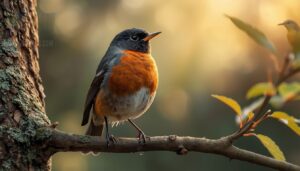
The American Robin’s name might make you think it belongs to one group of birds, but the full story is a little more interesting than that.
Despite the name, American robins are actually thrushes—and that lineage shapes everything from their behavior to how baby American robins develop in the nest.
Its scientific classification tells you a lot about where it actually fits in the bird family tree. Here’s what you need to know.
Scientific Name and Taxonomic Classification
The American Robin’s scientific name is Turdus migratorius — two Latin words that follow the rules of binomial nomenclature. Turdus is the genus, and migratorius is the species epithet, meaning "migratory." Together, they form one precise name recognized across every language.
It belongs to the order Passeriformes and the family Turdidae, placing it firmly within the thrush group.
Where It Fits Within The Thrush Family
Within Turdidae, Turdus migratorius belongs to Genus Turdus—a group of about 105 species spanning Europe, Asia, and the Americas. Its closest genetic relatives include Central American thrushes, such as the rufous-collared and rufous-backed thrush.
Shared traits across the family include:
- Plump bodies built for ground-foraging
- Cup-shaped nests with speckled eggs
- Seasonal diets of fruit and invertebrates
They also support thrush seed dispersal, which aids forest regeneration.
Why The American Robin is Not a True Robin
Despite the name, Turdus migratorius is not a true robin. The naming history traces back to English settlers in the early 1700s, who spotted its familiar reddish-orange breast and called it what they knew.
The evolutionary split, however, tells a different story. This bird belongs to the family Turdidae, while the European robin (Erithacus rubecula) falls under Muscicapidae. These different families and genera reflect a divergence separated by millions of years.
American Robin Vs. European Robin
Side by side, the two birds do not have much in common. The American Robin is nearly twice the size of Erithacus rubecula, the European robin, and sports a full brick-red chest rather than just a small orange face patch.
Their habitats, songs, and behaviors differ just as sharply — a gap shaped by millions of years of separate evolution, not just historical naming.
How to Identify an American Robin
Once you know what to look for, spotting an American Robin gets pretty easy. There are a handful of reliable clues — from body shape to feather color — that make this bird stand out.
Here’s what to pay attention to.
Size, Shape, and Overall Silhouette
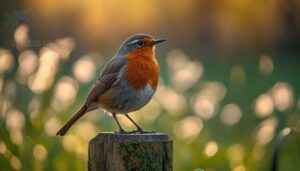
You can spot an American Robin from a distance by its distinctive sturdy, full-chested shape. Weighing 77–85 grams—roughly equivalent to three AA batteries—this bird boasts a plump silhouette, an upright posture supported by long legs, and a rounded to square-tipped tail.
Its wing roundness lends a smooth, steady look to its flight, making silhouette alone a reliable starting point for identification.
Key Plumage Markings and Coloration
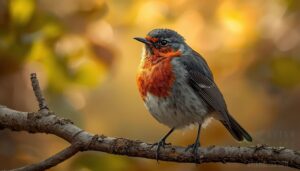
The robin’s bright orange-red breast is the first thing you’ll notice — a warm brick-red chest that pops against the gray back like a stop sign. Look closer and you’ll catch the white chin with dark streaks, white eye arcs framing a nearly black head, and small tail tip whites on a dark tail.
Juvenile breast spots replace that clean orange patch in young birds.
These speckled markings gradually fade as the bird matures, much like the subtle color variations seen in blue egg-laying bird species and their unique markings.
Male Vs. Female Differences
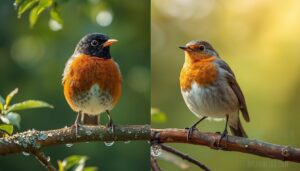
Most male American robins look noticeably bolder than females — darker heads, richer orange-red chests, and a sharper overall contrast. Once you know what to look for, sexual dimorphism makes identification of American Robin pairs straightforward.
Key differences include:
- Head color: Males appear nearly black; females show softer gray-brown
- Breast tone: Males carry a deeper, brick-red chest; females look washed out
- Male arrival on breeding grounds comes weeks before females
- Incubation duties and nest-building roles fall almost entirely to females
Juvenile Vs. Adult Features
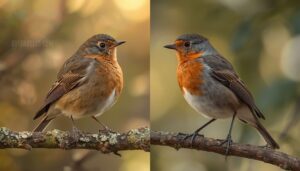
Young robins look almost like a different bird.
Breast Spotting is the fastest clue — juveniles carry heavy dark spots across their chests, while adults show a clean bright orange-red breast.
Check Wing Covert Color too: pale buff tips versus solid gray-brown in adults.
| Feature | Juvenile |
|---|---|
| Breast Spotting | Heavy dark spots |
| Wing Covert Color | Buff-tipped, pale |
| Plumage Tone | Duller overall |
| Tail Feather Differences | Narrower, less white |
| Molt Limits | Visible covert contrasts |
Bill, Tail, and Flight Pattern Clues
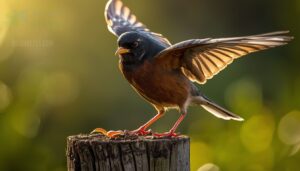
Three small details can lock in your ID fast. The yellow bill curves gently downward at the tip — perfect for pulling worms from soil.
Watch the tail during takeoff: white corners flash against dark feathers, acting like a rudder mid-flight.
Wingbeats follow a direct, steady path — no weaving, no erratic flicks.
That flat, undulating chirp seals it.
Where American Robins Live
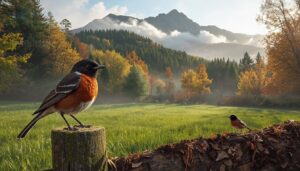
American Robins are one of the most widespread birds in North America, and they’re remarkably good at making themselves at home almost anywhere.
From your backyard to the edge of a mountain forest, these birds show up in more places than most people realize.
Here’s a closer look at where you’re most likely to find them throughout the year.
North American Range and Distribution
Few birds match the American Robin’s sheer continental footprint. Its latitudinal extent stretches from Alaska’s northern tree line down to Mexico’s mountain ranges — nearly 70 degrees of latitude.
Breeding density hotspots cluster across the southern Canadian prairies and north-central U.S. Subspecies distribution varies subtly across these wintering corridors, but range maps consistently confirm one thing: this thrush is ubiquitously everywhere.
Common Habitats in Towns, Parks, and Forests
You don’t have to venture far into the wilderness to find American Robins — your own backyard counts. Suburban lawn foraging is practically their signature move, and park meadow preference shows up every morning across city green spaces.
Here’s where robins thrive:
- Urban lawns — irrigated grass near hedges fosters rich earthworm activity
- Park meadows — short, sunlit fields ideal for run-stop foraging
- Forest Edge Corridors — trails and clearings mixing cover with open ground
- Dense shrubs and hedges — perfect hidden nesting spots between 1–3 meters tall
- Human Structure Roosting — eaves, ledges, and light fixtures substitute for trees in built-up areas
Edge habitat use ties it all together. Robins aren’t deep-forest birds or strictly urban ones — they thrive wherever open ground meets nearby cover.
Seasonal Habitat Shifts
Robins don’t stay put. When winter arrives, they swap open lawns for dense woodland patches packed with hollies, junipers, and crabapples — winter woodland foraging takes over entirely. Spring brings them back to your yard, claiming spring lawn territories the moment soil thaws.
| Season | Habitat | Key Behavior |
|---|---|---|
| Spring | Open lawns, suburban yards | Territory claiming, earthworm foraging |
| Winter | Woodlands, urban berry trees | Flock foraging, roosting in canopy |
| All Year | Mountain slopes (West) | Altitudinal elevation shifts up and down |
Urban winter refuges draw large flocks when countryside berries run thin. Weather-driven relocations occur rapidly — a hard freeze can move an entire flock overnight.
Migration Patterns Across The Year
Migration follows a loose schedule, not a fixed one. Spring arrival kicks off as early as February, with males pushing north ahead of females — sometimes by two full weeks. Fall departure stretches from September into November.
American Robin migration patterns shift with climate too; warmer winters have nudged robin migration timing about 12 days earlier since 1994.
Partial migration means some birds simply never leave.
Winter Flocking and Roosting Behavior
Once breeding wraps up, winter flocking behavior of American Robins kicks in quickly. Flock formation begins in late summer and builds through fall — sometimes reaching 250,000 birds at a single roost site.
These gatherings aren’t random. Dense swamps and berry-rich thickets offer thermal advantages on cold nights, while the group sharpens predator detection and shares food information about reliable fruit sources.
What American Robins Eat
American robins aren’t picky eaters, and that’s a big part of why they thrive almost everywhere. Their diet shifts with the seasons, which makes watching them feed genuinely interesting throughout the year.
Here’s a closer look at what they eat and how they find it.
Earthworms, Insects, and Other Invertebrates
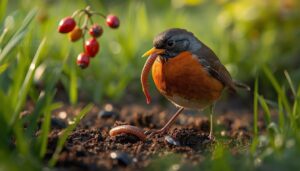
Observing an American Robin at work on a lawn showcases earthworm foraging in action, marked by rapid movements: a quick run, sudden stop, head tilt, and pull.
Earthworms form a daily staple, but beetle grub intake, caterpillar feeding, and snail calcium supplementation round out their invertebrate diversity.
Their diet and foraging habits cover 14 insect orders, highlighting the remarkable breadth of their ground foraging.
Fruits, Berries, and Seasonal Plant Foods
Beyond earthworms, fruit makes up roughly 60 percent of the American Robin’s yearly diet. Winter berry plants and native fruiting shrubs — staghorn sumac, Winterberry, American holly — become essential when the ground freezes.
Berry consumption peaks in cold months, and robins serve as quiet seed dispersal mechanisms, carrying seeds far from parent plants.
Fruiting trees and garden fruit feeders can draw them right to your yard.
How Diet Changes From Spring to Winter
The insect-fruit shift happens fast — almost like a switch flips. In April and May, protein demand is high, so robins hunt earthworms and insects almost exclusively, with berry consumption under 10%. Then fall arrives, and fruit jumps to over 90% of their diet.
From spring insects to fall berries, the American Robin flips its entire diet in a single season
This seasonal diet shift triggers real gut morphology changes: intestines actually shorten, and sugar absorption rises. Prey diversity reduction follows naturally.
Run-stop Foraging Behavior on Lawns
That run-stop foraging behavior you see on lawns across North America isn’t random. The American Robin runs about half a meter per second, then freezes for one to two seconds, head tilted, scanning for movement below the surface. Pause timing lengthens on rain-softened ground.
In flocks, birds adjust their flock coordination to avoid crowding. Shorter grass height means more successful stops — and fewer missed worms.
Feeding Habits in Urban and Rural Settings
Urban and rural yards aren’t equal for an American Robin. Where you live shapes what it finds on your lawn. Three key differences stand out:
- Lawn mowing impact keeps grass short, making earthworms easier to spot.
- Pesticide exposure shrinks worm populations, pushing robins toward fruit tree reliance.
- Human food subsidies like ornamental berries extend winter stays in cities, while rural robins depend on wild crops.
Lead contamination in city soils is a quieter threat — robins absorb it through worms.
American Robin Nesting and Survival
The American Robin puts a lot of energy into raising its young — from staking out territory with song to guiding fledglings out of the nest.
Understanding how robins breed, nest, and survive season after season gives you a much clearer picture of the bird you’re watching on your lawn. Here’s what you need to know.
Song, Calls, and Territorial Behavior
The American Robin’s voice is one of its most recognizable traits. Its cheerful carol—cheerily, cheer up, cheerily—rings out before sunrise as robins lead the dawn chorus. Males can repeat their song up to 2,000 times daily. When rivals encroach, a soft whisper song serves as a quiet warning, while alarm calls instantly alert others to nearby predators.
These vocalizations fulfill distinct roles: the cheerful carol is used for courtship and territory defense, primarily in early spring mornings; the whisper song mediates close-range territorial disputes; and alarm calls function as year-round predator alerts.
| Vocalization | Purpose | When You’ll Hear It |
|---|---|---|
| Cheerful Carol | Courtship and territory | Early morning, spring |
| Whisper Song | Close-range rival warning | During territorial disputes |
| Alarm Calls | Predator alert | Anytime, year-round |
Playback experiments further reveal that males actively sing back to simulated intruders, reinforcing their territorial behavior.
Nest Placement in Trees and Structures
Once you know how a robin sings to claim its space, it’s worth asking — where does it actually settle down? Robins are practical about nest site selection, favoring both trees and human structures.
Height preferences usually run 5–15 feet up, nestled in a Y-shaped fork where branch geometry naturally cradles a cup. Maples, oaks, and spruces are their favored trees, offering ideal spots for nesting.
But concealment strategies often pull robins toward your porch beam or gutter too.
Nest Construction and Materials
Once a robin picks her spot, the real work begins. She starts with a twig framework — rough sticks about six inches long — then packs mud mortar between them like natural cement.
Next come lining fibers: soft grasses and animal hairs that cushion the cup. She shapes everything using wing-shaping movements, pressing her body inward until the nest holds up to 280 grams.
Eggs, Incubation, and Fledgling Development
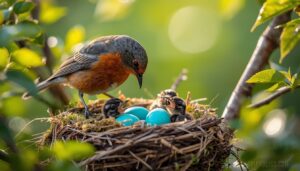
Those sky-blue eggs are hard to miss. Egg coloration comes from biliverdin, a natural pigment, giving each egg that signature robin’s egg blue.
The female develops a brood patch — bare, warm skin pressed directly against the clutch — handling the full incubation period of 12–14 days alone.
Hatchlings emerge helpless but grow fast, reaching fledgling independence around day 13–16.
Brood Size and Breeding Season Timing
Once those fledglings leave the nest, the pair doesn’t rest long. Most robins raise two broods per season, and southern pairs sometimes push for three. Clutch size variation follows the calendar — early nests often hold 3 eggs, mid-season clutches peak at 4, then taper again by July.
First clutch timing shifts with latitude, weather, and how quickly the ground warms.
Population Trends and Conservation Status
The American robin is one of North America’s great success stories. Breeding Bird Survey data tracking back to 1966 show slow but steady continental population growth—around 370 million strong today.
However, Western regional declines remind us the picture isn’t uniform everywhere.
Key takeaways on conservation status include:
- IUCN lists it as Least Concern
- Long-term population trends of American Robin remain broadly stable
- Climate change effects and severe weather are recognized concerns
- Citizen science data contributions to avian research—including Population monitoring through Christmas Bird Count—keep tabs on shifting regional patterns
Main Threats, Including Windows, Cats, and Pesticides
Even with stable populations, robins face real daily dangers. Window Collisions kill birds year-round — robins account for roughly 21% of identifiable window strike deaths. Vehicle Strikes claim thousands more each year.
Cat Predation adds up fast, as free-roaming domestic cats kill billions of birds annually, targeting fledglings on the ground. Pesticide Exposure reduces earthworm availability and poisons adults directly.
Fledgling Risks peaks early, with young birds particularly vulnerable during their initial ground-dwelling phase.
How to Attract Robins With Water, Shelter, and Native Plants
Turning your yard into a robin-friendly space doesn’t take much. A few thoughtful changes make a real difference:
- Birdbath Placement — Set a shallow basin in open ground with moving water features like a dripper to attract robins more quickly.
- Evergreen Shelter Plants — Holly and spruce provide year-round cover.
- Native Berry Shrubs — Serviceberry, elderberry, and dogwood match the robin’s diet and feeding habits perfectly.
- Seasonal Yard Cleanup — Leave leaf litter and reduce pesticide use to protect earthworms and their habitats.
Frequently Asked Questions (FAQs)
Is the American robin a thrush?
Yes, the American robin belongs to the family Turdidae — the true thrushes — as confirmed by genetic evidence and phylogenetic placement.
This classification establishes it as one of the largest thrushes and solidifies its status as a classic North American songbird.
What do American robins look like?
That bright orange-red breast gives it away instantly. You’ll also notice the yellow beak, small white spots around the eyes, gray-brown back uniformity, and white lower belly beneath.
Where do American robins live?
American robins are one of the most widespread birds on the continent, turning up in backyards, forests, alpine meadows, riparian zones, coastal marshes, desert oases, and along mountain ridgelines.
They thrive wherever food and shelter come together.
How many American robins are there?
Small bird, massive numbers. Around 370 million American Robins live across North America today, making it the continent’s most abundant species.
This prevalence is supported by its Least Concern IUCN Status, backed by long-term population trends and Christmas Bird Count monitoring data.
Is the American Robin rare?
Not at all. It is one of North America’s most common songbirds, with an estimated 320–380 million individuals. The IUCN lists it as Least Concern — about as far from rare as a bird can get.
What are some fun facts about American Robins?
Robins are seed dispersers, cultural symbols of spring, and true urban survivors.
They can raise two broods per season and flash their bright orange-red breast in mating dances.
Some longevity records show individuals living over a decade.
Where can you find American Robins?
You can spot them almost anywhere — from Golf Course Fairways and Riparian Woodlands to Schoolyard Gardens and Public Water Features.
Their American Robin habitat and range spans most of North America.
What does the American Robin look like?
Think of a bird dressed for autumn — warm chest, gray coat, white trim. That’s the American Robin: upright posture, sturdy legs, bright orange-red breast, white eyerings, and a rounded tail.
What do American Robins eat?
They eat both worms and fruit — roughly 40% invertebrates, 60% plant foods. That dietary diversity index shifts by season, leaning heavily on earthworms in spring and berries through winter.
What are 3 facts about the American robin?
American robins undergo molting cycles each year and employ thermoregulation strategies to survive cold nights.
They also support forests through ecological seed dispersal, consuming and transporting berries across wide distances.
Conclusion
Seasons shift, songbirds scatter, and still the American Robin returns—steady as the smell of rain on warm earth. Once you know what makes this thrush truly tick, every sighting changes.
You’re no longer just watching a bird tug a worm from the lawn. You’re reading soil health, seasonal timing, and centuries of survival written into one familiar creature.
Pay attention long enough, and the ordinary yard becomes something worth returning to.