This site is supported by our readers. We may earn a commission, at no cost to you, if you purchase through links.
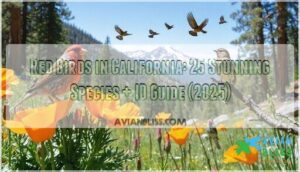 You’ll find 25 stunning red birds in California, each adapted to different habitats across the Golden State.
House Finches brighten your backyard with their rosy-red plumage, while Summer Tanagers display brilliant crimson feathers in oak woodlands.
Purple Finches show raspberry-red coloring in mountain forests, and Pine Grosbeaks inhabit high-elevation conifers.
American Robins sport red breasts in suburban areas, and Vermilion Flycatchers flash scarlet in desert regions.
These species range from coastal areas to alpine zones, with some year-round residents and others seasonal visitors, each with unique size, song, and behavior patterns that make identification straightforward once you know the key features that distinguish them from similar species.
Table Of Contents
- Key Takeaways
- Types of Red Birds in California
- Common Red Birds Found in California
- Unique Characteristics of California Red Birds
- Red Birds in California by Habitat
- California Birds With Red and Black Plumage
- Attracting Red Birds to Your Yard in California
- Identifying Red Birds in California
- Migratory Patterns of Red Birds in California
- Red Birds in California by Size
- Frequently Asked Questions (FAQs)
- What red birds are in California?
- What is the red bird but not a cardinal?
- Where in California do cardinals live?
- What does it mean when you see red birds?
- Are there any cardinal birds in California?
- What kind of bird is red headed in Northern California?
- What are the small red breasted birds in California?
- Are cardinals and red birds the same?
- What do red birds in California eat?
- Are red birds in California endangered?
- Conclusion
Key Takeaways
- You’ll find 25 different red bird species across California’s diverse habitats, from House Finches in your backyard to Summer Tanagers in oak woodlands and Pine Grosbeaks in high-elevation forests.
- You can attract red birds to your yard by setting up feeders with black oil sunflower seeds, providing shallow water sources, and planting native California plants like coast live oak and toyon that produce berries.
- You’ll need to focus on key identifying features like size, beak shape, and plumage patterns – male Summer Tanagers are completely red, Pine Grosbeaks have crossed bills, and Northern Cardinals sport distinctive black face masks with prominent crests.
- You can observe different migration patterns throughout the year, with species like Summer Tanagers arriving from Central America for breeding season while others like Red Crossbills move unpredictably based on cone availability rather than seasonal timing.
Types of Red Birds in California
You’ll find several distinct categories of red birds across California’s diverse habitats, from common backyard species like House Finches to seasonal visitors such as Summer Tanagers.
California’s red birds transform ordinary backyards into vibrant wildlife theaters, offering year-round beauty and seasonal surprises.
These species range from year-round residents that frequent bird feeders to migratory birds that appear only during specific seasons.
Each with unique identifying features and habitat preferences.
House Finch Description and Habitat
The House Finch showcases remarkable finch adaptations with males displaying rosy red heads and breasts.
This resilient urban finch thrives in California’s settled areas through successful finch evolution.
You’ll spot these California birds year-round displaying fascinating finch behavior:
- Habitat: Buildings, backyards, and parks
- Diet: Seeds, buds, and fruits at feeders
- Social: Flocks together frequently
- Identification: Conical beaks, notched tails
American Robin Description and Habitat
You’ll spot these rust-breasted beauties hopping across California lawns like tiny orange-vested groundskeepers.
American Robins showcase distinctive brick-red breasts with dark heads and white throat patches, making Robin Identification straightforward for backyard bird enthusiasts.
These adaptable California birds thrive in diverse Backyard Habitats, from suburban gardens to mountain forests.
Their Foraging Behavior involves characteristic ground-hopping while hunting earthworms and insects.
During breeding season, their Nesting Habits include building mud-lined cups in trees and shrubs.
| Feature | Spring/Summer | Fall/Winter |
|---|---|---|
| Diet | Earthworms, insects | Berries, fruits |
| Behavior | Ground foraging | Tree foraging |
| Habitat | Lawns, gardens | Wooded areas |
| Activity | Dawn singing | Quiet feeding |
| Flocking | Territorial pairs | Large groups |
Summer Tanager Description and Habitat
You’ll easily recognize the Summer Tanager by its stunning red plumage that makes it stand out among California birds.
Males sport brilliant crimson feathers from head to tail, while females display golden-yellow coloring with olive-green backs.
These medium-sized songbirds measure 6-7 inches with sturdy bills perfect for their insect diet.
Summer Tanagers prefer open woodlands, oak groves, and riparian areas throughout southern California.
You’ll spot them in parks, orchards, and along roadsides where they hunt for bees, wasps, and other flying insects.
Their migratory habits bring them to California from May through August before they head south to Central America.
These red birds in California showcase fascinating nesting behavior, building shallow cup nests on horizontal branches.
Watch for their distinctive hunting style as they catch insects mid-flight or glean them from foliage.
Bird identification becomes easier when you know their preference for bird habitats California offers, especially areas with scattered trees and open spaces.
Pine Grosbeak Description and Habitat
Pine Grosbeaks are California’s winter wanderers, showcasing vibrant Grosbeak Plumage in coniferous forests.
These red birds california enthusiasts love display distinctive crossed bills and melodic Grosbeak Sounds.
Find them in these bird habitats california:
- High-elevation pine and spruce forests
- Mountain slopes with dense conifers
- Areas rich in cone-bearing trees
- Winter feeding stations with sunflower seeds
Their Grosbeak Diet focuses on seeds and berries.
Purple Finch Description and Habitat
After admiring Pine Grosbeaks, you’ll discover Purple Finches showcase stunning plumage variation across California birds.
Males display raspberry-red coloring while females sport brown streaks with distinctive facial markings.
These California bird species inhabit coniferous forests and frequent backyard feeders during winter months.
Their vocalizations include rich, warbling songs that vary regionally.
Purple Finches prefer nesting habits in dense evergreen branches, creating cup-shaped nests.
Diet specifics include black-oil sunflower seeds, tree buds, and berries.
Though their conservation status remains stable, they face competition from House Finches in overlapping bird habitats throughout California’s diverse ecosystems.
black oil sunflower
Common Red Birds Found in California
You’ll find five red bird species that regularly inhabit California throughout the year or during specific seasons.
These common species include the House Finch, American Robin, Summer Tanager, Pine Grosbeak, and Purple Finch, each with distinct range patterns and seasonal presence across the state.
They are notable for their presence in California, with some species being more common than others.
House Finch Range Map

Across California’s diverse landscapes, the House Finch demonstrates remarkable Range Expansion through successful Urban Adaptation.
This resilient species thrives from coastal cities to inland valleys, showing impressive Population Density variations.
- Dense urban populations in Los Angeles and San Francisco
- Moderate numbers in Central Valley agricultural areas
- Scattered communities in mountain foothills
- Coastal adaptation along Pacific shorelines
- Desert edge colonization in southern regions
American Robin Range Map

California’s American Robin population shows remarkable Habitat Variation across the state’s diverse ecosystems. These red bird species demonstrate impressive Range Expansion from coastal areas to mountain forests, adapting to Human Influence in urban settings.
Bird range maps reveal their year-round presence throughout most california birds territories, making them prime subjects for bird watching california enthusiasts.
- Population Density: Highest in suburban areas with lawns
- Climate Impact: Seasonal elevation shifts during temperature changes
- Habitat Variation: Thrives from sea level to 12,000 feet
- Range Expansion: Continues spreading into developed areas
Summer Tanager Range Map
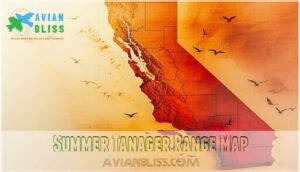
When you’re tracking Summer Tanagers in California, their Breeding Range covers southern regions from May through August.
These red birds in California then migrate to Wintering Areas in Central America, traveling thousands of miles.
Climate Change and Habitat Loss threaten their traditional routes, though some populations show Range Expansion northward.
Bird range maps help you locate these stunning California birds.
Pine Grosbeak Range Map
Pine Grosbeaks show unpredictable winter movements across California’s mountain forests.
These large finches don’t follow regular migration patterns – instead, they appear during irruptive years when northern food sources become scarce.
You’ll spot them in coniferous habitats, particularly around pine and fir trees.
Climate change affects their population trends, making conservation efforts increasingly important for California birds.
Purple Finch Range Map
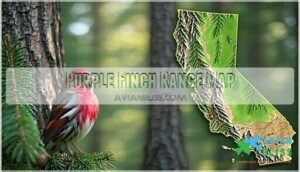
You’ll find Purple Finch populations throughout California’s coniferous forests, where breeding occurs in cooler mountain regions.
These raspberry-red beauties face significant challenges from habitat loss and climate change, affecting their population density across the state.
Their hefty beaks aid in consuming seeds.
- Breeding Range: Mountain forests and higher elevations throughout California
- Winter Range: Lower elevations and coastal areas during harsh weather
- Population Density: Declining due to urban development and forest fragmentation
- Climate Change: Shifting traditional ranges northward, impacting California birds distribution
Unique Characteristics of California Red Birds
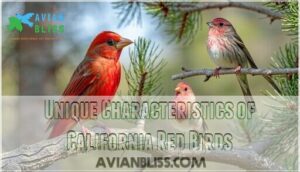
California’s red birds display remarkable differences in size, color intensity, and specialized features that set them apart from red birds in other regions.
You’ll notice Summer Tanager males are completely red unlike most species, Pine Grosbeaks rank among the largest finches, and Purple Finches show distinctive raspberry-red coloring with unique facial markings.
Summer Tanager Males Are Completely Red
Male Summer Tanagers showcase nature’s most vibrant red display – their plumage development creates completely crimson birds from beak to tail.
These california birds achieve their stunning red feathered appearance through dietary influence and genetic factors, giving them an evolutionary advantage in attracting mates.
Regional variations exist, but identifying birds becomes easier when you spot this unmistakable all-red coloration among red birds in California.
Pine Grosbeaks Are One of The Largest Finches
Among California’s largest finches, Pine Grosbeaks stand out with impressive Grosbeak Size reaching 10 inches.
These gentle giants display stunning Plumage Variation – males sport rosy-pink bodies while females show yellow-orange tints.
You’ll spot them at Winter Feeders cracking sunflower seeds with powerful bills.
Their Habitat Preferences include coniferous forests where their melodious Vocalizations echo through towering pines.
Purple Finches Are Described as Raspberry Red
Purple Finches stand out among California’s red feathered birds with their distinctive raspberry red coloration that bird enthusiasts describe as wine-dipped.
These finches showcase remarkable plumage variations between sexes, making them fascinating subjects for any California bird guide.
- Males display vibrant raspberry red across head, breast, and back regions
- Females feature brown streaking with distinctive white facial markings
- Habitat preferences include coniferous forests and backyard feeders
- Vocalizations consist of warbling songs and sharp flight calls
Red Crossbill Range Map
Red Crossbills roam California’s coniferous forests unpredictably, following cone crops rather than fixed migration routes.
These nomadic Red birds in California face challenges from habitat fragmentation and climate change, which affect their range expansion patterns.
Multiple Crossbill subspecies exist, each adapted to specific cone types.
Their erratic movements make them exciting discoveries for bird watching in California enthusiasts exploring Sierra Nevada forests.
Hepatic Tanager Range Map
Hepatic Tanagers have a limited breeding range in California, barely reaching the southwestern U.S.
These red birds in California retreat to wintering grounds in Mexico each fall.
Habitat loss and climate impact threaten their populations.
Bird identification guide data accuracy shows they’re expanding northward gradually.
You’ll spot them in pine-oak forests during brief migration windows.
Red Birds in California by Habitat

You’ll find California’s red birds in specific habitats based on their feeding needs and nesting preferences.
Each species has adapted to thrive in particular environments, from House Finches in urban areas to Pine Grosbeaks in mountain forests.
House Finches in Settled Areas
House Finches thrive in California’s urban landscapes, showing remarkable urban adaptation near your home.
These social birds demonstrate fascinating finch behavior around human interaction zones like parks and backyards.
Their feeding habits include:
- Seeds: Sunflower and nyjer preferences
- Fruits: Berries from ornamental plants
- Buds: Fresh spring growth
- Feeders: Regular backyard visitors
Their conservation status remains stable across California wildlife habitats.
American Robins in Backyards
Watch an American Robin hop across your lawn, cocking its head to listen for earthworms below. These backyard birds thrive in California’s suburban gardens, building cup-shaped nests in tree forks or on porch ledges.
Their varied backyard diet includes insects, berries, and fruits. Attracting Robins is simple—provide fresh water, maintain grassy areas for foraging, and plant berry-producing shrubs.
Their Robin Behavior includes territorial singing at dawn, creating a delightful Garden Impact for California wildlife enthusiasts.
Summer Tanagers in Open Landscapes
While backyard robins stick close to home, Summer Tanagers prefer California’s expansive open woodland habitat and orchards.
You’ll spot these brilliant red males from May through August in parks where tanager diets consist mainly of flying insects.
Their roadside bird behavior includes perching on exposed branches, making identification easier.
Supporting tanager conservation efforts helps protect these stunning summer visitors in their preferred habitats.
Pine Grosbeaks in Forests
Deep in California’s coniferous forests, you’ll find Pine Grosbeaks thriving in their high-elevation habitats.
These remarkable birds showcase fascinating conifer dependence and unique nesting habits among California’s diverse bird habitats.
- Forest Diet: Seeds from pine, fir, and spruce cones
- Winter Flocking: Form small groups during cold months
- High-Elevation Habitats: Prefer mountain forests above 6,000 feet
- Coniferous Trees: Build nests in dense evergreen branches
- Seasonal Movement: Descend to lower elevations when food’s scarce
Western Tanagers in Northern California
When you’re exploring northern California’s conifer forests, Western Tanagers offer spectacular birding opportunities despite habitat loss concerns.
These vibrant red-and-yellow birds prefer open woodlands where identification tips become essential for proper species recognition.
- Breeding Habits: Males develop brilliant red heads during spring courtship displays
- Conservation Status: Climate impacts threaten their traditional nesting territories in birding spots California enthusiasts frequently visit
California Birds With Red and Black Plumage
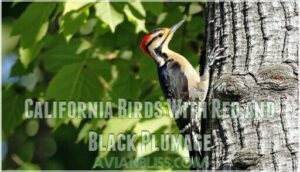
You’ll find some of California’s most striking red birds feature bold black markings that create dramatic contrasts in their plumage.
These red and black species include woodpeckers, sapsuckers, and cardinals that stand out easily against natural backgrounds, making them excellent birds for beginning birdwatchers to identify, with their dramatic contrasts.
Red-breasted Sapsucker Description
Red-breasted Sapsuckers stand out with their distinctive plumage details: bright red heads and breasts contrasting sharply with black-and-white dalmatian-like patterns.
Their drumming behavior creates neat rows of sap wells in tree bark, supporting their sap consumption diet.
These red birds prefer California’s coniferous forests, making species identification easier than distinguishing redbreasted sapsucker from rednaped sapsucker varieties in bird identification guides.
They create these sap wells to access a sugary sap treat, which sometimes leads to competition with other species.
Red-headed Woodpecker Description
California’s Red Headed Woodpecker stands out with its bold tri-colored appearance and acrobatic feeding style.
These striking red birds combine beauty with fascinating behaviors that’ll capture your attention.
Plumage Details:
- Bright crimson head contrasts sharply with snow-white belly
- Bold black wings create distinctive checkerboard pattern during flight
Habitat Preference: Open woodlands, orchards, and parks throughout california
Feeding Habits: Catches insects mid-air while storing acorns for winter survival
Northern Cardinal Description
While woodpeckers grab attention with their drilling, the Northern Cardinal commands respect with its stunning Cardinal Plumage.
You’ll instantly recognize males by their brilliant red feathers and distinctive black mask around the eyes and throat.
These Red birds in California sport a prominent crest and thick, orange-red beak perfect for cracking seeds.
Cardinal Behavior includes year-round residence, making them reliable backyard visitors.
Both sexes sing, though males are more vocal during breeding season.
Their Cardinal Diet consists mainly of seeds, fruits, and insects.
Cardinal Habitat preferences include woodland edges and suburban gardens with dense shrubs.
Cardinal Lifespan averages 3-15 years in the wild.
For bird identification purposes, remember females display warm brown plumage with red-tinged wings, tail, and crest – a key distinction among bird species in California.
Bright red plumage, black mask, short cone-shaped bill, prominent crest
Vermilion Flycatcher Description
What makes the Vermilion Flycatcher so enchanting among southern california birds? This stunning member of california wildlife displays remarkable flycatcher dimorphism—males sport brilliant red plumage while females show gray tones with subtle juvenile markings.
Their distinctive vocalizations echo across open woodlands during molting patterns seasons.
- Size: 13-14 cm with distinctive red birds coloration
- Habitat: Streamside areas in arid landscapes
- Behavior: Expert insect hunters for bird identification
White-winged Crossbill Description
You’ll recognize the White-winged Crossbill by its distinctive crossed beak morphology and striking wing markings.
Males display rose-pink plumage variation, while females show yellowish tones.
Both sexes feature prominent white wingbars that separate them from Red Crossbill species.
These California red birds present identification challenges due to subspecies differences in size and coloration patterns.
| Feature | Male | Female |
|---|---|---|
| Body Color | Rose-pink | Yellowish |
| Wings | Black with white bars | Black with white bars |
| Bill | Crossed, stocky | Crossed, stocky |
| Size | Stocky build | Stocky build |
| Markings | Two white wingbars | Two white wingbars |
The key characteristics to note are the rose-pink plumage variation in males and the yellowish tones in females, along with the prominent white wingbars and crossed beak morphology that are common to both sexes.
Attracting Red Birds to Your Yard in California
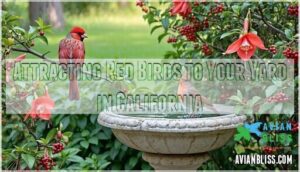
You can transform your California yard into a haven for red birds by providing the right combination of food sources, water features, and native plants.
Setting up seed feeders with sunflower seeds, installing shallow bird baths, and planting berry-producing shrubs will attract species like House Finches, Cardinals, and Summer Tanagers throughout the year, creating a welcoming environment for these native plants.
Bird Feeders and Seed Types
Setting up the right bird feeders transforms your yard into a red bird paradise.
These common red birds have specific seed preferences that’ll keep them coming back.
- Black oil sunflower seeds attract House Finches and Purple Finches with their high fat content
- Safflower seeds deter squirrels while appealing to Northern Cardinals and other red birds list favorites
- Nyjer seeds in tube feeders draw smaller finches seeking premium nutrition
Proper feeder placement and regular feeder maintenance guarantee lasting success with homemade mixes.
You can find a variety of different feeder models online.
Bird Baths and Water Sources
Fresh water draws common red birds like magnets to your California yard.
Choose shallow basins with textured surfaces for safe footing. Strategic bath placement away from predators guarantees bird safety while maintaining clear sightlines.
Providing water during freezing temperatures is possible with a specialized winter option.
| Feature | Recommendation |
|---|---|
| Water Depth | 1-2 inches maximum |
| Bath Types | Pedestal, ground-level, heated |
| Cleaning Frequency | Every 2-3 days |
| Winter Baths | Add heaters for year-round access |
| Water Quality | Fresh, chemical-free daily changes |
Native Plants and Trees
California’s native plants create perfect bird habitats while supporting local ecosystem restoration.
These drought-tolerant options attract northern california birds naturally, transforming your yard into a bird-friendly garden that rare red birds can’t resist.
To cultivate such a space, consider sourcing authentic native flora.
- Coast Live Oak: Provides acorns and insects that attract House Finches and Purple Finches year-round
- Toyon (Christmas Berry): Red berries draw American Robins and other fruit-eating species during winter months
- Manzanita: Nectar-rich flowers and berries support diverse red bird populations throughout breeding seasons
Suet and Fruit Feeders
Suet feeders packed with high-energy ingredients like nuts and dried fruits work wonders for attracting red birds to your yard.
Position these bird feeders near shrubs but away from windows to prevent collisions.
Fresh berries, chopped apples, and oranges in specialized fruit feeders create an irresistible buffet for Cardinals and tanagers.
Consider using double suet cake feeders to attract even more birds.
Clean feeders weekly to avoid pests and spoilage during California’s warm seasons, ensuring a healthy environment for the wildlife.
Bird-Friendly Yard Tips
Transform your backyard into a red bird haven with these proven strategies.
California’s vibrant species need specific conditions to thrive in your space.
- Native plants like elderberry and toyon provide natural food sources
- Water features such as shallow bird baths attract thirsty visitors
- Shelter options including dense shrubs offer safe nesting spots
- Safe feeders positioned away from windows prevent collisions
Identifying Red Birds in California
You’ll need to focus on key features like size, beak shape, and plumage patterns when identifying California’s red birds.
Look for specific details such as the Vermilion Flycatcher’s pointed black beak, the Red Crossbill’s distinctive crossed bill, or the Northern Cardinal’s prominent crest to distinguish between species.
Male Vermilion Flycatcher Identification
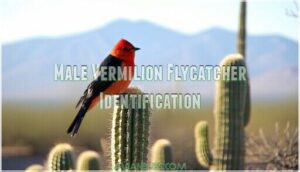
Spotting a male Vermilion Flycatcher among California’s types of red birds requires recognizing his Distinguishing Features. His vibrant red head and chest create unmistakable Plumage Details against desert landscapes.
Look for his compact size and pointed black beak near water sources. Regional Variations show brighter reds in breeding males.
This identification guide helps distinguish him from cardinals—he’s smaller with darker wings. Juvenile Plumage appears grayish-brown with subtle red hints.
Red-headed Woodpecker Identification
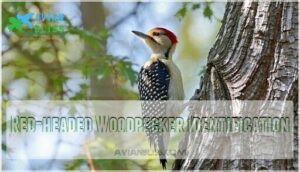
You’ll easily spot Red Headed Woodpeckers by their striking crimson heads contrasting with bold black-and-white bodies.
These medium-sized woodpeckers show distinctive plumage variations—adults display solid red heads while juvenile markings include brownish heads with streaked patterns.
Listen for their harsh "kweer" vocalizations echoing through open woodlands.
Unlike similar species, they lack the barred back patterns of other woodpeckers.
Northern Cardinal Identification
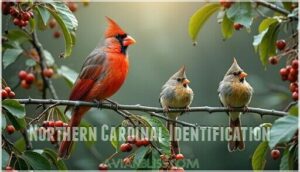
You’ll instantly recognize Northern Cardinals among California’s red birds by their striking features.
Males display brilliant crimson Cardinal Plumage with black face masks, while Female Cardinals show warm brown tones with reddish highlights.
Their sturdy orange beaks crack seeds effortlessly, and their distinctive Cardinal Song rings out in clear whistles.
- Size identification: Cardinals measure 8-9 inches with prominent crests
- Juvenile Cardinals: Young birds show mottled brown plumage before maturity
- Distinguishing Cardinals: Look for thick, cone-shaped beaks unlike other red birds
Hepatic Tanager Identification
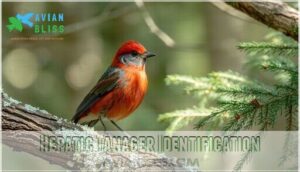
The Hepatic Tanager’s brick-red plumage distinguishes it from similar species in California.
Look for gray cheeks and a darker bill compared to Summer Tanagers. Males display deeper red coloration while females show yellow tones.
Listen for their whistled vocalizations echoing through oak and pine forests. Immature plumage appears more muted.
These habitat cues help confirm identification when using bird guides.
Red Crossbill Identification
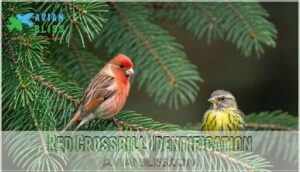
You’ll recognize the Red Crossbill by its signature crossed bill function for extracting pine seeds.
Males display bright reddish-orange plumage variations, while females show yellowish-green tones.
Age identification becomes easier when noting juveniles’ streaked brown feathers.
Listen for their distinctive "jip-jip" vocalizations overhead.
Subspecies differences exist across regions, making this bird species a fascinating entry in any bird field guide.
Migratory Patterns of Red Birds in California
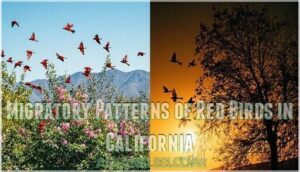
You’ll notice that many red birds in California follow distinct seasonal movement patterns, with species like Summer Tanagers and Western Tanagers arriving for breeding season before heading south to Central America.
Understanding these migration timings helps you predict when you’re most likely to spot specific red species throughout the year.
Summer Tanager Migration Patterns
Each spring, Summer Tanagers begin their remarkable journey from Central America to California’s breeding grounds.
These migratory birds follow predictable patterns driven by seasonal changes and food availability.
- Migration Triggers: Lengthening daylight and warming temperatures signal departure
- Stopover Habitats: They rest in riparian corridors and oak woodlands
- Climate Impact: Rising temperatures affect traditional bird migration patterns
Western Tanager Migration Patterns
Western Tanagers follow predictable bird migration patterns between their breeding grounds in California’s mountains and wintering habitats in Central America.
Migration triggers include daylight changes and food availability. These types of red birds travel established migration routes through Mexico, facing conservation concerns from habitat loss.
You’ll spot them during spring and fall migrations as they navigate between seasonal territories, following predictable bird migration patterns and traveling through established migration routes.
Vermilion Flycatcher Migration Patterns
Vermilion Flycatchers follow the Pacific Flyway during their remarkable journey.
You’ll spot these crimson gems leaving their breeding grounds in Nevada and Arizona each fall. Migration triggers include shorter daylight and cooler temperatures.
Their winter range extends through Mexico and Central America. Bird migration studies show they prefer riparian corridors along their flyway routes, making stopovers near water sources.
Hepatic Tanager Migration Patterns
Hepatic Tanagers leave their California breeding grounds each September, following ancient bird migration routes toward Mexico’s winter havens.
Migration triggers include shorter daylight and cooler temperatures.
Bird migration research shows these tanagers rely on stopover ecology sites for refueling during their journey south.
Climate impacts increasingly affect their bird distribution patterns, making conservation efforts essential for maintaining stable populations across their range.
Red Crossbill Migration Patterns
Red Crossbill migration patterns defy typical seasonal timing, driven by cone availability rather than calendar dates.
These nomadic birds experience Crossbill irruptions when food sources fail, triggering massive movements across California’s forests.
Climate impact and genetic diversity influence their population dynamics, making bird migration tracking challenging.
You’ll find them wherever conifer seeds are abundant, following unpredictable bird migration routes.
They build nests, bulky open cups, on horizontal conifer branches.
Red Birds in California by Size
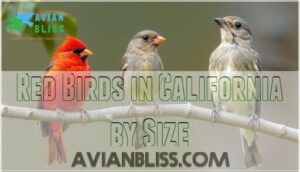
You’ll find red birds in California range from tiny 4-inch finches to impressive 10-inch woodpeckers, making size a useful identification tool.
Learning to recognize these birds by their physical dimensions helps you quickly narrow down species when you spot red plumage in your backyard or local park, using identification as a key factor.
Small Red Birds in California
California’s small red birds bring joy to any backyard.
These petite performers showcase incredible plumage variations and unique vocalizations that make bird identification exciting.
One way to attract these birds is by providing bird feeders.
- House Finch (5.5 inches): Males display rosy-red heads with streaked bodies
- Purple Finch (6 inches): Features raspberry-red coloring with distinct facial markings
- Red Crossbill (6.5 inches): Sports crossed bills for specialized seed extraction
- Vermilion Flycatcher (5.5 inches): Shows brilliant red plumage with insect-catching behavior
Medium-Sized Red Birds In
Moving up in size, you’ll spot Summer Tanagers and Pine Grosbeaks among California’s medium-sized red birds.
These crimson birds show distinct plumage variation – male Summer Tanagers display completely red feathers while Pine Grosbeaks blend reddish-pink with gray wings.
Both species face feeding competition with House Finches and American Robins, creating identification challenges across overlapping habitats.
Frequently Asked Questions (FAQs)
What red birds are in California?
Bright crimson flashes catch your eye as you spot California’s stunning red birds.
You’ll find Northern Cardinals, House Finches, Summer Tanagers, Vermilion Flycatchers, and Red-breasted Sapsuckers painting the landscape with their vibrant plumage year-round.
What is the red bird but not a cardinal?
You’ll spot several striking red birds beyond cardinals in California.
House Finches show rosy-red males, while Summer Tanagers display vibrant all-red plumage.
Vermilion Flycatchers feature brilliant red bodies, and Red-breasted Sapsuckers combine red with distinctive black-white patterns.
Where in California do cardinals live?
Over 90% of Northern Cardinals can’t survive California’s dry climate naturally.
You’ll find them only in well-watered suburban gardens with dense shrubs in Southern California, particularly around Los Angeles and San Diego areas.
What does it mean when you see red birds?
Seeing red birds doesn’t carry supernatural meaning, but you’re spotting cardinals, house finches, or tanagers. These sightings often feel special because red plumage is rare and eye-catching in nature.
Are there any cardinal birds in California?
Like finding a ruby in a desert, Northern Cardinals are rare gems in California.
You’ll occasionally spot these iconic red birds in urban areas and parks, but they’re not native residents—mostly escaped pets or wandering visitors.
What kind of bird is red headed in Northern California?
You’ll likely encounter Red-breasted Sapsuckers in Northern California’s pine forests.
These distinctive woodpeckers display striking red heads with black-and-white dalmatian-like patterns.
They’re known for drilling holes to feed on tree sap.
What are the small red breasted birds in California?
You’ll spot House Finches with rosy red breasts and Vermilion Flycatchers with vibrant red chests in California.
These birds, including the Red-breasted Sapsuckers, display striking red plumage and are known as small songbirds.
They frequent backyards, parks, and wooded areas throughout the state.
Are cardinals and red birds the same?
Cardinals are just one type of red bird.
You’ll find many red-feathered species in California like house finches, summer tanagers, and vermilion flycatchers.
"Red bird" is a broad term covering various species.
What do red birds in California eat?
Back in olden days, you’d find these crimson beauties feasting on insects, seeds, and berries.
You’ll see them munching sunflower seeds at feeders, catching bees mid-flight, or sipping tree sap depending on the species.
Are red birds in California endangered?
Most red birds you’ll see in California aren’t endangered.
House Finches, Northern Cardinals, and Summer Tanagers maintain stable populations.
However, you should check current conservation status since some species face localized threats from habitat loss.
Conclusion
Discovering red birds in California transforms ordinary birdwatching into extraordinary adventures.
You’ll spot vibrant House Finches at backyard feeders, brilliant Summer Tanagers in oak woodlands, and striking Vermilion Flycatchers in desert landscapes.
Each species offers unique identification challenges and rewards.
Whether you’re tracking migratory patterns or creating bird-friendly yards, these 25 species provide endless opportunities for observation and study.
Your patience and persistence will reveal California’s remarkable diversity of red-plumaged birds across every habitat from coastal areas to mountain forests, making the experience a truly endless opportunity for discovery.