This site is supported by our readers. We may earn a commission, at no cost to you, if you purchase through links.
That flash of raspberry-red at your feeder isn’t a robin having an identity crisis. It’s likely a purple finch, and honestly, spotting one feels like winning a tiny lottery.
Purple finch populations have dropped 47% since 1970, pushed out by their scrappier cousin, the House Finch, in most territory disputes. That makes every sighting worth paying attention to.
We’ll walk through what makes this bird’s raspberry wash so distinct, how to tell males from females from impostors, and where you’re likely to find one calling a conifer home.
Table Of Contents
- Key Takeaways
- What is a Purple Finch?
- Purple Finch Identification Guide
- Purple Finch Vs Similar Birds
- Purple Finch Habitat and Range
- Purple Finch Diet and Conservation
- Frequently Asked Questions (FAQs)
- How rare is a Purple Finch?
- What is the difference between a House Finch and Purple Finch?
- What is the difference between a house wren and a Purple Finch?
- What attracts Purple Finch?
- Where do Purple Finches go in the winter?
- What is the typical lifespan of a purple finch?
- Do purple finches only eat seeds?
- Are there any other birds that look like purple finches?
- Do purple finches always migrate in flocks?
- What is the typical incubation period for their eggs?
- Conclusion
Key Takeaways
- Purple Finch populations have dropped 47% since 1970, largely because House Finches win almost every territorial dispute with them.
- You can tell males apart by their raspberry-red wash covering the head, back, and chest, while females show a distinct white eyebrow stripe instead of color.
- The easiest way to distinguish a Purple Finch from a House Finch is its stockier build, less flank streaking, and deeper raspberry tone versus the House Finch’s orangey, streaky look.
- Purple Finches depend on conifer forests for breeding and shift their wintering range based on conifer cone crops, sometimes irrupting far south when food runs short.
What is a Purple Finch?
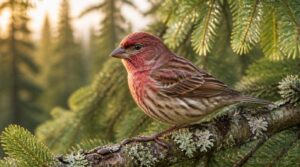
So what exactly makes a Purple Finch a Purple Finch? There’s more to it than just that raspberry-red color you might have heard about. Let’s break down the basics, starting with where this bird fits in the family tree.
Purple Finches belong to the Fringillidae family, a group that includes many of the birds with reddish-pink chests birdwatchers often mix up at the feeder.
Scientific Classification
Seven ranks stand between "living thing" and "this exact bird," and the Purple Finch’s full name is Haemorhous purpureus.
- Domain, Kingdom, Phylum down to Class, Order, Family
- Genus and Species form the binomial name
- Latin naming follows Linnaeus’s system, italicized and capitalized just so
- DNA sequencing reshuffled this genus from Carpodacus years back
- Monophyly keeps related finches grouped by shared ancestry
This organization is part of the broader scientific classification system used to categorize all living things.
Finch Family Traits
Genus and species aside, the Purple Finch belongs to a bigger crew: finches in North America, all sporting conical bills built by passerine beak evolution for cracking seeds.
They flock together for safety and better foraging, stay active by day, and males flash brighter colors than females—classic coloration and camouflage at work. Seasonal molt keeps that purplish-red plumage sharp before breeding season hits.
Size and Weight
Pick this bird up (figuratively—please don’t) and you’d feel about 18 to 25 grams, roughly three quarters as heavy as a AA battery. Length runs 13 to 15 cm, wingspan 20 to 28 cm.
Chicks start at barely 1 gram, doubling weight within a week. Adults pack on 2 to 4 extra grams each fall, fuel for winter’s leaner months.
Overall Body Shape
Weight aside, what really stands out is the shape. A compact silhouette gives this finch a chunky, big-headed look, with a short neck and thick bill that scream sturdy build.
Shoulders slope gently into a rounded back, and the tail tapers just enough to keep things tidy. It’s a study in symmetrical proportions—neat, balanced, built for perching more than showing off.
Common Birdwatching Appeal
Rarely does a feeder bird reward you this fast. Spot that raspberry-red plumage once and you’ll never mistake it again.
Purple Finches offer:
- Vibrant plumage colors
- Easy song recognition
- Backyard viewing rewards
- Reliable seasonal sightings
Their approachable size makes identification simple, even for beginners just starting a birdwatching life list.
Purple Finch Identification Guide
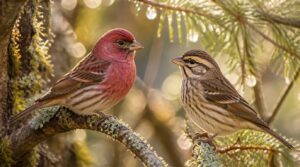
Spotting a Purple Finch takes a bit of practice, since color alone can trick you. Good news: this bird gives you plenty of clues if you know where to look. Let’s break down what to check first, from head to wingtip.
Start with the conical bill and reddish-brown wash across the face, then compare notes with this Purple Finch identification guide to nail down the finer details.
Male Raspberry-red Plumage
Ever seen a bird that looks dipped in raspberry juice? That’s your male Purple Finch.
The raspberry-red splashes cover his head, back, and chest in a warm, purplish-red wash. This isn’t random spotting—it’s smooth, saturated color from carotenoid-rich diets.
Intensity peaks during breeding season and fades with feather wear. Brighter males, generally older or healthier, signal strong condition to potential mates.
Female Facial Markings
Females skip the raspberry entirely. Instead, look for the white mark above each eye, paired with a subtle eye ring and mustache stripe.
Brow definition patterns and soft midface shading create real field marks worth memorizing. Even without bright color, brown-and-white plumage stays distinctive once you know where to look—no fancy avian morphology degree required.
Juvenile Appearance
Young purple finches look like a rough draft of the adults—muted, soft, and still figuring things out. Expect duller tones, fuzzier feather edges, and less contrast around the eyes.
Wing bars stay blurry rather than crisp. As molt progresses through their first season, juvenile colors shift toward adult hues, so patience pays off if you’re tracking one bird’s transformation over time.
Bill and Head Shape
Look at that bill first—short, conical, and built like a tiny nutcracker. That beak cracking strength comes from a sharp tip and a slightly curved upper mandible.
The head stays rounded with no crest, blending smoothly into the neck. This clean head silhouette profile, paired with raspberry-red plumage framing the face, makes the bill stand out for quick, confident identification.
Wings and Rosy Bars
Those wings hide a splash of color that rewards a closer look. Rosy bar visibility shifts with light, brightest when sun hits perched birds directly.
- Medium wing bars, less bold than the secondary
- Purplish-red plumage fading toward flight feathers
- Duller tones after seasonal molt cycles
- Juveniles show brownish, olive-tinted wings
Wingbeat frequency patterns average 9-11 beats per second, giving quick, agile flight through dense branches.
Purple Finch Vs Similar Birds
Even sharp-eyed birders mix up the Purple Finch with its look-alikes now and then. A few key clues make all the difference once you know where to look. Let’s break down the traits that set this bird apart from the crowd.
Purple Finch Vs House Finch
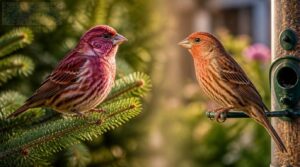
Ever mixed up a Purple Finch and a House Finch at your feeder? You’re not alone. The quickest tell is that raspberry wash covering the Purple Finch’s head and back, versus the House Finch’s oranger tone with streaky flanks.
| Purple Finch | House Finch |
|---|---|
| Stocky, short tail | Slender, longer tail |
| Straight, conical bill | Curved upper mandible |
| Less flank streaking | Bold flank streaks |
| Higher-pitched song | Slower trill |
| Conifer forests | Feeders, suburbs |
Purple Finch Vs House Wren
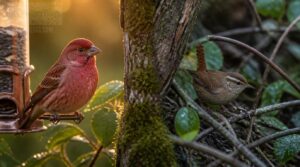
Confusing a Purple Finch with a House Wren seems odd once you know what to look for, but at a glance, both are smallish and brownish. The real giveaway is plumage color contrast and body silhouette.
| Purple Finch | House Wren |
|---|---|
| Stocky, raspberry-red | Slim, plain brown |
| Warbling song | Bubbly, scolding chatter |
| Feeder forager | Brush-dwelling insect hunter |
Key Color Differences
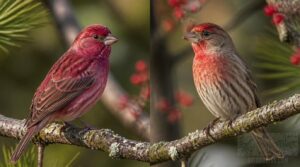
Color tells the real story here. A male Purple Finch shows raspberry-red plumage with warm, glowing tones, while a House Finch runs more orange-red and streaky below.
| Purple Finch | House Finch |
|---|---|
| Raspberry-red, all over | Red limited to head/breast |
| Females muted, unstreaked | Females plain brown, streaked |
Molt stage and lighting shift the intensity, but that deep, wine-washed glow stays distinctly Purple Finch.
Shape and Posture Clues
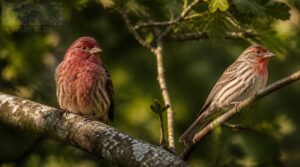
Shape gives you a second opinion when color feels tricky. A Purple Finch sits chunky and broad-shouldered, with a big head and short neck, while House Finches look slimmer and longer-tailed.
| Trait | Purple Finch | House Finch |
|---|---|---|
| Build | Stocky, deep-chested | Slim, upright |
| Tail | Shorter, notched | Longer, squared |
Posture stays calm and level-backed, rarely fidgety, giving that solid, well-fed look birders love.
Song and Call Comparisons
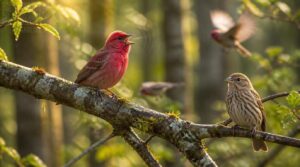
What does a Purple Finch actually sound like? Its warbling song rolls out in rich, undulating phrases—6 to 23 notes long—shaped by the syrinx into something almost liquid. House Finches sound scratchier, less musical.
| Bird | Vocal Style |
|---|---|
| Purple Finch | Smooth, melodic warble |
| House Finch | Buzzy, choppy song |
Both use sharp contact calls in flight, but dialects vary regionally, so trust your ears alongside your eyes.
Purple Finch Habitat and Range
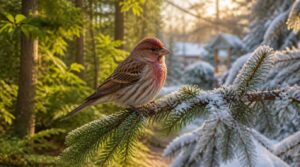
Where you’ll spot a Purple Finch depends a lot on the season and where you live. These birds move around more than you might expect, chasing food and shifting with the weather. Let’s look at where they nest, where they winter, and how they end up at your feeder.
Breeding Forest Habitats
Ever wonder why a breeding male picks one patch of conifer forest over another? It comes down to structure. Mature trees offer cavities and snags for nesting, while dense understory hides eggs and fledglings from predators.
Forest microclimate stability matters too—canopy shade and humidity protect nests. Managing forest complexity, with mixed-age trees and dead wood, boosts overall nesting success.
Wintering Areas
Winter finds this seed eater spreading across four very different worlds. Coastal thickets, inland conifer stands, mountain slopes, and even your backyard bird feeder can host them.
- Coastal Wintering Grounds: dense shrubs shield birds from wind
- Inland Forest Complexes: mixed woods hold fruit and seed
- Mountain Microhabitats: sheltered slopes block harsh gusts
- Urban Backyard Foraging: feeders and berry hedges draw crowds
Climate migration shifts quietly reshape where they settle each year.
North American Distribution
Canada holds the lion’s share of breeding Purple Finches, especially provinces thick with boreal conifer forests.
South of the border, the Northeast and upper Midwest see the densest summer numbers. Come winter, the Southeast becomes prime real estate, while Mexico only gets the occasional visitor.
This whole geographic range tracks one thing closely: wherever cone crops and forest cover thrive, so do the finches.
Migration and Irruptions
Some years bring a flood of Purple Finches; other years, barely a trickle. That’s the nature of irruptive movements—driven by conifer cone crops up north, not fixed calendars.
When boreal seed supplies crash, finches push south or east searching for food, reshaping their winter distribution overnight. Researchers track these irruptions closely, since they reveal how climate and food scarcity ripple through migration patterns across an entire continent.
Backyard Feeder Visits
Want Purple Finches at your feeder? Set up sunflower seed or nyjer near cover, and watch mornings and late afternoons—their busiest visiting hours.
- Fill feeders before civil dawn
- Offer sunflower and nyjer seed
- Place feeders 5–10 feet from shrubs
- Clean feeders regularly
- Watch winter months for more visits
Refills often trigger a quick visitation wave—a good identification and behavior cue for backyard birding.
Purple Finch Diet and Conservation
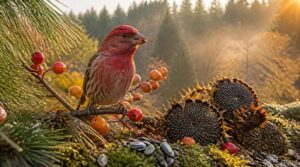
Now that you know where Purple Finches live, let’s talk about what keeps them fed and what puts them at risk. Their menu is more varied than you might think, and their future depends on more than just good food. Here’s what you need to know.
Favorite Seeds and Berries
Sunflower seeds top the menu, especially when you set out freshly hulled ones for quicker energy. Safflower and nyjer work well in specialized feeders too.
Beyond feeders, purple finches forage berries from serviceberry, chokecherry, and elderberry shrubs. Planting native berry shrubs near your yard rewards you with visits year-round. Store seed cool and dry to prevent mold, keeping your feeder a trustworthy stop for these dedicated seedeaters.
Insects for Nestlings
Berries and seeds keep adult purple finches humming along, but nestlings need something richer. Caterpillars top the menu, packed with essential amino acids and fat that fuel fast growth.
Parents mix in beetles, ants, and fly larvae too, since prey diversity boosts nestling condition. This steady variety keeps nestling growth rates on track through hungry, demanding days.
Breeding and Nesting Habits
Once caterpillar season fades, breeding becomes the main focus. Males kick things off with a courtship ritual—fluttering, singing rich warbles to prove song quality. Females weigh territory and song before choosing a mate.
Nests form from twigs and grass, lined with moss, hidden in conifer branches.
- Female builds nest
- Lays 3–6 pale bluish-green eggs
- Shared incubation begins
- Both parents feed nestlings
Population Decline Threats
Once nestlings fledge, the bigger story turns grim. Purple Finch numbers have dropped 47% since 1970, and the House Finch is a huge reason why, winning 95% of territory disputes.
Since 1970, Purple Finch numbers have fallen 47%, edged out by House Finches winning nearly every territorial fight
Habitat loss, climate change, cat predation, and window collisions pile on. Roughly 6.5 million remain, but that number keeps shrinking each year.
How Birders Can Help
So what can you actually do about it? Log every Purple Finch sighting on eBird, complete checklist and all—that data shapes real conservation decisions.
Plant native berry shrubs, skip pesticides, and mark windows to prevent collisions. Then speak up locally: attend a land-use meeting or back a habitat trust. Small, steady actions like these add up for the whole flock.
Frequently Asked Questions (FAQs)
How rare is a Purple Finch?
You’d think a bird with millions in its ranks couldn’t be scarce—yet regional abundance varies wildly.
Purple Finches remain Least Concern overall, but habitat loss and House Finch competition drive noticeable local declines, making them common in forests, yet surprisingly absent elsewhere.
What is the difference between a House Finch and Purple Finch?
Look for plumage color contrast: raspberry-red all over versus brick-red patches on head and chest. Check beak shape, flight bounce, and foraging habits, too—these lookalikes trip up many birders during avian identification, but patient study makes the differences click.
What is the difference between a house wren and a Purple Finch?
Picture a plain brown wren cocking its tail straight up like a tiny exclamation mark—that’s your first clue. House Wrens show no red plumage, have a shorter curved bill, and belt out bubbly songs, unlike the finch’s mellower warble.
What attracts Purple Finch?
Nyjer and sunflower seeds pull them in fast, alongside fruiting shrubs and nectar-rich blooms.
Add shelter cover, fresh water, and steady winter feeding, and your yard becomes prime birding habitat—especially when conifer cone crops run thin elsewhere.
Where do Purple Finches go in the winter?
Some winters send them far south; other years, they barely budge. It all comes down to conifer crop influence — poor cone crops trigger irruptive movement into the southeastern U.S., while good crops mean stronger wintering site fidelity closer to home.
What is the typical lifespan of a purple finch?
Most songbirds don’t get old, and this species is no exception: average wild lifespan is just two years, though a lucky few reach 6-8 years, with one banded bird surviving
Do purple finches only eat seeds?
Not even close. Their conical bill cracks tough seeds easily, but they also sip nectar, munch berries like juniper and blackberry, and grab caterpillars for protein—especially when raising hungry nestlings each summer.
Are there any other birds that look like purple finches?
Yes, quite a few. House Finch, pine siskins, redpolls, and crossbills can all cause mix-ups. Check the back color and bill shape closely, since plumage tones and posture often give the true identity away.
Do purple finches always migrate in flocks?
Safety in numbers isn’t just a saying for these birds—it’s survival strategy. Not always, but mixed-species flocking is common during migration, boosting foraging efficiency and predator detection. Solo travel happens too, especially during irruptive movements when food scarcity drives individual wandering.
What is the typical incubation period for their eggs?
Egg warmth needs steady attention, and incubation usually runs 12 to 13 days. Females do most of the sitting on pale bluish-green eggs, with temperature and nest microclimate shaping hatch timing before hungry, altricial chicks arrive needing round-the-clock care.
Conclusion
Raspberry rarities like the purple finch don’t owe you anything, yet every glimpse feels like a gift. Learning its field marks, its conifer haunts, its quiet decline, turns a backyard feeder into something bigger: a front-row seat to a story still being written. You won’t mistake it for a House Finch again, and that’s no small thing.
Keep your binoculars ready, your feeders full, and your eyes patient. Some birds reward the wait.
- https://app.birda.org/species-guide/33851/Purple_Finch
- https://feederwatch.org/learn/tricky-bird-ids/cassins-finch-house-finch-and-purple-finch
- https://www.delawarenaturesociety.org/blog/how-to-identify-house-finches-and-purple-finches-identification-tips
- https://www.audubon.org/field-guide/bird/purple-finch
- https://www.sdakotabirds.com/species/maps/purple_finch_map.htm