This site is supported by our readers. We may earn a commission, at no cost to you, if you purchase through links.

A shadow sweeps across the field, and you look up just in time to see powerful wings carving through the sky. Was that a hawk? An eagle? A falcon? If you can’t tell the difference, you’re not alone.
Most birders struggle to identify raptors in flight, where split-second observations and distant silhouettes replace the luxury of close-up views. The challenge isn’t just academic—accurate identification connects you to migration patterns, conservation needs, and the health of ecosystems.
Size, shape, flight style, and habitat all work together like pieces of a puzzle. Once you know what to look for, those fleeting glimpses transform into reliable IDs, turning every raptor sighting into a chance to sharpen your skills and contribute meaningful observations to conservation efforts across North America.
Table Of Contents
- Key Takeaways
- Raptor Identification Basics
- North American Raptor Species
- Raptor Identification Challenges
- Raptor Conservation Efforts
- Advanced Raptor Identification
- Frequently Asked Questions (FAQs)
- What equipment helps photograph raptors effectively?
- How do raptors hunt different prey types?
- When do raptors typically nest and breed?
- What sounds do various raptor species make?
- How long do different raptors live?
- How do weather conditions affect raptor identification accuracy?
- What equipment is essential for identifying distant raptors?
- How do juvenile raptors differ from adult plumage?
- When is the best time for raptor watching?
- Can vocalizations help identify raptor species in flight?
- Conclusion
Key Takeaways
- You’ll identify raptors reliably by focusing on four key factors working together: size and shape silhouettes, flight patterns like soaring versus flap-glide sequences, plumage field marks including age-related variations, and habitat context that narrows your species options before you even raise binoculars.
- North American raptor groups show distinct hunting adaptations—falcons slice through open air with pointed wings and stiff wingbeats for high-speed pursuits, accipiters weave through forests using short rounded wings for ambush tactics, while buteos and eagles soar on broad wings to scan fields and water for prey.
- Migration timing and flyway location directly impact which species you’ll see, with autumn concentrations peaking September through October along four major corridors where geographic features like ridges and coastlines funnel thousands of raptors southward in predictable daily pulses.
- Conservation threats hit raptor populations from multiple angles simultaneously—lead poisoning affects nearly half of North American eagles, while habitat fragmentation, climate-driven range shifts, vehicle collisions, and wind turbines create compounding survival challenges that require immediate public engagement and data-driven protection strategies.
Raptor Identification Basics
Getting started with raptor identification means knowing what to look for and where to get help. You’ll find plenty of tools and expert tips to sharpen your skills.
Here’s what you’ll want to keep in mind as you learn to spot these amazing birds.
Key Factors for Identification
When you’re out in the field, raptor identification starts with what you can see and measure. Size metrics and wing proportions help you separate species at a glance. Flight patterns—whether steady soaring or flap-glide—reveal even more. Plumage features and field marks, though subtle, offer critical clues. Don’t forget habitat cues; where a bird hunts or nests often narrows your options. Habitat fragmentation can greatly impact raptor populations.
- Shape and size metrics
- Flight patterns and behavior
- Plumage features and field marks
Expert Advice and Guidance
Learning from those with deep experience—like Jerry Liguori or seasoned Hawk Mountain mentors—can transform your Raptor ID skills. Mentorship opportunities, expert field techniques, and handling live birds all help you improve identification. Hawk Mountain offers a raptor field techniques course for adults interested in hands-on learning.
Ask questions, join workshops, and use expert resources. Sophisticated telemetry and Raptor identification techniques provide practical insight. Consider this quick comparison:
| Resource Type | Skill Gained | Example Use |
|---|---|---|
| Mentorship | Improving ID skills | Guided hawk watches |
| Field Techniques | Handling live birds | Banding, release events |
| Advanced Telemetry | Flight tracking | Migration studies |
| Workshops | Expert advice | Raptor ID training |
| Expert Resources | Raptor identification techniques | Video tutorials |
Field Guides and Mobile Apps
After learning from experts, you’ll want tools that work as hard as you do. Mobile apps like the FREE Raptor ID App offer annotated photos, quizzes, and identification videos, reaching 95% app accuracy for North American species. Digital updates in identification apps for raptors keep your info current, while print guides excel in clarity.
Classic Field Guides, valued for expert preference and guide portability, remain trusted for anatomical detail. Combined usage—apps for speed, guides for depth—boosts your Raptor ID success.
Whether you’re in the field or at home, these resources make mastering raptor identification practical and engaging.
North American Raptor Species
North America is home to a wide variety of raptor species, each with its own distinct traits. If you’re hoping to spot and identify them, knowing what sets each group apart is essential.
Let’s take a closer look at the main types you’ll encounter.
Hawk and Eagle Identification

Spotting a raptor overhead, have you ever wondered if it’s a hawk or an eagle? Size comparison is your first clue—hawks are “crow- to goose-sized,” while eagles stretch into “goose- to turkey-sized” territory, with wingspans up to 234 cm.
Plumage variations help, too. Red-tailed Hawks show rusty tails and dark patagial bars, while mature Bald Eagles flash white heads and tails.
Flight patterns reveal more: hawks soar with broad, rounded wings, eagles glide on long, plank-like wings with larger heads. Regional differences matter—western birds may migrate earlier than eastern ones.
Hybrid identification is rare, but knowing these field identification markers will let you distinguish North America’s hawks and eagles with confidence.
Falcon and Accipiter Characteristics
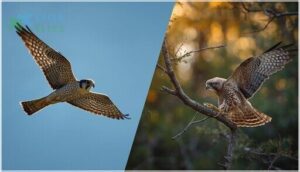
Across open fields or dense woods, falcons and accipiters reveal themselves through distinct Wing Morphology and Flight Dynamics. Falcons, like Peregrines and Prairie Falcons, slice the sky with long, pointed wings, using stiff, powerful wingbeats for high-speed aerial hunts. In contrast, accipiters such as Sharp-shinned and Cooper’s Hawks maneuver through trees with short, rounded wings and long tails, weaving after prey. Size Dimorphism complicates identification, especially between female Sharp-shinned and male Cooper’s Hawks.
Key features to watch:
- Falcons: dark helmet markings, stiff wingbeats, narrow tails
- Accipiters: flap-flap-glide flight, streaked juvenile Plumage Patterns
- Hunting Styles: open-air pursuits vs. woodland ambushes
Osprey and Vulture Identification

Near lakes and rivers, you’ll spot the diurnal raptor known as the Osprey—marked by striking Osprey morphology: long, crook-shaped wings and a bold dark eye stripe. Their high-contrast plumage patterns and specialized reversible toes make fishing efficient.
In contrast, Vulture flight is easy to identify: Turkey Vultures rock gently on wide, two-toned wings, while Black Vultures appear compact with bright white wingtips. Habitat cues matter—Ospreys nest near water, Vultures scavenge across open terrain. Conservation threats, like pesticide exposure and vehicle collisions, impact both species.
Use this table for quick reference:
| Species | Key Field Mark | Habitat Cue |
|---|---|---|
| Osprey | M-shaped wings | Water sources |
| Turkey Vulture | Red head | Open landscapes |
| Black Vulture | White wingtips | Urban edges |
Migration Patterns and Distribution

During autumn, raptor migration unfolds along major flyways—Pacific, Central, Mississippi, and Atlantic—where mountain ridges and coastlines funnel thousands of birds southward. Flyway Identification is essential, since each corridor hosts different concentrations of migratory hawks and other raptors.
Migration Timing varies: Sharp-shinned Hawks surge through in September, while Rough-legged Hawks arrive much later, often in November. Watchsite Data from places like Hawk Ridge and Hawk Mountain reveal daily pulses of movement, sometimes exceeding 10,000 raptors in one day.
Population Trends show declines in some species, with climate impacts causing earlier passage dates and range expansions. You’ll notice migration patterns shifting, as warming allows southern raptors to overwinter farther north. Understanding avian migration and these migration shifts helps you anticipate which species will appear, and when.
Raptor Identification Challenges

Spotting and identifying raptors isn’t always straightforward, even for seasoned birders. You’ll run into a few common challenges as you scan the skies and fields. Here’s what you’ll want to keep in mind as you work through the main hurdles.
Shape and Flight Style Recognition
Ever wondered how a Golden Eagle can glide for miles with barely a wingbeat, while a Sharp-shinned Hawk darts through trees with rapid flapping? Shape Recognition and Flight Patterns are your first clues. Each raptor family’s silhouette tells a story—broad wings in buteos signal smooth thermal soaring, while accipiters rely on short, rounded wings for agile bursts. Falcons slice through air with long, pointed wings, built for speed and direct flight. Eagles, with their massive wings, show powerful Soaring vs. Flapping, favoring steady glides at impressive Soaring Heights.
Behavior in the air reveals more than field marks ever could. For instance, Red-tailed Hawks often display heavy, buoyant glides, while Merlins zip past in purposeful, high-speed traverses. These Shape Categories and Gliding Aerodynamics help you sort species before you even see color. Next time you’re in the field, look for:
- Silhouette
- Wing shape
- Flight style
- Movement patterns
Plumage and Markings Identification
Spotting raptors by plumage is like reading a story written in feathers—every age, morph, and marking holds a clue. Age-related plumage stages mean juveniles often sport streaky browns, while adults show crisp, diagnostic markings. Plumage polymorphism throws in color morphs—dark and light forms that can look like separate species. Sexual dimorphism adds more layers, with males and females sometimes showing distinct plumage details.
Regional variation and molt patterns shift avian markings across North America, so a Red-tailed Hawk in Maine may look different from one in Arizona. With all this variability, misidentification risk is high. Focus on key plumage patterns and field marks for reliable ID.
Habitat and Behavior Analysis
Ever notice how habitat context shapes every raptor move? Your field ID depends on understanding nesting habitat, seasonal shifts, and territory structure. Foraging behavior varies—Red-tailed Hawks soar open fields, while Sharp-shinned Hawks hunt in dense woods. Migration stopover choices reveal adaptability. Watch for:
- Open vs. forested landscapes
- Nesting site selection
- Territorial displays
- Seasonal movement patterns
Commonly Confused Species
Habitat clues can help, but many raptors still blur together in the field. Accipiter ID trips up birders—Cooper’s and Sharp-shinned Hawks overlap in size and shape, especially at a distance. Buteo Confusion peaks with Red-tailed and Red-shouldered Hawks, as immature plumages lack clear adult marks. Eagle Misidentification is common; juvenile Bald Eagles often get reported as Golden Eagles. Osprey Lookalikes and Vulture Versus scenarios add to the mix. Here’s a quick comparison table for reference:
| Species Pair | Key Field Mark | Common Pitfall |
|---|---|---|
| Cooper’s/Sharp-shinned | Head shape | Size overlap |
| Red-tailed/Red-shouldered | Underwing pattern | Juvenile plumage |
| Bald/Golden Eagle | Bill/head profile | Range confusion |
| Osprey/Bald Eagle | Wing posture | Plumage variation |
Raptor Conservation Efforts

Protecting raptors takes more than just spotting them in the wild. You’ll need to understand what threatens their survival and how you can help.
Here’s what goes into effective raptor conservation today.
Threats to Raptor Populations
Threats to raptor populations aren’t just headlines—they’re daily realities. Lead poisoning affects nearly half of North American eagles, suppressing population growth. Vehicle collisions and wind turbines kill thousands each year, especially large-bodied species. Illegal shooting remains a hidden but significant danger, with forensic studies showing gunshot as a leading cause of death.
Raptor populations face daily threats from lead poisoning, vehicle collisions, wind turbines, and illegal shooting—not just distant headlines
Emerging pathogens, like West Nile virus, hit raptors hard, reducing survival and breeding success. When you add habitat loss and climate change to the mix, it’s clear why raptor conservation efforts need your attention and support now more than ever.
Habitat Loss and Climate Change
When raptors lose ground to habitat fragmentation and climate-driven shifts, their old haunts vanish fast. Protected areas help, but habitat loss and climate change impacts outpace conservation, leaving raptors searching for safe places to survive.
You’ll notice migration changes—hawks wintering closer to home, or showing up in unfamiliar spots. Breeding declines follow extreme weather, with nest failures rising.
Conservation Initiatives and Research
As migration patterns shift and habitats shrink, conservation initiatives and research step up to keep raptor populations stable. Breeding programs boost numbers for species like the peregrine falcon and California condor, while habitat restoration secures nesting sites.
Genetic diversity studies guide reintroduction strategies, and funding allocation underwrites ongoing monitoring. These raptor conservation efforts—spanning from Canada to Panama—deliver data-driven solutions, ensuring the conservation of raptors remains grounded in science and real-world impact.
Public Engagement and Support
Momentum for raptor conservation grows when you take part in public engagement and support. Your actions—big or small—drive real change.
For instance, citizen science lets you log sightings, fueling migration studies. Education programs reach thousands, shaping public attitudes and inspiring future advocates. Online engagement, like wildlife webcams, brings data and excitement to your screen. Volunteerism, from surveys to rehabilitation, makes conservation efforts possible.
You can:
- Join migration counts or local surveys
- Support raptor organizations
- Share raptor facts with your network
- Volunteer for field or outreach projects
Advanced Raptor Identification

Once you’ve mastered the basics, you’ll want to sharpen your skills even further. There are plenty of ways to challenge yourself and connect with others who share your passion.
Here’s how you can take your raptor identification to the next level.
Practice Tools and Quizzes
Ever tried spotting a distant hawk and felt unsure? Image-based quizzes like Rockfish Gap’s 50-question challenge and silhouette quizzes from Bird Academy’s SnapID put your skills to the test. Mobile apps, such as HawkWatch International’s Raptor ID, let you practice mixed-modality techniques—combining photo, audio, and field marks. These raptor identification guides and quizzes sharpen your eye, memory, and confidence.
| Tool | Focus | Unique Feature |
|---|---|---|
| SnapID | Silhouette Quiz | Unlimited attempts |
| Rockfish Gap Quiz | Image Quiz | Realistic field images |
| Raptor ID App | Mobile App | Side-by-side guides |
Online Communities and Forums
When you’re stuck on a tricky raptor ID, online forums connect you with experienced moderators and thousands of passionate members. Facebook’s Raptor ID Groups boast over 26,000 participants, while Reddit’s r/whatsthisbird offers 473,000 subscribers seeking bird identification help.
These birdwatching communities deliver expert moderation, with 78% of posts receiving verified responses within 12 hours. Forum accuracy runs between 88% and 96% when multiple users weigh in, and iNaturalist achieves 93% research-grade ID verification through its consensus model.
Beginner engagement thrives here—nearly half of all new threads come from entry-level birders. Your data contribution matters, too. Identification resources from these forums fed 6,700 regional distribution updates into eBird’s 2024 database, directly supporting raptor conservation across North America.
Field Experience and Expert Guidance
Field ID accuracy jumps 30% after you train with experienced mentors at structured workshops. Expert mentorship gives you individual feedback on flight style, silhouette recognition, and behavioral cues that field guides alone can’t teach.
Workshop accessibility has expanded through scholarships and free digital resources, bringing expert resources like Jerry Liguori’s techniques to broader audiences.
Field experience alongside seasoned hawkwatchers sharpens your skills faster than solo practice—you’ll catch subtle details in real time, from distant wingbeat patterns to habitat-specific behaviors.
Citizen engagement through monitoring programs reinforces what you’ve learned while supporting conservation data collection. Guide utilization paired with hands-on observation creates the foundation for confident, accurate raptor identification across North America’s diverse species.
Frequently Asked Questions (FAQs)
What equipment helps photograph raptors effectively?
Capturing raptors in flight is like trying to freeze lightning in a jar—doable, but you’ll need the right tools. Your camera body should feature fast autofocus systems that lock onto birds instantly. Pair it with telephoto lenses reaching 400mm or beyond, equipped with lens stabilization to counteract shake.
A sturdy tripod selection ensures sharp photos of raptors during extended sessions. Don’t forget weather sealing for unpredictable field conditions, optical aids like binoculars for spotting distant subjects, and field guides or mobile apps as visual aids to confirm species before shooting.
How do raptors hunt different prey types?
Hunting techniques vary by raptor species and prey selection. Accipiters ambush birds in forests, while buteos soar over open fields targeting rodents.
Habitat influence, age effects, and seasonal prey availability shape these hunting strategies considerably.
When do raptors typically nest and breed?
Like clockwork tuned to the sun’s arc, raptor nesting phenology follows seasonal cues. Most North American raptors breed from March through July, though regional differences and climate impacts now shift some nesting habits earlier—Red-tailed Hawks and Bald Eagles often begin in February.
What sounds do various raptor species make?
Raptor vocalizations vary widely across species. Red-tailed Hawks deliver piercing screams reaching 103 decibels. Great Horned Owls hoot at low frequencies between 300–400 Hz. American Kestrels produce high-pitched “klee” calls averaging 6,054 Hz.
Ospreys screech loudly during breeding season, while Turkey Vultures mostly grunt and hiss quietly due to lacking a developed syrinx.
How long do different raptors live?
Your backyard hawk might only see a decade, but that soaring eagle overhead? It could outlive your dog. Bald Eagles reach 20-30 years in the wild, while smaller species like Sharp-shinned Hawks average just 5-10 years—age differences tied directly to body size and survival challenges.
How do weather conditions affect raptor identification accuracy?
Visibility limitations from clouds and fog reduce your ability to see field marks clearly. Wind effects alter flight patterns, while thermal influence pushes raptors higher.
Precipitation impacts force identification challenges, and observer fatigue compounds visual identification difficulties.
What equipment is essential for identifying distant raptors?
You’ll need binoculars with 8x or 10x magnification for most observations.
A spotting scope with 20–60x magnification helps identify distant birds.
Camera lenses over 400mm and mobile apps support field documentation.
How do juvenile raptors differ from adult plumage?
Young birds sport streaked, muted tones instead of the bold patterns adults display.
Molt cycles spanning years gradually transform juveniles through subadult stages, with feather wear revealing developmental clues essential for accurate field identification.
When is the best time for raptor watching?
Fall migration delivers the best raptor watching, especially September through October. You’ll catch peak migration between 9 a.m. and 3 p.m. when thermal activity lifts migrating hawks along ridge-top geographic hotspots.
Can vocalizations help identify raptor species in flight?
Acoustic limitations constrain flight call ID for soaring raptors, since many vocalize rarely during migration. Nocturnal migration monitoring and automated detection work better for owls.
Species mimicry by jays complicates raptor identification through vocalizations alone.
Conclusion
Every raptor you identify becomes a thread in a larger tapestry—connecting you to migration corridors, habitat quality, and conservation priorities. This raptor identification guide north america provides you with the tools to move beyond guesswork and contribute observations that matter.
The next time wings slice across your view, you won’t just watch—you’ll recognize, record, and join a community protecting these noteworthy predators for generations to come.
- https://dwr.virginia.gov/wildlife/raptors/
- https://www.hawkmigration.org/raptor-identification-resources/
- https://fwp.mt.gov/binaries/content/assets/fwp/education/literacy-program/16-raptors-every-montanan-should-know-article.pdf
- https://www.chesapeakebay.net/discover/field-guide/critters?fieldGuideType=Raptors
- https://dnrec.delaware.gov/fish-wildlife/conservation/hawk-watch/