This site is supported by our readers. We may earn a commission, at no cost to you, if you purchase through links.

Freshwater covers less than 3% of Earth’s surface, yet lakes and rivers hold nearly everything life depends on—drinking water, food, migration routes, and entire ecosystems built over millions of years.
A glacially carved lake in Canada and a rain-fed river winding through a tropical floodplain look nothing alike, but they run on the same basic rules. Understanding those rules changes how you see every body of water you encounter.
Whether you’re drawn to the stillness of a mountain lake or the relentless pull of a current, there’s more happening beneath the surface than most people ever stop to notice.
Table Of Contents
- Key Takeaways
- Defining Lakes and Rivers
- How Lakes and Rivers Form
- Key Differences Between Lakes and Rivers
- Wildlife in Lakes and Rivers
- Why Lakes and Rivers Matter
- Frequently Asked Questions (FAQs)
- What is the only U.S. state with no lakes?
- Who names lakes and rivers?
- What’s the difference between lakes and rivers?
- What are the 7 great lakes?
- What are the major lakes and rivers in Florida?
- Can rivers form from lakes?
- What is the difference between a river and a lake?
- Where are rivers and lakes found?
- Why are lakes and rivers important?
- What type of water is a lake?
- Conclusion
Key Takeaways
- Lakes hold water in place while rivers keep moving, but both pull from the same source—rain, snowmelt, and groundwater feeding into a shared watershed.
- How a lake or river forms—whether carved by glaciers, cracked open by tectonic shifts, or built by a dam—shapes everything about the life it can support.
- Freshwater ecosystems aren’t just wildlife habitat; they’re the backbone of drinking water, food production, and energy for billions of people every day.
- Pollution, invasive species, and nutrient overload are quietly dismantling these systems, and protecting a watershed upstream is the only real way to keep what’s downstream alive.
Defining Lakes and Rivers
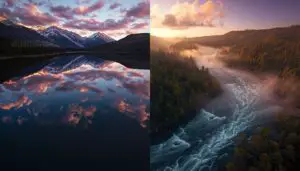
Most people use the words "lake" and "river" like they’re obvious — but the line between them is more interesting than you’d think.
Before discussing how they form and why they matter, it helps to clarify what each one actually is.
Here’s what sets them apart, what they share, and the key terms worth knowing.
Whether you’re just getting started or want to go deeper, this guide to wood duck identification and behavior breaks down the finer distinctions that make all the difference.
What Makes a Lake
A lake is simply water that collects and stays put. Basin topography determines where it forms — a low point shaped by glacial lakes, tectonic lakes, or volcanic lakes fills in over time. Groundwater inflow and climatic catchment keep it topped up. Endorheic basins trap water with no outlet.
Subsurface springs feed others quietly from below. Lake stratification and oxygen levels then shape everything living inside it.
Lake Baikal is a significant freshwater reservoir, holding roughly 20% of the world’s unfrozen fresh water.
What Makes a River
A river doesn’t stay put — it moves, always hunting lower ground. Water gathers across a watershed, then commits to a channel shaped by gradient and hydraulic roughness.
Discharge fluctuations follow rainfall and snowmelt.
Active meanders shift the longitudinal profile over time.
Fluvial processes drive sediment transport from source to mouth.
River flow dynamics never really stop — they just change pace.
Shared Freshwater Features
Both water bodies pull from the same playbook. Rainfall, snowmelt, and groundwater feed them equally — that’s watershed linkages in action. Shared microbial communities drive nutrient recycling in both. Common sediment deposition shapes their beds over time.
Three features connect them at the core:
- Aquatic biodiversity across fish, plants, and invertebrates
- Seasonal water levels shaped by hydrology and runoff
- Surface wave patterns responding to wind and flow
Common Lake and River Terms
Speaking the language helps. Here are terms you’ll actually use:
| Term | Where It Applies | What It Means |
|---|---|---|
| Catchment area | Both | Land draining into a water body |
| Water residence | Lakes | How long water stays in the basin |
| Hydraulic gradient | Rivers | Slope controlling river discharge and flow speed |
| Meander pattern | Rivers | Winding curves shaped by bank erosion |
Hydrology connects them — watershed inflow and outflow drive lake stratification, and river behavior alike.
These hydrological shifts hit riparian-dependent birds especially hard, as seen in the Louisiana Waterthrush’s sensitivity to stream degradation and watershed health.
How Lakes and Rivers Form
Water doesn’t just appear — it gets shaped by forces that have been working for millions of years. Lakes and rivers each have their own origin stories, and some of them are surprisingly wild.
Here’s a look at the main ways these freshwater bodies come to exist.
Glacial, Tectonic, and Volcanic Lakes
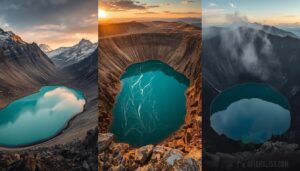
Nature doesn’t ask permission when it reshapes the land. Three forces drive most lake formation processes:
- Glacial activity carves cirque basins and deposits moraines that create dams, trapping meltwater and leaving glacial silt layers on the lake floor.
- Tectonic activity creates fault-line basins where the crust splits apart.
- Volcanic activity blasts open caldera basins, later filled with water holding volcanic ash sediments.
Springs, Snowmelt, and Rain-Fed Rivers
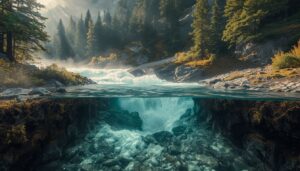
Unlike lakes, rivers don’t just sit there — they’re born from movement. Springs deliver steady groundwater contributions that keep channels alive through dry summers. Snowmelt runoff follows predictable seasonal hydrographs: a sharp spring surge, then a slow fade. Rain-fed rivers spike fast and drop faster.
Isotopic tracing and hyporheic dynamics help scientists read each source, tracking how groundwater inflow, sediment pulse timing, and water flow dynamics in rivers shape riverine habitats year-round.
Oxbow Lakes and Floodplain Changes
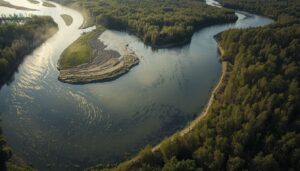
Rivers don’t stay in their lanes — meanders tighten, flood pulses breach the neck, and suddenly you’ve got an oxbow lake cut off from the main channel.
Sediment dynamics in fluvial systems gradually fill it in, driving the marsh transformation. Here’s how it unfolds:
- Cutoff — Flooding redirects flow, isolating the crescent-shaped basin
- Sediment transport and river shaping — Silt layers build up the lake floor
- Seasonal flood pulses — Brief reconnections refresh nutrients and fish communities
- Bank stabilization — Riparian plants anchor the margins over time
- Carbon sequestration — Organic buildup locks carbon into floodplain soils
Reservoirs and Other Man-Made Waters
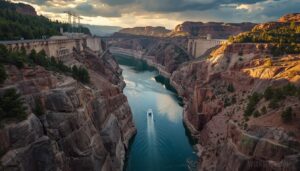
Humans built dams to take control of water — and reservoirs followed. Human-made dams block river flow, creating storage for drinking water, irrigation, and hydroelectric power generation.
Spillway design controls floods, while sediment management addresses the gradual loss of storage capacity. These engineering solutions mitigate risks and maintain functionality over time.
Water resource management presents complex challenges: evaporation losses reduce supply, water rights spark legal battles, and community relocation displaces thousands when land is flooded.
Key Differences Between Lakes and Rivers
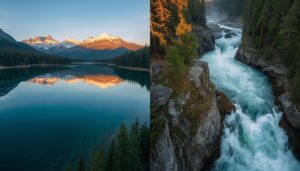
Lakes and rivers might both hold freshwater, but they’re built differently and play by different rules.
Once you see how they compare, you start to notice things you never paid attention to before.
Here’s what actually sets them apart.
Flow and Water Movement
Think of a lake as water that finally sat down to rest. A river never does. Gradient-driven velocity keeps water pushing forward, faster on steep drops, slower on flat runs. Helical flow patterns spin through every bend. Groundwater base flow keeps streams alive in dry months. Energy dissipation zones form wherever flow hits resistance.
Water flow dynamics in rivers shift constantly — no two hours are the same.
Depth, Width, and Shape
Lakes can stretch kilometers wide or barely fill a bowl — depth, width, and shape vary wildly. Bathymetric mapping and cross-section profiling reveal those differences clearly. Lake formation and geological origins shape basin geometry, creating depth-driven habitats where life stratify by oxygen levels.
Rivers meander in predictable geometry, with shoreline fractality marking where water carves its own rules.
Sediment Transport and Water Clarity
Shape tells you where water sits. Movement tells you what it carries. In rivers, sediment transport and river shaping go hand in hand — flow picks up fine particles, raises turbidity, and cuts new channels. Light attenuation drops fast when clay dominates.
Lakes trap that load, so lake water clarity holds longer, though plume dispersion and erosion mitigation both matter for maintaining balance.
These dynamics are critical for keeping eutrophication and pollution in check.
Tributaries, Inflows, and Outflows
Every river’s story starts upstream. Tributaries feed the main channel, delivering water, nutrients, and sediments from across the watershed.
Baseflow contributions sustain rivers during dry periods, while seasonal flood pulses redistribute nutrients and reshape channel morphology. These dynamics highlight the interconnectedness of watershed processes.
- Nutrient loading flows in via agricultural drainage
- Sediment deposition builds where currents slow
- Water flow dynamics shift at every confluence
- Hydrology data reveals how inflows drive discharge cycles
Lake Stratification Vs River Mixing
Still water plays by different rules. In lakes, warm water floats on cold—that is the epilimnion sitting above the hypolimnion, separated by the thermocline. These density gradients create nutrient partitioning and oxygen gradients that shape what lives where.
Rivers, however, don’t stratify; continuous turbulence keeps things mixed.
Seasonal turnover briefly levels the playing field, disrupting lake stratification and oxygen levels.
Wildlife in Lakes and Rivers

Freshwater ecosystems are some of the most crowded neighborhoods on Earth. Lakes and rivers shelter an astonishing range of creatures, from the fish you can see to the tiny invertebrates doing the real heavy lifting underwater.
Here’s a closer look at the wildlife that calls these waters home.
Fish, Amphibians, and Invertebrates
Freshwater ecosystems hide more life than most people realize. Fish use camouflage coloration to blend into rocky beds, while benthic feeding species work the bottom like quiet cleanup crews.
Amphibians undergo larval metamorphosis, shifting from gill-breathing tadpoles to lung-breathing adults.
Invertebrates filter water and feed fish, supporting spawning behaviors and acoustic communication that link species across seasons. These processes drive aquatic biodiversity and maintain water quality.
Riparian and Littoral Habitats
Riparian and littoral zones play a crucial role along river edges and lake shores, serving as essential biodiversity hotspots. These areas quietly perform vital ecological functions, safeguarding freshwater ecosystems.
- Riparian zones manage bank stabilization, nutrient filtration, and carbon storage through deep-rooted trees like willows and alders.
- Littoral zones anchor sediments and provide shelter for juvenile fish via shoreline vegetation.
- Both zones act as buffers against habitat fragmentation, protecting freshwater ecosystems.
By mitigating fragmentation, these zones collectively enhance ecosystem resilience. Invasive plant management remains critical to maintaining their health and preserving aquatic biodiversity.
Food Webs and Nutrient Cycling
Think of a freshwater food web as a living recycling system. Primary production starts with algae converting sunlight into energy, which zooplankton and fish consume.
Consumer-mediated recycling occurs when fish excrete waste, returning nutrients to the water. The microbial loop further breaks down dead organic matter, ensuring continuous nutrient cycling.
Seasonal turnover redistributes nutrients from deep sediments, fueling algae growth and sustaining aquatic biodiversity in rivers and lakes.
Migration Corridors and Seasonal Wetlands
Wetland bottlenecks are where migration timing and corridor connectivity come together. Birds moving along riverine migration routes rely on seasonal wetlands as fuel stops—and hydroperiod length determines who can stay and feed.
Shrink those wetlands through land use impacts, and the whole network breaks down. Protecting watershed health isn’t optional; it’s what keeps aquatic biodiversity in rivers and lakes intact for waterfowl and countless other species.
Birds Found Near Freshwater
Birds turn freshwater into a living field guide. Watch mallards dabble in shallow margins, spotted sandpipers pick along rocky banks, or great blue herons stalk fish with almost suspicious patience. Ring-billed gulls scavenge reservoir edges, while coots work vegetated shallows.
Waterfowl feeding, shorebird foraging, heron hunting—each behavior maps the ecological importance of freshwater bodies. These actions remind us why environmental conservation and aquatic biodiversity in rivers and lakes deserve protecting.
Why Lakes and Rivers Matter
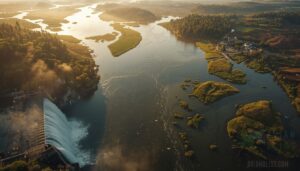
Lakes and rivers aren’t just scenic backdrops — they’re doing serious work for people every single day. From your morning glass of water to the electricity powering your home, freshwater systems are woven into almost everything.
Freshwater systems aren’t scenic backdrops — they’re the invisible infrastructure behind everything you drink, grow, and power
Here’s a closer look at why they matter more than most people realize.
Drinking Water and Irrigation
Lakes and rivers serve as your most direct freshwater lifeline, providing essential source water for communities and agriculture. Most cities draw drinking water directly from these reservoirs and rivers, then filter it to meet Water Quality Standards before distribution through pipe infrastructure.
This same source water sustains agricultural systems, feeding farms via Drip Systems and smart Irrigation Scheduling. Crucially, Source Water Protection keeps both clean, safeguarding these vital resources from contamination.
Without rigorous protection, the Role of lakes in drinking water supply and irrigation collapses fast, jeopardizing freshwater access for both urban and rural needs.
Recreation, Fishing, and Boating
Freshwater isn’t just for drinking — it’s where you go to breathe. Kayaking access and canoeing access open up quiet corners most people never see. Rental services and guided tours make it easy to start, even if you own nothing.
Always check permit requirements and seasonal access rules before you go — recreational fishing in California, for example, has strict rules.
Always bring proper safety equipment.
Hydropower and Human Use
Water doesn’t just sit there — it works. Human-made dams tap the hydroelectric potential of rivers, converting water flow dynamics into grid stability and energy storage. This translates to community jobs, economic benefits, and fuel-free power.
- Pumped storage moves water uphill to save energy for peak demand.
- Environmental mitigation tools like fish ladders reduce ecological harm.
- Human use of lakes and rivers extends far beyond recreation.
Pollution, Eutrophication, and Invasive Species
Not everything that flows downstream is clean. Nutrient loading from farms and cities fuels algal bloom dynamics that choke oxygen from the water. Toxic sediment buildup follows industrial discharge.
Eutrophication turns stagnant lakes soupy and dead, while invasive species disrupt aquatic ecosystems. These interconnected threats degrade water bodies through oxygen depletion, toxin accumulation, and habitat destruction.
| Threat | Lakes | Rivers |
|---|---|---|
| Nutrient enrichment and eutrophication | Algal blooms, oxygen depletion | Excess algae, reduced flow clarity |
| Microplastic contamination | Settles in sediments | Carried downstream continuously |
| Invasive species | Disrupts native fish balance | Blocks migration corridors |
| Water quality issues | Stratification traps toxins | Runoff spreads pollutants fast |
| Toxic sediment buildup | Accumulates in deep zones | Disturbed during flooding |
Conservation and Watershed Protection
Fixing what’s broken starts with prevention. Watershed management and protection brings together stakeholder partnerships — farmers, towns, and conservation groups — to reduce runoff before it enters water bodies.
Land use planning limits erosion, while green infrastructure slows stormwater. Watershed monitoring tracks whether these efforts are working, ensuring strategies remain effective.
These strategies also integrate climate adaptation measures, safeguarding freshwater ecosystems’ long-term ecological importance.
Frequently Asked Questions (FAQs)
What is the only U.S. state with no lakes?
Maryland holds that title.
Due to the absence of glacial scouring and coastal plain geology, it has no natural lakes — only ponds, man-made reservoirs, and the vast Chesapeake estuary dominating its water story.
Who names lakes and rivers?
Naming authorities like the U.S. Board on Geographic Names make it official.
Indigenous communities, federal policies, and historical figures all shape the names you see on any hydrographic map or geographic information system today.
What’s the difference between lakes and rivers?
Think of still water versus water on the move. Lakes hold; rivers go. One stays, one flows — that’s the core difference between them.
What are the 7 great lakes?
The Great Lakes—Superior, Michigan, Huron, Erie, Ontario, and Lake St. Clair—along with their connecting channels, form a network of waterways straddling the Canada-U.S. border.
These include five iconic Great Lakes plus two often overlooked bodies, all sharing impressive shorelines along the shared border.
What are the major lakes and rivers in Florida?
Florida holds over 7,000 lakes. Lake Okeechobee is the biggest, covering 730 square miles. The St Johns, Suwannee, Apalachicola, and Withlacoochee rivers drain the state toward both coasts.
Can rivers form from lakes?
Yes, rivers can form from lakes.
When water exits through a spillway or natural outlet, channel incision processes and outlet erosion carve a defined path, letting glacial lake outflows become full rivers.
What is the difference between a river and a lake?
Still water vs. moving water — that’s the heart of it. A lake holds water in a basin. A river flows in a channel, always heading somewhere downstream.
Where are rivers and lakes found?
You’ll find them on every continent except Antarctica. Mountain headwaters, rift basin lakes, floodplain networks, and urban watercourses all shape continental abundance.
Water bodies mapping and hydrographic data collection across the United States reveal this spread clearly.
Why are lakes and rivers important?
They are life itself. Lakes and rivers drive food security, flood control, and climate buffering.
They boost economies, carry cultural heritage, and keep ecosystems breathing.
Lose them, and you lose everything downstream.
What type of water is a lake?
Most lakes hold freshwater—low salinity, neutral pH (5–9), and layered thermal stratification. Mineral content and oxygen distribution shift with depth, season, and trophic status.
Conclusion
Lakes and rivers aren’t just scenery. They’re the circulatory system of every landscape they touch, moving nutrients, sheltering life, and supplying water that billions depend on daily. Once you see how they form, flow, and connect, you can’t unsee it.
Every shoreline tells a story. Every current carries history. Protect what feeds you.
The watershed doesn’t care about borders—and honestly, neither should you.