This site is supported by our readers. We may earn a commission, at no cost to you, if you purchase through links.
 You’re likely spotting one of several stunning species when you see a bird with blue tail feathers.
The Blue-tailed Bee-eater, common across Asia and Africa, flashes brilliant turquoise while catching insects mid-flight.
North America’s Red-flanked Bluetail displays azure tail patches that shimmer in forest light.
Blue-tailed Trogons inhabit tropical regions, their electric blue tails contrasting with vibrant bodies.
These birds use their colorful tails for mate attraction and territorial displays.
The blue pigmentation comes from specialized feather structures that reflect specific light wavelengths.
Each species has adapted unique tail patterns and behaviors that help with identification and survival strategies.
Table Of Contents
- Key Takeaways
- Blue Tailed Bird Species
- Blue Tail Characteristics
- Bird Species With Blue Tails
- Blue Bird Regional Distribution
- Blue Tail Bird Conservation
- Frequently Asked Questions (FAQs)
- What type of bird has a blue tail?
- What attracts Eastern Bluebirds to your yard?
- What does it mean if you see a bluebird?
- Are Bluebirds rare to see?
- What bird has a blue tail?
- What does it mean to see an Eastern Bluebird?
- What is a blue and gray bird with a long tail?
- Are Eastern Bluebirds rare?
- What is the red-flanked bluetails conservation status?
- How long does the red-flanked bluetail live?
- Conclusion
Key Takeaways
- You’ll find over 21 species of birds with blue tails worldwide, including Blue-tailed Bee-eaters, Blue-tailed Trogons, Red-flanked Bluetails, and various hummingbirds that display colors ranging from brilliant azure to deep navy blue.
- You can identify these birds by their unique behaviors – Blue Jays mimic hawk calls to scare competitors, Bee-eaters catch insects mid-flight with precision aerial maneuvers, and Trogons repeat monotonous calls while perched motionless for hours.
- You’re witnessing specialized feather structures that create blue coloration through light reflection rather than pigmentation, with males typically displaying brighter blue tails than females for mate attraction and territorial displays.
- You need to support conservation efforts since these birds face serious threats from habitat destruction, climate change, and pollution – many species depend entirely on dense forest environments that are rapidly disappearing due to deforestation and urban development.
Blue Tailed Bird Species
You’ll find over 21 species of birds with blue tails across forests, mountains, and wetlands worldwide, from tiny hummingbirds to striking bee-eaters.
These birds display blue tails ranging from brilliant azure to deep navy, with tail lengths varying from a quarter inch to over five inches depending on the species.
Forest Habitats and Threats
Most blue-tailed bird species call forests home, but they’re facing serious challenges.
These magnificent forest dwellers are fighting for survival against mounting environmental pressures.
Habitat fragmentation and deforestation impact their survival daily, while climate vulnerability makes things worse.
You’ll find these endangered birds struggling with pollution effects across their natural habitats.
Forest conservation efforts are essential for protecting these stunning species, as many depend entirely on dense woodland environments for nesting and feeding.
Supporting bird’s natural habitat is vital for their survival, and it requires efforts to preserve their natural habitats.
Geographic Distribution and Diversity
Countless bird species with blue tails span the globe, creating fascinating biogeographic patterns across continents.
You’ll discover remarkable diversity hotspots where these stunning creatures thrive in varied habitats.
Species Range Distribution:
- Asia – Blue-tailed bee-eaters migrate seasonally across vast territories
- Americas – Hummingbirds inhabit tropical Central American forests
- Australia – Splendid fairy-wrens showcase regional endemism
- Europe – Bluetails exhibit habitat variation from forests to woodlands
- Global – Over 21 distinct bird species demonstrate widespread distribution
Tail Length and Color Variations
Various species showcase remarkable differences in their azure vs. navy tail shades and length variations.
You’ll notice tail length ranges from quarter-inch stubs to impressive 5-6 inch displays that exceed body length.
Sexual dimorphism affects coloration intensity, while lighting influence can dramatically alter blue perception.
Genetic factors determine whether you’re observing brilliant cerulean or deep navy hues in different bird species.
| Species | Tail Length | Color Shade | Display Feature | Dimorphism |
|---|---|---|---|---|
| Blue Jay | 4-5 inches | Blue-black | Prominent crest | Minimal |
| Eastern Bluebird | 2-3 inches | Sky blue | Compact size | Moderate |
| Western Bluebird | 2.5-3 inches | Shiny blue | Metallic sheen | Strong |
| Red-flanked Bluetail | 2 inches | Navy blue | Contrasting flanks | Pronounced |
| Blue-tailed Trogon | 4-5 inches | Purple-blue | Longest display | Distinct |
The table provides a detailed comparison of different bird species, including the Blue Jay, Eastern Bluebird, and Western Bluebird, highlighting their unique characteristics such as tail length, color shade, and display features.
Each species exhibits distinct dimorphism and color shade variations, making them fascinating subjects for study.
Unique Behaviors and Identification
While blue-tail colors help with basic recognition, behavior patterns provide the most reliable bird identification methods.
Each bluetailed bird species displays distinct characteristics that separate them from similar-looking relatives.
Here are three key behavioral traits to watch for:
- Mimicry Abilities – Blue jays copy hawk calls to scare competitors away from food sources
- Hunting Techniques – Bee-eaters catch insects mid-flight with precision aerial maneuvers
- Vocalizations – Trogons repeat monotonous calls while perched motionless for hours
Blue Tail Characteristics
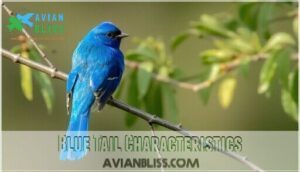
You’ll notice that blue tail characteristics vary substantially across species, ranging from quarter-inch patches to tails measuring 5-6 inches in length.
These distinctive blue hues shift from bright azure to deep navy depending on lighting conditions, and they’re often prominently displayed when birds perch or fly, showcasing their distinctive features.
Plumage and Coloration
Color perception plays tricks when you observe blue-tailed birds.
Your eyes deceive you—these azure tails shift from brilliant sky blue to deep navy depending on the light.
Their plumage displays remarkable iridescence through specialized feather structure containing microscopic platelets.
Sexual dimorphism means males typically show brighter blue colors than females.
Pigment types like melanin combine with structural elements to create stunning visual effects.
Avian optics reveal how plumage function extends beyond beauty—these colors serve essential communication and camouflage purposes.
Some species also display iridescent plumage, enhancing their visual complexity.
Size and Shape Variations
You’ll notice remarkable differences in body size among blue-tailed species, ranging from tiny hummingbirds weighing mere grams to robust jays exceeding 100 grams.
Tail proportions vary dramatically – some species display tails nearly matching their body length, while others showcase compact, stubby appendages.
Wing shape and beak morphology reflect feeding habits, with bee-eaters sporting pointed wings and curved bills for aerial hunting, which is a key aspect of their aerial hunting.
Habitat and Diet Preferences
Blue-tailed birds show remarkable Forest Dependence, thriving in woodlands from mountain peaks to coastal regions.
Their diet shifts seasonally – you’ll find them catching insects during breeding season, then switching to fruits and nectar as weather cools.
Many species demonstrate impressive Suburban Adaptation, making backyards their new hunting grounds. The blue-tailed bee-eater, for instance, is known to nest in vertical mud banks.
- Mountain Diets include high-altitude berries and alpine insects
- Coastal Habitats provide salt-tolerant seeds and marine insects
- Insect Consumption peaks during spring nesting periods
Mating and Nesting Habits
Bird courtship among blue-tailed species involves elaborate displays where males showcase their vibrant plumage during breeding season.
You’ll observe intricate nest building behaviors as pairs select secure nesting sites in tree cavities or dense foliage.
Egg laying typically produces 3-7 eggs, with both parents sharing parental care duties.
These courtship rituals strengthen pair bonds essential for successful bird reproduction.
Bird Species With Blue Tails
You’ll discover over twenty distinct species of birds that display striking blue tails, ranging from the vibrant Blue-tailed Bee-eater of Asia to the subtle Red-flanked Bluetail of northern forests.
These species showcase remarkable diversity in size, habitat preferences, and tail coloration, with some displaying azure hues while others feature deep navy blue plumage that changes appearance based on lighting conditions, highlighting their unique diversity.
Blue Tailed Bee Eater

You’ll spot the bluetailed beeeater across South and Southeast Asia, where these vibrant birds form massive colonies near water sources.
Their bee-eater diet creates significant pollinator impact, consuming up to 250 bees daily.
These bluetail feathered birds showcase remarkable migration patterns and adaptability.
Some species achieve their vibrant colors through melanin and carotenoids.
Here’s what makes this bird with blue tail extraordinary:
- Colony nesting – Thousands gather in breeding sites
- Aerial hunting – Catches insects mid-flight with precision
- Monogamous bonds – Pairs often mate for life
- Seasonal migration – Travels vast distances following food sources
Blue Tailed Trogon

Dwelling in Colombia and Ecuador’s dense rainforests, you’ll find the Blue Tailed Trogon showcasing stunning plumage nuances with its dark blue tail and purple-blue cap.
This bird with blue tail grows up to 11 inches, spending daylight hours perched quietly in trees.
Forest conservation efforts protect these bluetailed birds from habitat loss threatening their survival.
| Feature | Description |
|---|---|
| Size | Up to 11 inches long |
| Habitats | Dense rainforests, foothills |
| Trogon Vocalizations | Repetitive calls throughout day |
| Diet Specifics | Spiders, insects, and fruit |
| Species Threats | Deforestation and habitat loss |
Blue Tailed Hummingbird

Moving from rainforest shadows to open woodlands, you’ll discover the Blue Tailed Hummingbird in Central America’s tropical habitats.
This bird species showcases remarkable sexual dimorphism through its plumage colors.
- Males display vibrant metallic green bodies with deep blue tails during flight display
- Females exhibit more subdued gray-brown coloration with subtle blue tail accents
- Both consume nectar from flowering plants throughout their conservation status range
Red Flanked Bluetail and Himalayan Bluetail

Exploring the high-altitude forests of Asia reveals two remarkable bluetailed birds with distinct characteristics.
You’ll find the Red-flanked Bluetail across northern Asia’s coniferous forests, while the Himalayan Bluetail prefers the region’s elevated terrain.
Both species showcase stunning blue tails, though their habitat differences and plumage variations make identification straightforward for dedicated birdwatchers.
| Feature | Red-flanked Bluetail | Himalayan Bluetail |
|---|---|---|
| Habitat | Siberian and East Chinese forests | High-elevation Himalayan forests |
| Migration Patterns | Expands to Southeast Asia and Northern Europe | Partly migratory, descends in winter |
| Male Plumage | Blue plumage with dark navy blue tail | Blue dorsal nuances with short dark blue tail |
| Female Coloration | Brown and gray with 2-inch blue tail | Gray-brown with distinctive blue tail |
| Diet Comparison | Insects including spiders, ants, flies | Similar insect diet with seasonal variations |
These avian bluetail species represent nature’s artistry in high-altitude environments.
Conservation status remains stable for both bluetail feathered birds, though habitat protection guarantees their continued presence.
The azuretailed bird family’s diversity showcases remarkable adaptation to challenging mountain ecosystems across Asia’s vast wilderness areas.
Blue Bird Regional Distribution
You’ll find blue-tailed birds across all continents except Antarctica, with North America hosting species like the Mountain Bluebird and Blue Jay.
While Asia features the Blue-tailed Bee-eater and Himalayan Bluetail, each region supports different species adapted to local climates.
From Australia’s Splendid Fairy-wren to South America’s Blue-tailed Trogon in Colombian forests.
North American Species

North America hosts remarkable blue-tailed species that’ll capture your attention.
The Eastern Bluebird showcases brilliant azure wings and tail, while the Western Bluebird displays darker blue coloration.
Mountain Bluebirds feature sky-blue backs extending to their tails.
Blue Grosbeaks sport vibrant blue with distinctive wing bars, and Indigo Buntings present intense blue plumage.
Blue Jays combine blue with gray for striking bird tail characteristics.
- Eastern Bluebird – Small migratory thrush with blue back, wings, and tail
- Western Bluebird – Males show dark blue head, throat, back, wings, and tail
- Mountain Bluebird – One of three North American bluebird species
- Blue Grosbeak – Bright blue feathers with coppery wing bars
- Blue Jay – Blue head, wings, and tail with distinctive grey back
South American Species

South America harbors spectacular bluetail feathered birds across its diverse ecosystems.
You’ll discover Andean Bluetails in high-altitude forests, while colorful birds with blue tails like trogons inhabit lowland rainforests.
These rare blue tail birds showcase remarkable plumage variations, from metallic blues to deep navy hues.
Hummingbird diets vary by region, and forest conservation efforts protect these birds with vibrant blue tails throughout trogan habitats.
Asian and European Species

Asia and Europe host remarkable bluetail feathered birds with stunning plumage variations.
You’ll find Red-flanked Bluetails in Siberian forests, while Blue-tailed Bee-eaters showcase incredible bee-eater migration patterns from India to Thailand.
These colorful birds with blue tails thrive in diverse bluetail habitats, from high-elevation pines to tropical woodlands.
Their Eurasian diets vary substantially, though conservation status remains stable for most species despite habitat pressures.
Australian and African Species
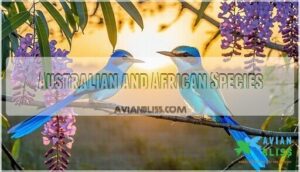
Australia and Africa showcase remarkable blue-tailed species with distinct adaptations.
Australian Fairy-wrens like the Splendid display vibrant breeding plumage, while males sport brilliant blue tails year-round.
African Bluetails include the Lilac-breasted Roller with varied blue tail shades and Golden-breasted Starling’s bright blue coloration.
These species demonstrate unique Habitat Adaptations across diverse environments.
Conservation Status varies, though most populations remain stable despite localized threats.
Some species exhibit iridescent feather structures, enhancing their visual appeal with distinct adaptations and brilliant blue tails.
Blue Tail Bird Conservation

You’ll find that blue-tailed birds face significant challenges from habitat destruction, climate change, and human activities that threaten their survival worldwide.
Conservation efforts now focus on protecting forest ecosystems and establishing breeding programs to guarantee these colorful species don’t disappear from our skies, which is crucial for their survival.
Habitat Loss and Degradation
Developers bulldoze millions of acres annually, destroying vital bird habitats where blue-tailed species once thrived.
You’re witnessing an environmental crisis that’s reshaping entire ecosystems through relentless changes.
Consider these devastating impacts on bird habitats preservation:
- Forest Fragmentation isolates populations into small, vulnerable patches
- Agricultural Expansion eliminates native vegetation and nesting sites
- Urban Development replaces natural landscapes with concrete barriers
- Habitat degradation reduces food sources and breeding opportunities.
Bird conservation efforts struggle against this unprecedented habitat destruction. Consistent observations help conservationists track habitat changes and implement targeted preservation strategies.
Pollution and Climate Change
Climate change disrupts migration patterns as blue-tailed birds struggle with shifting seasons and food availability.
Rising temperatures cause habitat degradation, forcing species to relocate or adapt quickly.
Pollution worsens air quality, affecting bird health and plumage alterations.
Insect decline reduces food sources, while extreme weather creates nesting impacts.
Conservation efforts must address these interconnected threats to guarantee protection of these stunning species and their fragile habitats, ensuring the survival of stunning species.
Hunting and Poaching Threats
Beyond habitat loss, you’ll find that illegal trapping poses serious threats to blue-tailed birds worldwide.
Trophy hunting and trade markets fuel demand for these colorful species, while habitat disturbance from poaching activities compounds existing pressures.
Key hunting and poaching threats include:
- Wire snares targeting multiple species indiscriminately
- Pet trade capture reducing wild populations substantially
- Poisoning risks from contaminated bait affecting entire ecosystems, which is a result of poaching activities and can lead to habitat loss.
Conservation Efforts and Protection Laws
Through coordinated conservation efforts, you’ll find blue-tailed birds receiving essential protection from multiple fronts.
Anti-poaching measures and legal protection under acts like the Migratory Bird Treaty Act safeguard these species from hunting pressures.
Habitat preservation programs focus on climate resilience, while community involvement strengthens local protection efforts.
Protecting these birds often requires specialized bird products, and these extensive conservation programs guarantee future generations can witness these stunning birds in their natural environments, thanks to coordinated conservation.
Frequently Asked Questions (FAQs)
What type of bird has a blue tail?
Over 21 species worldwide sport blue tails! You’ll spot blue-tailed bee-eaters, trogons, hummingbirds, and fairy-wrens. These vibrant tail feathers help with identification, ranging from azure to navy blue across different continents.
What attracts Eastern Bluebirds to your yard?
You’ll attract Eastern Bluebirds by offering dried or live mealworms, installing nest boxes in open areas, and maintaining short grass where they can hunt insects easily.
What does it mean if you see a bluebird?
Seeing a bluebird traditionally symbolizes happiness, hope, and renewal in many cultures.
You’re witnessing nature’s messenger of joy – these azure visitors often appear during life changes, bringing optimism and reminding you that brighter days lie ahead.
Are Bluebirds rare to see?
Bluebirds aren’t particularly rare, but their populations declined substantially due to habitat loss and competition.
You’ll spot them more easily in open fields, parks, and suburban areas with nest boxes during spring and summer months, which is a key time for spotting them.
What bird has a blue tail?
You’ll spot several birds sporting blue tails, including the vibrant Blue-tailed Bee-eater, elegant Blue-tailed Trogon, and tiny Blue-tailed Hummingbird.
Red-flanked Bluetails and Splendid Fairy-wrens also display stunning blue tail feathers across different continents.
What does it mean to see an Eastern Bluebird?
Just when you’re searching for hope, an Eastern Bluebird appears.
You’re witnessing nature’s symbol of happiness, renewal, and good fortune.
Their presence signals spring’s arrival and reminds you that brighter days lie ahead.
What is a blue and gray bird with a long tail?
You’re likely observing a Blue-gray Gnatcatcher, a small songbird with distinctive blue-gray plumage and an exceptionally long tail that’s often held upright. These active birds frequent forests near water sources.
Are Eastern Bluebirds rare?
Eastern Bluebirds aren’t rare anymore, thanks to conservation efforts and nest box programs.
You’ll find them throughout eastern North America, thriving in open woodlands, farmlands, and suburban areas with proper habitat management.
What is the red-flanked bluetails conservation status?
Like a ship sailing steady waters, you’ll find the red-flanked bluetail isn’t facing immediate danger.
This species maintains stable populations across its Siberian and East Asian range, currently listed as "Least Concern" by conservation organizations.
How long does the red-flanked bluetail live?
You’ll find red-flanked bluetails typically live 3-5 years in the wild.
These small songbirds face harsh winters and predation pressures that limit their lifespan, though some individuals may reach 6-7 years under favorable conditions.
Conclusion
Discovering a bird with blue tail feathers opens doors to nature’s most spectacular displays.
Whether you’re observing the Blue-tailed Bee-eater’s acrobatic hunting or the Red-flanked Bluetail’s forest shimmer, each species offers unique behavioral insights.
These azure-tailed beauties face mounting conservation challenges, making your appreciation and protection efforts essential.
Next time you spot brilliant blue tail feathers, you’ll recognize the remarkable adaptations behind their stunning coloration and understand why preserving their habitats matters for future generations.