This site is supported by our readers. We may earn a commission, at no cost to you, if you purchase through links.
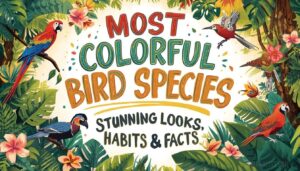
Somewhere in the Amazon, a Scarlet Macaw (Ara macao) stretches nearly a meter of red, blue, and yellow across a forest canopy—and it still somehow blends into the noise of color around it. That’s how saturated ecosystems get.
Birds have been running the color game for roughly 150 million years, and some species have pushed it so far that scientists still can’t fully explain the optics behind their feathers. The most colorful bird species on Earth aren’t just pretty—they’re engineering marvels, ecological linchpins, and, increasingly, conservation priorities worth knowing by name.
Table Of Contents
- Key Takeaways
- Most Colorful Bird Species Worldwide
- Where Colorful Birds Live
- How Birds Get Their Colors
- Bright Bird Behavior and Diet
- Protecting Colorful Bird Species
- Frequently Asked Questions (FAQs)
- What type of bird is colorful?
- What juice is safe for birds?
- Where do birds sleep when it rains?
- What parrot talks the most?
- What are the world’s most colorful birds?
- Which animal is the most colorful?
- What bird has a bright plumage?
- What is the brightest bird in the world?
- What does a Bluebird look like?
- What bird has a pink color?
- Conclusion
Key Takeaways
- world’s most colorful birds — like the Scarlet Macaw (Ara macao) and Gouldian Finch (Chloebia gouldiae) — get their stunning looks from two sources: pigments pulled from their diet and light-bending nanostructures built right into their feathers.
- Bright plumage isn’t just beautiful — it signals mate fitness, drives seed dispersal, and anchors entire ecosystems, making these birds ecological keystones, not just pretty faces.
- The biggest threats to colorful bird species are habitat loss, illegal pet trade, and climate-driven range shifts, which together can fragment core habitats by up to 70 percent.
- Birdwatching and ecotourism are genuinely effective conservation tools — they fund habitat restoration, create income for local communities, and turn casual sightings into real scientific data.
Most Colorful Bird Species Worldwide
Some birds look like they were painted by someone who had way too much fun with a color wheel. From electric blues to blazing reds, the world is full of species that stop you in your tracks.
Whether it’s a toucan’s oversized beak or a peacock’s shimmering tail, exotic bird species from around the world prove that nature has never been shy about showing off.
Here are six of the most colorful birds you’ll find anywhere on the planet.
Scarlet Macaw
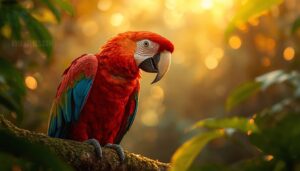
The Scarlet Macaw (Ara macao) is basically a flying sunset — red body, blue wings, yellow shoulder patch. Measuring up to 90 cm, its beak adaptations let it crack seeds that most birds can’t touch.
It thrives in tropical rainforest habitats from Mexico to Brazil, traveling in social flocking groups. Juveniles start duller, developing full color after molting.
Pairs practice strong pair bonding and regularly visit mineral licks for gut health.
Its role as a keystone species promotes seed dispersal throughout the forest, keystone species importance.
Paradise Tanager
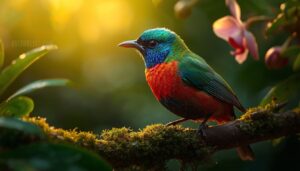
If the Scarlet Macaw is a flying sunset, the Paradise Tanager (Tangara chilensis) is a living mosaic. Here’s what makes this 13–15 cm Amazonian gem unforgettable:
- Bird coloration and structural color mechanisms layer pigment and light-bending nanostructures for that electric iridescence
- Tropical rainforest habitats across northern South America define its altitude range
- Omnivorous diet: fruit, berries, seeds, insects
- Subtle mating system with canopy-based courtship
- Vocal repertoire stays simple — short, sharp chips
Hyacinth Macaw
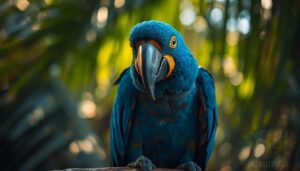
Now meet the largest of all flying parrots — the Hyacinth Macaw (Anodorhynchus hyacinthinus). Stretching nearly a meter long, this cobalt-blue giant is one of the most striking colorful bird species around the world.
Its bill pressure tops 300 psi, making palm nut foraging look easy. These large parrots form lifelong pair bonds and can live 60+ years in captivity.
Painted Bunting
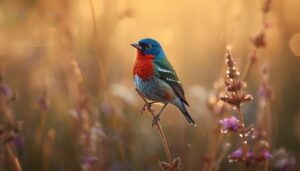
From cobalt giants to something almost unbelievable — the Painted Bunting (Passerina ciris) looks like someone handed a songbird to a watercolor artist. Sexual dimorphism is extreme here: males wear blue, red, and green simultaneously.
Here’s what makes this species stand out:
- Molt Timing peaks during breeding season, maximizing color intensity
- Migration Pathways stretch from Texas to Central America
- Urban Adaptation brings them reliably to backyard feeders
Gouldian Finch
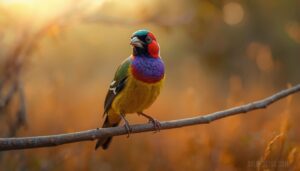
If you think the Painted Bunting pushed the limits, the Gouldian Finch (Chloebia gouldiae) takes colorful plumage to a whole new level. This little Australian gem comes in three distinct head colors — red, black, and yellow — and Head Morph Dominance, means red-headed birds actually outrank black-headed ones socially.
| Feature | Detail | Why It Matters |
|---|---|---|
| Head Morphs | Red, black, yellow | Drives social hierarchy |
| Nest Site | Tree Hollow Availability | Critical for breeding success |
| Habitat Need | Water Source Dependence | Shapes daily foraging range |
| Conservation | Population Monitoring | Tracks morph frequency shifts |
Fire Regime Effects on savanna woodlands directly shape how many suitable hollows exist for nesting. Thoughtful bird conservation work — including fire management — is slowly helping this species bounce back across its tropical and subtropical bird habitats.
Mandarin Duck
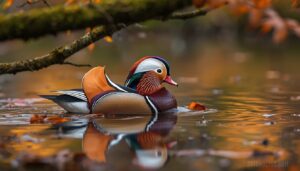
Few ducks stop people in their tracks quite like the Mandarin Duck (Aix galericulata). That iridescent crest alone is worth the trip. Here’s what makes this species unforgettable:
Those dazzling sail-like feathers are actually a masterpiece of physics—explore how bird feather color and nanostructure science explains the optical wizardry behind that unmistakable plumage.
- Molt Cycle shifts males from dull eclipse plumage back to full breeding brilliance each season
- Bird coloration mechanisms — layered keratin barbules create shifting iridescent hues
- Wetland habitats in wooded riparian zones provide ideal nesting and foraging cover
- Hybridization potential with other dabbling ducks remains a concern in introduced populations
- Cultural significance in East Asia symbolizes lifelong partnership and fidelity
Their cryptic female plumage doubles as predator defense during nesting — smart evolutionary design. Any serious birdwatching guide puts this species high on the list, and while conservation status remains stable, habitat protection keeps these living jewels thriving.
Where Colorful Birds Live
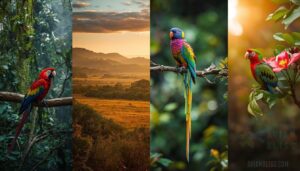
The most dazzling birds on Earth don’t show up just anywhere — they tend to cluster in a handful of wild, specific places. From dripping rainforests to open savannas, each habitat shapes the species that call it home.
Here are the key hotspots where you’re most likely to spot something that stops you in your tracks.
Amazon Rainforest Birds
The Amazon is basically a living cathedral for birds. Over 1,300 species pack its layers, and canopy stratification keeps them sorted by height.
Scarlet macaws own the treetops, while the spangled cotinga flashes iridescent blue from exposed perches.
Mixed species flocks move through together during fruiting seasons. Many birds tuck bromeliad nests high up for predator avoidance — smart real estate in a crowded forest.
New Guinea Birds
New Guinea is basically the world’s best argument for island biogeography. Over 700 species call it home, including dozens of endemic species found nowhere else.
Wilson’s Bird of Paradise dances in lowland forest; the Western Crowned Pigeon struts the forest floor as a ground nester.
Mountain habitats shelter altitude specialists, while traditional feather use by local communities reflects just how deeply these birds are woven into island culture.
East Asian Wetland Birds
East Asian wetlands punch way above their weight for colorful birds. The Mandarin Duck (Aix galericulata) steals every glance, while the Common Kingfisher (Alcedo atthis) flashes electric blue across reed bed nesting sites.
These marshes serve as critical migratory stopovers along the East Asian Australasia Flyway — but aquaculture impacts and wetland pollution are squeezing habitat fast, making conservation here genuinely urgent.
African Savanna Species
Africa’s savanna isn’t just big cats and grasslands — it’s a living canvas. Savanna Bird Ecology here is shaped by seasonal rainfall impact, fire regime effects, and predator-prey dynamics that push color to the forefront.
- Lilac-breasted Roller tumbles through open air in electric blue and lilac.
- Flamingo colonies turn alkaline lakes pink across sub-Saharan Africa.
- Yellow-collared Lovebird flashes green and gold in acacia scrub.
- African Ground Hornbill stalks the grass, bold red throat blazing.
Cultural ecotourism thrives on these sightings — though conservation challenges for colorful birds grow as habitats shrink.
Tropical Canopy Hotspots
Move from open savanna skies into the layered world of the rainforest canopy, and everything intensifies. Vertical Connectivity through Liana Pathways links the understory to the emergent tops, creating birdwatching hotspots around the world where Epiphyte Diversity and Microclimate Regulation concentrate fruit‑seeking species.
Canopy Fruit Phenology drives ornithological diversity in rainforests, pulling tanagers, macaws, and toucans into predictable feeding windows — but conservation challenges for colorful birds grow as tropical rainforest habitats shrink.
How Birds Get Their Colors
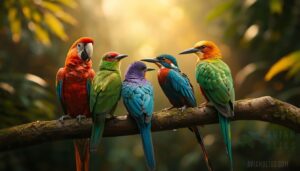
That splash of red on a cardinal or the electric blue of a kingfisher isn’t random — birds have a few clever tricks for pulling off those looks.
Some colors come from what they eat, others are built right into the feather’s structure at a microscopic level.
Here’s a closer look at how each method works.
Structural Coloration
Some birds don’t use pigment at all — they use physics. Feather Microstructures packed with Nanostructured Spacings and Photonic Crystal Arrays bend and reflect light through Thin Film Interference, producing iridescent feathers in blues and greens.
Some birds skip pigment entirely and use physics to conjure iridescent blues and greens from light itself
Kingfishers and hummingbirds pull this off beautifully. This structural coloration even shifts hue as the bird moves — that’s Responsive Adaptive Coloration doing its thing.
Carotenoid Pigments
Not all color comes from physics. Some birds earn their reds, oranges, and yellows through what they eat.
These are carotenoid pigments — pulled straight from dietary carotenoid sources like fruits, seeds, and insects. Many species even convert yellow carotenoids into deeper ketocarotenoids, intensifying that scarlet pop.
Feather pigment deposition happens during molting, so a bird’s diet literally shapes its next look. Carotenoid signaling role? Simple: brighter means healthier.
Melanin and Feather Contrast
Carotenoids handle the warm tones, but melanin feather strength is what gives plumage its grit and contrast. Melanin Distribution across barbules creates sharp dark patches — think of a woodpecker’s crown or a bunting’s black mask.
Those darker zones boost Feather Wear resistance and drive Thermal Absorption in cold snaps.
For Species Signaling, that bold Contrast Function basically broadcasts fitness to every potential mate nearby.
Iridescence and Light Refraction
Unlike pigments, iridescent plumage creates color purely through physics.
Tiny nanostructure geometry inside feather barbules acts like a natural diffraction grating effect system, splitting light into shifting hues.
Here’s what makes structural color so impressive:
- Angle-dependent brightness flips from vivid to dull in seconds
- Polarization signaling encodes hidden messages between birds
- Camouflage iridescence confuses predators mid‑flight
- Structural feather nanostructure outlasts any chemical dye
Color perception and iridescence in birds is basically light bending to show off.
UV-Reflective Plumage
What you can’t see, birds absolutely can. Ultraviolet vision in birds unlocks a whole hidden channel of communication.
Through feather nanostructure and structural coloration, UV patches flash signals invisible to human eyes.
Age-dependent UV brightness shifts help birds read a partner’s fitness instantly.
| Signal Type | Function | Example |
|---|---|---|
| UV Patch Variation | Mate selection | Hummingbird crown |
| Uropygial Preening | UV brightness control | Breeding season glow |
| Multimodal Signaling | Territory defense | Song + UV flash |
| Age-Dependent UV | Social hierarchy | Younger vs. older males |
Bright Bird Behavior and Diet
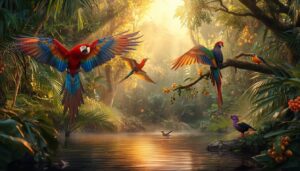
Colorful birds aren’t just pretty to look at — they’re fascinating to watch in action. Their bold looks actually connect to how they eat, compete, and find a mate.
Here’s a closer look at the behaviors that make these birds so impressive.
Courtship Displays
Bright feathers aren’t just for show — they’re an audition. During breeding season, males pull out every trick: Wing Flap Synchrony, UV Plumage Signaling, and complex songs tied to Vocal Display Complexity.
Watch for these moves:
- Aerial Dive Patterns — fast loops that signal strength
- Gift Giving Behaviors — food offerings that prove parental fitness
- Territory dances showcasing sexual dimorphism and bright feathers
Avian sexual selection rewards the boldest performers.
Fruit and Nectar Feeding
Think of these birds as the rainforest’s delivery network.
Scarlet macaws and paradise tanagers rely on fruit and nectar as core Energy Budget Strategies — foraging at Seasonal Foraging Peaks in the morning and late afternoon.
Bill Morphology Adaptations, like hummingbirds’ slender tongues, enable precise Nectar Feeding and support Pollination Mutualisms.
Meanwhile, frugivores drive Seed Dispersal Mechanics by passing intact seeds across vast distances, powering Bird Diet Diversification across colorful bird species worldwide.
Insect and Seed Diets
Not every colorful bird lives on fruit alone — many depend on insects and seeds to hit their nutritional targets.
- Scarlet macaws eat protein-rich seeds, nuts, and clay to neutralize toxins
- Insectivorous birds like the paradise tanager chase essential amino acids through insects
- Seed diet variety helps nutrient balance across life stages
- Microbial digestion helps birds release nutrients from tough seed coats
Nesting and Breeding Habits
Nesting behavior and reproductive strategies vary wildly across colorful species.
Nest site selection often comes down to safety — tree cavities, dense canopy, cliff edges. Nest material use ranges from woven grasses to spider silk.
Incubation strategies differ too: flamingos breed in synchronized colonies, while crowned pigeons are quietly monogamous, sharing a single egg.
Parental care is intense, with clutch size variation running from one egg to several.
Territorial Calls and Displays
Beyond the nest, colorful birds get loud — and showy. Territorial behavior shifts into high gear during breeding season, with males pulling out every trick:
- Song Structure follows tight patterns, with phrases lasting 0.5–2.5 seconds, peaking at dawn.
- Crest Feather Raises and Boundary Posturing create visual warnings rivals can’t ignore.
- Display Flights combine rapid wingbeats with aerial positioning to claim space.
Species-specific vocalizations and calls, avian mating displays, and vocal timing all work together.
Protecting Colorful Bird Species
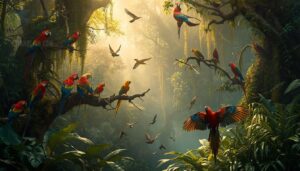
Some of the world’s most remarkable birds are also the most at risk. Vivid plumage, rare habitats, and high demand in the pet trade make them easy targets for poachers and collectors.
Here’s what’s pushing these species to the edge — and what’s giving them a fighting chance.
Habitat Loss Threats
Habitat loss hits colorful birds hard.
Deforestation impacts species like the hyacinth macaw by stripping nesting trees, while agricultural expansion pushes flocks into shrinking fragments.
Forest fragmentation can cut core tropical rainforest habitat by up to 70 percent.
Wetland drainage wipes out feeding grounds.
Infrastructure development carves roads straight through bird habitat conservation zones, opening the door for hunters before recovery even begins.
Pet Trade Pressure
Deforestation pushes birds out — then collectors move in. The pet trade hits hardest through illegal smuggling routes, exploiting legal loopholes in CITES documentation.
Demand drivers? Simple: rare plumage means big money.
Here’s what that looks like in practice:
- Exotic bird species fetch thousands per bird on black markets.
- Welfare concerns mount as birds suffer during multi-stage transport.
- Endangered status accelerates demand, not caution.
bird conservation programs, work against bird conservation programs.
Climate Change Impacts
The pet trade isn’t the only threat. Climate change is quietly reshaping the world’s colorful birds call home.
Range Shifts push species toward cooler elevations, while Phenology Mismatch means chicks hatch after peak insects are gone. Heat Stress strains rainforest canopy bird communities, and Disease Spread accelerates as mosquitoes push into new zones.
| Climate Threat | Bird Impact |
|---|---|
| Range Shifts | Habitat Fragmentation intensifies |
| Phenology Mismatch | Chick survival drops |
| Heat Stress | Breeding cycles disrupted |
| Disease Spread | Mortality rises in vulnerable species |
These climate change effects on rainforest birds compound existing habitat loss across tropical rainforest ecosystems.
Birdwatching and Ecotourism
Birdwatching actually puts money where it matters. Ecotourism built around colorful bird species worldwide funds real Habitat Restoration and keeps forests standing.
Community Guides earn year-round income, making conservation personal for local families. You can contribute too — apps and Citizen Science programs turn your sightings into research data.
Sustainable Practices like staying on trails protect habitat diversity of colorful birds without shutting anyone out.
Conservation Status and Recovery
Even the most threatened species can bounce back — if the effort is real. Here’s what’s driving recovery for colorful birds right now:
- Population Trends improve when habitat restoration reconnects fragmented forests.
- Genetic Diversity monitoring prevents inbreeding in small populations.
- Legal Enforcement and Community Engagement shut down illegal trapping.
Conservation status of vivid birds keeps shifting as protected areas expand and population monitoring of rare colorful birds catches problems early.
Frequently Asked Questions (FAQs)
What type of bird is colorful?
Think of a living rainbow scattered across every continent.
Colorful bird families span parrots, tanagers, and finches — each shaped by avian biodiversity hotspots, habitat diversity, and vivid bird plumage coloration mechanisms, nature spent millions of years perfecting.
What juice is safe for birds?
Fresh water always comes first.
Water wins, always.
Diluted fruit juice is okay as a rare treat, but skip citrus juice — the acidity causes gut issues.
Never offer fermented juice or sugary drinks.
Where do birds sleep when it rains?
When rain hits, birds tuck into dense canopies, cavity shelters, or urban eaves. Downwind roosts cut wind and chill.
Preening waterproofing keeps feathers dry. Communal roosting adds warmth.
Smart survival, every storm.
What parrot talks the most?
The African Grey Parrot talks the most. Its vocabulary size, social interaction skills, and response to training techniques make it the top talker.
Yellow-naped Amazons and Rose-Ringed Parakeets follow close behind.
What are the world’s most colorful birds?
million species compete for the title, but a few birds are just in a league of their own.
Scarlet Macaw, Paradise Tanager, and Rainbow Lorikeet sit comfortably at the top.
Which animal is the most colorful?
Regarding the Animal Kingdom Spectrum, the nudibranch sea slug rivals any contender. But among vertebrates, most colorful birds in the world — like the scarlet macaw — steal the crown every time.
What bird has a bright plumage?
Some birds pull off colors that don’t seem real. The Scarlet Macaw blazes red, yellow, and blue — pure structural coloration and colorful feather pigments working together like nature’s own spotlight.
What is the brightest bird in the world?
Spectrophotometry studies crown the Eurasian Woodcock an unlikely winner — its white tail tip scattering, driven by keratin nanostructure, beats even the Scarlet Macaw’s reds in raw woodcock brightness record reflectance.
What does a Bluebird look like?
Picture a flash of electric blue plumage darting across an open field — that’s your Eastern Bluebird.
Males sport a rusty chest, white underparts, and a compact body with a short pointed bill.
What bird has a pink color?
Flamingos are the classic example — their pink color comes entirely from Flamingo Diet: carotenoid pigments in algae and crustaceans.
Roseate spoonbills share similar Spoonbill Habitat in coastal wetlands and glow just as brilliantly.
Conclusion
It’s no coincidence that most colorful bird species share habitats with some of Earth’s richest ecosystems—where biodiversity thrives, color follows.
Every Gouldian Finch, every Paradise Tanager, every Painted Bunting is a living signal that something in that environment is still working.
When you spot one, you’re not just watching a bird. You’re reading the health of a place.
Protect the habitat, and you protect the color. Lose it, and the canopy goes quiet—and grey.
- https://academy.allaboutbirds.org/wilsons-bird-of-paradise-a-full-spectrum/
- http://m.espacepourlavie.ca/en/biodome-fauna/spangled-cotinga
- https://neotropical.birds.cornell.edu/Species-Account/nb/species/kebtou1/overview
- https://web.stanford.edu/group/stanfordbirds/text/essays/Color_of_Birds.html
- http://www.iucnredlist.org/technical-documents/categories-and-criteria