This site is supported by our readers. We may earn a commission, at no cost to you, if you purchase through links.
That flash of yellow in the underbrush might be one of dozens of species—some common as dandelions, others rare enough to send birders sprinting for their binoculars. You can’t identify birds with yellow breasts by color alone. The timing matters: that striking goldfinch flaunting April plumage transforms into drab olive by fall.
The location tells half the story before you even raise your optics—meadowlarks stake claims on open grasslands while warblers hunt insects in dense canopy cover. Beak shape, wing patterns, and behavioral quirks separate look-alikes faster than any field guide description.
Once you learn what to watch for beyond that sunny breast, identification shifts from guesswork to pattern recognition.
Table Of Contents
- Key Takeaways
- Yellow Breasted Birds
- Birds With Yellow Chests
- Gray Birds With Yellow Bellies
- Yellow Breasted Warblers
- Rare Yellow Breasted Birds
- Frequently Asked Questions (FAQs)
- What kind of bird has a yellow chest?
- Are Yellow-breasted Chats rare?
- What kind of bird is gray with a yellow belly?
- What time of year do yellow-breasted birds migrate?
- How to attract yellow-breasted birds to feeders?
- What do yellow-breasted birds eat in winter?
- How to distinguish male from female yellow birds?
- When do yellow-breasted birds typically nest?
- Can yellow-breasted birds survive in urban areas?
- How to photograph yellow-breasted birds effectively?
- Conclusion
Key Takeaways
- You can’t identify yellow-breasted birds by color alone—timing, location, beak shape, wing patterns, and behavior separate look-alikes faster than any field guide description.
- American Goldfinches transform from vibrant breeding yellow to drab olive-brown in winter through carotenoid pigments absorbed from their seed-based diet, proving plumage shifts with season and food source.
- Eastern and Western Meadowlarks occupy different grassland habitats and are best distinguished by song—Eastern birds deliver plaintive descending whistles while Western birds produce flute-like complexity.
- Rare species like the Yellow-breasted Chat face habitat loss from vanishing shrublands, while the yellow-breasted bunting crashed from common to critically endangered in just nine years due to trapping and habitat destruction.
Yellow Breasted Birds
You’ll spot yellow-breasted birds across nearly every habitat in North America, from open fields to forest edges. The key to identifying them lies in understanding the subtle differences in their plumage patterns, bill shapes, and where they choose to feed.
Let’s start with three iconic species that showcase the range of yellow-breasted birds you’re likely to encounter.
American Goldfinch Characteristics
You’ll recognize the American Goldfinch by its striking transformation during breeding season—males shift from drab winter olive-brown to vibrant yellow bodies crowned with black foreheads and wings. This plumage pattern emerges through carotenoid pigments absorbed from seed-based diets, making these birds living proof that you’re what you eat.
At just 11–14 cm long, they’re smaller than house sparrows yet impossible to miss in flight, bobbing through open fields with distinctive undulating movements. Their conical beak shapes reveal their granivorous nature, perfectly adapted for cracking thistle and sunflower seeds.
Watch for their flocking behavior outside breeding season—winter gatherings can swell to 300 individuals, creating yellow-tinged waves across dormant meadows. The American Goldfinch’s diet and nesting habits are influenced by its preference for seed eating habits.
Western Meadowlark Identification
While goldfinches flit through fields, Western Meadowlarks stake out grasslands with authority. You’ll spot these yellow-breasted bird species by their bold black V splashed across bright yellow underparts—a plumage pattern that breaks camouflage rules. At 19–26 cm, they’re larger than most yellow birds, with white outer tail feathers flashing during takeoff.
Their flute-like song variations carry across prairies, declaring territory from fence posts. Habitat selection centers on open country: rangelands, stubble fields, anywhere trees don’t block the view. That pointed bill? Built for probing soil, not cracking seeds. The Western Meadowlark’s population is affected by climate change issues.
Eastern Meadowlark Distinctive Features
Eastern Meadowlarks stake their claim across wet grasslands, wearing a bold black V on their yellow breast like a badge. You’ll spot this yellow-breasted bird species at 19–26 cm, roughly robin-sized, with white tail flashes during low flight. Plumage patterns show cryptic brown streaking above—perfect camouflage in dry grass—while facial markings reveal contrasting stripes: a pale crown stripe, white eyebrow, and yellow lores connecting to that vivid throat.
Song variations clinch identification when Western Meadowlark ranges overlap. Listen for plaintive whistles—often three to seven descending notes—not the flute-like complexity of their western cousins. Flight behaviors include rapid wingbeats followed by glides, tail-flicking while foraging on the ground. Habitat preferences lean toward lower, damper fields than Western Meadowlark territory. That pointed gray bill? Built for probing soil, extracting insects with surgical precision. Bird identification separates these meadowlarks by voice first, plumage second.
Birds With Yellow Chests
When you’re out in the field, birds with yellow chests announce themselves with bold plumage that breaks through dense foliage and open grasslands alike. Feather coloration varies by season—American Goldfinches shift from bright breeding yellow to muted winter olive, while Western Meadowlarks maintain their striking black “V” year-round.
Here’s what sets these Yellow Breasted Bird Species apart:
- Beak Shapes reveal diet—goldfinches have short, conical bills for seeds; meadowlarks sport long, pointed bills for probing insects
- Song Patterns differ markedly—goldfinches deliver bouncing “po-ta-to-chip” calls; meadowlarks produce flutelike melodies across prairies
- Habitat Preferences range from weedy fields (goldfinches) to expansive grasslands (meadowlarks)
- Yellow Bird Migration timing varies—some species winter locally while warblers travel to Central America
- Size and behavior distinguish species—chats skulk in thickets; kingbirds hawk insects from exposed perches
You’ll find these birds reward patience with reliable field marks for accurate bird identification.
Gray Birds With Yellow Bellies
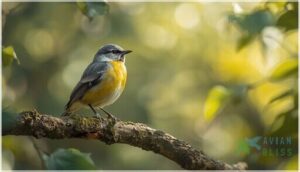
You’ll find some of the most elegant color combinations in birds that wear gray feathers above and yellow below. This understated pattern appears across several families, from delicate warblers to hardy finches.
Let’s break down the key species you’re likely to encounter and what sets each one apart.
Warbler Species Identification
Warblers with yellow breasts can fool even experienced birders—these small, energetic birds share similar sizes but show critical differences in plumage patterns and beak shapes.
Yellow Warbler identification is marked by a uniformly yellow glow with rusty streaks on males, while the Magnolia Warbler features a bold black necklace across its chest and striking white wing patches. Cape May Warbler identification hinges on chestnut cheek patches and dense streaking underneath.
Migration routes overlap considerably among yellow-breasted bird species, so you’ll need sharp eyes for song variations and habitat preferences. Watch for the Prairie Warbler’s distinctive tail-wagging behavior and facial stripes during spring passage.
Sparrow Characteristics
You won’t find yellow breasts on sparrows—these birds sport pale gray or brown underparts with streaking, never the bright yellow common in warblers or yellow-breasted birds.
House Sparrows reach 14–18 centimeters with gray crowns and black bibs on males, while species like Savannah Sparrows show yellow only on their lores.
Their beak shapes, feather patterns, and flocking behaviors differ markedly from true yellow birds during migration routes.
Finch Species Overview
You’ll spot finches among the most striking gray birds with yellow bellies across North America, though their coloration tells a deeper story about diet and adaptation. American Goldfinch males flash vivid yellow bodies with black caps during breeding—colors derived from dietary carotenoids deposited directly into their plumage. Females display subtler gray-yellow tones year-round. Lesser Goldfinches show darker backs against bright yellow underparts, while Evening Grosbeaks pair gray wings with yellow bellies and remarkably thick bills.
These beak adaptations reflect specialized seed preferences—conical bills built for cracking tough seed coats. Watch for plumage variation across seasons as finches shift between breeding and winter colors. Finch migration patterns vary by species, with some populations moving south while others remain sedentary.
Finch conservation efforts focus on habitat preservation, though many species thrive in gardens and parks where bird identification becomes straightforward.
Yellow Breasted Warblers
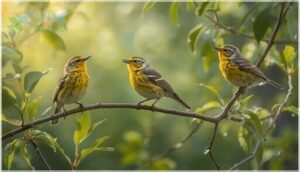
Warblers with yellow breasts aren’t just pretty—they’re wanderers, survivors, and masters of adaptation. Each species follows its own path through the seasons, from epic migrations to carefully chosen breeding grounds.
Here’s what sets three standout yellow-breasted warblers apart from the rest.
Yellow Warbler Migration Patterns
You’ll track Yellow Warblers across thousands of kilometers twice yearly as they navigate structured flyways between North American breeding grounds and Neotropical wintering sites. These warblers migrate earlier than most species—departing by August and arriving in April.
Many populations undertake nonstop Gulf of Mexico crossings, while stopover sites around coastal zones support distinct regional groups moving through asynchronously, demonstrating extraordinary migratory connectivity across their range.
Magnolia Warbler Breeding Habits
When males arrive in dense conifer forests each May, they launch into Territorial Behavior—chasing rivals and flashing tail patches during Mating Rituals. You’ll notice their Nest Site Selection favors low spruce branches, where females build flimsy cups holding 3-5 speckled eggs.
Both parents share Fledgling Care duties throughout Breeding Seasons, feeding nestlings for ten days before these Yellow warblers take flight, making Bird Identification and Nesting observation rewarding.
Cape May Warbler Distinctive Features
Among Yellow Breasted Birds, you’ll spot the Cape May Warbler by its tiger-striped underparts—bold black streaks running down bright yellow Plumage Colors that few warblers match. Breeding Habits bring males north with vivid chestnut cheek patches framing their faces, a hallmark for Bird Identification.
Notice their decurved Beak Shapes, perfectly curved for sipping nectar during Migration Routes through Caribbean islands. Feather Patterns show greenish backs and white wing bars, while females wear subdued yellows without that rusty facial blaze.
This yellow warbler’s high-pitched song echoes through spruce forests each spring.
Rare Yellow Breasted Birds

Some yellow-breasted birds are harder to find than your backyard regulars. These species occupy specific habitats or face threats that make spotting them a real achievement.
Let’s look at the birds that’ll test your identification skills and why protecting them matters.
Yellow Breasted Chat Habitat
You’ll discover Yellow Breasted Chats haunting dense shrublands and tangled thickets across North America’s Breeding Grounds, where Shrubland Ecology creates perfect cover for these secretive Yellow Birds. Look for them in Riparian Zones along streams, forest edges, and abandoned fields—anywhere thick vegetation grows 1-8 feet high.
Habitat Fragmentation threatens their survival as forests mature and brushy areas disappear. Conservation Efforts now focus on maintaining early successional habitats that these rare Warblers need.
When you’re doing Bird Identification in powerline corridors or regenerating clearcuts, watch for their distinctive olive-green backs and bright yellow chests moving through the understory.
Rare Warbler Species
You’re witnessing Warbler Migration routes collapsing as Rare Species vanish from their ancestral grounds. Bachman’s Warbler—declared extinct in 2023 after last sightings in 1988—shows what Habitat Loss achieves.
Warbler migration routes are collapsing as rare species vanish, with Bachman’s Warbler declared extinct in 2023 after habitat loss erased its ancestral grounds
Kirtland’s Warbler dropped from 2,245 pairs to 1,477 by 2025, while Swainson’s Warbler battles southern forest clearing.
Bird Conservation efforts now target these Endangered Birds before they follow Bachman’s path into oblivion.
Conservation Status of Yellow Breasted Birds
Beyond individual rare warblers, you’ll find that yellow-breasted species as a group face mounting threats. Eastern Meadowlarks show steady population declines since 1966—a pattern mirrored across North American grasslands, where nearly three-quarters of bird species are dropping. The yellow-breasted bunting’s crash from common to critically endangered in just nine years proves how fast Habitat Loss and trapping can erase a species.
Habitat Preservation now drives Conservation Efforts: delayed mowing protects meadowlark nests, while China’s hunting bans target bunting recovery. Bird Migration routes need protection from window strikes—killing 600 million birds annually. Environmental Impact from pesticides hits insect-eaters hardest.
Conservation Status varies, but Wildlife Conservation priorities are clear: restore grasslands, monitor populations, and preserve breeding grounds before more species follow the yellow-breasted bunting toward extinction.
Frequently Asked Questions (FAQs)
What kind of bird has a yellow chest?
You’ll encounter American Goldfinches flashing lemon-yellow plumage, meadowlarks with black V-shaped breast markings, and Yellow Warblers during migration.
Orioles also display bright yellow chests, each species offering distinct feather color patterns for identification.
Are Yellow-breasted Chats rare?
Yellow-breasted Chats aren’t globally rare—Partners in Flight counts 17 million individuals. However, population trends show a 32% decline since 1966, with habitat loss driving regional rarity in northeastern states despite conservation efforts elsewhere.
What kind of bird is gray with a yellow belly?
Several species match this description. Western Kingbirds show gray heads and backs with bright yellow bellies—they’re flycatchers that perch openly in grasslands.
Canada Warblers display blue-gray upperparts contrasting with yellow underparts and distinctive breast streaking.
What time of year do yellow-breasted birds migrate?
You’ll observe most yellow-breasted birds migrating during spring (April-May) and fall (August-October).
American Goldfinches move mid-fall through early spring, while Yellow Warblers begin their southward journey by early August, following distinct seasonal movements and breeding cycles.
How to attract yellow-breasted birds to feeders?
You’ll boost bird watching success at backyard feeders by offering nyjer and black-oil sunflower in tube feeders near native vegetation.
Position bird feeders within one meter of windows, add moving water sources, and plant coneflowers for bird identification.
What do yellow-breasted birds eat in winter?
When cold months arrive, your backyard visitors shift strategies. American Goldfinches raid seed heads and feeders for nyjer and sunflower. Yellow-rumped Warblers switch to bayberries and juniper fruits. Western Meadowlarks forage for grain and buried insects.
How to distinguish male from female yellow birds?
You’ll spot males by their vivid lemon-yellow breasts and bold streaking during breeding season. Females show duller olive-brown tones with muted yellow bibs.
Bill brightness and black caps on males like American Goldfinches provide additional sex determination clues.
When do yellow-breasted birds typically nest?
You might think all yellow-breasted birds nest in spring, but their nesting seasons vary.
For example, American Goldfinches nest late—July through September—while warblers and chats start in May or June, aligning with food and migration cycles.
Can yellow-breasted birds survive in urban areas?
You’ll find urban adaptation varies widely among yellow-breasted birds. American Goldfinches thrive near feeders in cities, while Yellow-breasted Chats struggle with habitat loss from development—conservation efforts become vital for sensitive species.
How to photograph yellow-breasted birds effectively?
Golden hour transforms yellow plumage into fire. You’ll need fast shutter speeds—around 1/3,200 s for small birds—plus continuous autofocus and patient field techniques.
Move slowly, let birds approach, and capture their brilliance when light dances across feathers.
Conclusion
Break free from the guesswork—once you decode habitat preferences, seasonal plumage shifts, and behavioral cues, you’ll identify birds with yellow breasts with confidence that borders on instinct. That meadowlark perched on barbed wire tells a different story than the warbler flitting through oak branches.
Your binoculars reveal more than feathers; they disclose patterns written in migration routes and foraging strategies. Field marks matter, but context transforms observation into certainty. You’re not just spotting color anymore—you’re reading the landscape itself.