This site is supported by our readers. We may earn a commission, at no cost to you, if you purchase through links.
 You’ll find nine remarkable heron species across California’s wetlands, from the iconic Great Blue Heron standing like a statue in shallow water to the secretive American Bittern that blends perfectly with marsh reeds.
These graceful wading birds call California home year-round, thriving in coastal estuaries, freshwater marshes, and even urban ponds.
Each species has carved out its own niche – the tiny Least Bittern skulks through cattails while massive Great Egrets patrol open waters.
Whether you’re a weekend birder or serious wildlife enthusiast, California’s diverse aquatic habitats offer unmatched opportunities to observe these elegant hunters.
Knowing where and when to look makes all the difference.
Table Of Contents
- Key Takeaways
- Great Blue Heron
- American Bittern
- Black-crowned Night-Heron
- Green Heron
- Great Egret
- Cattle Egret
- Snowy Egret
- Least Bittern
- Little Blue Heron
- Frequently Asked Questions (FAQs)
- Are there herons in California?
- What is the difference between a heron and a Great Blue Heron?
- Did I see a crane or a heron?
- What are the white herons in California?
- When is the best time to photograph herons?
- What diseases commonly affect California heron populations?
- How do herons survive during California drought periods?
- Which heron species are most endangered in California?
- Do herons migrate through California or stay year-round?
- Conclusion
Key Takeaways
- You’ll find nine remarkable heron species across California’s wetlands, from the towering Great Blue Heron to the secretive Least Bittern that masters camouflage among marsh reeds.
- You can spot these elegant wading birds year-round in diverse habitats including coastal estuaries, freshwater marshes, urban ponds, and even agricultural areas where Cattle Egrets follow livestock.
- You’ll have the best success photographing and observing herons during early morning or late afternoon when they’re most active, with many species like Great Blue Herons staying year-round while others migrate seasonally.
- You should visit protected areas like Sacramento National Wildlife Refuge or San Joaquin Wildlife Sanctuary for optimal viewing, as conservation efforts have helped species like Great Egrets and Snowy Egrets recover from near extinction due to historical plume hunting.
Great Blue Heron
You’ll easily recognize California’s largest heron by its impressive six-foot wingspan and distinctive blue-gray plumage with white throat markings.
California’s majestic Great Blue Heron commands attention with its towering presence and elegant blue-gray feathers.
This adaptable year-round resident thrives in both freshwater and saltwater environments, from quiet ponds to coastal marshes.
Where it stands motionless before striking fish with lightning speed.
Range and Habitat of The Great Blue Heron

You’ll find Great Blue Herons throughout California’s diverse wetland habitats, from coastal marshes to inland agricultural areas.
These adaptable birds thrive year-round in the Golden State, making their homes wherever water meets opportunity.
Here are five key habitat features where you’ll spot Great Blue Herons:
- Coastal Habitats – Salt marshes, estuaries, and mangrove swamps along California’s shoreline
- Inland Wetlands – Freshwater lakes, rivers, and marshes throughout the Central Valley
- Nesting Colonies – Tall trees near water sources where they build stick nests communally
- Agricultural Impact – Flooded rice fields and irrigation canals that provide abundant fishing spots
- Conservation Status – Protected wetlands and wildlife refuges maintaining stable populations
These herons are protected under the Migratory Bird Treaty Act.
Behaviors and Characteristics of The Great Blue Heron

With patience rivaling a meditation guru, the great blue heron employs remarkable hunting strategies.
You’ll witness these masters standing motionless for hours, then striking with lightning speed.
Their physical adaptations include razor-sharp beaks and flexible necks that coil like springs.
| Behavior | Description |
|---|---|
| Hunting Strategies | Stands motionless, then spears prey with precise strikes |
| Nesting Habits | Builds large stick nests in colonies near water |
| Social Interactions | Generally solitary but nests communally in rookeries |
| Conservation Status | Stable populations throughout California wetlands |
Explore The Great Blue Heron on YouTube

YouTube offers incredible close-up footage of great blue heron behaviors you’ll rarely witness in person.
These videos showcase California herons’ remarkable adaptations and daily lives through expert cinematography.
Essential Great Blue Heron YouTube Content:
- Heron vocalizations during mating rituals and territorial disputes
- Fishing techniques demonstrating their patient hunting strategies
- Nest building sequences revealing intricate construction methods
Search "California herons birdwatching" for local footage.
American Bittern
You’ll find the American Bittern harder to spot than other California herons because this medium-sized, buffy brown bird masters the art of camouflage in freshwater marshes and dense vegetation.
Listen for its distinctive "oong-KA-chunk" call while it hunts fish, frogs, and insects in reedy lakeshores and coastal wetlands throughout the state.
Spotting The American Bittern in California

American Bitterns master the art of bittern camouflage, blending seamlessly into California’s reed beds.
You’ll hear their distinctive bittern vocalizations—a deep "oong-KA-chunk"—before spotting them.
Visit Sacramento National Wildlife Refuge or San Joaquin Wildlife Sanctuary at dawn for your best chance.
These elusive California herons freeze when threatened, making identification challenging among similar heron species in wetland environments.
They’re often observed exhibiting cryptic coloration for camouflage.
Range and Habitat of The American Bittern

You’ll discover American Bittern across diverse wetland habitats throughout North America.
These secretive heron species showcase remarkable camouflage behavior in their preferred environments.
Migration Patterns and Breeding Grounds:
- Summer Range – Breeds from Alaska to California in freshwater marshes
- Winter Territory – Migrates to Pacific and Gulf coasts for warmer months
- Preferred Heron Habitat – Dense cattail marshes with tall vegetation
- Wetland Conservation Areas – Protected marshlands support stable populations
Black-crowned Night-Heron
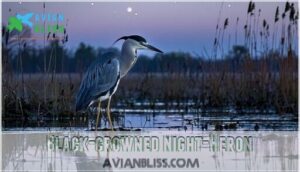
You’ll spot the black-crowned night-heron’s stocky silhouette at dusk, when this remarkable heron species begins its nocturnal foraging activities. Unlike other herons in California, this bird has adapted perfectly to nighttime hunting with large eyes that excel in low-light conditions.
Adult black-crowned night herons display striking gray and white plumage with their signature black crown and back. However, juvenile plumage tells a different story – young birds sport brown, heavily streaked feathers until they reach two years old, making identification tricky for new birders.
These adaptable birds thrive in various heron habitats, from coastal wetlands to urban environments. You’ll find them in parks, golf courses, and city ponds, proving their remarkable tolerance for urban habitats.
Key identification features include:
- Stocky build with shorter legs than other California herons
- Distinctive "quawk" call heard during evening hours
- Colonial nesting behavior in tall trees for predator protection
- Diverse diet ranging from fish to small mammals
Their conservation status remains stable, thanks to their adaptability and varied heron behavior patterns.
Green Heron

Unlike the night-hunting Black-crowned Night-Heron, you’ll find Green Herons actively foraging during daylight hours in California’s quiet waterways.
This crow-sized heron species showcases remarkable intelligence, dropping insects as bait to lure fish within striking distance.
They’re known to inhabit marshes and streamsides across California.
| Green Heron Feature | Description | Identification Tips |
|---|---|---|
| Size & Build | 16-22 inches tall | Compact, hunched posture |
| Coloring | Dark cap, chestnut neck | Greenish back with streaks |
| Habitat Preferences | Wooded streams, ponds | Dense vegetation cover |
| Foraging Techniques | Tool-using hunter | Patient stalking behavior |
Green Heron ID becomes easier when you recognize their distinctive "skeow" call and secretive nature among California’s heron identification challenges.
Great Egret

The Great Egret stands as California’s most elegant heron species, a living symbol of conservation success.
Once nearly extinct due to the Plume Trade that harvested their spectacular breeding plumes, these magnificent birds have made a remarkable comeback.
You’ll recognize them by their pure white feathers, yellow bills, and impressive four-foot height.
During breeding behavior season, Great Egrets develop gorgeous plumes that flow like silk ribbons in courtship displays.
Their conservation status has improved dramatically since protective laws ended the devastating plume hunting era.
- Habitat flexibility – They thrive in freshwater marshes, coastal wetlands, and even urban ponds
- Diet adaptations – Fish, frogs, and small mammals make up their varied menu
- Year-round presence – Unlike Great Blue Heron populations that migrate, many stay put
Cattle Egret

Across California’s farmlands, you’ll spot the compact Cattle Egret following livestock like a faithful shadow.
This opportunistic heron species demonstrates remarkable range expansion since arriving from Africa in the 1950s. Unlike other egret species, they’ve mastered foraging ecology by catching insects stirred up by grazing animals.
Their habitat preferences include agricultural areas and pastures rather than traditional wetlands. Their diet consists primarily of insects, which they find through opportunistic feeding habits.
While not considered an invasive species, their conservation status remains stable due to their adaptability to human-modified landscapes throughout California.
| Physical Features | Behavioral Traits |
|---|---|
| Stocky, short-necked build | Forms large communal roosts |
| Orange-buff breeding plumage | Follows cattle and farm equipment |
| Yellow bill and legs | Nests colonially in trees |
| Smaller than other California bird species | Feeds primarily on grasshoppers |
Snowy Egret

You’ll recognize the Snowy Egret by its brilliant white plumage, slim black bill, and distinctive bright yellow feet that earn it the nickname "golden slippers."
This elegant wader represents one of conservation’s greatest success stories, having recovered from near extinction due to the early 1900s plume trade to become an increasingly common sight in California’s wetlands today, which is a testament to conservation’s greatest success stories and the recovery from the plume trade.
Range and Habitat of The Snowy Egret
You’ll find Snowy Egrets throughout California’s coastal marshes and estuarine habitats, from San Francisco Bay to San Diego.
These wetland specialists prefer shallow waters with muddy bottoms where they can hunt effectively.
Their breeding colonies cluster in protected areas like wildlife refuges.
Conservation efforts have helped stabilize their populations, though habitat threats from development continue challenging their wetland preferences along California’s coast.
You can find habitat-related products for these birds online.
Unique Behaviors and Characteristics of The Snowy Egret
You’ll instantly recognize Snowy Egrets by their signature yellow feet and energetic foraging behavior.
These California birds actively shuffle through shallow water, stirring up prey with their bright feet – a unique technique among heron species.
During breeding season, they develop elegant plumes and perform elaborate courtship displays.
This conservation success story showcases remarkable habitat adaptations across wetland environments.
Least Bittern

You’ll need sharp eyes and patience to spot California’s smallest heron species, the Least Bittern, as it expertly camouflages itself among dense marsh reeds with its buff-colored, streaked plumage.
This secretive bird freezes completely when threatened and uses its exceptional ability to blend into freshwater wetlands throughout the Central Valley and coastal areas, making it one of the most challenging herons to observe in the wild, with its ability to expertly camouflages itself.
The Smallest Heron Species in California
Standing just 11-14 inches tall, the Least Bittern claims the title of California’s smallest heron species.
You’ll need sharp eyes for Least Bittern ID since these secretive birds master the art of camouflage in dense marshlands.
Their buff-colored plumage with dark streaks helps them vanish among cattails and reeds.
Unlike the more visible Green Heron, Least Bitterns freeze motionless when threatened, pointing their bills skyward to mimic marsh vegetation.
Their diet uniqueness includes small fish, frogs, and insects caught with lightning-quick strikes.
Unfortunately, habitat loss threatens their breeding habits and overall conservation status.
These remarkable herons prove that size doesn’t determine hunting prowess.
When other heron species forage openly, Least Bitterns prefer solitary stealth missions through California’s remaining wetlands, making every sighting truly special.
Range and Habitat of The Least Bittern
You’ll find the Least Bittern primarily in California’s Central Valley and coastal wetland ecosystems, where marsh distribution creates perfect breeding grounds.
This smallest heron species depends heavily on dense vegetation for camouflage, making habitat loss a serious conservation concern.
Their preference for freshwater marshes with thick cattails and bulrushes means protecting these specialized heron habitats remains essential for their survival. Wetland restoration is vital for maintaining biodiversity.
Little Blue Heron

You’ll find the Little Blue Heron is California’s master of disguise, with juveniles sporting pure white plumage that mimics other egrets before transforming into slate-blue adults.
This rare breeding bird prefers shallow wetlands in southern California, where it hunts crayfish and small fish with patient precision.
Range and Habitat of The Little Blue Heron
You’ll find Little Blue Herons primarily in Southern California’s wetland ecosystems, where they establish nesting colonies near freshwater marshes and lagoons.
Their California distribution remains limited compared to other heron species, showing a strong wetland preference for shallow waters rich with their favored crayfish diet.
Juvenile habitats mirror adult preferences, though young birds venture slightly farther from traditional heron range boundaries, with a diet likely including crayfish.
Identifying Other Water Birds in California
While searching for Little Blue Herons, you’ll spot many other water birds sharing California’s wetlands.
Learning Duck Identification helps distinguish mallards with their iridescent green heads from the graceful curves of mute swans.
Gull Varieties range from California Gulls to smaller species, while Shorebird Species like Black-Bellied Plovers and Dunlin probe mudflats alongside herons.
- Grebe Distinctions: Western Grebes display elegant necks and diving behaviors unlike wading herons
- Pelican Overview: California Brown Pelicans feature massive pouches and dramatic plunge-diving techniques
- Cormorant Calls: Double-crested Cormorants make distinctive three-part whistles while drying their wings
Great Egrets and Snowy Egrets often share feeding areas with these diverse species.
You might even spot an Anna’s Hummingbird, which is a year-round resident in California.
Mastering bird identification enhances your wetland adventures, revealing the rich tapestry of California’s aquatic ecosystems beyond just herons.
Frequently Asked Questions (FAQs)
Are there herons in California?
Yes, you’ll discover several heron species thriving throughout California’s diverse wetlands.
Great Blue Herons, Snowy Egrets, and Black-crowned Night Herons are common residents, while others like Little Blue Herons visit seasonally in southern regions.
What is the difference between a heron and a Great Blue Heron?
Like comparing a family tree to one specific branch, "heron" encompasses the entire bird family while Great Blue Heron refers to one specific species.
You’re looking at the difference between a category and its individual member, which is a complete concept to understand in this context.
Did I see a crane or a heron?
You probably spotted a heron if it was near water with a long neck and sharp beak.
Cranes are taller, have different beaks, and often gather in fields rather than wetlands.
What are the white herons in California?
California hosts over 20,000 breeding pairs of white herons.
You’ll spot three main white species: the towering Great Egret with its yellow bill, smaller Snowy Egret with distinctive yellow feet, and rare Cattle Egret with orange breeding plumes.
When is the best time to photograph herons?
Early morning and late afternoon offer perfect lighting conditions for photographing herons. You’ll catch them actively feeding during these golden hours, when soft light creates stunning reflections and dramatic silhouettes.
What diseases commonly affect California heron populations?
You’ll encounter avian botulism as the biggest threat to heron populations, along with West Nile virus and parasitic infections.
Contaminated water sources spread these diseases rapidly through colonies during breeding season.
How do herons survive during California drought periods?
During severe droughts, 60% of heron colonies relocate to deeper water sources.
You’ll find they concentrate around remaining wetlands, switch to urban water features, and adjust their diet to include more terrestrial prey like rodents.
Which heron species are most endangered in California?
You’ll find that most California heron species aren’t currently endangered, though they face habitat threats.
Least Bitterns show concerning population declines, while Great Egrets and Snowy Egrets have recovered well from historical hunting pressures, which is a concerning issue for some species.
Do herons migrate through California or stay year-round?
California’s herons aren’t exactly following your vacation schedule.
Some species like Great Blue Herons stay year-round, while others migrate seasonally.
You’ll spot Snowy Egrets moving through during migration, but many stick around permanently.
Conclusion
California’s wetlands offer unparalleled opportunities to observe these magnificent wading birds throughout the year.
You’ll discover herons in California’s coastal marshes, freshwater ponds, and urban waterways if you know where to look.
Each species requires different habitats and timing for ideal viewing.
Start your birding journey at local wetlands during early morning or late afternoon when these patient hunters are most active.
With persistence and the right locations, you’ll witness these graceful predators in their natural element.
- https://www.sacramentoaudubon.org/kids-corner/meet-the-great-egret
- https://nationalzoo.si.edu/migratory-birds/species-profile-black-crowned-night-heron
- https://www.allaboutbirds.org/guide/Great_Blue_Heron/id
- https://eyeonbird.com/10-types-of-herons-in-california/
- https://www.facebook.com/photo.php?fbid=10158780654924539&id=51110454538&set=a.185449004538