This site is supported by our readers. We may earn a commission, at no cost to you, if you purchase through links.

small white bird follows a water buffalo through tall grass, snatching insects stirred up by each heavy step. That’s the cattle egret’s signature move—and it’s so effective that birds foraging near large mammals catch prey 3.6 to 5.2 times faster than those hunting alone.
What started as a behavioral adaptation in African savannas quietly became one of the most notable self-driven range expansions in modern ornithology.
By the 1940s, cattle egrets had crossed the Atlantic without human help, and within decades they’d established themselves across five continents.
Understanding how this compact, opportunistic bird lives, feeds, and breeds explains exactly why it keeps turning up everywhere.
Table Of Contents
- Key Takeaways
- Cattle Egret Identification
- Habitat and Global Range
- Feeding Behavior and Diet
- Breeding and Nesting Habits
- Conservation and Human Impact
- Frequently Asked Questions (FAQs)
- Why do cattle egrets follow cows?
- How did cattle egrets get to North America?
- Is a cattle egret the same as a white egret?
- What are some interesting facts about cattle egrets?
- How fast can a cattle egret fly?
- Do cattle egrets make any distinctive vocalizations?
- What is the average lifespan of a cattle egret?
- Can cattle egrets swim or dive for food?
- Are there any notable predators of cattle egrets?
- How long do cattle egrets typically live?
- Conclusion
Key Takeaways
- Cattle egrets foraging near large animals catch prey 3.6 to 5.2 times faster than those hunting alone, making their bond with livestock one of the most efficient feeding strategies in the bird world.
- Without any human help, Cattle egrets crossed the Atlantic by the 1940s and established themselves across five continents within decades — one of the most remarkable self-driven range expansions in modern ornithology.
- During breeding season, their pure white plumage shifts to orange-buff plumes on the head, chest, and back, giving you one of the clearest visual cues for identifying a nesting adult in the field.
- Despite holding an IUCN Least Concern status globally, cattle egrets cause real ecological friction in non-native regions by displacing local herons and egrets from nesting sites.
Cattle Egret Identification
Spotting a Cattle Egret in the field is easier than you’d think once you know what to look for. A few key physical traits set this bird apart from the other white waders you might encounter.
Its compact build and short yellow bill really stand out — explore this visual guide to white wading birds to see how it compares to similar species at a glance.
Here’s what to pay attention to.
Body Size and Proportions
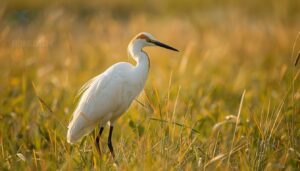
cattle egret is a compact bird — body length runs 46–56 cm (18–22 in), weight 270–512 g (9.5–18.1 oz), and wingspan 88–96 cm (34.6–37.8 in).
Its low wing loading facilitates agile, efficient flight aerodynamics, while a favorable tail ratio aids steering.
Minimal size sexual dimorphism means males and females share nearly identical measurements and size and shape.
White Plumage and Breeding Plumes
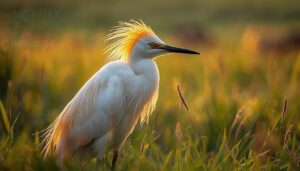
Beyond size, the egret’s white plumage is its most recognizable trait.
Year-round, feathers stay pure white — but breeding season timing triggers striking plumage changes during breeding. Orange-buff plumes appear on the head, chest, and back, driven by molt synchrony.
Subtle plumage iridescence, UV reflectance, and crest ornamentation intensify display quality, while a distinct facial skin hue briefly marks breeding adults.
These shifts illustrate the broader pattern of seasonal colour changes seen across many bird species.
Bill, Legs, and Neck Features
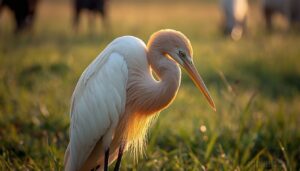
Those orange-buff plumes draw the eye, but the egret’s structural traits tell an equally precise story.
The straight, daggerlike bill — short and thick, with slight base flexibility — facilitates rapid prey capture mechanics when insects scatter underfoot. Leg scaling keeps joints flexible through seasonal wear.
Short legs and a short thick neck reflect careful morphological traits, while neck articulation allows compact S-curve coiling mid-strike.
Juvenile Vs. Adult Appearance
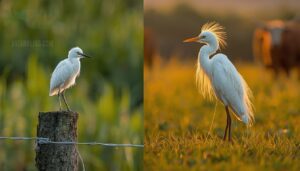
Spotting the difference between a juvenile and adult cattle egret isn’t hard once you know what to look for.
Juveniles show a softer Neck Loop Shape, rounder head, and Eye Size Contrast that make them look almost oversized for their face. Their Plumage Texture stays matte white — no breeding plumes, no gloss.
Adults develop longer legs, a higher Leg Length Ratio, warmer Facial Skin Tone, and rich breeding plumage during nesting season.
Similarities to Herons and Egrets
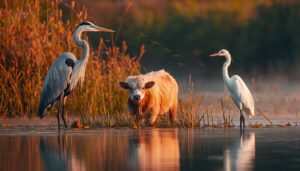
If you’ve ever struggled to tell a cattle egret from a snowy egret or great blue heron, you’re not alone.
All ardeids share long-legged wading builds, broad wing shapes, zygodactyl feet, and that classic S-shaped neck posture. Shared foraging tactics, colonial nesting habits, and mostly white non-breeding plumage also blur the lines.
Size and shape comparison among heron species remains your sharpest identification tool.
Habitat and Global Range

The cattle egret has pulled off one of the most impressive range expansions in modern bird history. What started as a species tied to Europe, Africa, and Asia has turned into a global success story spanning nearly every continent.
Here’s a look at where this bird actually lives and how far it’s traveled.
Native Range in Europe, Africa, and Asia
The Cattle Egret’s native range tells a story of impressive adaptability.
In Europe, you’ll find it working in Mediterranean marshes and Iberian lowlands.
Across Africa, it thrives from Sahelian savannas to East African riverbanks.
In Asia, Monsoon wetlands and Asian rice paddies define its core habitat preference for cattle egrets, where seasonal flooding concentrates both livestock and insect prey reliably.
Expansion Into The Americas and Australasia
What started as a natural dispersal event became one of ornithology’s most studied colonization timelines. Cattle egrets reached the Americas by the 1940s, sweeping through North America within two decades through a mix of natural flight and human‑assisted dispersal.
Climate suitability shifts opened pathways into Australia and New Zealand by the 1960s–70s, where agricultural landscapes basically rolled out the welcome mat.
Preferred Grasslands, Fields, and Wetlands
You’ll find cattle egrets wherever open ground and large animals meet. Their habitat preference leans toward pastures and fields, seasonally flooded grasslands, and upland areas with short vegetation.
Seasonal floodplain use peaks during wet periods, when invertebrate abundance spikes.
Edge habitat preference is strong — wetland buffer strips and irrigation ditch foraging zones attract them consistently, reflecting core wetland bird ecology principles.
Use of Agricultural and Urban Areas
Farming landscapes are practically built for cattle egrets. They thrive in agricultural fields, using crop field foraging zones and irrigation canal usage to increase prey access.
Urban roosting sites — parks, golf courses, lighted green roof habitats — extend their range further.
Symbiotic foraging with livestock remains their signature strategy, but pesticide impact can reduce insect availability, making human‑altered environments and egrets a complex, evolving relationship.
Seasonal Movements and Migration
Migration patterns of egrets aren’t random — they follow the land’s rhythm.
Flood-driven dispersal pushes birds toward fresh insect outbreaks after wet-season rains, while drought-induced relocation drives flocks to greener grazing regions.
Temperature cue timing signals when to shift north or south, and wind-assisted travel shapes nightly movement windows.
Seasonal stopover habitats bridge the gaps along migratory pathways, threading together their impressive global range expansion.
Feeding Behavior and Diet
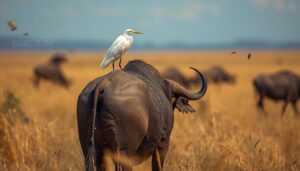
The cattle egret has one of the most clever feeding strategies in the bird world. It doesn’t just hunt — it works smarter by team up with animals far larger than itself.
Here’s a closer look at exactly how it finds, tracks, and catches its food.
Following Cattle and Other Large Mammals
When cattle move across a pasture, the cattle egret moves with them — and that’s no accident. Herd movement cues tell the birds exactly where insects will surge from the grass next.
This commensal relationship with cattle, and other livestock association with horses, elephants, and deer, delivers a foraging efficiency boost of 3.6–5.2 times compared to solo hunting.
By following cattle, horses, and elephants, egrets hunt up to 5 times more efficiently than alone
Vigilance sharing within the group also cuts predator risk, while some birds practice mutualistic parasite removal directly from the animals’ backs.
Insect-heavy Diet and Prey Types
That efficiency boost from following herds means nothing without the right prey waiting in the grass.
The cattle egret’s insectivorous diet spans a wide Prey Size Spectrum — from 3 mm flies to 25 mm grasshoppers. Insect Taxonomic Diversity keeps feeding behavior and diet composition flexible across seasons, with Seasonal Prey Shifts moving from spring aphids through summer beetles into autumn moths.
Capture Mechanics and Digestive Adaptations handle even hard‑shelled beetles with ease.
Opportunistic Feeding in Shallow Water
Insects aren’t the whole story. When cattle egrets work in wetland habitats, their diet composition and prey types shift quickly.
Edge Probing and Mudflat Tactics, they wade shallow margins hunting crustaceans, small fish, and aquatic larvae.
Tide-Driven Foraging and Riparian Prey Pulses concentrate prey predictably, while Temperature-Influenced Capture success rises in turbid water.
Their ground foraging techniques make every mudflat edge count.
Head-bobbing and Prey Detection
Head-bobbing isn’t random fidgeting — it’s precision engineering. Each bob alternates a thrust phase with a hold phase, achieving visual stabilization that cuts motion blur and sharpens prey detection.
Three things drive this behavior:
- Motion parallax gauges exact prey distance.
- Gait synchronization times each bob with footfall.
- Binocular vision locks in during the hold phase.
Multisensory integration — beak vibrations included — seals the deal.
Flock Foraging and Capture Efficiency
When flock size rises from 5 to 15 birds, capture efficiency climbs sharply — more eyes mean faster prey detection across open fields. Synchronised pecking bursts drive higher instantaneous captures than solitary foraging ever could.
Vocal cue communication directs subgroup movement patterns toward richer patches, while competition and sharing balance resource access.
This symbiotic foraging relationship with livestock amplifies feeding behavior and diet composition, making pest control a genuine side effect.
Breeding and Nesting Habits

Cattle egrets don’t just show up somewhere and start a family — there’s a whole process behind it. From the way they court a mate to how their chicks take their first flight, every stage follows a clear pattern worth knowing.
Here’s a closer look at how that process unfolds.
Colonial Nesting in Trees and Shrubs
Cattle egrets don’t nest alone — they build entire neighborhoods in the treetops. Breeding colonies form high in trees or dense shrubs, where elevation acts as a predator defense strategy. Colony communication calls keep birds synchronized throughout the day.
Here’s what defines a typical nesting site:
- Tree height preference favors tall canopies over low vegetation
- Shrub density influence shapes how tightly nests cluster together
- Nest construction materials include sticks, twigs, and soft inner lining
- Seasonal nest repair keeps reused platforms stable year after year
Courtship Displays and Pair Bonding
When breeding season arrives, cattle egrets put on a surprisingly intricate show. Males flash breeding plumage through synchronized wing waggling and plumage contrast signaling — bowing low, presenting side profiles, and performing territorial display rituals from perch sites.
Both sexes reinforce bonds through mutual preening rituals and vocal duet coordination, while nest material presentation signals a male’s readiness to provide.
| Display Behavior | Purpose |
|---|---|
| Synchronized wing waggling | Attracts and impresses mate |
| Mutual preening rituals | Strengthens pair bond |
| Vocal duet coordination | Aligns breeding timing |
| Nest material presentation | Signals provisioning ability |
Nest Building and Site Selection
Nest height matters more than you’d think. Pairs select branches 2–15 meters up, prioritizing branch strength and camouflage materials like moss and plant fiber to mask the shallow stick platform.
predator detection with livestock proximity — staying close enough to productive foraging fields while keeping chicks safely elevated.
Both sexes contribute: males gathering sticks, females weaving the final structure.
Egg Laying and Incubation Period
Once the nest is ready, the female usually lays 3 to 5 pale blue-white eggs, with staggered egg laying occurring one egg per day. Clutch size variation depends on food availability and local conditions.
Both parents share incubation duties, maintaining ideal incubation temperature effects within 36–39°C. Egg moisture balance stays stable through consistent brooding, with the full incubation period lasting roughly 23–25 days.
Chick Development and Fledging Timeline
Once hatched, cattle egret chicks grow fast — gaining 3 to 6 grams daily through consistent parental care through regurgitation. Feather growth stages unfold quickly, with pin feathers emerging by day 5–7 and primary wing feathers by day 10–14.
- Weight gain rate peaks in weeks 1–2
- Nutritional requirements include protein, calcium, and water
- Young begin to climb about near nest around days 15–20
- Fledging behavior develops fully by day 30; juvenile development timeline and independence follow around day 45
Conservation and Human Impact

The cattle egret’s story doesn’t end in the field—it carries real weight for farmers, conservationists, and policymakers alike. As this bird continues spreading across new regions, its relationship with humans gets more complicated.
Here’s what you should know about where it stands today.
Least Concern Population Status
The cattle egret holds an IUCN Least Concern status — and the data backs that up. Population trends remain stable across its global range, supported by strong genetic diversity and consistent range stability.
Monitoring programs confirm no significant declines. Threat assessments show the species adapts well to changing landscapes, with population dynamics staying healthy enough that no urgent conservation action is currently needed worldwide.
Invasive Status in Some Regions
That stable global status comes with a catch, though. Outside its native range, the cattle egret’s global range expansion and colonization raise real concerns. Competitive displacement of local herons and egrets for nest sites remains a documented ecological impact across the Americas, Australasia, and parts of Europe.
Regional responses vary, but generally include:
- Population monitoring to track colony growth and seasonal movements
- Management strategies centered on habitat modification near sensitive wetlands
- Legal restrictions limiting introductions in vulnerable ecosystems
- Ecological impact assessments guiding protected area planning
Benefits to Farms and Pest Control
Despite its invasive reputation in some regions, the cattle egret genuinely earns its place on working farms. Its symbiotic foraging relationship with livestock drives real biological pest control — each bird consumes hundreds of grasshoppers, beetles, and flies daily.
That’s natural agricultural pest management without chemicals.
Their diet composition and role in insect pest control support livestock health while strengthening egret ecosystem services within integrated pest management strategies.
Effects of Human-altered Landscapes
Human-modified landscapes shape where cattle egrets thrive — and where they struggle. Fragmentation effects split foraging patches, forcing birds to travel farther between feeding and roosting sites.
Urban heat islands shift activity toward cooler hours. Pesticide exposure quietly narrows insect diversity.
Artificial water bodies, though, create new feeding opportunities. noise disturbance near colonies can reduce breeding success, reminding you that anthropogenic impact cuts both ways.
Legal Protection and Regional Monitoring
Where cattle egrets nest, the law often follows. The UK’s Wildlife and Countryside Act 1981 places them on the Birds of Conservation Concern 5 amber list — not red, but watched closely.
Protection Zones set legal boundaries around key sites, while Permitting Systems restrict disturbance during breeding. Compliance Audits keep farms accountable.
Citizen Science programs and Satellite Tracking feed data into national networks, strengthening regional monitoring year-round.
Frequently Asked Questions (FAQs)
Why do cattle egrets follow cows?
They follow grazing animals for pure energy savings — foraging behavior of egrets thrives on commensalism, exploiting visual cues from disturbed insects, turning every feeding association with livestock into an easy, high-efficiency meal.
How did cattle egrets get to North America?
Cattle egrets crossed the Atlantic on their own — riding Atlantic wind currents from Africa to South America, then pushing north.
They reached Florida by the early 1950s and bred there by
Is a cattle egret the same as a white egret?
No, they’re not the same.
White egrets like the Snowy Egret belong to different evolutionary lineages. Taxonomic classification separates them by genetic divergence, historical naming, and distinct white plumage, size, and foraging behavior.
What are some interesting facts about cattle egrets?
Few birds tell a story quite like this one — a species that crossed oceans without human help, built mutualistic bonds with grazing animals, and thrived through colonial nesting and impressive global range expansion.
How fast can a cattle egret fly?
During migration, you’re looking at cruising speeds of around 43–45 km/h, with wind-assisted velocity pushing closer to 50 km/h depending on flight altitude and conditions.
Do cattle egrets make any distinctive vocalizations?
You won’t hear much from them while foraging — soft and low is their style.
But in a breeding colony, that quiet shifts to rhythmic rick-rack calls and sharp raa threat notes.
What is the average lifespan of a cattle egret?
In the wild, you’re looking at an average lifespan of around 7 years, though survival factors like environmental stressors and seasonal mortality vary. Captive longevity often exceeds 20 years with proper care.
Can cattle egrets swim or dive for food?
No, they don’t swim or dive for food.
Their compact build, short neck, and stout bill reflect a Diving Morphology suited for surface grabs — not deep plunges like Comparative Diving Herons.
Are there any notable predators of cattle egrets?
Yes — raccoon predation, fox attacks, crow mobbing, and raptor threats are real risks. Rat nest raids also occur on islands.
Colonial nesting and sentry behavior remain their primary predator avoidance strategies.
How long do cattle egrets typically live?
In the wild, cattle egrets generally live 7 to 8 years, though adult longevity can reach
Captive lifespan often exceeds 20 years, while predation mortality and juvenile survival challenges cut many lives short early.
Conclusion
The cattle egret thrives precisely because it asks so little—yet it’s reshaped ecosystems across five continents. That quiet contradiction is worth sitting with.
A small, white bird following a buffalo through tall grass doesn’t look like a success story, but the numbers don’t lie: faster prey capture, self-driven global expansion, and populations still growing.
Once you understand how it works, you’ll never overlook one standing in a field again.