This site is supported by our readers. We may earn a commission, at no cost to you, if you purchase through links.
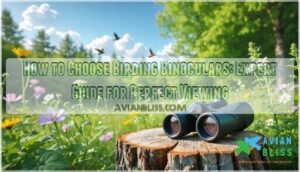 When learning how to choose birding binoculars, focus on three critical specifications: magnification (8x or 10x works best), objective lens diameter (32mm-42mm for ideal brightness), and field of view (wider is better for tracking fast-moving birds).
Consider roof prism designs for durability and porro prisms for superior optics at lower costs.
Eye relief matters if you wear glasses—look for 15mm minimum. Close focus capability under 8 feet helps with nearby subjects.
Weight affects comfort during long birding sessions, so balance performance with portability.
Quality coatings on lenses dramatically improve light transmission and color accuracy.
The right binoculars transform fleeting glimpses into detailed observations, but understanding prism technologies and optical coatings reveals performance secrets most birders overlook.
Table Of Contents
- Key Takeaways
- Birding Binocular Basics
- Choosing Birding Binoculars
- Binocular Specifications
- Binocular Price and Accessibility
- Optimizing Binocular Performance
- Frequently Asked Questions (FAQs)
- Are binoculars necessary for birdwatching?
- Which binoculars are best for birds?
- Why is a 10X50 binocular ideal for bird watching?
- How to choose binoculars?
- Do birding binoculars come in 8x or 10x?
- Should you buy binoculars?
- How to choose the right binoculars for bird watching?
- Which is better, 10×42 or 10×50 for birding?
- Is 8×32 or 8×42 better for birding?
- What weatherproofing features protect binoculars outdoors?
- Conclusion
Key Takeaways
- Choose 8x or 10x magnification – You’ll get the best balance between detail and stability, avoiding the hand shake that comes with higher powers while still bringing distant birds close enough for identification.
- Pick 32mm-42mm objective lenses – You’ll capture enough light for bright, clear images without carrying excessive weight during long birding sessions.
- Consider roof prisms for durability, porro prisms for value – You’ll get weather-resistant compactness with roof designs or superior optics at lower costs with porro configurations.
- Test eye relief and close focus before buying – You’ll need 15mm+ eye relief if you wear glasses and under 8 feet close focus to observe nearby birds without losing sharpness.
Birding Binocular Basics
You’ll discover that binoculars aren’t just helpful for birdwatching—they’re absolutely essential for transforming distant specks into detailed, identifiable birds with vibrant colors and intricate feather patterns.
Without proper optics, you’ll find yourself squinting at blurry shapes and missing the fascinating behaviors that make birding such a rewarding hobby.
Importance of Binoculars in Birdwatching
Without proper binoculars, you’re basically birdwatching blindfolded.
These birdwatching essentials transform distant specks into detailed subjects, revealing intricate feather patterns and subtle behaviors necessary for accurate bird identification.
Quality birding binoculars enhance your viewing experience by magnifying details invisible to naked eyes, making binocular selection fundamental to successful bird watching.
Superior optical quality guarantees crisp image quality, turning challenging observations into rewarding discoveries.
Understanding bird identification techniques is also essential for making the most of your birding experience.
Enhancing Bird Observation and Identification
Quality birding binoculars transform your Wildlife Viewing experience by revealing intricate details invisible to the naked eye.
Superior Optical Quality and lens quality enable precise Bird Species identification through enhanced Field Views of:
- Feather patterns and coloration variations
- Distinctive behavioral movements and feeding habits
- Bill shapes and sizes for taxonomic classification
- Flight patterns and wing configurations.
These image quality improvements paired with proper ergonomics make Bird Behavior observation more engaging and scientifically accurate for successful bird identification.
Key Features for Birding Binoculars
When selecting birding binoculars, prioritize magnification power between 7x-8x for ideal stability and wide field view.
Choose 32mm-42mm lens size to balance brightness with portability. Roof prism type offers compact design while Porro prisms provide wider field view.
Verify adequate eye relief (14mm+) for comfortable viewing. Quality waterproof binoculars with superior lens quality enhance your birding experience substantially.
Choosing Birding Binoculars
Selecting the right binoculars transforms your birdwatching experience from guesswork into precise identification.
You’ll need to balance three critical factors: magnification power, objective lens diameter, and field of view to match your specific birding needs.
Magnification and Objective Lens Diameter
Choosing the right magnification power and objective lens diameter transforms your birding experience through superior image clarity and brightness.
Most birders find 8x magnification strikes the perfect balance between detail and stability, while 42mm objective lenses provide excellent light-gathering capability.
Consider these essential specifications:
- 8x magnification – Offers stable viewing with minimal hand shake
- 42mm objective lens diameter – Balances brightness and portability effectively
- 10x optical zoom – Provides more detail but narrows your field view substantially
- 32mm lenses – Lighter weight option with reduced image quality in low light
When selecting binoculars, understanding optical quality factors is vital for a great birding experience.
Field of View and Close Focus
Field Width determines your visual coverage when tracking birds through dense foliage or open skies.
You’ll want minimum 350 feet at 1,000 yards for effective bird location.
Close Focus under 6.5 feet lets you observe nearby subjects without losing sharpness.
Wide Angle viewing enhances tracking moving species, while superior Lens Quality maintains Image Quality at closer distances.
Ideal Ergonomics complement these Optical Zoom specifications perfectly, ensuring a complete viewing experience.
Prism Types and Their Effects
Binoculars utilize two distinct prism types that dramatically affect your birding experience.
Roof prisms create compact, streamlined designs that excel in portability and weatherproofing, though they require advanced lens coating for maximum optical clarity.
Porro prisms offer superior image quality and wider fields of view at lower costs, but they’re bulkier and less durable than their roof counterparts.
When choosing the right binoculars, consider the prism design differences to optimize your viewing experience.
Binocular Specifications
Understanding binocular specifications helps you match technical features to your specific birdwatching needs and viewing conditions.
These measurements determine how well your binoculars will perform when tracking a Northern Cardinal through dense foliage or identifying distant raptors soaring overhead, which is crucial for birdwatching.
Understanding Magnification and Lens Size
When you decode binocular numbers like 8×42, you’re revealing the secrets of optical performance.
The first number represents Magnification Power—how many times closer objects appear.
Eight-power magnification brings that distant warbler eight times nearer.
The second number indicates objective lens diameter in millimeters, directly affecting image brightness and Optical Quality.
Larger lenses gather more light, enhancing detail recognition in challenging conditions.
Field of View and Its Importance
Magnification sets the stage, but field of view determines your birding success.
This specification measures the width of area visible through your binoculars at 1,000 yards, directly impacting Bird Tracking effectiveness.
Key field of view considerations:
- Wide Angles enhance bird location in dense foliage
- Minimum 350 feet recommended for ideal Field Visibility
- Larger objective lens diameter typically provides wider coverage
- Compact binoculars often sacrifice viewing area for portability
Waterproof binoculars with superior Optical Clarity maintain consistent Viewing Distance performance across conditions.
Prism Types and Their Advantages

Understanding prism types helps you select binoculars that match your birding style perfectly.
Two main prism designs dominate the market, each offering distinct advantages for different situations.
| Feature | Roof Prisms | Porro Prisms |
|---|---|---|
| Design | Compact, streamlined body | Bulkier, offset eyepieces |
| Weight | Lighter, easier carrying | Heavier but stable grip |
| Cost | Higher manufacturing price | More budget-friendly |
| Durability | Better weatherproofing | Traditional construction |
| Field of View | Narrower viewing area | Wider observation range |
Roof prisms create sleek, lightweight binoculars perfect for extended hiking, while Porro prisms deliver wider fields of view at lower costs.
BaK4 prism materials provide superior optical quality compared to BK7 prisms, reducing light loss through better refraction types.
Evaluating Clarity, Brightness, and Color Rendition
Exceptional image quality hinges on three critical factors: clarity, brightness, and color rendition.
Extra-low dispersion glass and fully multi-coated lenses deliver superior optical sharpness and lens clarity. BaK-4 prisms enhance visual acuity through improved light transmission.
Phase-corrected coatings maintain image sharpness while dielectric coatings boost color accuracy, ensuring vibrant plumage details shine through with remarkable precision and eye relief. For ideal viewing, consider investing in high quality birding optics.
Considering Ergonomics and Build Quality

While selecting binoculars, prioritize ergonomic design and build materials that enhance your birding experience.
Weight distribution substantially impacts comfort during extended field sessions, while proper eye relief accommodates eyeglass wearers effectively.
- Grip Comfort: Textured armor and contoured body design prevent slipping during wet conditions
- Binocular Durability: Magnesium alloy construction withstands field abuse better than plastic housings
- Comfort Factors: Balanced weight distribution reduces neck strain during all-day birding adventures
Binocular Price and Accessibility
You’ll find binocular prices range from budget-friendly models under $100 to premium options exceeding $2,000, with manufacturer’s suggested retail prices often higher than actual street prices.
Smart shoppers can secure quality optics at reduced costs through online retailers, specialty stores, and seasonal sales, making excellent birding binoculars accessible across various budget ranges, which is a key factor in finding budget-friendly options.
Manufacturer’s Suggested Retail Prices
Most birding binoculars carry manufacturer’s suggested retail prices between $100-$2,000, though actual retail costs often run 20-30% lower.
Smart birdwatchers know these list prices serve as starting points for cost analysis rather than final purchase decisions.
When selecting binoculars, considering the best binoculars options is vital for exceptional viewing experiences.
| Price Range | Typical Features |
|---|---|
| $100-$400 | Basic optics, limited warranties |
| $400-$1,200 | Premium coatings, better ergonomics |
| $1,200+ | Professional-grade glass, lifetime warranties |
Affordable Options and Budget Considerations
Budget-conscious birders can find excellent affordable options without sacrificing performance.
Modern budget binoculars deliver roughly 85-90% of premium model quality at a fraction of the cost.
Smart shoppers should focus on:
- Celestron Nature DX 8×42 – Best value at $130-185 with strong durability
- Bushnell H2O 10×42 – Top beginner choice around $100 with waterproofing
- Vortex Crossfire HD series – Reliable performance under $200
Entry-level models excel in daylight conditions for backyard and local park birding.
When evaluating budget options, considering budget binoculars quality is essential for making an informed decision.
Warranty and Support Options
Premium binoculars typically offer lifetime or extended warranty coverage, while budget models provide limited protection.
Evaluate warranty length, repair services, and customer support quality before purchasing. Strong brand reputation often correlates with reliable warranty replacement programs and responsive customer care teams.
Review return policies and warranty claims processes to guarantee thorough coverage for your investment and ensure that you have a clear understanding of the warranty terms.
Optimizing Binocular Performance
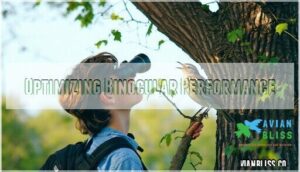
Once you’ve selected your binoculars, proper adjustment transforms them from a basic tool into precision equipment suited to your vision.
These simple calibration steps guarantee you’ll capture every detail of that elusive warbler without the frustration of blurry images or eye strain.
Adjusting Focus and Diopter Rings
Perfect focus begins with proper calibration of your binoculars’ dual adjustment system.
First, close your right eye and use the focus wheel to sharpen the left eyepiece image.
Next, close your left eye and adjust the diopter ring on the right eyepiece until both eyes achieve optical alignment.
This lens calibration process guarantees crisp viewing across varying distances, while smooth focus mechanism operation prevents jarring movements that could startle nearby birds.
Understanding the ideal magnification power is also vital for achieving perfect focus and viewing experiences.
Using Twist-Out Eyecups and Fold-Down Eyecups
Proper eyecup adjustments guarantee comfortable viewing and eliminate vignetting that can ruin your birding experience.
Eyeglass wearers need different settings than those without glasses to achieve maximum eye relief and full field coverage.
- Twist-out eyecups: Extend these for non-eyeglass wearers to maintain proper eye relief distance
- Fold-down eyecups: Keep these retracted when wearing glasses to prevent lens interference
- Eyeglass compatibility: Test different positions to find your sweet spot for complete field visibility
- Focus wheels coordination: Adjust eyecups before fine-tuning diopter settings for maximum clarity
Maintaining and Cleaning Binoculars for Optimal Use
Regular binocular maintenance preserves optical performance and extends equipment lifespan.
Use compressed air to remove debris before lens cleaning with microfiber cloths and proper solutions.
Store binoculars in padded cases with desiccants for fog prevention.
Check strap maintenance and eyecup adjustment regularly.
Proper binocular cleaning protects lens coatings, while correct binocular storage maintains waterproofing integrity and binocular warranty coverage.
Frequently Asked Questions (FAQs)
Are binoculars necessary for birdwatching?
Binoculars aren’t your eyes’ crutches—they’re your superpower for detailed bird identification.
Without them, you’re squinting at distant silhouettes, missing intricate feather patterns and diagnostic features that separate similar species with scientific precision.
Which binoculars are best for birds?
For birdwatching, Nikon Monarch M5 8×42 offers best clarity and brightness for a terrific price.
Consider Vortex Viper HD 8×42 for perfect performance-to-price ratio .
Most birders prefer 7- or 8-power because they’re bright with wide field of view.
Why is a 10X50 binocular ideal for bird watching?
While 10×50 binoculars offer excellent magnification and light-gathering capabilities, they’re actually less ideal than 8×42 models for birding.
The higher magnification creates more image shake and reduces field of view, making it harder to track moving birds effectively.
How to choose binoculars?
Consider magnification (8x ideal), objective lens size (42mm balances brightness and weight), field of view (350+ feet at 1,000 yards), and close focus under 5 feet for detailed observation.
Do birding binoculars come in 8x or 10x?
Most birders favor 7x or 8x magnification over 10x for best performance.
Yes, both 8x and 10x birding binoculars exist, but 8x models offer wider fields of view and steadier images for tracking birds.
Should you buy binoculars?
Yes, you should invest in quality binoculars for birdwatching.
They’re essential tools that transform your experience by revealing intricate feather details, colors, and behaviors impossible to see with naked eyes, making bird identification accurate and enjoyable.
They enable you to observe intricate feather details, which is crucial for a fulfilling birdwatching experience.
How to choose the right binoculars for bird watching?
While expensive optics can dazzle with premium features, choosing effective birding binoculars depends on practical specifications.
Prioritize 8×42 magnification for ideal field-of-view and brightness.
Test focus wheels, eye relief, and ergonomics before purchasing to guarantee comfortable extended use.
Which is better, 10×42 or 10×50 for birding?
The 10×42 offers better portability and stability for extended birding sessions, while 10×50 gathers more light for dawn and dusk observations but adds weight and bulk.
Is 8×32 or 8×42 better for birding?
8×42 binoculars outperform 8×32 models for serious birding applications.
The larger 42mm objective lenses gather substantially more light, delivering brighter images during dawn, dusk, and overcast conditions when birds remain most active.
What weatherproofing features protect binoculars outdoors?
Waterproof and fog-proof seals protect your optics from rain and humidity.
Nitrogen purging prevents internal condensation while rubber armoring shields against impacts.
These weatherproofing features guarantee reliable performance in harsh field conditions.
Conclusion
Perfect binoculars don’t grow on trees, but choosing the right pair transforms your birding experience dramatically.
Understanding how to choose birding binoculars requires balancing magnification, objective lens size, and field of view with your specific needs.
Consider 8×32 or 10×42 configurations for superior performance.
Evaluate prism types, coatings, and ergonomics carefully.
Quality optics enhance bird identification accuracy while comfortable designs reduce fatigue during extended observations.
Your investment in proper binoculars directly impacts your birding success and enjoyment.
- https://wsobirds.org/images/pdfs/FS_optics.pdf
- https://www.ornitheology.com/post/getting-started-in-birdwatching-choosing-binoculars
- https://www.nikonusa.com/learn-and-explore/c/tips-and-techniques/binoculars-for-bird-or-wildlife-watching
- https://www.allaboutbirds.org/news/choosing-binoculars-field-of-view-and-close-focus/
- https://en.wikipedia.org/wiki/Refractive_index