This site is supported by our readers. We may earn a commission, at no cost to you, if you purchase through links.
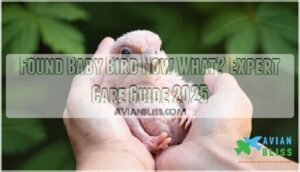 If you’ve found baby bird now what should you do? First, don’t panic. Most "abandoned" birds aren’t actually in trouble.
Check if it’s a fledgling—these fully feathered youngsters are supposed to be on the ground learning to fly. Keep pets and people away, and parents will continue caring for it.
However, if you spot a naked, featherless hatchling, it likely fell from its nest. Gently place it back if you can locate the nest safely.
Can’t find it? Create a makeshift nest using a small basket lined with soft materials, then secure it in nearby bushes. The "human scent" myth is false—birds have poor smell.
Watch from distance for parental activity. There’s much more to proper baby bird rescue than meets the eye.
Table Of Contents
- Key Takeaways
- Identify Baby Bird Type
- Assess Bird’s Condition
- Help Grounded Baby Birds
- Care for Injured Birds
- Feed and Hydrate Baby Birds
- Handle and Release Baby Birds
- Seek Professional Help
- Frequently Asked Questions (FAQs)
- Can you find a baby bird on the ground?
- What if a baby bird is naked or only partially feathered?
- What if a baby bird has been touched by humans?
- What is a baby bird?
- What if a baby bird is a nestling or a fledgling?
- Should you help a baby bird?
- Who to contact if you find a baby bird?
- How long will baby birds survive without their mother?
- Can baby birds survive without their parents?
- How long before baby birds learn to fly?
- Conclusion
Key Takeaways
- **Don’t panic – most baby birds don’t need rescuing.
** If you’ve found a fully feathered fledgling hopping on the ground, it’s likely learning to fly with parents nearby watching over it.
- **Check the bird’s development stage before acting.
** Naked or barely feathered nestlings that have fallen from their nest need help, while fully feathered fledglings should be left alone unless they’re clearly injured.
- **You can safely handle baby birds if needed.
** The myth about human scent causing parents to abandon their young is false – gently return fallen nestlings to their nest or create a makeshift one nearby.
- **Contact wildlife rehabilitators for injured birds.
** If you spot signs of injury like drooping wings, visible wounds, or an inability to react to your presence, get professional help immediately rather than attempting care yourself.
Identify Baby Bird Type
When you spot a baby bird on the ground, your first step is figuring out what type you’re dealing with.
The bird’s age and development stage will determine whether it needs your help or if you should simply walk away and let nature handle things, considering the complete concepts of its needs.
Hatchling Characteristics

Hatchlings represent baby bird development‘s most fragile stage.
These tiny creatures arrive completely helpless—nature’s most vulnerable beginnings.
These newborn creatures arrive completely helpless—eyes sealed shut, bodies naked without feathers, and utterly dependent on parental care for survival.
Their vulnerability is striking; they can’t regulate body temperature or move much beyond weak head movements.
In the nest environment, parents provide constant warmth and feeding every few minutes during daylight hours, which is crucial for their survival and development, relying on constant warmth.
Nestling Features
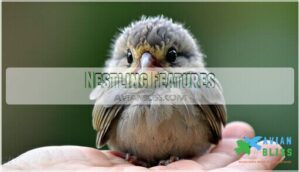
Between hatchlings and fully independent fledglings, you’ll encounter nestlings—baby birds in their awkward teenage phase.
These developing birds show clear signs they’re not quite ready for the world yet.
Key nestling features to recognize:
- Feather development appears patchy with pin feathers and down mixed together
- Eye condition shows eyes that are open but may seem dull or unfocused
- Physical vulnerability is evident—they can’t hop well or grip your finger tightly
- Nutritional needs are high, requiring frequent feeding from parents every 15-20 minutes
- Nest dependence remains strong, as they lack the strength and coordination for independent survival
Nestlings typically range from 3 days to 2 weeks old.
Their baby bird care requires immediate attention if found on the ground, unlike fledglings who naturally leave the nest.
Understanding bird development stages helps you provide proper nestling care when these vulnerable creatures need help most.
Fledgling Traits
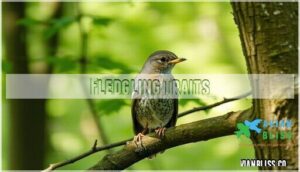
You’ve spotted the teenager of the bird world! Fledglings sport full Feather Development and impressive Hopping Ability, bouncing around like feathered ping-pong balls.
These young adventurers practice Flight Practice under watchful Parental Supervision, exploring branches and ground safely.
Their Natural Exploration is part of normal bird development milestones. Fledglings are learning to fly but still require intensive parental care. Don’t worry—they’re supposed to be there!
Assess Bird’s Condition
Before you can help a baby bird, you need to figure out if it’s actually in trouble or just learning to fly.
Take a moment to observe the bird from a safe distance and look for signs of injury, distress, or weakness that might require your intervention, and consider if the bird is showing signs of distress.
Checking for Injuries
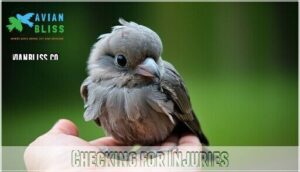
Spotting an injured bird requires quick detective work. Look closely for obvious signs that something’s wrong – these little creatures can’t tell you what hurts, so your eyes become their voice.
- Visible wounds – Check for cuts, blood, or exposed areas on the body
- Feather condition – Look for matted, missing, or disheveled plumage
- Limb function – Notice drooping wings or inability to stand properly
- Eye appearance – Watch for swollen, cloudy, or half-closed eyes
Breathing difficulty often shows as rapid panting or open-beak breathing.
An injured bird needing first aid won’t hop away when you approach – healthy baby bird behavior includes being alert and responsive to your presence.
Observing Behavior
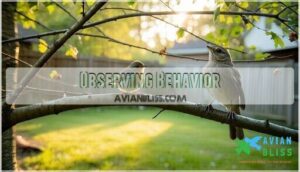
A bird’s behavior tells its story like an open book.
Watch for distress signals such as frantic chirping, labored breathing, or inability to stand.
Natural development means fledglings hop awkwardly while attempting flight—this is normal bird behavior requiring patience.
Notice parental absence lasting over two hours during daylight, which suggests genuine need for intervention.
Social interaction between parents and young indicates healthy bird care situations.
Determining Age
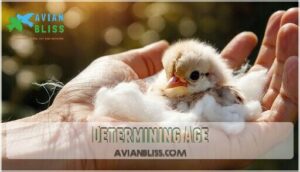
Accurately determining your baby bird’s age requires examining key developmental markers.
Check feather development – hatchlings lack feathers, nestlings sport pin feathers, while fledglings display full plumage.
Eye condition reveals age too: closed eyes indicate hatchlings, partially open suggests nestlings, and bright, alert eyes mark fledglings.
Mobility skills differ dramatically – hatchlings can’t move much, nestlings wiggle weakly, but fledglings hop confidently around nest departure time.
Note any signs of illness, such as labored or open-beak breathing, which require immediate attention.
Help Grounded Baby Birds
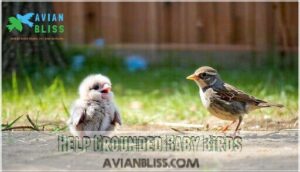
When you find a grounded baby bird, your first step is figuring out whether it actually needs help or if it’s just learning life’s ropes.
Most birds hopping around on the ground are fledglings doing exactly what they’re supposed to do, while naked or barely feathered nestlings genuinely need a lift back home.
Returning to Nest
Once you’ve confirmed the nestling needs help, look around carefully for its bird nest within a few yards.
Gently pick up the baby using clean hands—don’t worry about parental scent myths, as parent birds won’t abandon their young because you touched them.
Place the nestling back in its nest location, ensuring nest safety and proper nest construction.
Monitor from a distance for several hours to confirm monitoring success of the bird rescue.
Creating Substitute Nest
When the original nest is damaged or unreachable, you’ll need to craft a substitute nest that mimics nature’s design. Think of yourself as a temporary landlord providing safe housing.
- Basket Material: Use a woven basket, small cardboard box, or plastic container with drainage holes
- Nest Placement: Position 3-6 feet high in nearby shrubs or trees, sheltered from direct sunlight
- Weather Protection: Add a small roof or overhang using leaves or cloth to shield from rain
- Size Considerations: Verify the substitute nest allows nestlings to move but prevents falling out
For basket options, consider a specially designed nest.
Monitoring Parental Return
After placing the baby bird back in its nest, step back to an observation distance of at least 20 feet and wait patiently.
Timing considerations matter—parents may take several hours to return, especially if they sense interference signs.
Watch for parental behavior like bringing food or calling to their young.
If no parents appear after four hours, contact wildlife rescue for alternative solutions to help the potentially orphaned bird.
Remember to check for signs of dehydration and malnutrition if the parents don’t return.
Care for Injured Birds
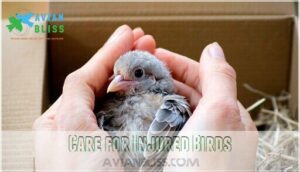
When you discover a baby bird that’s clearly hurt or sick, quick action can save its life.
You’ll need to provide immediate care while arranging professional help, but knowing the warning signs makes all the difference.
Signs of Injury or Illness
Red flags signal trouble for baby birds needing immediate help.
When baby birds won’t react to your approach, something’s seriously wrong.
Watch for specific warning signs that indicate serious health problems requiring professional intervention.
- Feather Condition: Matted, dirty, or missing feathers suggest illness or injury
- Eye Appearance: Swollen, cloudy, or dull eyes indicate potential infection or trauma
- Wing Drooping: One or both wings hanging unnaturally signals possible fractures
Breathing Difficulty and Unusual Stillness are critical symptoms.
Healthy baby birds react when you approach, but injured birds often remain motionless.
Providing Warmth and Safety
Once you’ve spotted signs of trouble, creating a safe enclosure becomes your top priority.
Use a small cardboard box with soft cloth lining for your baby bird shelter. Temperature regulation matters—place a heating pad on low underneath or use warmed towels.
Maintaining proper baby bird temperature is critical for survival. Keep the warm environment dark and quiet for stress reduction.
This setup provides predator protection while you arrange professional bird care.
Contacting Wildlife Rehabilitators
When faced with a sick or injured baby bird, reaching out to wildlife rehabilitation professionals becomes your lifeline.
These trained experts possess the knowledge and legal permits to provide proper medical care.
Here’s your action plan:
- Search online for "wildlife rehabilitator near me" or contact your state’s fish and wildlife department for referrals to licensed bird rehabilitation centers
- Call immediately – many rehabilitators offer 24/7 hotlines for emergency bird rescue guidelines and can assess whether transport is necessary
- Follow transport instructions carefully, as improper handling during the journey can worsen injuries before professional follow-up care begins
Feed and Hydrate Baby Birds
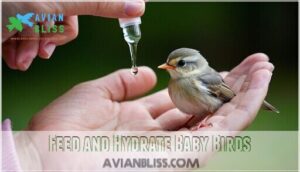
Feeding a baby bird isn’t as simple as tossing it some breadcrumbs from your sandwich.
You’ll need to understand what’s safe and nutritious for different bird species, plus learn how to provide water without accidentally drowning your tiny patient.
Suitable Food Options
Which baby bird diet works best? Commercial formulas like Kaytee Exact provide balanced nutrition and should be your first choice.
These specially designed foods meet growing birds’ complex needs better than homemade options. It’s important to note the bird’s age, as nestlings need specialized care.
| Food Type | Best For |
|---|---|
| Commercial Formulas | All baby birds – balanced nutrition |
| Appropriate Insects | Songbirds, worms, and mosquito larvae |
| Seed Mixtures | Finch and goldfinch babies |
| Fruit Purees | Older nestlings as supplements |
Feed baby birds every 2-3 hours using proper feeding frequency guidelines.
Avoiding Harmful Foods
Never give toxic foods like chocolate, avocado, or caffeine to baby birds—these cause fatal heart problems and seizures.
Salt, dairy, and artificial sweeteners create serious digestion problems too.
Skip bread, fruit pits, and anything moldy, as these don’t meet their specific dietary needs.
Birds are also susceptible to cyanide poisoning from certain fruit seeds.
Stick to safe alternatives like moistened cat food or insects instead.
Providing Water Safely
Water poses serious risks to baby birds, so proceed with extreme caution.
Never force water into their mouths—you’ll risk water aspiration risk, which can be fatal.
- Use electrolyte solutions warmed to room temperature instead of plain water for better hydration methods
- Offer water on your fingertip or shallow dish, letting the bird control intake naturally
- Maintain container cleanliness by washing feeding tools between uses to prevent bacterial growth
- Monitor water temperature carefully—lukewarm feels safest for delicate bird care and proper bird hydration
Handle and Release Baby Birds

When you’re ready to handle and release a baby bird, proper technique makes all the difference between success and stress.
You’ll need to know when the bird is truly ready for independence and how to give it the best shot at thriving in the wild.
Safe Handling Techniques
Gentle hands make all the difference when handling baby birds.
Always wear gloves for hygiene practices and bird safety.
Use a secure containment approach—cup your hands softly around the bird without squeezing.
This gentle approach reduces stress substantially.
Move slowly and speak quietly during bird handling.
Proper bird rescue best practices include supporting the bird’s body completely.
Remember these bird care dos and donts for successful rescue, and always prioritize gentle hands, secure containment, and proper bird rescue.
Choosing Release Location
When selecting your bird care release location, choose spots that mirror their natural habitat while prioritizing safety from threats.
- Quiet wooded areas – Away from bustling human activity and traffic noise
- Dense shrubs or trees – Providing natural cover from aerial predators
- Food-rich environments – Ensuring adequate insects, seeds, or berries nearby
Consider weather conditions and habitat suitability carefully.
Avoid areas with heavy human impact or known predator concentrations.
The ideal bird safe location offers shelter, food availability, and minimal disturbance for successful reintegration.
Ensuring Bird’s Readiness
Before releasing any bird, confirm it’s fully feathered with complete Flight Capability and strong Feather Development.
Watch for Independent Feeding behaviors and natural Predator Avoidance instincts.
The bird should hop confidently and attempt short flights, demonstrating Perfect Release Timing, which means the bird shows curiosity about bird exploration and demonstrates readiness for independent bird learning without human intervention.
Consider if the bird is altricial and needs care, ensuring you provide the necessary support for its development and well-being, especially in terms of Independent Feeding.
Seek Professional Help
When you can’t handle a baby bird’s needs alone, professional help becomes essential.
Wildlife rehabilitators have the training, proper permits, and specialized knowledge to give injured or orphaned birds the best chance at survival.
Contacting Local Rehabilitators
When your feathered friend needs professional help, wildlife rehabilitation centers become your lifeline.
Search online using "bird rescue network" plus your location, or call your state wildlife agency for certified facilities.
Most wildlife rehabilitator services operate 24/7 for emergencies.
Before transporting birds, call ahead – many centers provide bird care professional advice over the phone first.
Ask about specific Rehabilitator Qualifications and any Rehab Costs upfront to avoid surprises during this stressful time, and consider the importance of certified facilities.
Consulting Veterinarians
When wildlife rehabilitators aren’t available, veterinarians become your lifeline for injured bird emergency care.
Many vets possess bird-specific knowledge and can provide essential medication guidance for avian care situations.
They’ll assess your wild bird’s condition, offer bird first aid recommendations, and determine if long-term care is needed.
Call ahead—not every vet handles wildlife, but they can direct you to someone with veterinarian expertise in wild bird care, providing essential medication guidance.
Following Legal Guidelines
You’re walking into legal territory when caring for wild birds.
The Migratory Bird Treaty Act makes unauthorized possession illegal, carrying hefty fines up to $15,000.
Here’s what you need to know:
- Permit Requirements – Only licensed rehabilitators can legally keep wild birds
- Species Protection – Most songbirds fall under federal conservation laws
- Release Regulations – Proper rehabilitation follows strict protocols
Contact professionals immediately to stay within bird possession laws.
Frequently Asked Questions (FAQs)
Can you find a baby bird on the ground?
Picture a tiny feathered bundle sitting helplessly in your path.
Yes, you can find baby birds on the ground, especially during spring.
They’re often fledglings learning to fly, not abandoned. Observe first—parents are usually nearby caring for them, which is a complete concept to understand when encountering such situations.
What if a baby bird is naked or only partially feathered?
A naked or partially feathered bird is likely a nestling that needs help.
Look for its nest nearby and gently place it back using clean hands.
If you can’t find the nest, contact a wildlife rehabilitator immediately.
What if a baby bird has been touched by humans?
Don’t worry – that’s an old wives’ tale! Human scent won’t make parents abandon their baby. You can safely handle the bird and return it to its nest if needed.
What is a baby bird?
A baby bird is a young bird in different stages of development.
You’ll encounter hatchlings (newborns with closed eyes, no feathers), nestlings (partially feathered, can’t fly yet), or fledglings (fully feathered juveniles learning to fly outside the nest).
What if a baby bird is a nestling or a fledgling?
Surprisingly, 80% of "rescued" baby birds don’t actually need help.
If it’s a nestling (little to no feathers), gently return it to its nest.
If it’s a fledgling (fully feathered), leave it alone—parents are likely nearby teaching it to fly.
Should you help a baby bird?
Most baby birds don’t need your help. Fledglings learning to fly are normal on the ground with parents nearby. Only intervene if you see injury, danger, or it’s truly orphaned.
Who to contact if you find a baby bird?
Contact your local wildlife rehabilitator, veterinarian, or animal control agency immediately.
They’re trained professionals who can properly assess and care for injured or orphaned birds, ensuring the best survival chances while meeting legal requirements.
How long will baby birds survive without their mother?
Apparently, Mother Nature forgot to include survival instructions with baby birds.
Without mom, hatchlings and nestlings typically survive just hours to one day.
Fledglings might last two to three days since they’re more developed and mobile, but overall, baby birds have a very short survival time without mom.
Can baby birds survive without their parents?
Yes, but it depends on their age.
Nestlings (naked or barely feathered) can’t survive without parents – they need constant feeding and warmth.
Fledglings (fully feathered) have better odds since they’re learning independence, but still rely on parents for food and protection during this critical development period, which is a time of learning and gaining protection.
How long before baby birds learn to fly?
While some parents helicopter over their chicks for weeks, most baby birds master flying between 13-21 days old.
You’ll witness fledglings awkwardly hopping around, practicing their wings before achieving graceful flight.
Conclusion
When the dust settles, knowing what to do when you’ve found baby bird now what can mean the difference between life and death for these vulnerable creatures.
Remember, most baby birds don’t need rescuing—they need space. Watch from afar, trust the parents, and intervene only when truly necessary.
Your quick thinking and proper actions can give orphaned or injured birds their best shot at survival and freedom.
- https://www.rspca.org.uk/adviceandwelfare/wildlife/birds/baby
- https://www.massaudubon.org/nature-wildlife/birds/baby-birds-out-of-the-nest
- https://nycbirdalliance.org/take-action/help-a-bird-in-trouble/what-to-do-if-you-find-a-young-bird
- https://bestfriends.org/pet-care-resources/find-baby-bird-how-help
- https://dnr.maryland.gov/wildlife/pages/plants_wildlife/sickorinjured.aspx