This site is supported by our readers. We may earn a commission, at no cost to you, if you purchase through links.
A single backyard robin packs over 75 distinct phrases into its morning routine—and that’s before 6 a.m. Birds don’t just just make noise. They communicate with a most human conversations that puts most human conversations to shame.
The difference between a song and a call isn’t just length or melody; it’s intent, timing, and a whole biological system wired for meaning.
Once you start recognizing those patterns, every walk outside sounds completely different. Understanding the types of bird songs and calls turns background noise into a conversation you can actually follow.
Table Of Contents
- Key Takeaways
- Bird Songs Vs Bird Calls
- Common Bird Song Types
- Common Bird Call Types
- What Bird Calls Mean
- Seasonal Bird Vocal Patterns
- How Birds Learn Vocalizations
- Identify Birds by Sound
- Frequently Asked Questions (FAQs)
- Do birds use sounds to communicate?
- How many bird songs are there?
- What makes a bird song different from a call?
- What is a bird call?
- What are the five voices of the birds?
- What are the four types of bird calls?
- What are the five voices of birds?
- What is the most common song bird?
- How do birds learn their first songs?
- Why do some birds sing at night?
- Conclusion
Key Takeaways
- Songs and calls aren’t the same thing — songs are full melodies used mostly for mating and territory, while calls are quick, sharp signals that keep birds connected year‑round.
- Bird vocal behavior shifts with the seasons, peaking in spring at dawn, going quiet in winter, and switching to flight calls during fall migration.
- Some birds are born knowing their sounds, but many learn by listening to local tutors — which is why birds from different regions can sound noticeably different from each other.
- You can identify birds by ear using pitch, rhythm, and free apps like Merlin or BirdNET, especially when paired with clean audio recordings and a good field guide.
Bird Songs Vs Bird Calls
Most people use "song" and "call" interchangeably, but they’re actually two very different things. Once you understand the distinction, you’ll start hearing birds in a whole new way.
This guide to bird songs and calls breaks down exactly what sets them apart and why birds use each one.
Here’s what sets them apart.
Length and Note Patterns
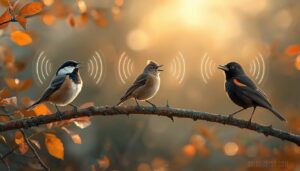
One of the clearest ways to tell songs apart from calls is simply by listening to their length and rhythm.
| Feature | Songs vs. Calls |
|---|---|
| Note Duration | Songs use long, sustained notes; calls stay short |
| Syllable Length | Songs stretch syllables; calls clip them tight |
| Rhythmic Complexity | Songs weave syncopated patterns; calls stay simple |
| Tempo Variation | Song repertoire shifts pace; calls stay consistent |
Bird vocalizations reveal so much when you tune in.
Melodic Versus Brief Sounds
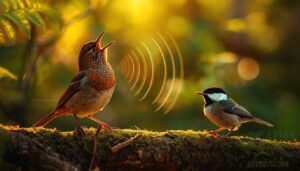
Think of a song as a melody you can hum — it has pitch contour, harmonic complexity, and song repertoire diversity packed into every phrase. A call? It’s more like a sharp tap on the shoulder.
| Feature | Song | Call |
|---|---|---|
| Pitch | Rising/falling contour | Flat or simple |
| Energy | Sustained phrases | Call energy burst |
| Neural Song Control | Active | Minimal |
That contrast makes identifying birds by their sounds surprisingly natural.
Breeding-season Song Use

Breeding season flips a switch in male birds. Peak Singing kicks in at dawn and midday, driven by hormones responding to longer daylight. Repertoire Expansion signals male quality — the more varied the song, the stronger the message. Boundary Signaling keeps rivals away, while courtship songs spark Female Response and drive mate attraction.
| Song Purpose | Timing |
|---|---|
| Territorial singing | Dawn & midday |
| Courtship songs | Early breeding period |
The primary song functions are attracting mates and defending territories.
Year-round Call Functions

Songs fade when breeding ends, but calls never really stop. Year-round contact calls keep flocks together, while year-round territory monitoring ensures rivals stay away even in winter.
quick look at how these functions break down:
| Call Function | Purpose |
|---|---|
| Contact Calls | Group synchronization calls during foraging |
| Alarm Calls | Multispecies alarm coordination against predators |
| Territorial Song Behavior | Perimeter defense across all seasons |
| Pair Bond Reinforcement | Strengthening mate connection year-round |
Common Bird Song Types

Not all bird songs serve the same purpose — a male robin singing at dawn isn’t doing the same thing as a lyrebird mimicking a chainsaw. Birds have evolved distinct song types, each shaped by a specific need or situation.
main ones worth knowing.
Territorial Songs
A territorial song is basically a bird’s way of saying, "This is mine — back off." Males use these bird vocalizations to defend territory without throwing a single punch. Rival response is immediate — a stranger’s song triggers aggressive tempo shifts and boundary reinforcement fast.
Watch for these territorial song behaviors:
- Song matching a neighbor’s tune signals direct confrontation
- Volume increases as a rival moves closer
- Territory size signaling through song travel distance
- Repeated phrases reinforce familiar boundaries daily
- Bird song identification becomes easier when songs grow more insistent
Courtship Songs
When a male bird wants to impress, he pulls out all the stops. Courtship songs rely on motif variation and trill complexity — not just repetition — to signal mate attraction.
Some males even sing through the night, and understanding why birds chirp after dark reveals just how relentless the drive to attract a mate can be.
Females respond to courtship song complexity with measurable female response timing cues.
Multimodal display ties acoustic and nonacoustic sounds together through temporal synchrony, making bird song identification and understanding song learning mechanisms genuinely fascinating to watch unfold.
Dawn Chorus Songs
If you’ve ever stepped outside just before sunrise in spring, you’ve heard the dawn chorus phenomenon in action — a wave of bird vocalizations that builds from near silence into something impressive.
Cool air enhances acoustic propagation, carrying songs farther. Species diversity rises with habitat structure quality.
Light pollution influence can shift timing in cities, and bird song complexity peaks during these brief morning windows.
Duetting Songs
Some birds don’t just sing — they sing together. Duetting is a fascinating behavior where mated pairs coordinate their vocalizations with impressive timing coordination and role alternation, each voice carrying a distinct part.
harmony structure strengthens duetting and pair bonding while also serving as a territory duet, warning rivals. The result is a shared emotional narrative woven from two voices into one.
Duetting pairs weave two voices into one, bonding mates while warning rivals away
Mimicry-based Songs
Some birds are basically living mixtapes. Vocal mimicry in birds — where a singer weaves phrases from neighboring species into its own performance — is one of the most impressive examples of bird song learning you’ll encounter.
Northern mockingbirds and lyrebirds push their Model Diversity Index to extremes, borrowing 5 to 12 species’ sounds.
This cognitive learning load signals fitness, making mimicry-based songs a powerful acoustic contrast strategy for attracting mates.
Common Bird Call Types
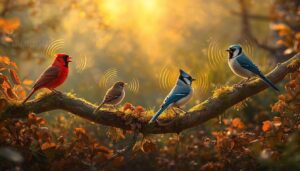
Birds use calls for a lot more than just making noise — each type has a specific job to do. You’ll find calls that keep flocks together, warn of danger, and even help chicks get fed.
Here are the most common call types you’re likely to encounter.
Contact Calls
Think of contact calls as a flock’s group chat — short, quiet pings that say, "Still here, where are you?" Both sexes use them year-round, adjusting temporal call spacing as the group spreads out or bunches up.
Individual signature variation even lets birds recognize familiar flockmates. In mixed-species flocks, these signals become shared language, with habitat-specific frequency helping them cut through dense foliage without alerting predators.
Flight Calls
While contact calls keep the flock grounded, flight calls kick in the moment wings start moving. These brief vocalizations coordinate the group mid-air — especially during spring and fall migration.
Think of them as real-time coordination sequences passing through the flock.
Here’s what makes flight calls worth knowing:
- They maintain flock cohesion during nocturnal migration
- Bird call analysis and acoustic monitoring tools can detect them overhead at night
- Birdidentifying apps help match recorded flight calls to species
- Each species uses recognizable, consistent patterns — almost like standard phraseology
- Even a single clear recording improves your identification confidence greatly
Alarm Calls
Alarm calls are a bird’s fastest tool for threat differentiation. A sharp, high-pitched burst signals an aerial predator. A rougher, lower call warns of something on the ground. That distinction matters — it triggers completely different escape responses.
High frequencies also help with habitat propagation through dense foliage.
Human disturbance has even started altering alarm signaling patterns in some species, which tells you a lot about how sensitive these mechanisms really are.
Begging Calls
Begging calls flip the script entirely — instead of warning others, they’re about asking for something.
Nestlings use these loud, repeated cries to signal nutritional need, signalling to parents.
Sibling competition dynamics push each chick to call harder as hunger rises, sometimes hitting 70–80 decibels.
Brood parasitism influence can even hijack this system, tricking host parents into feeding foreign chicks.
Mobbing Calls
Now flip the situation — instead of asking for help, birds band together to push back. Mobbing calls are loud, rapid bursts aimed directly at a predator.
Groups coordinate through group synchronization, adjusting tempo as they close in — classic temporal escalation.
Habitat density effect plays a role too; dense cover means tighter, more intense mobs. Juveniles absorb these predator-specific cues by watching adults respond.
What Bird Calls Mean

Bird calls aren’t random noise — each one carries a specific message, and once you start recognizing the patterns, a whole new layer of the natural world opens up. different sounds call for different sounds, whether a bird is warning its flock, begging for food, or keeping tabs on a mate.
breakdown of what those calls are actually communicating.
Alarm and Predator Warnings
Birds don’t just scream when danger arrives — they send coded messages. Alarm call mechanisms are surprisingly precise. Here’s what those signals actually mean:
- Predator-specific tones tell flock members whether to freeze or flee
- Threat distance cues intensify as a predator closes in
- Sentinel perch signals from elevated lookouts trigger the fastest responses
- Alarm escalation sequences shift from quiet warnings to urgent group alerts
- Urgency encoding speeds up call repetition when danger is imminent
Recognizing these predator avoidance calls transforms your bird call identification skills completely.
Flock Cohesion Signals
When flock moves as one, it’s not magic — it’s a conversation happening in real time. Contact calls are the glue.
Short acoustic cues tell each bird where the others are, even when visibility drops. Add wingbeat timing, tail fanning, gaze alignment, and body micro movements, and you’ve got a full communication system in motion.
| Signal Type | How It Works | What It Does |
|---|---|---|
| Contact calls | Short, repeated vocalizations | Maintains flock communication across distance |
| Wingbeat timing | Synchronized wingbeat rhythm | Reduces collision risk, tightens formation |
| Tail fanning | Wing/tail tip spreading | Signals preferred turning direction |
| Gaze alignment | Head and eye orientation | Shares neighbor intentions instantly |
| Predator approach cues | Combined calls and movement | Pulls flock into tighter defensive formation |
Contact call social cohesion is especially critical during low-visibility conditions. Even subtle body micro movements ripple outward through the group within wingbeats. Flock communication isn’t just sound — it’s a full sensory system working together.
Parent-chick Communication
Think of the nest as a tiny command center. Each chick broadcasts Individual Chick Signatures through begging calls, and parents decode those nest calls through parent‑offspring acoustic recognition mechanisms — no guesswork involved.
Parental Response Timing tightens when Growth Condition Cues signal real hunger. Distress Comfort Signals settle anxious nestlings fast.
Through Feeding Synchronization, parents match feeding calls to actual need, boosting provisioning efficiency by up to 40 percent.
Mate and Pair Bonding Cues
Pair bonding isn’t just about love songs. Plumage signaling, allopreening frequency, and olfactory scent matching all work alongside courtship songs and mating calls to seal the deal.
Courtship dances paired with synchronized incubation shifts show how acoustic and nonacoustic sounds combine. Mate choice based on song quality and complexity tells a partner: I’m healthy, reliable, and worth your investment.
Social Identification Signals
Every bird is fundamentally broadcasting its ID. Through vocal signature matching, individuals recognize neighbors by unique trill frequencies and note spacing.
Dialect recognition separates locals from outsiders instantly. Age-based trills signal experience, while postural displays and plumage signaling reinforce what the voice already says.
Contact calls, territorial songs, courtship songs, and species-specific calls all work together — one layered, living social network.
Seasonal Bird Vocal Patterns

Bird vocal activity isn’t the same all year — it shifts with the seasons in ways that are genuinely fascinating once you know what to listen for. Spring looks nothing like fall, and what you hear in a tropical forest sounds completely different from a backyard in Vermont.
patterns break down.
Spring Singing Peaks
turns up the volume on birds, too.
Day length effects trigger hormonal triggers that push males into full vocal mode.
peak vocal activity really spikes:
- Warm temperature spells after cold fronts trigger sudden territorial songs.
- song complexity surge drive longer days in repertoire and duration.
- Mate attraction peaks as seasonal variation in bird songs intensifies.
- late-morning singing bursts become easiest for bird song identification.
Dawn Chorus Timing
The dawn chorus doesn’t follow a strict clock — it follows light cues and temperature influences. Most birds kick off about 30 minutes before sunrise, though moon phase, elevation effect, and urban lighting can shift that window noticeably.
| Factor | Effect on Dawn Chorus |
|---|---|
| Full moon | Starts up to 20 min earlier |
| Urban lighting | Delays or compresses onset |
| Higher elevation | Later start, cooler dawn skies |
Seasonal variation in bird songs means spring mornings feel loudest — perfect for bird song identification and spotting territorial songs.
Fall Migration Flight Calls
Once the dawn chorus fades into summer, fall brings a quieter — but just as fascinating — vocal world. Flight calls peak on nights with low cloud cover and steady tailwinds, when nighttime detection rates surge along coastlines.
- Acoustic masking from wind turbulence effects reduces call clarity.
- Cloud cover influence pushes migrants lower, increasing audibility.
- Species-specific trills help identify warblers and sparrows mid-migration.
- Migration vocal cues like sharp upslurs mark individual species.
Listen for these acoustic cues — identifying birds by their sounds at night is surprisingly rewarding.
Nonbreeding Season Changes
When fall migration wraps up, you’ll notice something shifting in the soundscape — a kind of acoustic habitat shift toward simpler, quieter communication. Song reduction is real: most species drop elaborate tunes entirely. What remains is mostly short, energy-saving calls for staying connected.
| Behavior | Breeding Season | Nonbreeding Season |
|---|---|---|
| Vocal output | Full, complex songs | Simplified vocal output |
| Call purpose | Territory and courtship | Contact and cohesion |
| Singing frequency | Daily, sustained | Occasional, brief |
| Hormonal drive | High testosterone | Lowered levels |
| Molt activity | Active | Paused or slowed |
Bird song plasticity is striking here — the same bird that sang endlessly in May goes nearly quiet by December.
Tropical Versus Temperate Patterns
Temperate birds are primarily ruled by the calendar. Temperature stability in the tropics changes that equation entirely. Without harsh winters or dramatic rainfall seasonality, flipping resource availability on and off, tropical species don’t need to sing in seasonal bursts.
vocal repertoire size stays consistently active year‑round. acoustic niche partitioning also drives acoustic niche partitioning, letting more species coexist vocally without overlap.
How Birds Learn Vocalizations

Not every bird is born knowing exactly what to sing — a lot of it gets picked up along the way, almost like learning a language.
Some sounds are hardwired from birth, while others take months of listening and practice to get right.
Here’s a closer look at how that process actually works.
Instinct and Inherited Sounds
Some birds don’t need a teacher. They’re born wired with genetic song templates — neural circuitry that shapes their core repertoire from day one.
Hormonal triggers activate these fixed action calls during breeding season, no learning required. Here’s what instinct builds into bird vocalizations:
- Species-specific calls that emerge at hatching
- Hard-wired territorial alerts without prior exposure
- Courtship sequences tied to hormonal cues
- Alarm calls birds never had to practice
- Dawn chorus timing synced to biological cycles
Learned Song Variation
Not every bird sings exactly like its father. Through tutor influence, young birds absorb syllable patterns — then add their own spin. Individual tempo shifts, syllable drift, and motif recombination all shape personal song signatures.
| Variation Type | What Changes |
|---|---|
| Syllable Drift | Timing or order shifts subtly |
| Motif Recombination | Core phrases reassemble into new sequences |
Neuroplasticity effects make this possible — the brain literally rewires itself through song learning mechanisms.
Regional Dialects
Think of white-crowned sparrows like regional accents — a bird raised in one valley genuinely sings differently than one from the next. These Regional Song Dialects form through cultural transmission of song, shaped by local tutors across Accent Boundaries.
Dialect Mapping research reveals Phonemic Mergers, Vowel Shifts, and Lexical Variations in bird song identification, similar to human dialect formation:
- Songs shift subtly across neighboring territories
- Young birds mirror local tutors, not distant ones
- Dialect boundaries often follow geographic barriers
- Regional dialects strengthen over generations through repeated learning
Vocal Mimicry
Some birds don’t just sing — they steal sounds. Vocal mimicry in birds is one of the most fascinating things you’ll encounter in bird call analysis.
Lyrebirds and mockingbirds nail Mimicry Species Examples, reproducing car alarms and camera clicks through precise Mimicry Mechanisms — the syrinx literally rewires to match foreign sounds.
Mimicry Social Functions include attracting mates and outsmarting rivals.
Identifying birds by their sounds gets trickier when one bird sounds like five.
Urban Song Adjustments
City noise changes how birds sing — and it’s more deliberate than you’d think. Urban Adaptations of Bird Songs show up in measurable ways, shaped by anthropogenic noise impacts on daily communication:
- Frequency Elevation lifts songs 200–500 Hz higher to cut through traffic rumble
- Tempo Slowing and Syllable Shortening improve clarity amid building echoes
- Repertoire Diversification and Directional Emphasis help birds stand out in acoustic clutter
These aren’t random shifts — they’re learned, repeatable strategies passed between generations.
Identify Birds by Sound
Once you know what to listen for, identifying birds by sound becomes one of the most satisfying skills you can build as a birder. The good news is you don’t need perfect ears — just a few simple tools and habits.
Here’s what actually helps.
Listening for Pitch and Rhythm
Pitch contour analysis is your secret weapon here. Focus on the first and last notes of any phrase — that’s where melodic phrase ID becomes easy.
Rhythmic timing cues matter just as much as pitch. Is the tempo fast or slow? Regular or syncopated?
| Cue | What to Listen For |
|---|---|
| Pitch contour | Rising, falling, or flat intervals |
| Rhythmic timing | Fast bursts versus slow, spaced notes |
Matching Sounds to Species
Once you’ve got pitch and rhythm locked in, matching those sounds to a species is where it gets satisfying. Think of each bird’s voice as a spectral fingerprint — a unique combination of frequency band analysis and temporal rhythm matching that sets it apart.
Here’s what to cross-check:
- Note the frequency range (small warblers usually sing above 5 kHz)
- Compare syllable shape and duration against bird sound libraries
- Use noise reduction techniques to isolate clean phrases
- Run machine learning classification tools to confirm your best guess
Identifying birds by their sounds becomes second nature once you trust the patterns.
Using Bird ID Apps
Once you’ve matched a pattern by ear, apps like Merlin and BirdNET take you further fast.
Both use machine learning identification against massive bird sound libraries — Merlin even supports Offline Identification without cell service.
Birda adds Custom Taxonomy Filters and Multi-Device Sync, while community-driven apps improve through Community Data Sharing.
Many offer Photo-Audio Integration too.
There’s genuinely a free app to identify bird sounds for every skill level.
Recording Clear Audio Samples
Apps only work as well as the audio you feed them. For solid field recording, position your microphone 6–12 inches from the perch and use a windscreen for wind noise reduction. Set your gain staging so peaks hit around –6 dB.
Start with a short ambient preface, then log your file metadata — species, location, time. Clean recordings make bioacoustic apps genuinely reliable.
Comparing Calls With Field Guides
Once you’ve captured clean audio, a good field guide becomes your decoder ring. Look for guides that pair calls with spectrograms — those visual waveforms make spectrogram matching surprisingly easy to grasp.
Strong guides include habitat context tags, confidence scoring notes, and clear field guide terminology for bird sounds. Cross-referencing audio quality metrics with range maps helps you pin down even tricky garden visitors using bird identification by call.
Frequently Asked Questions (FAQs)
Do birds use sounds to communicate?
Yes — and in ways that’ll genuinely surprise you.
Bird vocalizations are the backbone of avian communication, driving everything from territory mating alarm to inter-species communication and complex acoustic social bonding across entire soundscapes.
How many bird songs are there?
No one’s landed on a fixed global song tally — and honestly, that’s part of what makes bird vocalizations so fascinating.
Acoustic species richness keeps growing as researchers document new repertoires worldwide.
What makes a bird song different from a call?
Think of it like this: a song is a full melody, while a call is a single text message. Songs run longer with rising and falling notes.
Calls stay short, simple, and straight to the point.
What is a bird call?
A bird call is a short, sharp vocalization — a quick acoustic signature built for speed. Your syrinx fires it off in an instant, cutting through habitat noise to deliver one clear signal.
What are the five voices of the birds?
Birds speak in five voices: baseline chatter keeps the peace, territory proclamation stakes a claim, danger alarm raises the alert, courtship trill woos a mate, and begging chirp tells parents, "feed me.
What are the four types of bird calls?
Four calls stand out: contact calls keep flocks together, flight calls coordinate mid-air movement, alarm calls signal danger, and begging calls let hungry nestlings ask parents for food.
What are the five voices of birds?
Most ornithologists recognize five core voices: song, call, alarm calls, contact calls, and begging calls — each shaped by syrinx anatomy, non‑vocal signaling, seasonal vocal plasticity, wing‑generated sounds, and even urban pitch shift.
What is the most common song bird?
If North America had a mascot songbird, it’d be the American robin. Its range stretches from Alaska to Mexico, making it the most common chirping bird most people encounter daily.
How do birds learn their first songs?
Young songbirds learn through a sensory phase, memorizing a tutor’s song as a neural template.
Then, sensorimotor practice and auditory feedback polish their voice until the song crystallizes — all within a critical period.
Why do some birds sing at night?
Think of nighttime as an empty stage. Some birds, like the nightingale, take it.
Cooler air carries sound farther, rivals stay quiet, and artificial light triggers hormonal cues that keep them singing well past darkness.
Conclusion
Think of the forest as a city—every bird a resident with something urgent to say.
Once you learn to read the language of types of bird songs and calls, you stop being a stranger passing through. You become someone who actually understands the neighborhood.
A sharp alarm call, a slow courtship song, a soft contact note—each one tells a real story.
Step outside and start listening. The conversation’s already happening without you.
- https://www.researchgate.net/publication/236122471_The_Functions_of_Bird_Song
- https://www.bl.uk/the-language-of-birds/articles/the-purpose-of-birdsong
- https://www.allaboutbirds.org/guide/Henslows_Sparrow/id
- https://link.springer.com/chapter/10.1007/978-3-319-91689-7_5
- https://www.audubon.org/news/start-using-spectrograms-read-bird-songs-and-calls