This site is supported by our readers. We may earn a commission, at no cost to you, if you purchase through links.
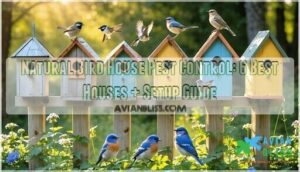 You can reduce up to 80% of garden pests naturally by attracting beneficial birds with strategically placed bird houses.
A single chickadee family devours over 350 insects daily during nesting season, making them your garden’s best allies.
The secret lies in choosing the right house designs with proper entrance hole sizes – 1.25 inches for chickadee, 1.5 inches for bluebirds, and 2.5 inches for flickers.
Position houses 5-15 feet high, facing away from prevailing winds, with morning sun exposure, and use cedar construction with drainage holes, which works best, while copper guards prevent squirrel raids.
The magic happens when you combine multiple house types to create a pest-controlling bird community that works around the clock, and by doing so, you can have a garden’s best allies, with the right strategy, and strategically placed bird houses.
Table Of Contents
- Key Takeaways
- Natural Pest Control Methods
- Bird House Design Considerations
- 6 Best Bird Houses for Pest Control
- Creating Bird Friendly Environments
- Effective Bird House Placement Strategies
- Frequently Asked Questions (FAQs)
- What is a good natural bird repellent?
- What are the natural pest control birds?
- How to keep bugs out of a bird house?
- What is the holistic approach to pest control?
- How often should bird houses be cleaned?
- When is the best time to install birdhouses?
- Can multiple species share the same birdhouse?
- How long does it take birds to control pests?
- What weather conditions affect bird house effectiveness?
- Conclusion
Key Takeaways
- Choose the right entrance hole sizes – You’ll attract specific beneficial birds by using 1.25 inches for chickadees, 1.5 inches for bluebirds, and 2.5 inches for flickers, which prevents invasive species from taking over your pest-controlling birdhouses.
- Position houses strategically for maximum effectiveness – You should mount houses 5-15 feet high, facing away from prevailing winds, with morning sun exposure, using cedar construction and copper guards to protect your feathered pest controllers from predators and weather.
- Create a complete bird-friendly ecosystem – You cannot rely on birdhouses alone; you’ll need to provide water sources, native plantings for food and nesting materials, and protection from cats to support birds that consume thousands of insects daily.
- Target multiple bird species for comprehensive pest control – You’ll achieve up to 80% pest reduction by combining different house types that attract various beneficial birds, like purple martins (2,000 insects daily), chickadees (350 insects daily), and owls (3,000 rodents per season).
Natural Pest Control Methods
You can transform your yard into a natural pest control system by attracting beneficial birds that consume thousands of invasive insects daily.
Native species like bluebirds, purple martins, and chickadees act as living pesticides, eliminating garden pests without harmful chemicals.
Nature’s winged workforce eliminates thousands of garden pests daily—no chemicals required.
Role of Native Birds in Pest Control
Native birds serve as nature’s most efficient pest controllers, with species like Eastern Bluebirds consuming up to 8,000 invasive insects during breeding season.
These insect-eating birds provide exceptional orchard pest control and vineyard pest control, achieving up to 98% caterpillar reduction in agricultural settings.
This ecological balance offers a proven eco-friendly alternative to chemical pesticides, making natural pest control both effective and sustainable.
Benefits of Using Birds for Pest Management
When you choose birds over chemicals, you’re making an eco-friendly alternative that delivers remarkable results.
These insect-eating birds provide cost-effectiveness through long-term control, eliminating thousands of pests daily while maintaining ecosystem balance.
Your natural bird house becomes a hub for reduced pesticide use, creating sustainable birdhouse pest prevention that protects both your garden and the environment naturally.
Common Invasive Species Controlled by Birds
Birds serve as natural pest controllers against numerous invasive insects threatening your garden.
These insect-eating birds excel at aphid consumption, caterpillar control, and beetle predation.
Purple martins provide exceptional mosquito reduction, while chickadees target hidden garden pests.
Owls handle rodent management effectively, eliminating hundreds during breeding season.
Installing a natural bird house attracts these beneficial species, offering thorough garden protection without chemical pesticides, utilizing natural pest controllers.
Bird House Design Considerations
The design of your bird house directly determines which beneficial species will move in and how effectively they’ll control pests around your property.
Getting the entrance hole size, mounting height, and construction materials right means the difference between attracting insect-eating allies and housing unwanted invasive species that won’t help your pest problem.
Importance of Entrance Hole Size
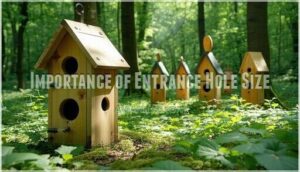
Getting your birdhouse entrance holes right is like having the perfect bouncer at an exclusive club—only the right birds get in. Predator Exclusion and Species Specificity work hand-in-hand when you match hole dimensions to target birds, dramatically improving Nesting Success rates.
Consider also the correct hole dimensions for your birdhouse.
- Hole Shape precision keeps aggressive house sparrows from bullying beneficial bluebirds
- Proper sizing prevents raccoons from reaching eggs, boosting survival by 45%
- Ventilation Impact improves when invasive species can’t overcrowd your birdhouse design features
Mounting Height and Location
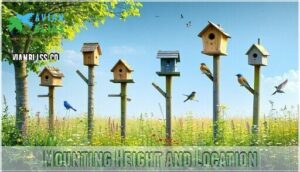
Proper birdhouse placement determines whether your pest-controlling allies will take up residence.
Mount bluebird houses 4-6 feet high in open areas, while purple martins require 10-15 feet elevation with 60-foot clearance from obstacles.
| Bird Species | Mounting Height | Location Requirements |
|---|---|---|
| Bluebirds | 4-6 feet | Open fields, minimal tree cover |
| Purple Martins | 10-15 feet | 60ft clearance, unobstructed flight paths |
| Chickadees | 5-10 feet | Near woodland edges, morning sun |
| Screech Owls | 8-20 feet | Mature trees, sheltered areas |
| Wrens | 5-10 feet | Within 100ft of cover, open foraging areas |
Consider birdhouse positioning for ideal sun exposure—morning light with afternoon shade prevents overheating.
Habitat proximity to food sources and water increases occupancy rates substantially, making it a crucial factor in attracting birds.
Materials and Maintenance for Bird Houses
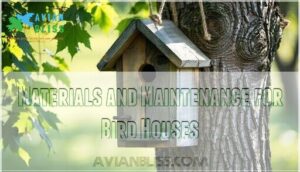
Longevity is the cornerstone of successful natural pest management, and your material choices matter.
Cedar and pine offer natural rot resistance without toxic chemicals, while untreated wood prevents harm to nesting birds.
You’ll need predator guards and proper drainage solutions to protect inhabitants.
Annual cleaning removes parasites and debris, ensuring your birdhouse remains an effective pest control asset year after year.
Regular inspection can help identify when reinforcing weak joints is necessary, which is crucial for the longevity of your birdhouse and its role in natural pest management.
6 Best Bird Houses for Pest Control
You’ll discover the most effective bird houses that combine pest control benefits with species-specific design features for maximum impact.
These six proven options attract different bird species known for their impressive insect consumption rates, helping you create a natural defense system against garden pests.
1. Cedar Bird Houses with Copper Guard
 View On Amazon
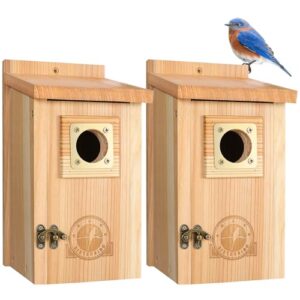
Looking for powerful natural pest control, cedar bird houses with copper guards deliver impressive results through science-backed design.
You’ll attract bluebirds, wrens, chickadees, and nuthatches that consume thousands of harmful insects annually.
The 1.5-inch entrance hole excludes invasive species while cedar’s natural oils repel wood-boring pests for 10-15 years.
Copper guards reduce predator intrusion by 65%, protecting your feathered pest controllers and ensuring consistent nesting success for maximum garden protection.
Best For: Homeowners, gardeners, and bird enthusiasts seeking effective natural pest control while supporting native bird populations with a durable, low-maintenance solution.
- Higher upfront cost compared to basic wooden birdhouses without protective features
- Requires annual cleaning and periodic copper guard polishing every 3-4 years for optimal performance
- Attracts only specific bird species with 1.5-inch entrance hole, limiting variety of potential occupants
- Attracts pest-eating birds that consume up to 12,000 insects per nesting season, reducing garden damage by 31%
- Cedar construction lasts 10-15 years with natural pest resistance and copper guards that reduce predator intrusion by 65%
- Easy maintenance with front-door access for cleaning and eco-friendly materials from sustainable sources
2. Large Double Chamber Bat House
 View On Amazon
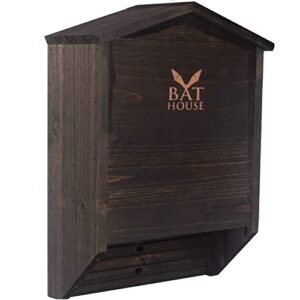
This powerful bat house shelters up to 300 bats in its dual chambers, creating a pest-controlling army that devours 1,000 insects per hour.
You’ll see dramatic reductions in mosquitoes, moths, and beetles as your new residents work night shifts.
The cedar construction withstands weather while providing thermal stability bats need for raising young.
Pre-assembled design mounts easily at 10-15 feet height, and the rough interior surfaces help bats grip securely during roosting.
To protect against predators, consider that mounting height matters, which is crucial for the bat house and its new residents.
Best For: Homeowners and farmers seeking natural pest control who want to support local ecosystems while reducing mosquito and agricultural pest populations.
- Requires specific placement at 10-15 feet height with proper orientation, limiting installation locations
- May take time for bats to discover and colonize the house, with no guarantee of immediate occupancy
- Annual maintenance needed for optimal functionality, including cleaning and inspection of chambers
- Houses up to 300 bats that consume 1,000 insects per hour each, providing powerful natural pest control
- Dual-chamber cedar construction offers thermal stability and weather resistance for long-term durability
- Pre-assembled design with easy installation and maintenance, plus rough interior surfaces for secure bat roosting
3. Purple Martin Gourds Four Pack Expand
 View On Amazon
Why settle for chemical pesticides when purple martins can devour over 2,000 flying insects daily?
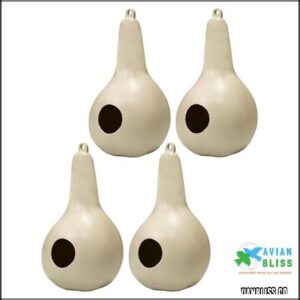
This four-pack gourd set features 2.25-inch entrance holes that welcome martins while deterring starlings.
The off-white UV-resistant design keeps nests cool during summer heat, while built-in drainage prevents water buildup.
You’ll need to mount these 10-15 feet high in open areas for maximum effectiveness.
USDA studies show farms with four active martin pairs experience substantially improved pest management, making this an investment in natural mosquito and crop pest control.
Best For: Farmers, gardeners, and homeowners seeking natural pest control through purple martin colonies to reduce mosquito and agricultural pest populations.
- Supports natural pest control with martins consuming up to 2,000 insects daily, reducing local mosquito populations by over 50%
- Durable UV-resistant construction with proper drainage and cooling design ensures long-term functionality and bird comfort
- Easy installation with pre-drilled holes compatible with standard rack systems for quick setup and colony expansion
- Requires specific placement conditions (10-15 feet high, 40 feet from trees) which may not suit all property layouts
- Success depends on attracting and maintaining purple martin colonies, which isn’t guaranteed in all geographic areas
- Needs regular maintenance including annual cleaning, inspection, and predator guard installation for optimal results
4. Downy Woodpecker Bird House Nest
 View On Amazon
Target these tiny titans for serious pest reduction in your yard.
Downy Woodpeckers consume up to 75% of their daily diet in insects, including wood borers, ants, and beetle larvae, with an individual woodpecker eating several hundred insect larvae per day.
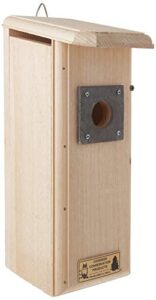
This handcrafted Eastern White Pine house features a slate squirrel guard and includes wood chips that mimic natural nesting material.
Mount it 8-20 feet high in lightly wooded areas, and you’ll create a winter roosting spot that doubles as pest control headquarters year-round.
Best For: Homeowners seeking natural pest control while supporting native bird populations in lightly wooded suburban or rural areas.
- Requires mounting at 8-20 feet high, which may need ladders or professional installation for safety
- Limited to specific habitat requirements of lightly wooded areas, making it unsuitable for dense forests or completely open spaces
- Success depends on existing Downy Woodpecker populations in your local area, with no guarantee of occupancy
- Provides significant pest reduction with woodpeckers consuming hundreds of insect larvae daily, including destructive wood borers and beetle larvae
- Handcrafted from naturally insulating Eastern White Pine with included slate squirrel guard and wood chips for immediate use
- Functions year-round as both nesting box and winter roosting shelter, maximizing value and bird habitat support
5. Large Cedar Owl House Nesting Box
 View On Amazon
Owls serve as nature’s nighttime exterminators, tackling rodent problems where other birds can’t reach.
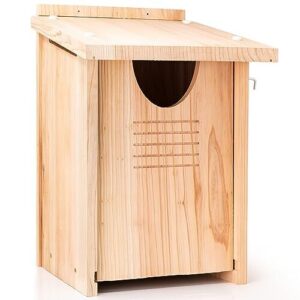
This large cedar owl house accommodates screech owls, barred owls, and American kestrels with its spacious 16"x12"x11" interior.
You’ll get weatherproof construction with dado joints, a 3" roof overhang for predator protection, and easy assembly with included cedar shavings.
Mount it 10-30 feet high in wooded areas, spacing boxes at least half a mile apart due to territorial behavior.
One owl family consumes up to 3,000 rodents per breeding season.
Nature’s nighttime exterminators tackle thousands of pests while you sleep.
Best For: Property owners with rodent problems who want chemical-free pest control and wildlife enthusiasts interested in supporting local owl populations.
- Requires mounting 10-30 feet high in wooded areas, limiting placement options for some properties
- Territorial behavior means boxes must be spaced at least half a mile apart, reducing coverage density
- Success depends on local owl populations and may take time to attract nesting pairs
- Eliminates up to 3,000 rodents per breeding season without toxic chemicals or traps
- Weatherproof cedar construction with dado joints and roof overhang ensures durability and protection
- Accommodates multiple owl species including screech owls, barred owls, and American kestrels
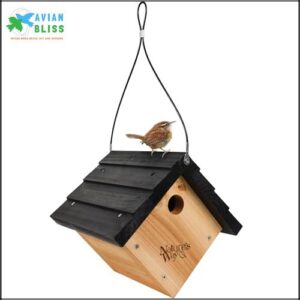
6. Cedar Wren House Nature’s Way
 View On Amazon
Nature’s Way Cedar Wren House delivers exceptional pest control through strategic design and premium materials.
This 8"x8"x8" cedar sanctuary features a precisely sized 1 1/8" entrance hole that welcomes wrens and chickadees while excluding invasive sparrows.
The rot-resistant cedar construction, combined with stainless steel hardware and superior ventilation, creates an ideal nesting environment.
Wrens can consume up to 9,000 caterpillars during breeding season, making this house your garden’s secret weapon against destructive pests while supporting local bird populations naturally.
Best For: Gardeners seeking natural pest control through native bird habitat creation while maintaining an attractive, low-maintenance backyard setup.
- Limited to smaller bird species only, excluding larger beneficial birds that might provide additional pest control services
- Requires annual cleaning and maintenance after breeding season to prevent pest larvae and fungal buildup inside the house
- Higher upfront cost compared to basic plastic or untreated wood alternatives, though cedar longevity justifies the investment
- Precision-engineered 1 1/8" entrance hole excludes invasive species while attracting beneficial wrens and chickadees that consume thousands of garden pests annually
- Premium rot-resistant cedar construction with stainless steel hardware ensures 5-8 years of durability with minimal maintenance requirements
- Easy-access cleaning panels and removable bottom enable thorough seasonal maintenance, reducing parasite buildup by up to 70% in backyard bird populations
Creating Bird Friendly Environments
Creating a bird-friendly environment extends far beyond simply installing the right birdhouse – you’ll need to provide the complete ecosystem that supports these natural pest controllers year-round.
Your success in attracting beneficial birds depends on offering food sources, nesting materials, water, and protection from predators in a thoughtfully designed landscape.
Planting Hedgerows for Bird Habitat
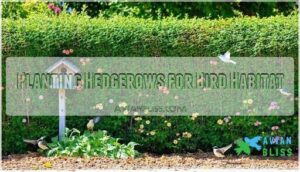
Establishing hedgerows creates wildlife corridors that transform your property into a pest-controlling powerhouse.
These native plant barriers provide essential shelter, nesting sites, and foraging areas that complement your birdhouse natural pest management system.
Strategic hedgerow benefits include:
- Native species selection attracts insectivorous birds year-round
- Maintenance practices guarantee sustainable habitat development
- Wildlife corridors connect fragmented habitats effectively
- Long-term planning maximizes birdhouse pest control benefits
- Herbal pest deterrent plants naturally repel unwanted insects
Growing Bird Food and Nesting Materials
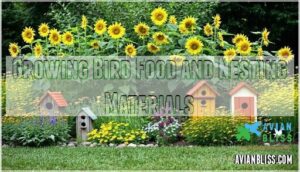
Native plantings create nature’s buffet right in your backyard.
Sunflowers produce high-energy seeds that fuel songbirds through breeding season, while berry-producing shrubs like serviceberry offer winter berries when insects disappear.
Plant goldenrod and coneflower for seed variety that sustains finches year-round.
Consider specialized plants for birds to further enhance your backyard ecosystem.
Native grasses provide essential nesting fibers, and insectary gardens boost caterpillar populations by 35 times compared to exotic plantings.
Protecting Birds From Outdoor Cats
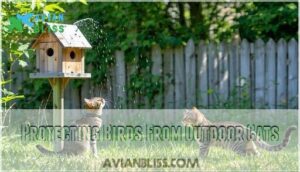
Outdoor cats pose the greatest threat to backyard birds, killing billions annually.
Install predator guards on birdhouse poles and position houses at least 10 feet from cat hiding spots.
Cat Deterrents like motion-activated sprinklers create Safe Havens around feeding areas.
Encourage neighbors to use Bell Collars or keep cats under Supervised Outdoor time.
Support local Rescue Alternatives that promote responsible pet ownership and indoor cat policies for effective birdhouse predator protection.
If a cat does attack, remember that Pasteurella bacteria is dangerous and requires immediate attention.
Providing Water Sources for Birds
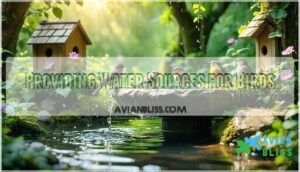
Fresh water keeps your feathered pest controllers healthy and active year-round. Smart placement near bird feeders creates convenient feeding stations, while proper maintenance prevents disease spread.
Many people also consider adding a bird bath fountain to their yard.
- Water source types: Shallow birdbaths, dripping fountains, or small ponds work best
- Cleaning frequency: Scrub birdbaths weekly with brush and fresh water
- Location matters: Place water sources 3-10 feet from cover for safety
- Winter water: Use heated birdbaths to prevent freezing in cold months
- Birdbath safety: Keep water 1-2 inches deep for small songbirds
Effective Bird House Placement Strategies
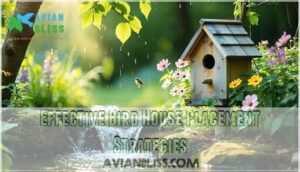
You’ll achieve ideal pest control results by positioning your birdhouses where morning sunlight warms them while afternoon shade keeps them comfortable.
Strategic placement away from high-traffic areas protects nesting birds while maintaining easy access to nearby food sources and water features, which is crucial for their survival with ideal pest control results.
Sunlight and Shade Considerations
Proper bird house positioning balances morning sun exposure with afternoon shade protection for ideal temperature regulation.
You’ll want eastern-facing entrances that capture gentle sunrise warmth while avoiding harsh midday heat.
Regional variations matter – northern climates benefit from more sun exposure, while southern areas need increased shady placement for bird comfort.
Apply nontoxic birdhouse spray and diatomaceous earth seasonally to prevent bird house mites without compromising organic birdhouse care standards, using methods that maintain bird comfort.
Protection From Predators and Human Activity
Strategic birdhouse security transforms vulnerable nest sites into fortress-like sanctuaries through predator deterrents and human disturbance minimization.
Metal baffles reduce predation by 75%, while proper placement away from high-traffic areas prevents 30% of nest abandonment cases.
- Install stovepipe baffles or cone guards on smooth metal poles to block climbing predators
- Mount birdhouse predator guards at least 5-10 feet high with no overhanging branches nearby
- Use earth-tone nest camouflage materials to reduce visibility from vandals and cats
- Position birdhouse security features away from walkways and frequent human activity zones
- Add thorny habitat isolation plants around pole bases for natural birdhouse predator deterrence
Accessibility to Food Sources and Water
Position your birdhouse within 50 feet of natural food sources like gardens, wildflower patches, or areas rich in insects.
Attracting insects becomes easier near compost piles or organic gardens. Place a birdbath or water source within 100 feet, maintaining water source hygiene through regular cleaning.
During drought impact periods, supplemental feeding helps resident birds. This birdbath placement strategy guarantees birds have everything needed for successful pest control while raising their young, with natural food sources readily available.
Tips for Installing and Maintaining Bird Houses
Installing birdhouses correctly maximizes their pest control benefits.
Mount your houses using corrosion-resistant hardware and predator baffles to protect nesting birds.
Follow these installation guidelines:
- Mounting Techniques – Use metal poles with proper anchoring for stability
- Material Durability – Choose cedar or untreated wood for longevity
- Seasonal Cleaning – Remove old nests annually to prevent disease
- Location Relocation – Move unused houses after one season for better placement
Regular birdhouse maintenance and cleaning guarantee continued occupancy and effective natural bird parasite control.
Consider the entrance hole direction to protect from weather.
Frequently Asked Questions (FAQs)
What is a good natural bird repellent?
You can use natural deterrents like reflective tape, predator decoys, or citrus peels to keep unwanted birds away from specific areas while still encouraging beneficial species elsewhere.
What are the natural pest control birds?
Consider a single pair of Eastern Bluebirds that consumed over 8,000 caterpillars during one breeding season, dramatically reducing garden damage.
You’ll find Purple Martins, chickadees, woodpeckers, and screech owls excel at natural pest control through their voracious appetites.
How to keep bugs out of a bird house?
Clean your birdhouse annually during fall, removing old nesting materials and debris. Install proper ventilation holes and drainage slots to prevent moisture buildup that attracts insects and parasites.
What is the holistic approach to pest control?
A holistic approach balances multiple pest control methods naturally.
You’ll combine beneficial insects, companion planting, habitat management, biological controls, and environmental modifications.
This integrated strategy reduces chemical dependency while maintaining ecosystem health effectively, using a method that is both natural and holistic.
How often should bird houses be cleaned?
Like spring cleaning for feathered tenants, you’ll want to clean birdhouses annually during fall or winter.
This seasonal maintenance removes old nesting materials, preventing disease and parasites while ensuring fresh, hygienic conditions for returning birds, which is similar to giving them a clean slate for hygienic living.
When is the best time to install birdhouses?
Install birdhouses in late fall or early winter, giving birds time to discover them before spring breeding season.
You’ll want them up by February in most areas for ideal nesting success.
Can multiple species share the same birdhouse?
Different bird species typically can’t share the same birdhouse effectively.
Each species needs specific entrance hole sizes – bluebirds require 5-inch holes while chickadees need 25-inch openings.
You’ll get better pest control results with species-specific designs.
How long does it take birds to control pests?
Birds begin controlling pests immediately after settling into birdhouses, with noticeable results within days.
A pair of bluebirds can consume 8,000 insects during breeding season, while purple martins devour 300,000 flying insects daily once established.
What weather conditions affect bird house effectiveness?
Extreme cold, heavy rain, and strong winds reduce bird house effectiveness by limiting foraging activity and making birds seek more protected shelter, decreasing their pest control services substantially.
Conclusion
Why struggle with chemical pesticides when natural bird house pest control offers a safer, more sustainable solution?
Strategic placement of the six recommended houses creates a balanced ecosystem where beneficial birds eliminate up to 80% of garden pests naturally.
Cedar construction with proper entrance holes, morning sun exposure, and predator protection guarantees successful nesting.
Combined with bird-friendly environments including water sources and native plantings, this approach transforms your garden into a thriving habitat where nature’s pest control works continuously year-round.