This site is supported by our readers. We may earn a commission, at no cost to you, if you purchase through links.

Watch a European starling flock descend on a field at dusk and you’ll witness something that looks almost choreographed—thousands of birds spiraling into a hedgerow, then vanishing. Same field, same hedgerow, same evening ritual. But return the following night, and they might be gone entirely.
Do birds sleep in the same place every night? The short answer is: it depends, and the full answer reveals a surprisingly clever survival system. Most birds operate within a general roosting area but shift their exact position based on predator activity, weather, food proximity, and seasonal change.
Understanding what drives those decisions changes how you see every bird perched silently in your backyard after dark.
Table Of Contents
- Key Takeaways
- Birds Usually Don’t Sleep Same Place Nightly
- Why Birds Change Sleeping Spots
- When Birds Reuse Nightly Roosts
- Roosting Versus Nesting Explained
- Where Backyard Birds Sleep
- How Different Birds Choose Roosts
- How Birds Sleep Safely
- Why Birds Roost Together
- How Seasons Affect Sleeping Places
- Help Birds Find Safe Roosts
- Frequently Asked Questions (FAQs)
- Do birds sleep in the same place every night?
- Do birds sleep in their nests?
- How do gregarious birds sleep?
- When do birds go to sleep?
- Do birds sleep alone at night?
- Where do birds sleep?
- Where do birds go at night?
- Do birds sleep in water areas at night?
- Why do birds sleep at night?
- When do nocturnal birds go to bed?
- Conclusion
Key Takeaways
- Most birds don’t return to a single fixed spot each night — they rotate among familiar sheltering areas, adjusting based on predator activity, weather, and where food is most accessible.
- Predictability is a liability: wild birds deliberately vary their roost locations so predators can’t learn their patterns, making nightly movement a survival strategy, not random wandering.
- Roosting and nesting serve entirely different purposes — nests are breeding stations built for eggs and chicks, while roosts are chosen purely for safe, energy-efficient sleep outside the breeding season.
- You can make your yard a reliable refuge by planting native shrubs, keeping cats indoors, reducing artificial light, and skipping pesticides — small changes that directly support birds’ nightly safety needs.
Birds Usually Don’t Sleep Same Place Nightly

Most birds don’t have a single "reserved spot" they return to every night like you might expect. Their sleeping habits are actually shaped by a mix of biology, instinct, and whatever the environment throws at them. Here’s what drives those patterns.
Each species has its own clever approach to finding safe rest, as explored in this guide to where birds sleep at night and the surprising factors that influence their choices.
Regular Roosting Areas
Most birds gravitate toward a handful of reliable shelter types night after night. Dense shrubs, thick-foliaged branches, tree cavities, and cliff crevices all offer the same basic advantages: overhead cover, microclimate stability, and quick escape routes nearby.
Urban species extend this logic to building ledges and eaves. The habitat varies; the selection criteria don’t. Many structures act as attractive architectural features that mimic natural environments.
Not Always Exact Spots
Knowing a bird prefers dense shrubs doesn’t mean it’ll land on the same branch tonight. Nightly movement scales can shift just a few meters — a different bush, a lower perch, a sheltered gap slightly to the left.
Microhabitat selection changes based on whatever conditions arrive at dusk: wind direction, a nearby disturbance, or simply a more concealed option spotted on the way in.
Species-based Differences
Species shape everything. A body size and perch height correlation means larger thrushes favor exposed upper canopy, while wrens tuck into dense understory — often just a meter apart but occupying entirely different microclimates.
Light sensitivity also splits roosting habits: some species settle at dusk’s first dimming, others wait for near-darkness. Migratory birds lean toward opportunistic sites; resident birds show stronger site fidelity overall.
Safety-driven Movement
Predictability is a vulnerability. Most wild birds rotate roosting sites deliberately, denying predators the chance to learn their patterns.
Wild birds rotate sleeping spots deliberately — because predictability is a vulnerability predators exploit
Three main safety-driven movement triggers shape this behavior:
- Predation pressure intensifies near repeatedly used sites
- Flight paths grow dangerously predictable over time
- Habitat security declines once a roost is disturbed
This deeply rooted survival instinct keeps roosting site selection fluid — and keeps birds alive.
Why Birds Change Sleeping Spots

Birds don’t stick to one sleeping spot without good reason — and when they move, something specific pushed them to go. Several real factors drive that decision, from immediate safety threats to shifts in the landscape around them. Here’s what’s actually behind those nightly changes.
Predator Avoidance
Staying in one spot is practically an open invitation for predators. Predation risk alone drives most roost-switching behavior, since a cat or owl quickly learns where reliable prey sleeps.
| Threat | Bird Response | Strategy |
|---|---|---|
| Approaching predator | Rapid takeoff (0.25–0.5 sec) | Escape to canopy |
| Repeated disturbance | Site abandonment | Rotate roost locations |
| Dawn/dusk pressure | Collective vigilance | Alarm signaling across flock |
Weather Protection
Weather drives roost-switching just as reliably as predators do.
When strong gusts arrive, birds abandon exposed perches for dense evergreen cover, where windbreaks cut wind speed by 25–60%, and canopy microclimates run 2–6°C warmer than open air. Heavy rain triggers the same instinct — overhanging branches divert rainfall, keeping feathers dry and thermal insulation intact, which directly preserves overnight energy reserves.
Food Availability
Roost placement and food source proximity are tightly linked. When local prey or seed density drops — whether through seasonal harvest cycles or simple depletion — birds don’t wait around. They shift their sleeping sites closer to more productive foraging grounds, trimming the energy cost of each morning’s first flight.
Think of it like choosing a hotel near tomorrow’s meeting rather than across town.
Species that roost communally gain an extra edge here: communal roosts function as information centers , where individuals track which members return well-fed and follow them toward richer patches the next morning. Ravens (Corvus corax) demonstrate this precisely.
What pulls a bird toward a new roost site:
- A patch of nutrient-rich, calorie-dense seeds appearing after a seasonal harvest cycle
- Insect emergence concentrated near wetland edges or forest clearings
- Fruiting shrubs offering high edible calorie density within short flight range
- Sudden local scarcity stripping a formerly reliable foraging area bare
Foraging efficiency — the ratio of calories gained to energy spent — ultimately governs roosting site selection as much as safety does. When food availability shifts, the roost moves with it.
Seasonal Habitat Shifts
As seasons turn, bird roosting sites shift dramatically. In winter, species descend to lower elevations where snow cover is minimal. Autumn draws them toward seed-rich shrublands; spring toward insect-abundant forest edges. Drought years trigger nomadic roosting, birds chasing scattered resources across wide ranges.
| Season | Habitat Preference | Key Driver |
|---|---|---|
| Winter | Low-elevation shelter | Snow depth |
| Autumn | Shrub and forest edge | Seed availability |
| Spring | Wetland margins | Insect emergence |
Post-breeding clustering concentrates migratory and resident birds alike in transitional habitats before long journeys begin each year.
Human Disturbance
Human activity reshapes avian roosting behavior more than most people realize. Hikers shift birds 120–300 meters from trails, urban light pollution delays settling by up to 90 minutes, and free-roaming cats drive nocturnal displacement from established sites.
- Trail traffic disrupts predator avoidance rhythms
- Artificial light fragments natural dusk cues
- Recreational noise suppresses nighttime vocal coordination
Your presence in their habitat carries real consequences.
When Birds Reuse Nightly Roosts

Not every bird is a wanderer at heart. Some return to the same roost night after night — and there are good reasons why. Here’s what draws a bird back to a familiar sleeping spot.
Safe Established Sites
A roosting site earns repeat visits by proving itself reliable. Landing zone markers, stable perch textures, and natural predator barriers — overhead canopy that blocks moonlight, dense cover that conceals without trapping — all signal safety to returning birds.
Site fidelity reflects earned trust. When avian behavior consistently rewards a location, birds stop searching and simply return.
Stable Food Nearby
Proximity to food matters as much as cover. Birds don’t waste energy traveling far to forage before nightfall — they roost where breakfast is close. Foraging efficiency shapes site loyalty; a location within reliable feeding range gets reused night after night.
When food sources stay predictable, birds stop searching and simply return.
Familiar Territory
Territory itself becomes the compass. Birds rely on using landmarks — a familiar shrub, a water feature, a fence line — to reach roosting sites with minimal effort. That microhabitat familiarity cuts energy costs dramatically.
Three cues strengthen site fidelity:
- Recognizable vegetation anchoring nightly route shifts
- Spatial memory of the microhabitat layout
- Territory recognition reducing search time at dusk
Low Predator Pressure
When predators are scarce, birds don’t waste energy on constant vigilance. Relaxed vigilance patterns mean they stay longer on exposed perches, sleep more deeply, and extend sleep duration well into the night. Alarm calls drop off noticeably.
That quiet signals a safe site worth returning to — one where reduced predator pressure consistently rewards fidelity with better rest and stronger survival odds.
Communal Roost Loyalty
That pull toward safety scales up in communal species. Starlings and barn swallows return to the same communal roosts nightly — sometimes millions strong.
Flock size patterns strengthen this loyalty:
- Collective vigilance strategies multiply watchful eyes
- Social learning benefits flow from experienced adults
- Group decision making sharpens daily foraging routes
- Age-based fidelity keeps older birds anchoring the site
Roosting Versus Nesting Explained
Roosting and nesting aren’t the same thing, even though birds do both — and the difference actually matters more than you’d think. Knowing which is which helps you understand why birds behave the way they do at night throughout the year. Here’s what each term really means and how they shape a bird’s daily life.
Nests Are for Breeding

A nest isn’t a bedroom — it’s a nursery. Birds build nests specifically for egg protection and nestling warmth during the breeding season, not for nightly sleep.
Every structural choice, from tightly woven walls to soft down lining, helps with parental duties: incubating eggs, shielding chicks from weather, and maximizing breeding success. Once the fledglings leave, the nest’s purpose is complete.
Roosts Are for Sleeping

A roost is where a bird actually sleeps — night after night, outside the breeding season. Unlike nests, roosts are chosen purely for nightly energy conservation and safety, not reproduction.
Avian roosting habits align tightly with circadian rhythms, with diurnal species settling after sunset to enter restorative sleep cycles. The roost site selection process balances predator awareness with thermal comfort.
Empty Nest Reuse
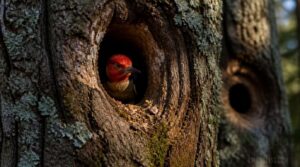
Sometimes an empty nest gets a second life. Cavity-nesting birds like woodpeckers regularly return to tree cavities, weighing three factors:
- Energy saving benefits outweigh rebuilding costs
- Predator memory patterns increase detection risk
- Parasitism risk factors rise with repeated use
Habitat stability impacts this decision heavily — stable territories with consistent food favor reuse, while disturbed sites usually don’t.
Baby Birds in Nests

Hatchlings emerge naked and helpless after 10–14 days of incubation, entirely dependent on parents for warmth and food.
| Stage | Timeline |
|---|---|
| Eyes open | Days 7–10 |
| Feathers develop | Weeks 2–3 |
| Fledgling departure | Week 3+ |
Feeding frequency peaks in those earliest days, with both parents delivering food constantly while regulating nest microclimate. The nest isn’t a sleeping spot — it’s a survival station that fledglings leave permanently once independent.
Adult Nighttime Habits

Once the breeding season ends, adult birds shed their parenting obligations — and with that, the nest. No fixed address guides their nights.
Instead, most species follow a surprisingly deliberate wind-down, seeking sheltered perches, roosting cavities, or dense cover where consistent thermal conditions and low predator exposure allow their brains to cycle through proper avian sleep, including REM stages.
Where Backyard Birds Sleep
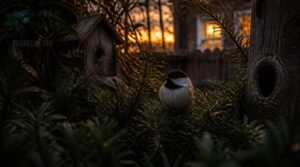
If you’ve ever wondered where the birds visiting your feeder disappear to once the sun goes down, the answer is usually closer than you’d think. Backyard birds don’t need much — just the right kind of cover to feel safe and stay warm through the night. Here are the spots they’re most likely using in your own yard.
Dense Shrubs
Dense shrubs are among the most reliable nighttime refuges for backyard birds. Their interwoven branches limit light penetration by up to 60%, creating dark, sheltered pockets that conceal roosting birds from predators.
- Thermal cover during cold nights
- Predator-blocking branch density
- Insect-rich habitat for foraging nearby
- Stable soil moisture supporting shrub health
Plant native species to boost biodiversity and structural complexity.
Evergreen Trees
Where dense shrubs offer tangled cover, evergreen trees take protection a step further — year-round.
Winter thermal insulation makes conifers genuinely irreplaceable. Needles retained for up to seven years create layered canopies that block wind and trap warmth, helping birds survive freezing nights. Species like juncos and sparrows instinctively favor these conifer habitat structures when deciduous trees drop their leaves and concealment disappears entirely.
Brush Piles
Brush piles offer something evergreens can’t — ground-level refuge. Built with a tic-tac-toe log foundation topped by tangled branches, they create insulated interior chambers that stay warmer than the surrounding air in winter.
Songbirds seeking cover from predators, plus insects sheltering in the crevices, make these piles self-sustaining micro-ecosystems. Place them along woodland edges, away from foot traffic, and they’ll remain functional for over a decade.
Tree Cavities
Where brush piles shelter birds at ground level, tree cavities do the same overhead — and with far greater thermal efficiency. Fungal decay and woodpecker excavation hollow out mature trunks over decades, creating insulated chambers that stay much warmer than exposed branches on cold nights.
Cavity-nesting birds like owls, chickadees, and woodpeckers return to these natural openings repeatedly. One caution: severe internal rot can compromise structural integrity, so inspect cavity-bearing trees near pathways regularly.
Protected Ledges
Vertical surfaces offer something tree cavities can’t — urban microhabitat at scale. Concrete parapets, stone cornices, and metal window ledges create narrow, sheltered perches that migratory and cliff-adapted birds exploit instinctively.
Grip matters: rough surfaces outperform smooth composites on wet nights. That’s why pigeons favor weathered stone over painted metal. Structural integrity determines whether a ledge holds one bird or twenty safely.
How Different Birds Choose Roosts

Not every bird sleeps the same way — or in the same kind of place. A duck’s idea of a good night’s rest looks nothing like an owl’s, and that difference comes down to millions of years of adaptation. Here’s how several common species approach the nightly question of where to settle in.
Songbirds on Branches
Songbirds rely on a tendon-locking toe grip to stay anchored through the night without any muscular effort.
Their roosting site selection favors branches with dense foliage and complex branching patterns, which reduce wind exposure and improve camouflage a lot.
- Higher perches improve acoustic reach during morning song
- Horizontal branches ease morning takeoff at first light
- Leaf cover naturally minimizes song attenuation
Ducks on Water
Unlike perching birds, ducks sleep directly on water, drifting through the night on a surface that doubles as an early-warning system — any approaching predator creates ripples or splashing that stirs the flock instantly.
Their waterproof uropygial oil and air-trapping feather structure maintain buoyancy with almost no energy expenditure, while webbed foot paddling keeps them oriented even while dozing.
Woodpeckers in Cavities
Woodpeckers chisel into decayed heartwood using reinforced skulls and beak anatomy — creating thermal cavities that function as nightly refuges from both cold and predators.
Five reasons cavities matter:
- Heat retention from tight wooden walls
- Wood chip cushioning insulates the chamber
- Narrow entrances block predator access
- Abandoned sites host secondary nesters like nuthatches
- Familiar cavities get reused nightly
Owls in Sheltered Spots
Owls treat shelter like a precision tool. Their cryptic plumage dissolves them into bark and rock during daylight, but concealment only works when the roost itself cooperates.
| Roost Type | Key Benefit |
|---|---|
| Tree cavities | Thermal insulation, predator exclusion |
| Rock crevices | Wind block, cryptic backdrop |
| Dense conifers | Visual cover, moisture protection |
| Urban vents/chimneys | Year-round warmth, human-scarce zones |
Thermal crevice benefits extend well beyond warmth — tight walls reduce silhouette exposure entirely.
Nightjars on Ground
Nightjars don’t perch — they disappear. Cryptic plumage patterns align so precisely with leaf litter that a resting bird becomes part of the forest floor itself.
- Substrate tone matching lets individuals melt into local soil and dead leaves
- Flattened posture and shadow reduction techniques minimize any visible silhouette
- Ground microhabitats near open clearings keep nocturnal foraging routes within easy reach
How Birds Sleep Safely

Sleeping out in the open every night sounds risky — and for birds, it genuinely is. But over millions of years, they’ve developed some remarkably clever ways to stay safe while they rest. Here’s what actually happens when a bird closes its eyes for the night.
Locking Feet on Perches
A bird asleep on a branch isn’t holding on — its body does that automatically. When a bird’s leg bends upon landing, specialized tendons tighten, curling the toes around the perch without any muscular effort.
This tendon-locking mechanism keeps the grip secure through the night, conserving energy while preventing falls — releasing only when the leg straightens for takeoff.
Fluffed Insulating Feathers
Once the feet lock in place, the body takes over its own thermal defense. Birds fluff their down feather layers, expanding air pocket volume to raise thermal resistance against cold nights — a passive, energy-efficient response requiring no sustained muscular effort.
Regular preening keeps those barbules aligned, ensuring maximal insulation is maintained throughout the roost.
One-eye Alertness
Thermal defense controls the body — the brain controls the threat. Unihemispheric slow-wave sleep lets one hemisphere rest while the other stays alert, one eye open and scanning. Retinal sensitivity sharpens in low light, detecting movement long before a predator closes in. In flocks, shared sentinel roles distribute this cost:
- Perimeter birds sustain higher alertness throughout the night
- One open eye preserves a continuous field of view
- Retinas adapt to ambient darkness for motion detection
- Brief acoustic cues trigger instant wakefulness across the roost
- Inner birds rest more deeply, cycling through fuller avian sleep stages
Camouflage While Resting
Alertness keeps one eye open — but camouflage means predators never get close enough to matter.
Roosting birds select perches where feather patterns mirror bark and lichen, breaking the silhouette entirely. Nightjars flatten against the forest floor, motionless, their mottled plumage dissolving into leaf litter. Behavioral stillness does the rest — no motion, no cue, no threat detected.
Quick Escape Routes
Camouflage buys time — but when a predator closes in, birds need clear exit paths, fast.
Roosting perches are selected with at least two unobstructed flight lines in mind. No dead ends. A branch overlooking open air beats a dense thicket with one narrow gap.
- Perches face prevailing wind for instant lift
- Rapid fallback routes avoid foliage that slows takeoff
- Open sight lines double as predator detection corridors
Why Birds Roost Together

There’s a reason you’ll rarely spot a single starling sleeping alone — birds that roost together simply survive better. Communal roosting isn’t just a social habit; it’s a strategy shaped by millions of years of evolutionary pressure. Here’s what actually drives birds to sleep in numbers.
Safety in Numbers
When thousands of starlings pack into a single roost, no individual bird is an easy target. This dilution effect mathematically reduces each bird’s personal predation risk — the larger the flock, the slimmer the odds of being singled out. Communal roosting also triggers predator confusion, as synchronized movement makes targeting nearly impossible.
Group thermoregulation keeps smaller species alive on bitter winter nights.
Shared Predator Alerts
Roosting together turns every bird into a lookout on duty. When one individual spots danger, alarm calls ripple through the flock within seconds — faster in denser groups.
Four signals that keep communal roosts safe:
- Sharp acoustic bursts that pinpoint aerial threats
- Synchronized head turns broadcasting visual warnings
- Predator-specific calls distinguishing hawks from foxes
- Cross-species eavesdropping, where nearby birds react to neighboring flocks’ alerts
Collective vigilance means no single bird shoulders the watch alone.
Warmth During Cold Nights
Cold nights drain reserves fast — sometimes fatally. Huddling in communal roosts lets birds pool metabolic heat, cutting individual heat loss through direct contact and shared body warmth.
| Strategy | Survival Benefit |
|---|---|
| Feather fluffing | Traps insulating air near skin |
| Microclimate selection | Blocks wind and cold exposure |
| Group huddling | Reduces heat loss per bird |
Adult birds claim the protected center. Bigger flocks survive winter cold more reliably than solitary birds ever could.
Better Foraging Information
A roost isn’t just a bedroom — it’s an information exchange. Birds that forage poorly one day watch successful flock-mates at dawn, then follow them to productive patches.
- Observing flock movements pinpoints active feeding zones
- Foraging memory reduces wasted travel to depleted patches
- Audio cues like seed cracking signal nearby food
Communal roosting turns individual knowledge into shared foraging intelligence.
Social Flock Behavior
Flock behavior isn’t random — it’s governed by neighbor alignment rules, where each bird adjusts speed and direction based on nearby individuals. No single leader directs the group; transient leadership shifts mean any bird can briefly guide movement based on position.
These information cascade effects ripple through thousands of birds in milliseconds, producing the fluid, collective turns you see at dusk roosts.
How Seasons Affect Sleeping Places

The time of year shapes where birds sleep just as much as predators or weather do. As seasons shift, so do the roosting strategies birds rely on to stay safe and warm. Here’s how each seasonal change influences the sleeping spots birds choose.
Winter Shelter Needs
Winter strips away the leaf canopy that birds depend on for cover, forcing rapid adjustments in roost selection.
Species like starlings pack into communal thermal roosts — dense evergreen stands or building cavities — where huddling conserves body heat against dangerous overnight drops. Without adequate insulation from wind and cold, even short exposure risks hypothermic energy loss that no amount of daytime foraging can fully recover.
Summer Breeding Routines
Summer flips the script entirely. Breeding season locks birds into predictable nightly patterns — incubating parents return to the same nest each night, whether sitting on eggs for 11 to 14 days or brooding newly hatched chicks.
Nest placement in dense shrubs or forked branches isn’t accidental; it reflects months of mate attraction, courtship displays, and deliberate construction using grasses, spider silk, and feathers.
Migration Stopover Roosts
Migration turns roosting into a calculated gamble. Migrating songbirds don’t repeat locations — they select opportunistic stopover sites based on immediate cover, insect abundance, and perceived predation risk.
Weather-driven timing matters here: rain or cold fronts extend stays, while clear skies push birds onward quickly. A high-quality site with food and dense refuge can mean the difference between surviving the journey and not.
Leaf Cover Changes
Leaf cover shapes roosting options more than most people realize. As deciduous canopy thins each autumn, birds lose the dense overhead shelter they relied on through warmer months. Evergreen trees become prime real estate.
Climate-driven greening has extended leaf retention in some regions, quietly stretching the window of usable roost cover — a small but meaningful shift in available nighttime habitat.
Storm-driven Relocation
Severe storms strip roost sites instantly. When coastal storms hit, birds abandon established shelters within hours, forced into unfamiliar terrain by post-storm displacement.
- Structural roost loss from flooding
- Predator exposure in damaged cover
- Food depletion near origin sites
- Relocation to higher, sheltered ground
Climate-driven storm frequency means these disruptions aren’t isolated events anymore — they’re becoming seasonal patterns birds must adapt to survive.
Help Birds Find Safe Roosts

If you want to make your yard a place birds actually trust, a few simple changes go a long way. You don’t need a complete garden overhaul — just the right elements in the right places. Here’s what you can do to give local birds a safer, more reliable place to rest each night.
Plant Native Shrubs
Native shrubs do more than fill garden space — they recreate the layered structure birds depend on for safe nighttime roosting. Dense thickets of species like viburnum or native hawthorn offer genuine cover, not just decoration.
Once established, these shrubs survive on natural rainfall and support local wildlife year-round, attracting the insects and berries that keep birds returning night after night.
Provide Birdhouses Carefully
A well-placed birdhouse can substitute for natural cavities that are increasingly scarce in managed landscapes. Match entrance hole diameter to your target species — 1½ inches for bluebirds, 1 inch for wrens — and use untreated cedar or redwood to avoid chemical leaching.
Mount boxes at the correct height, install metal entrance plates against predators, and clean them out each season.
Keep Cats Indoors
Domestic cats kill billions of birds annually — many during vulnerable nighttime roosting hours when survival instincts can’t fully compensate. Keeping cats indoors directly protects roosting birds and helps urban nature stay balanced.
- Contained cats lower zoonotic disease risk transmitted between animals and humans
- Indoor living reduces wildlife predation across backyard habitats a lot
- Responsible pet ownership strengthens local bird conservation and biodiversity
Reduce Nighttime Lights
Artificial light after dark disrupts avian circadian rhythms, pulling birds away from established roosts or preventing restful sleep entirely.
Installing shielded outdoor fixtures and choosing warm LEDs at 3000 Kelvin or lower cuts blue light emissions that confuse nocturnal survival cues. Motion sensors help by limiting unnecessary illumination. Less skyglow means calmer nights — for birds and for you.
Avoid Pesticide Use
Pesticides don’t just target pests — they cascade through entire food webs. Residual chemicals can eliminate the insects birds depend on for foraging near roost sites, making familiar territories functionally uninhabitable overnight.
Where you can, lean on natural pest suppression: companion planting, beneficial insects, and compost-enriched soil keep populations in check without poisoning the chain that connects your yard’s ecology to the birds sleeping in it.
Frequently Asked Questions (FAQs)
Do birds sleep in the same place every night?
Like a cautious traveler, most birds rotate through familiar roosting areas nightly rather than claiming one fixed perch. Safety, weather, and food availability all shape where they settle each night.
Do birds sleep in their nests?
Most birds don’t sleep in their nests. Nests are built for breeding and raising young, not nightly rest. Once chicks fledge, adults usually abandon them and roost elsewhere in trees or shrubs.
How do gregarious birds sleep?
Gregarious birds sleep in communal roosts, sometimes numbering in the millions. This synchronized roosting combines communal thermoregulation with the many-eyes effect, letting individuals take turns watching for predators while the flock collectively conserves warmth.
When do birds go to sleep?
Ironically, birds don’t set an alarm — they rely on fading sunset light to trigger sleep. Most diurnal species roost within 30 minutes after dusk, though latitude and season shift that window considerably.
Do birds sleep alone at night?
It depends on the species. Solitary birds rest alone, while social species roost together in flocks that can number in the millions. Most backyard birds fall somewhere between, roosting near others without direct contact.
Where do birds sleep?
Where birds sleep depends entirely on their species and habitat. Songbirds perch in dense shrubs or branches, waterfowl rest on water, and cavity-nesters shelter in tree hollows or building crevices for thermal insulation.
Where do birds go at night?
Like commuters heading home after a long day, birds slip into dense shrubs, tree cavities, evergreen branches, or sheltered ledges — wherever darkness, cover, and safety converge to offer a reliable place to rest until dawn.
Do birds sleep in water areas at night?
Yes, some birds do sleep on water. Ducks and waterfowl commonly float in groups at night, using the splashing of ripples as a natural alarm system against approaching land predators.
Why do birds sleep at night?
Birds sleep at night to conserve energy, reduce metabolic rate, and align with their circadian rhythm — rest that repairs the body, resets the brain, and gets them ready for another full day of foraging and survival.
When do nocturnal birds go to bed?
Nocturnal birds usually begin roosting 15 to 60 minutes after sunset, though bright moonlight can delay sleep by up to an hour when prey remains active. Cold temperatures often push bedtime earlier.
Conclusion
The answer to do birds sleep in the same place every night isn’t black and white. Birds play it by ear — reading predator pressure, weather shifts, and food proximity before committing to any roost.
Safety drives every decision. A familiar hedge means nothing if a hawk claimed it last night. What looks like random movement is actually a finely tuned survival calculation. Respect that intelligence by keeping your yard dark, quiet, and dense with native cover.
- https://www.birdwatchingdaily.com/beginners/birding-faq/where-do-birds-sleep-at-night
- https://homeandroost.co.uk/blogs/garden-birds/where-do-garden-birds-sleep
- https://pmc.ncbi.nlm.nih.gov/articles/PMC12751336
- https://www.birdfact.com/bird-behavior/sleeping-habits-and-behavior
- https://www.birdsandblooms.com/birding/birding-basics/birds-sleep-night