This site is supported by our readers. We may earn a commission, at no cost to you, if you purchase through links.
 Last spring, I watched a scarlet tanager—a bird I’d only seen in field guides—feed its fledglings in an oak tree twenty feet from where I stood. That moment didn’t happen by accident. It came from understanding how to move through a bird’s world without disrupting it, recognizing the right habitat at the right time, and having the patience to let the scene unfold naturally.
Observing birds in their natural habitat requires more than just showing up with binoculars. You need to read landscapes like a map, interpret behaviors as they happen, and respect the delicate balance between curiosity and intrusion.
The techniques and ethics that follow will help you get closer to these moments while keeping the birds’ welfare at the center of every observation.
Table Of Contents
Key Takeaways
- Successful birdwatching depends on understanding habitat selection and seasonal timing rather than just having expensive equipment, since birds concentrate in specific locations during migration peaks and breeding seasons that can increase species counts dramatically.
- Ethical field practices—maintaining buffer zones of 50-100 meters from nests, limiting playback to under 30 seconds, and staying on marked trails—directly protect vulnerable populations and prevent behavioral disruption that can reduce reproductive success by up to 15%.
- Combining visual observation tools with acoustic monitoring and detailed note-taking improves species identification accuracy by 45% and boosts data quality for citizen science projects by 33%, turning casual observations into meaningful conservation contributions.
- Physical field marks like wingbars and crown stripes provide the foundation for identification, but observing flight patterns, feeding behaviors, and territorial displays reveals species-specific adaptations that separate look-alikes and deepen ecological understanding.
Essential Gear for Birdwatching
Getting ready for birdwatching doesn’t have to feel overwhelming. The right gear makes your time outdoors more enjoyable and helps you spot birds you’d otherwise miss.
Here’s what you’ll want to bring along on your next outing.
Choosing The Right Binoculars
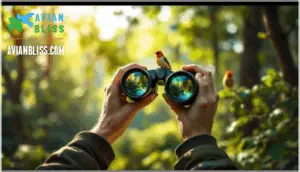
How do you choose binoculars that won’t let a single field mark slip past your view? Start with 8×42 models, balancing magnification power with a 400-450 foot field of view, minimizing hand shake while tracking fast movers. Roof prism types dominate for their compact build, while fully multi-coated lenses boost light transmission to 95% for dawn patrol. Look for phase-corrected BAK-4 prisms in your objective lens if you’re spending over $300. Weight matters too—aim for 500-700 grams for all-day comfort.
Budget options under $150 work fine for beginners, but premium models deliver sharper specifications through ED glass and dielectric coatings. Consider the objective lens diameter for best light gathering. Choosing binoculars means matching ergonomics to your field habits and binocular magnification to the species you’re after.
Selecting Field Guides and Apps

Your binoculars are dialed in—now pair them with the right field guides and apps. Printed vs. digital depends on your style: The Sibley Guide to Birds tops North American sales with detailed illustrations, while the National Geographic Field Guide covers over 1,000 species with better guide portability at 1.3 pounds.
Mobile apps like Merlin Bird ID offer app functionality across 10,000 species in 18 languages, with real-time sound identification hitting 95% accuracy. These apps can greatly improve your birdspotting experiences for both beginners and experts.
Field guides excel for learning plumage patterns, but apps deliver instant species coverage and identification accuracy when you’re tracking an unfamiliar warbler.
Useful Clothing and Accessories

What you wear shapes your comfort and effectiveness in the field. UPF clothing blocks up to 98% of UV during long watches, while insect protection gear with permethrin cuts tick bites by 87% in wooded areas. Waterproof boots with strong footwear traction improve safety by 20% on wet ground.
Utility vests keep field guides and gear close without the hassle of bags. Performance enhancements like polarized sunglasses sharpen color detection by 15%, and a binocular strap frees your hands while protecting your optics—all part of ethical practices that keep you prepared without disturbing the birds you’re tracking.
Benefits of Cameras and Notebooks

Beyond comfort gear, cameras and notebooks sharpen your skills in ways binoculars alone can’t. Wildlife photography improves photo identification accuracy by 45%, helping you verify species long after you’ve left the field. Notebooks and journals support learning retention—you’ll remember 52% more through recording sightings and reflective notes.
Together, these tools boost data completeness by 33% in citizen science projects, strengthening conservation data while promoting ethical engagement through thoughtful, non-invasive bird photography that respects the subjects you’re documenting.
Finding The Best Birdwatching Locations

You’ll find birds thriving in diverse locations, from the neighborhood park down the street to specialized reserves designed for wildlife viewing. The key is knowing where different species gather based on habitat type, season, and available resources.
Let’s explore three practical approaches to discovering prime birdwatching spots in your area and beyond.
Exploring Local Parks and Nature Reserves
Your local parks and nature reserves aren’t just green spaces—they’re vibrant bird habitats supporting critical biodiversity. In the U.S., 96 million people engage in urban birding, with parks providing essential refuge for diverse species year-round.
These birdwatching locations offer seasonal dynamics, from migratory surges in spring to stable breeding populations in summer.
By participating in citizen science programs like eBird, you contribute to habitat conservation while enjoying economic impacts that support community preservation of these natural habitats.
Identifying Habitats for Different Species
Each habitat type holds specific bird populations you’ll want to target during your outings. Understanding habitat identification helps you predict which species you’ll encounter and improves your habitat selection strategy:
- Forest birds like warblers and woodpeckers thrive in areas with mature canopy structures, where old-growth forests contain 60% higher avian biomass than younger stands.
- Grassland species such as Eastern Meadowlarks prefer native prairie remnants with rotational grazing, though they’ve declined 34% since 1970 due to agricultural conversion.
- Wetland habitats attract waterfowl and shorebirds, with restored areas supporting 20-30% increases in migratory stopover populations.
- Aridland birds and desert specialists occupy riparian zones, while urban birds concentrate in neighborhoods maintaining at least 30% native vegetation cover.
Birdwatching in Different Seasons
Throughout the year, seasonal changes shift bird migration patterns and alter which species you’ll encounter. Spring Migration peaks in April when more than 400 million birds move north in single nights, while Summer Breeding from May through July fills forests with nesting activity. Fall Movements begin in late August as species travel up to 6,000 miles south, and Winter Birds like Dark-eyed Juncos become your most reliable sightings in colder months.
| Season | Peak Activity | Target Species | Seasonal Habitats |
|---|---|---|---|
| Spring | April–May migration | Warblers, thrushes | Mixed forests, wetland stopovers |
| Summer | May–July breeding | Flycatchers, ducks | Freshwater areas, forest canopy |
| Fall | September–October | Raptors, swallows | Flyways, riparian corridors |
| Winter | December–February | Juncos, nuthatches | Southern regions, feeders |
You’ll find that timing your birdwatching trips to these natural rhythms increases your species counts dramatically, since habitat use changes as birds move between breeding grounds and wintering areas.
Techniques for Observing Birds in Nature

Watching birds takes more than just showing up with binoculars—you need the right techniques to get close without scaring them off. The way you move, listen, and document what you see can make the difference between a fleeting glimpse and a memorable encounter.
Here are the key methods that’ll help you observe birds successfully in their natural surroundings.
Approaching Birds With Stealth and Patience
Getting close to birds without spooking them takes practice, but you can improve your odds by understanding bird behavior and environmental timing. Movement patterns matter—approach at slow speeds (0.5–1 m/s) using indirect, meandering paths rather than straight lines. Your body language should stay relaxed, avoiding direct eye contact and jerky motions.
Here’s how to master stealth and patience in natural habitats:
- Choose smart approach angles: tangential paths reduce flight distance by 15–40% compared to direct approaches
- Read the bird’s signals: relaxed feeding or preening means low alert; tail-raising or fidgeting signals imminent flight
- Time your observations wisely: dawn and dusk feeding periods allow 20% closer distances than midday
- Pause between movements: alternating steps with rests helps 63% of species tolerate closer observation
Ethical considerations include maintaining 10 m buffers for small birds and avoiding repeated disturbances that disrupt feeding.
Recognizing Bird Calls and Songs
You can reveal a forest’s hidden life when you start tuning into bird calls and songs, improving your auditory skills through consistent practice. Most bird vocalizations fall between 1 and 5 kHz, where human hearing can distinguish rhythm, pitch, and repetition patterns—essential markers for song identification.
AI identification tools like Merlin Bird ID now recognize multiple species simultaneously using acoustic monitoring technology, while 15–20 minute daily training sessions greatly boost your learning birdsongs accuracy.
Understanding avian communication through vocalization frequency helps you detect species in dense foliage where visual observation fails.
Recording Sightings and Behaviors
Manual Recording remains the foundation of bird behavior observation, allowing you to document precise interactions through focal sampling or scan methods that capture feeding rates and social dynamics.
Digital Logging platforms like eBird bring your field notes into continent-wide datasets, while Acoustic Techniques and Video Monitoring extend your reach beyond visual limits, detecting nocturnal species and subtle movements.
Data Analysis transforms these recordings into migration patterns and population trends you can trust.
Using Spotting Scopes and Audio Equipment
Your field notes capture what you see, but spotting scopes and audio equipment reveal what you’d otherwise miss. Zoom optics between 15x–60x magnification bring distant waterbirds into sharp detail, while larger objective lenses—50 mm or more—brighten backlit plumage so you can identify subtle markings. Pairing scopes with portable recorders lets you document bird calls using 48 kHz sampling, the standard in 94% of acoustic monitoring projects.
Consider these tools for serious fieldwork:
- Spotting scopes with 20–60x zoom eyepieces for flexible observation
- Multi-coated lenses that increase light transmission in variable conditions
- Uncompressed.WAV recorders capturing full-spectrum bird sounds
- Smartphone adapters for digiscoping and instant visual documentation
- AudioMoth units for continuous, hands-free acoustic monitoring
The birdwatching equipment market is growing at 7% annually, making quality gear more accessible than ever.
Identifying Bird Species and Behaviors

Once you’ve spotted a bird, the real detective work begins. Learning to read physical features, behaviors, and patterns helps you move from simply seeing birds to truly identifying them.
Here’s what to focus on when you’re trying to figure out which species you’re looking at.
Noting Physical Features and Markings
When you’re trying to pin down a species, plumage patterns and field marks are your first clues. Over 90% of birds display distinctive wingbars, crown stripes, or tail banding—details that separate look-alikes in seconds.
You’ll want to note body shape, beak shape, and head features like eyebrow stripes or eye rings, since these traits drive successful bird identification.
Wing markings and seasonal color shifts matter too, especially when using bird identification techniques for avian identification in the field.
Observing Feeding and Flight Patterns
Beyond color and shape, you’ll see how birds actually use their bodies. Watching flight patterns and foraging habits reveals species identity and environmental adaptation. That’s why bird behavior at feeders tells you so much—feeding rhythms shift with temperature, and flight energetics vary by wing movements and habitat.
- Cold snaps trigger more frequent visits, with temperature drops directly tied to foraging variation
- Mid-day peaks dominate feeding schedules, not the classic dawn-and-dusk pattern you’d expect
- Raptors soar differently than songbirds, their wing shape dictating pursuit versus hovering flight
- Observation methods like RFID tracking capture hundreds of thousands of visits, showing individual consistency over months
Understanding Seasonal and Mating Behaviors
You’ll notice breeding seasons vary by species—multi-brooded birds stretch nesting by four days per decade, while single-brooded types compress by two. Climate effects trigger earlier courtship rituals, from aerial talon-locking in red-tailed hawks to vocal duetting in barred owls.
Bird migration patterns shift too, with 61% of North American species moving wintering ranges northward.
Territory fidelity anchors lifelong pairs, who return annually to familiar nesting sites and defend them through elaborate mating behavior displays.
Utilizing Bird Identification Apps
When you’re trying to pin down a tricky species, birding apps like Merlin Bird ID and BirdNET offer fast mobile identification through photo and sound analysis. App accuracy reaches 95% for images and 88% for audio under clear conditions, though noisy environments can drop precision by 25%.
User experience benefits from offline guides and multilingual support across 200+ countries, while data privacy and ethical considerations arise as submissions feed citizen science platforms like eBird.
Future advancements in AI promise even sharper bird identification, but experts recommend using bird guides and apps as supplements—never replacements—for field-based learning.
Birdwatching Ethics and Conservation

Birdwatching isn’t just about spotting species—it’s about protecting them too. Your actions in the field can make a real difference in preserving bird populations and their habitats.
Here’s how you can be a responsible observer while contributing to conservation efforts.
Minimizing Disturbance to Birds and Habitats
When you enter nesting areas, do you realize your steps might cause more harm than your eyes see? Minimizing disturbance protects birds during their most vulnerable moments, especially in breeding seasons when stress leads to nest abandonment or reduced survival.
- Maintain buffer zones of 50–100 meters from active nests, as recommended by ethical guidelines
- Stay on marked trails to reduce trampling of vegetation and critical nesting materials
- Respect trail closures during sensitive breeding periods to support conservation efforts
- Support habitat preservation through habitat fencing that shields vulnerable colonies
- Practice ethical photography by avoiding sudden movements and noise reduction near roosting sites
Responsible Use of Playback and Calls
If you’ve heard bird songs on apps and wondered whether playing them in the field crosses an ethical line, you’re asking the right question. Responsible use of playback requires understanding avian disturbance risks and research benefits.
Playback ethics demand restraint—birding organizations recommend under 30 seconds of calls followed by pauses exceeding one minute to minimize behavioral disruption. Habituation risks arise when repeated exposure causes birds to ignore both real and recorded sources, potentially lowering reproductive success by up to 15%.
Best practices include confirming the target species’ presence first, keeping volume under 70 dB, limiting total playback to five minutes per observation, and avoiding use during nesting seasons or near endangered populations—ethical practices that respect bird behavior while supporting conservation.
Following Trail Etiquette and Access Rules
Sticking to marked trails isn’t just about following rules—it’s about protecting the ecosystems that make birdwatching possible. Practicing trail etiquette means noise reduction, respecting group size limits of 12 or fewer, and carpooling to minimize trail erosion and habitat disturbance.
You’ll want to check permit requirements before visiting restricted habitats, especially during nesting seasons when access may be limited. Birding responsibly through ethical practices at birdwatching locations preserves the very environments that support the species you’re hoping to observe.
Supporting Bird Conservation Efforts
Your field observations contribute directly to species recovery when you participate in citizen science programs like eBird or the Great Backyard Bird Count. Conservation efforts supported by birdwatcher data have helped protected species increase populations by an average of 624%, while habitat protection and ecosystem restoration generate over $41 billion annually in economic benefits.
Environmental stewardship through wildlife conservation initiatives and policy impacts ensures habitat preservation for declining species, turning your passion into measurable action.
Frequently Asked Questions (FAQs)
What time of day is best for birdwatching?
You’ll witness the most impressive avian performances at dawn, roughly 30 minutes before sunrise, when the dawn chorus peaks and birds actively mark territories.
Midday activity drops as light levels and temperatures rise, while dusk behavior brings another surge as birds return to roost.
How do weather conditions affect bird activity?
Weather shapes everything from foraging efficiency to migration timing. Heat stress reduces activity, while rain lowers nesting success. Wind speed influences flight altitude and energy use. Cold snaps trigger shelter-seeking behavior, and storms disrupt breeding cycles, ultimately affecting bird populations in natural habitats.
Can you birdwatch successfully in urban areas?
Cities might seem like concrete jungles, but you can absolutely birdwatch successfully in urban areas. Urban bird diversity thrives in green space impact zones like parks and reserves, where habitat quality bolsters citizen science and conservation efforts.
Even smaller patches attract adaptable species, giving you valuable observation opportunities. Natural environment features such as native vegetation improve bird habitats and behavior, letting you contribute meaningful data through birdwatching while practicing threat mitigation awareness.
What are common beginner mistakes to avoid?
Beginners often pick binoculars that aren’t weatherproof, reducing accuracy by 25%. Rushing observations disturbs birds and misses sightings.
Ignoring habitat needs cuts sightings by 30-50%, and visiting late decreases activity by 40-60%.
Making noise or using excessive playback stresses birds, while misidentifying species reaches 30% error rates.
How long should a typical birdwatching session last?
Most productive birdwatching sessions run between four to eight hours, starting at dawn when birds are most vocal and active.
You’ll want to focus your efforts during the first two hours after sunrise for best observation.
Conclusion
Watching birds takes wing when observation becomes second nature. The skills you’ve built—from reading habitats to recognizing calls—transform casual walks into meaningful encounters with species you might’ve missed before.
Observing birds in their natural habitat isn’t about ticking boxes on a list; it’s about understanding the rhythms that govern their survival and learning to move through their world without leaving a trace. Every outing sharpens your eye and deepens your connection to the ecosystems that depend on our respect and restraint.
- https://www.birdcount.org/2025-final-results/
- https://www.amraandelma.com/bird-marketing-statistics/
- https://www.birdwatchingdaily.com/beginners/birding-faq/the-surprising-economic-impact-of-birdwatching-in-the-us/
- https://www.allaboutbirds.org/news/birds-decline-strongholds-ebird-models-offer-hope/
- https://www.technexion.com/resources/how-embedded-vision-can-enable-remote-animal-and-bird-watching/