This site is supported by our readers. We may earn a commission, at no cost to you, if you purchase through links.
Three billion. That’s how many birds North America has lost since 1970—nearly one in three, gone.
Not from a single catastrophe, but from a slow, compounding erosion that most people never notice until a once-common species becomes a rarity.
The meadowlarks that used to fill farm fields with song, the swifts that wheeled above town squares at dusk—their absence is quieter than their presence ever was.
Threats to bird populations don’t announce themselves; they accumulate. Understanding what’s actually driving these losses—from the glass on your office building to the cat on your neighbor’s porch—is the first step toward doing something about it.
Table Of Contents
- Key Takeaways
- Habitat Loss and Fragmentation
- Agriculture, Logging, and Development
- Climate Change and Weather Extremes
- Collisions, Pollution, and Toxic Exposure
- Invasive Predators and Direct Mortality
- Frequently Asked Questions (FAQs)
- How do wind turbines affect bird populations?
- What role does noise pollution play?
- Are certain bird species more vulnerable than others?
- How does habitat connectivity influence bird survival?
- What impact do power lines have on birds?
- Which bird species have successfully recovered from decline?
- How do citizen scientists help monitor bird populations?
- What role do zoos play in bird conservation?
- How does noise pollution affect bird communication and breeding?
- Conclusion
Key Takeaways
- Habitat loss—through forest clearing, wetland drainage, and grassland conversion—remains the single largest driver of bird population decline, with some converted landscapes showing lowland bird abundance drops exceeding 88%.
- Everyday human infrastructure quietly accounts for staggering losses: window collisions kill over a billion birds annually in the U.S., vehicle strikes claim roughly 214 million more, and outdoor cats are responsible for up to 4 billion deaths each year.
- Climate change compounds every other threat by misaligning migration timing, shrinking food availability, and pushing species toward ranges they can’t safely reach due to fragmented habitats blocking the way.
- No single threat pushes a species to collapse—it’s the pile-up of habitat loss, predation, pollution, and climate pressure hitting simultaneously that overwhelms a population’s ability to recover.
Habitat Loss and Fragmentation
Habitat loss is the single biggest reason bird numbers keep falling, and its effects ripple across every stage of a bird’s life.
From nesting grounds to migration stopovers, the destruction rarely stops—as seen across bird species lost to habitat destruction.
From the forests of the Pacific Northwest to the grasslands of the Great Plains, the places birds depend on are disappearing faster than most people realize.
Here’s what what that loss actually looks like on the ground.
Forest, Grassland, and Wetland Conversion

Forest-to-farmland conversion, grassland plowing, and wetland drainage have quietly dismantled habitats that birds have relied on for millennia.
Lowland bird abundance has dropped over 88% in converted landscapes, while grassland degradation in the Prairie Pothole Region has cost more than a million hectares since the mid‑2000s.
Mosaic conversion and plantation expansion compound these losses, turning rich, layered ecosystems into biological deserts that specialists simply can’t survive.
A long‑term study in Japan documented a 72% decline in bird abundance over 166 years.
Disappearing Nesting and Foraging Habitat

When old‑growth trees vanish, so do the hollows that birds depend on for raising young—Cavity Tree Loss and Snag Decline quietly erase breeding sites that took decades to form.
Foraging Corridor Fragmentation cuts daily feeding routes, while Edge Nesting Risk and Small Patch Isolation compound the pressure.
Habitat conversion and degradation, alongside land‑use change, make habitat restoration, native plant landscaping, and protection initiatives more urgent than ever.
The decline of mountain chickadee nesting highlights the need for cavity preservation.
Lost Migration Stopover Sites
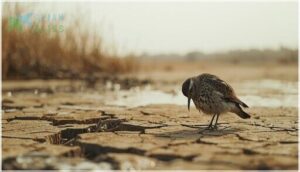
Just as nesting habitat loss cuts off where birds begin their journey, losing stopover sites can end that journey entirely.
Think of Stopover Network Connectivity as chain links—remove one, and the whole route breaks.
Migratory birds depend on these rest points for food, water, and shelter. Key sites now face:
- Seasonal Food Scarcity from habitat conversion and degradation
- Water Availability Decline in arid desert oases
- Protected Area Gaps leaving long, dangerous stretches unprotected
- Migration Timing Mismatch driven by climate change influences on bird threats
Effects of Fragmented Breeding Territories
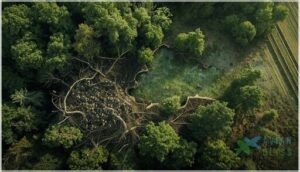
When stopover gaps fracture migratory routes, the damage doesn’t stop there—habitat fragmentation hits breeding grounds just as hard.
Territory Crowding forces birds into shrinking patches, intensifying Edge Pressure near boundaries where Nest Failure rates climb and Food Shortage worsens.
Dispersal Stress pushes young birds into risky open ground.
Without habitat restoration initiatives to counter land-use change, these compounding pressures quietly hollow out entire populations.
Why Small Habitat Patches Raise Risk

Small patches look like refuge, but they’re closer to a trap.
Edge Effects mean birds spend more time in harsh boundary zones where Predator Pressure spikes. Isolation Barriers block recolonization after local failures.
Territory Limits shrink breeding output, and Genetic Weakness quietly erodes resilience.
Without habitat restoration and protection initiatives countering ongoing habitat loss from land-use change and urbanization, these risks compound until populations simply collapse.
Agriculture, Logging, and Development
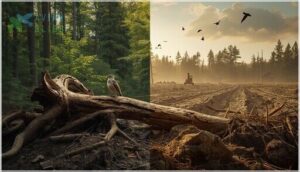
Habitat loss doesn’t happen in a vacuum — it has a face, and that face is usually a bulldozer, a chainsaw, or a plow.
The ways humans reshape the land for food, timber, and city growth are among the direct pressures birds face today.
Here are five of the most significant land-use drivers behind their decline.
Monoculture Farming and Land Clearing
When a diverse landscape gives way to wall-to-wall crops, birds lose far more than scenery.
Crop monoculture impacts every link in the food chain — field edge reduction strips away the hedgerows and weedy margins that birds depend on for cover and nesting, while pesticide dependency crashes insect populations that nestlings need to survive.
Native vegetation removal and land conversion together accelerate habitat degradation, leaving fragmented, chemically saturated ground where few species can persist.
Urban Expansion, Roads, and Commercial Construction
Urban expansion doesn’t just push birds out — it replaces their world with noise, glass, and pavement. Road edge effects disrupt foraging and communication, while Construction Noise forces breeding birds to abandon nests mid-season. You can help by supporting Setback Policies and Urban Greenways that reconnect fragmented landscapes.
Key urban hazards include:
- Collision Building Glass and artificial lighting killing hundreds of millions annually
- Collision Vehicles claiming over 200 million birds per year
- Stormwater Runoff degrading wetland stopover sites critical for migrants
Deforestation and Forest Degradation
Deforestation doesn’t just clear trees — it unravels entire ecosystems.
Logging and habitat conversion trigger Carbon Release, Soil Erosion, and forest fragmentation that strip away the layered habitats birds depend on for nesting and foraging.
Illegal Logging compounds losses where enforcement is weakest, often violating Indigenous Rights.
Restoration Funding can reverse this, but habitat loss continues faster than recovery.
Your awareness drives the pressure for change.
Water Diversion and Resource Extraction
Have you noticed how rivers run lower and wetlands dry up as water‑use competition intensifies? Riparian flow reduction, groundwater table decline, and wetland salinity rise fracture riverine habitat, shrinking spaces for waterfowl and migratory birds.
You can help by:
- Reducing energy and water use
- Supporting wetland protection and restoration
- Advocating for resource consumption reduction in your community
How Intensive Land Use Accelerates Decline
Imagine a patchwork quilt torn apart—intensive landuse change does just that to habitats.
Agricultural expansion, habitat conversion, and logging drive soil nutrient depletion, hydrological alteration, and increased fire risk. These changes foster human‑wildlife conflict and reduce genetic connectivity, accelerating habitat loss and degradation.
That’s why species relying on large, continuous territories face sharp declines as their world shrinks and fragments.
Climate Change and Weather Extremes

Birds face some of their toughest challenges as climate shifts and weather patterns grow more unpredictable. These changes are reshaping where species can live, breed, and find food.
Here’s how climate and extreme weather are impacting bird populations today.
Shifting Ranges and Altered Migration Timing
Climate change influences on bird threats in ways that quietly reshape entire life cycles. Many species now show poleward range expansion and elevational migration shifts as temperatures rise, while arrival dates at breeding grounds have shifted by days or weeks.
These temporal breeding adjustments create phenology mismatch between chick hatching and insect availability. Stopover corridor connectivity also suffers when fragmented landscapes block birds tracking newly suitable habitats.
Heat, Drought, and Food Shortages
Beyond shifting ranges, rising temperatures hit birds where they’re most vulnerable—their bodies and food supply. Thermal Stress Physiology research shows extreme heat forces birds to pant instead of feeding or parenting. In tropical regions, some populations have declined 38% as climate change influences on bird threats intensify.
- Water‑Limited Foraging worsens in deserts, where food yields less moisture as drought deepens.
- Insect Decline Cascades starve chicks when dry spells collapse the prey base parents depend on.
- Breeding Timing Mismatch widens when insect peaks arrive before nestlings hatch.
- Seabird Starvation Events claim hundreds of thousands of birds when warming oceans shrink prey availability.
Wildfires and Climate-driven Habitat Damage
Wildfires accelerate what drought and heat begin.
ground insect populations slash ground insect populations by up to 60 percent, triggering post-fire insect loss that starves cavity-nesting species already facing cavity-nesting delay of 3–15 years.
continuous forest breaks into isolated patches, collapsing successional habitat shifts that birds depend on.
Firebreak effectiveness around key nesting areas remains one practical defense you can support locally.
Sea-level Rise on Coasts and Islands
Where wildfires scorch inland habitats, rising seas quietly swallow coastal ones. Coastal Flooding doesn’t just wet a shoreline — it washes eggs and chicks away before they ever have a chance. Coastal shorebirds have already lost more than one-third of their population, and sea-level rise is tightening that pressure.
Five ways rising seas reshape bird survival:
- Nesting Habitat Loss permanently submerges beaches and saltmarshes where birds breed
- Salinity Intrusion converts freshwater marshes into hostile, salty environments
- Shoreline Erosion strips the flat, open ground shorebirds depend on for nesting
- Island Population Risk leaves isolated colonies with nowhere higher to go
- Marine debris and plastic pollution compound climate change effects on bird habitats already shrinking under rising tides
Compounding Effects With Habitat Loss
When habitat shrinks and climate shifts at the same time, birds don’t just face one bad day — they face a system working against them.
| Compounding Threat | Mechanism | Effect on Birds |
|---|---|---|
| Microclimate Stress | Edge heat dries fragment interiors | Reduced nesting success |
| Source‑Sink Dynamics | Small patches can’t sustain populations | Local extinction risk rises |
| Invasive Predator Access | Fragmented corridors let predators penetrate | Higher nest predation rates |
| Pollution Concentration | Fewer habitats concentrate contaminants | Direct mortality increases |
| Edge Predation Increase | Generalists exploit exposed nest edges | Songbird productivity collapses |
These cascading pressures — collision-related bird deaths from infrastructure, climate change influences on bird threats, and habitat loss on migratory bird populations — overwhelm species simultaneously. Habitat restoration and protection initiatives remain your most powerful tool for reversing this spiral.
Collisions, Pollution, and Toxic Exposure

Beyond habitat loss and climate pressures, birds face a quieter but equally relentless set of dangers built into the everyday world around them.
From the glass on your office building to the pesticides used in your neighbor’s garden, human infrastructure and chemicals are taking a serious toll.
Here’s a closer look at five of the most damaging collision and pollution threats birds face today.
Building Glass and Artificial Light at Night
Glass kills over one billion birds annually in the U.S. — most of them healthy migrants.
Here’s what’s driving that toll and what can change it:
- Birds can’t distinguish reflections from open sky, making window collisions a major threat to birds at full-speed impact.
- Artificial light draws migrants into danger zones, where skyglow mitigation becomes critical.
- Glass pattern design and birdsafe glass technology — including UV-reflective coatings — break up lethal reflections.
- Lights-out programs and building lighting policies cut collision rates on peak migration nights.
- Making windows safer through birdfriendly building design is one of the most practical steps available.
Vehicle Strikes, Power Lines, and Towers
Beyond windows and glass, birds face deadly risks from roads and electrical infrastructure every single day. Vehicle strikes kill a median 214.5 million birds annually, while power line electrocution and collision with communication towers add millions more deaths.
Tower structural failure and debris‑induced fires compound these dangers.
Emergency response protocols exist for humans — but birds have no such protection.
Wind Turbines and Other Energy Infrastructure
Wind turbines present a genuine paradox for conservation: renewable energy projects and bird mortality don’t belong together, yet here we are.
Wind turbine bird mortality—though relatively modest at a median of roughly 234,000 deaths annually—adds to cumulative collision mortality already devastating populations.
Noise disturbance and habitat fragmentation around turbine corridors compound the damage, keeping birds from nesting nearby even when direct collision with electrical lines isn’t the immediate cause.
Pesticides, Rodenticides, and Chemical Contamination
Toxic pesticides reach birds through routes you mightn’t expect. Seed Treatment Exposure means ground‑feeders ingest coated seeds before a crop ever sprouts. Neonicotinoid impacts from systemic insecticides move through pollen and prey, disrupting migration physiology and clutch size. Key chemical hazards include:
- Anticoagulant Rodenticide Risks causing cascading secondary poisoning
- Heavy Metal Accumulation, measurable through Egg Contaminant Effects on hatchability
- Chronic pesticide exposure silently compressing already fragile populations
Plastic Waste, Oil Spills, and Seabird Harm
Plastic ingestion and feather fouling are quietly dismantling seabird populations one bird at a time. When seabirds mistake marine debris for food, toxin bioaccumulation follows — plastics carry sorbed pollutants straight into liver and kidney tissue.
Oil exposure destroys feather waterproofing, causing hypothermia. Entanglement mortality adds another layer of loss. Rescue rehabilitation helps individual birds, but plastic pollution effects on marine birds demand systemic change.
Invasive Predators and Direct Mortality

Beyond glass, chemicals, and collisions, birds face threats that are far more direct — predators that don’t belong, weapons that don’t discriminate, and fishing gear that catches the wrong catch.
These dangers hit hard and fast, often wiping out entire local populations before anyone notices the decline.
Here’s what’s actually driving some of the most severe bird losses happening right now.
Outdoor Cats and Bird Predation
Predation by domestic cats kills an estimated 1.3 to 4.0 billion birds annually in the United States alone — making outdoor cats one of the most significant human‑linked threats to bird populations. Even well‑fed cats hunt instinctively, averaging roughly 2.1 kills per week outdoors.
Outdoor cats kill up to 4 billion birds annually in the U.S., instinctively hunting even when well-fed
Here’s what you can do:
- Keep cats indoors — indoor cat benefits include a lifespan of 15–17 years versus 4–5 years for roaming cats
- Build a catio enclosure design that gives your cat outdoor enrichment safely
- Try cat collar effectiveness tools, like colorful bands, which reduce predation rate statistics by up to 19 times
- Monitor nest disturbance impacts — a single cat near a nest can cut chick feeding by 33 %
- Share strategies to reduce cat predation on birds with your neighbors and local community
Rats, Pigs, and Other Non-native Predators
Cats aren’t the only problem. Rats and feral pigs — invasive alien species introduced by human activity — drive devastating nest predation rates on islands where birds never evolved defenses against mammals. Black rats raid burrows; pigs flatten nesting cover entirely.
| Predator | Primary Impact | Recovery Method |
|---|---|---|
| Black rats | Egg and chick loss | Poison-baiting, trapping |
| Feral pigs | Habitat destruction | Eradication, fencing |
| Mongoose | Adult bird mortality | Biosecurity protocols |
Predator‑proof fencing and island eradication methods have helped seabird colonies rebound substantially.
Hunting, Trapping, and Illegal Killing
Eradication programs help islands recover, but on the mainland, direct human persecution remains a stubborn driver of bird loss. Raptor persecution alone accounts for thousands of confirmed illegal killing incidents, with poisoned baits, trap abuse, and illegal shooting concentrated heavily around gamebird conflict zones.
In the UK, 72% of cases link to shooting estates. Wildlife trade and poaching compound these losses:
- Over 900 raptors confirmed poisoned between 2000–2022
- 800+ birds deliberately shot in the same period
- Millions illegally killed across Europe annually for trade and "pest" control
Fisheries Bycatch and Accidental Deaths
Beyond land-based threats, seabirds face serious danger at sea. Commercial fisheries kill hundreds of thousands annually — through gillnet entanglement, trawl cable strikes, and longline hook mitigation failures during bait-setting timing windows.
Gear abandonment impacts persist long after vessels leave. Bycatch and fisheries impacts on seabird communities are compounding, with plastic pollution effects on marine birds and marine debris ingestion adding pressure that these populations simply can’t absorb.
How Multiple Threats Push Species Toward Extinction
No single threat kills a species — it’s the pile-up that does. When habitat loss, anthropogenic mortality, collisions with glass, pesticide poisoning, and climate change effects on birds hit simultaneously, synergistic threat interactions overwhelm a adaptive capacity limits:
- Cumulative mortality rates exceed reproduction
- Threshold effects trigger irreversible collapse
- Ecological cascade impacts ripple through entire communities
Recovery becomes nearly impossible.
Frequently Asked Questions (FAQs)
How do wind turbines affect bird populations?
Wind turbines cause roughly 234,000 bird deaths annually in the U.S.
Blade speed risk, turbine-induced displacement, and migration corridor avoidance compound quietly, making wind turbine bird mortality a genuine concern within renewable energy development.
What role does noise pollution play?
Noise pollution disrupts song masking, compresses territory, spikes stress hormones, delays migration, and blunts predator detection — quietly unraveling bird communication and survival one decibel at a time.
Are certain bird species more vulnerable than others?
Yes — species with specialist diets, low fecundity, or island‑endemic ranges face the steepest risks.
Long‑distance migrants and ground‑nesting birds encounter compounding hazards, from habitat loss to domestic cats, at nearly every life stage.
How does habitat connectivity influence bird survival?
Think of habitat connectivity as nature’s highway system. When corridors link patches, gene flow strengthens populations, dispersal success climbs 50%, and predation buffering improves—directly boosting population viability and long-term survival.
What impact do power lines have on birds?
Power lines create electrocution hotspots and deadly collision corridors. Perch-induced mortality is highest on medium-voltage distribution lines, where species vulnerability and population impact are greatest, demanding urgent mitigation technologies.
Which bird species have successfully recovered from decline?
Bald Eagles, brought back from barely 417 nesting pairs through chemical bans and the Endangered Species Act, now number over 71,400 pairs — proof that partnership monitoring, reintroduction efforts, and conservation funding genuinely work.
How do citizen scientists help monitor bird populations?
Citizen scientists fuel bird conservation through programs like eBird, the Breeding Bird Survey, and Christmas Bird Counts, submitting complete checklists with effort metadata that enable range mapping, abundance trends, and atlas validation across thousands of locations.
What role do zoos play in bird conservation?
Zoos serve as lifelines for threatened birds through captive breeding, reintroduction programs, and genetic stewardship.
Veterinary health monitoring, public education, and conservation partnerships make them quiet but essential allies in protecting vulnerable species.
How does noise pollution affect bird communication and breeding?
Noise pollution forces birds to shift song frequency upward, masking mating signals and elevating stress hormones.
Territory avoidance near loud zones pushes species into quiet habitat corridors, quietly reducing breeding success over time.
Conclusion
Congratulations—you’ve successfully identified threats to bird populations from the comfort of a glass-walled office, under bright artificial lights, next to the neighbor’s free-roaming cat.
Awareness, of course, changes nothing on its own. But yours can.
Supporting habitat restoration, advocating for bird-safe building standards, and keeping cats indoors aren’t grand gestures—they’re small, deliberate choices that collectively shift the trajectory.
Three billion birds lost is a wound. What comes next depends on what you do with that number.
- https://iucn.org/press-release/202510/arctic-seals-threatened-climate-change-birds-decline-globally-iucn-red-list
- https://www.discoverwildlife.com/animal-facts/birds/us-state-of-the-birds-report-2025
- https://sentientmedia.org/study-shows-link-between-industrialized-agriculture-and-declining-bird-populations/
- https://www.cnn.com/2025/10/10/science/iucn-red-list-update-conservation-congress-spc
- https://wildlife.org/climate-poses-greatest-threat-to-north-american-birds/