This site is supported by our readers. We may earn a commission, at no cost to you, if you purchase through links.
Over 11,000 species carry the title of "bird," yet a hummingbird weighing less than a nickel and a bustard standing over a meter tall share the same class, Aves. That gap tells you everything about how varied this group really is. Taxonomists split birds by genetics, habitat, and diet, not just looks, which explains why a penguin and a pelican land in wildly different categories despite both loving water.
Understanding types of bird species gives you sharper eyes in the field and a deeper appreciation for what you’re watching outside your window. From syrinx-powered songbirds to scavengers with acid-proof stomachs, each group evolved its own toolkit for survival.
Table Of Contents
- Key Takeaways
- What Are Bird Species?
- Major Types of Bird Species
- Bird Species by Habitat
- Bird Species by Diet
- Identifying Common Bird Species
- Frequently Asked Questions (FAQs)
- What are different bird species called?
- Where do robins sleep at night in the winter?
- What are the 20 names of birds?
- What are the most common bird types?
- What are the 8 classification of birds?
- What are some common bird species?
- What are some bird species names?
- How do birds communicate with each other?
- What economic impact does birdwatching generate annually?
- How do migratory birds navigate long distances?
- Conclusion
Key Takeaways
- True bird species are defined by species, genetic distinctness, not just appearance, with each one identified through binomial nomenclature.
- Over 11,000 bird species exist across roughly 40-44 orders, with Passeriformes (perching songbirds) making up more than half of that total.
- Physical traits like beak shape, foot structure, and body size directly reflect a bird’s diet and habitat, making them reliable clues for field identification.
- Bird classification keeps evolving as DNA sequencing reveals genetic relationships that don’t always match traditional groupings based on looks alone.
What Are Bird Species?

Before you can name a bird, you need to know what "species" actually means in scientific terms. It’s a word that gets tossed around loosely, but ornithologists use it with real precision. Here’s what sets true species apart from broader bird types, and how scientists sort them into orders, families, and genera.
For a real-world example of these distinctions in action, this guide to identifying the yellow-headed blackbird breaks down the genus, range, and plumage cues that separate it from similar species.
Scientific Meaning of Species
Reproductive isolation is the heart of it. A species shares one gene pool, breeds true, and stays genetically separate from its neighbors — that’s the biological species concept at its simplest. Robins don’t interbreed with wrens.
Scientific classification then assigns each one a two-part name, or binomial nomenclature, cementing its identity within avian taxonomy. This classification often relies on the biological species concept to identify organisms capable of producing fertile offspring.
Birds Versus Bird Types
"Bird" is a general category. "Species" is specific — that’s the whole distinction.
- Genus and morphology narrow things down
- Behavior separates look-alikes
- Function (diet, habitat) varies within one species
- Taxonomy tracks biological reality, not appearance
- 11,000+ species exist under one class, Aves
Calling something "a bird" tells you little. Calling it a species tells you everything: its gene pool, its range, its story.
Orders, Families, Genera
Species tells you what, but the Linnaean hierarchy tells you where it fits. Above species sit genus, family, then order — each broader, each grouping relatives by shared ancestry, not looks.
Passeriformes alone holds over 6,500 species, more than half of all birds. Families cluster tightly related genera; genera bundle near-identical species under binomial nomenclature, like Buteo jamaicensis for the red-tailed hawk.
Why Classification Changes
That red-tailed hawk name isn’t permanent. DNA sequencing keeps reshuffling avian phylogeny, revealing genetic vs morphology mismatches old-school birders never suspected.
Genuine kinship trumps looks alike. Taxonomic consensus building among global experts now corrects historical errors, fixing misidentified specimens.
Classification isn’t static—it’s a living, breathing science chasing evolutionary lineage shifts as they’re uncovered.
Major Types of Bird Species

With roughly 11,167 species split across 40-plus orders, you’ll want a clear map before going further. Some groups stand out for their sheer numbers, others for wonderful adaptations you won’t forget once you’ve seen them. Here’s a look at the major bird types that shape how you’ll recognize species in the field.
Songbirds and Perching Birds
Listen closely at dawn and you’re hearing biology in action: nearly half of all bird species are Passeriformes, perching birds built for song. A locking ankle joint gives perching stability on the thinnest twig, while three-forward, one-back toe anatomy seals the grip.
Not every bird relies on this toe-and-tendon trick, though—species covered in these interesting facts about flightless birds traded perching grip for powerful legs built to run or swim.
Their syrinx produces trills and whistles, learned during critical songbird learning periods, sometimes evolving into local regional dialects.
Birds of Prey
Watch a hawk circle a field and you’re seeing Raptor Vision at work—eight to ten times sharper than yours, spotting prey from hundreds of feet up.
Accipitriformes and Strigiformes rely on:
- Talons and Beaks for gripping and tearing flesh
- Silent ambush Hunting Strategies
- High Nesting Habits in eyries on cliffs or trees
As avian predators, raptors carry serious Trophic Importance, keeping prey populations balanced.
Waterbirds and Shorebirds
Herons, ibises, and flamingos wade through shallow water, using long legs and probing bills to hunt invertebrates in mudflats. Tidal flats create shifting feeding grounds as tides expose prey.
Shorebird migration routes stretch thousands of miles between Arctic breeding grounds and wintering wetlands, where crustaceans and mollusks fuel these astonishing journeys across coastal habitats worth protecting.
Parrots and Tropical Birds
Ever wonder why a macaw’s grip never slips? Blame the zygodactyl foot—two toes forward, two back—built for tropical branches.
Order Psittaciformes thrives across rainforest canopies, cracking nuts with curved bills. Bright plumage hides them in sunlit leaves, while clay licks neutralize toxic seeds.
Their social intelligence shines through mimicry, pair bonds, and tree-cavity nesting—wisdom worth admiring.
Flightless Bird Species
Trading sky for speed and muscle, flightless birds prove evolution doesn’t always point upward. Ratites like ostriches and emus rely on powerful terrestrial locomotion, while Sphenisciformes—penguins—swim instead of soar.
Island endemism explains plenty here: fewer predators meant wings became optional. That trade-off leaves many species facing serious predator vulnerability today, especially ground nesters guarding eggs from introduced cats and rats.
Bird Species by Habitat

Habitat shapes everything about a bird, from its beak to its behavior. Different environments demand different survival strategies, and you’ll find species finely tuned to each one. Here’s a look at where some of the world’s most fascinating birds call home.
Forest Bird Species
Step into any mature woodland and you’ll notice the layers first—canopy, subcanopy, understory, each hosting different foragers. Cavity nesters claim old woodpecker holes; camouflaged plumage hides others from predators.
Breeding season syncs with spring insect flushes, feeding hungry nestlings. Structural diversity matters most: deadwood, fallen logs, and multi-layered stands support far more species than simplified, managed timber ever could.
Wetland and Aquatic Birds
Trade the forest canopy for open water, and the whole game changes. Aquatic foraging strategies vary by depth—waders probe shallow mud, diving ducks work deeper pools.
Wetlands serve as critical migratory flyway stopovers, letting exhausted travelers refuel.
Sadly, wetland pollution and habitat loss threaten these freshwater ecosystems, making nesting habitat protection for waterfowl and water birds more urgent every season.
Grassland and Savanna Birds
Leave the water behind, and the ground takes over. Grassland species rely on strong legs and short feet for scratching soil and treading grass without sinking.
- Streaked plumage for camouflage
- Broad, seed-cracking beaks
- Ground or shrub nesting
Diets mix insects, seeds, and nectar. Fire, grazing, and habitat conversion remain the biggest threats to these grassland birds’ survival.
Desert Bird Species
Water is scarce, so desert birds cheat the system. Arid water conservation means concentrated urine, dry feces, and drawing moisture from food, not puddles.
The Greater Roadrunner sprints at 20 mph, using clever desert foraging strategies to nab lizards and scorpions. Cactus Wrens nest inside spiny cactus arms—specialized nesting sites deterring predators while easing heat stress on eggs and chicks.
Arctic and Tundra Birds
Desert dwellers cheat drought; tundra birds cheat the cold. Permafrost breeding sites thaw briefly, offering shorebirds and waterfowl a narrow window to nest. Tundra camouflage strategies—mottled, white-crowned plumage—hide chicks from predators.
Arctic migration timing aligns with insect blooms; species like the blue-winged teal fly 4,000+ miles. Compact bodies show extreme weather adaptations, while warming habitat impacts shift shrub growth, threatening breeding success across this fragile avian habitat.
Bird Species by Diet

What a bird eats shapes its beak, its behavior, and even where it chooses to live. Diet splits the bird world into distinct groups, each built for a different kind of meal. Here’s a look at five common feeding types you’ll spot in backyards, forests, and coastlines alike.
Seed-eating Birds
Crack a sunflower seed with your teeth and you’ll feel a fraction of what a finch does daily. Beak mechanics matter here: short, conical bills concentrate force at the tip, splitting husks clean. Their gizzard grinds what’s left, often with swallowed grit.
Foraging favors oil-rich seeds for energy, and habitat seed availability, from grasslands to feeders, shapes where these species thrive.
Insect-eating Birds
Watch a swift dart through open sky, and you’re seeing aerial insect hunting at its finest—wide gapes snapping prey mid-flight. Woodpeckers take the opposite approach, chiseling bark for larvae.
This diversity reflects real avian beak evolution: needle-thin for warblers, thick for beetle-crunching. Feeding peaks at dawn, aiding insect population control and nutrient cycling across forests, wetlands, and gardens alike.
Nectar-feeding Birds
Hover next to a hummingbird feeder and you’ll spot pure avian biology in action—sugar-fueled flight at extreme metabolic rates. These nectarivores favor concentrated solutions near 60% sucrose, with specialized tongue morphology enabling rapid uptake.
Sunbirds and honeyeaters share this rapid nectar digestion strategy, absorbing sugars almost instantly for energy.
Their foraging drives coevolutionary pollination processes, linking flower shape directly to feeding success across diverse bird habitats.
Fish-eating Birds
Picture an osprey folding its wings mid-air, then plunging talons-first into open water—that’s precision hunting at its finest.
Reversible outer toes and spiny footpads lock onto slippery prey, while herons stalk shallows and cormorants chase fish underwater. Pelicans scoop with pouched beaks.
Sharp binocular vision spots fish beneath the surface, and this predation keeps aquatic environment balance intact across wetlands, rivers, and coastal habitats worldwide.
Scavenging Bird Species
Nature’s cleanup crew works overhead: vultures and condors soar for hours, using avian carrion detection to sniff out death from miles away.
Their stomach acid neutralizes deadly bacteria. Crows and ravens, meanwhile, show corvid problem-solving daily, scavenging roadsides and cities.
Nutrient recycling roles matter most: these birds prevent disease spread while urban scavenging benefits both bird and the natural world alike.
Identifying Common Bird Species
You don’t need a field guide open every time to know what you’re looking at. Once you start noticing a few key traits, identification becomes second nature. Here’s what to look for first.
Size and Body Shape
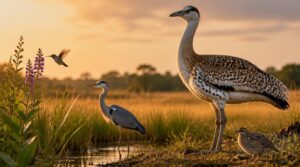
Size in birds spans a massive range, from hummingbirds barely 6 cm long to the great bustard stretching past 1.2 meters.
Wing loading and aspect ratio shape flight style, while body shape—compact, slender, or plump—reflects habitat and lifestyle.
Skeletal proportions and juvenile growth shifts further influence how a species looks, giving you real clues for quick, confident identification in the field.
Beak and Foot Types
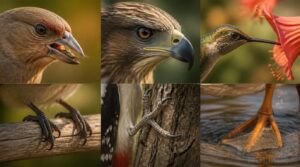
Beaks tell you everything about diet. Conical beaks crack seeds efficiently; hooked beaks tear flesh; nectar feeders show extreme elongation for probing flowers.
Feet matter too. Songbirds grip perches with anisodactyl toes, woodpeckers use zygodactyl feet for climbing, and ducks paddle with webbed toes—each shape solving a specific survival problem.
Colors and Markings
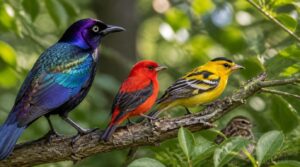
Color often finishes what beak shape starts. Pigment chemistry explains most of it: melanin builds black, brown, and gray tones, while carotenoids from diet produce reds and yellows. Structural iridescence adds shimmer without pigment—hence a grackle’s oil-slick sheen.
Camouflage strategies like countershading and disruptive markings hide birds, while mate selection favors bold patches and UV plumage. Pattern symmetry aids field identification and species recognition.
Songs and Calls
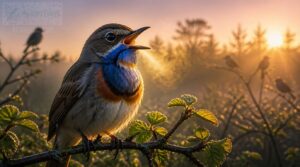
Sound often reveals what plumage hides. A male’s dawn song announces territorial ownership, sung fastest as rivals approach the boundary.
Courtship calls add trills and complexity—females favor elaborate repertoires. Alarm notes stay sharp and abrupt, warning flockmates of danger.
- Booming dawn choruses
- Flirtatious courtship trills
- Urgent alarm shrieks
- Learned regional dialects
- Vast song repertoires
Vocal learning lets songbirds perfect these sounds through practice, shaping true avian communication.
Behavior and Movement
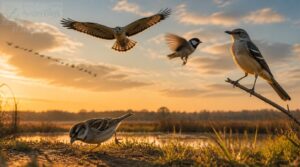
Watch how a bird moves and it’ll tell you what it is. Ground foragers hop and pause, pecking between steps, while perching species alternate quick hops with stillness.
Flight reveals more: soaring versus rapid flapping signals lifestyle. Social flocking, migration timing, and foraging bursts all round out identification—behavior is the final, living clue plumage and song can’t fully capture.
Behavior is the final, living clue that plumage and song can never fully capture
Frequently Asked Questions (FAQs)
What are different bird species called?
Each bird species carries a unique binomial name—genus plus species epithet, like Passer domesticus. Taxonomic authorities classify roughly 11,167 species across 40-44 avian orders, tracing evolutionary lineage back to theropod dinosaurs, using plumage, vocalizations, and genetics for identification.
Where do robins sleep at night in the winter?
Picture a huddle of tiny feathered blankets tucked into evergreen boughs—that’s your winter robin roost. They favor dense conifers and shrubs for thermal energy conservation, often joining communal roosting groups, sometimes using eaves or hedges in urban habitats for extra shelter.
What are the 20 names of birds?
Robin, sparrow, cardinal, blue jay, hawk, eagle, owl, falcon, duck, swan, goose, sandpiper, parrot, macaw, cockatiel, hummingbird, woodpecker, crow, raven, and heron — common bird names spanning backyard species to impressive raptors and exotic tropical varieties.
What are the most common bird types?
Common garden visitors like the Northern Cardinal, American Robin, and Blue Jay dominate backyard bird diversity.
These urban adapter species, alongside House Sparrows and Mourning Doves, represent the most familiar bird types across seasonal bird populations and regional bird variety nationwide.
What are the 8 classification of birds?
Traditionally, taxonomy grouped birds into eight classic orders, from Struthioniformes through Eurypygiformes. Modern DNA sequencing has since expanded this to roughly 40–44 orders, reflecting evolutionary lineage links and ongoing taxonomic authority debates among ornithologists worldwide.
What are some common bird species?
Your backyard feeder likely hosts the house sparrow, blue tit, and great tit—familiar garden bird sightings.
Add the robin’s orange breast, blackbird’s yellow eye-ring, and chaffinch’s pinkish flush, and you’ve got a solid start on local avian diversity and urban bird identification.
What are some bird species names?
Because "just call it a bird" won’t cut it in science — that’s like calling every car a "vehicle" and calling it a day. Latin nomenclature solves this: Falco peregrinus, Haliaeetus leucocephalus, Ara macao — precise, universal, unmistakable across every language.
How do birds communicate with each other?
Birds rely on vocalizations, courtship dances, and non-vocal percussion like wing rattles to communicate. Contact calls maintain flock togetherness, while urban noise pushes species to adjust pitch and timing, keeping avian courtship and territorial signals effective despite city clamor.
What economic impact does birdwatching generate annually?
Funny how a "quiet" hobby generates such loud numbers: $279 billion in economic output, 4 million jobs, and $90 billion in wages, all from birding gear spending, ecotourism job creation, and travel costs across the birdwatching industry.
How do migratory birds navigate long distances?
Your feathered travelers rely on celestial navigation, magnetic field sensing, and solar position cues together. They combine visual landmarks with an internal map, adjusting constantly for wind and weather, plotting precise routes across thousands of migratory miles.
Conclusion
A flash of wings at dawn, a curved beak catching sunlight, a lone call echoing across wetland reeds—these moments reveal what studying types of bird species truly offers. You gain a lens for reading feathers, feet, and flight patterns like a language.
Every sparrow in your yard and every raptor overhead now tells a story of adaptation. Keep watching, keep listening. The sky holds a breathtaking, living archive, and you now hold the key to reading it.
- https://birdsoftheworld.org/bow/news/2025-taxonomy-update
- https://frenchvintageprints.com/blogs/news/top-3-types-of-flightless-birds
- https://peckperk.com/blog/what-birds-can-t-fly-14-flightless-birds-you-should-know
- https://www.fieldmuseum.org/about/press/when-birds-lose-the-ability-to-fly-their-bodies-change-faster-than-their-feathers
- https://podcasts.apple.com/us/podcast/flightless-bird/id1763461729