This site is supported by our readers. We may earn a commission, at no cost to you, if you purchase through links.

You spot movement in the branches, but before you can raise your binoculars, the bird vanishes. You catch a flash of yellow, maybe a dark head, but that’s it. Without solid identification skills, moments like these leave you guessing instead of checking off a new species.
Learning how to identify different bird species transforms frustration into confidence. Size, shape, and plumage patterns form your foundation, but field marks—those small details like wing bars or eye rings—seal the deal.
Sound adds another dimension when leaves hide your target. With practice, you’ll move from uncertain guesses to quick, accurate IDs that make every outing more rewarding.
Table Of Contents
Key Takeaways
- You can identify birds by combining size, shape, plumage patterns, and unique field marks like wing bars or eye rings.
- Listening for songs and calls is essential, especially when dense foliage hides birds from view, and apps like Merlin or BirdNET can help train your ear.
- Quick field notes and sketches boost your confidence and accuracy, letting you capture details before the bird flies away.
- Using the right tools—binoculars, field guides, cameras, and spotting scopes—makes it easier to spot, document, and confirm bird species in any setting.
Essential Bird Identification Techniques for Beginners
Learning to identify birds doesn’t have to feel overwhelming. You just need a few core techniques that turn confusing field marks into clear answers.
Here’s what you should focus on when you’re starting out.
Using Size and Shape to Narrow Down Species Groups
Spotting an unfamiliar bird can feel overwhelming, but silhouette analysis helps you start strong. You’ll narrow species groups fast by comparing relative sizing against known birds—is it sparrow-sized or closer to a crow? Check proportional features like bill length and tail shape.
These group size markers work so well that automated ID systems rely on them, and you can master this bird identification technique with practice. Comparing a bird to familiar size references aids in quicker identification.
Observing Plumage Patterns and Field Marks
Once you’ve pinned down the size and shape, plumage patterns become your next detective tool. Look for specific field marks on anatomical zones—wing bars, eye rings, or throat patches. About 24% of bird species show mottled plumage, while barred or spotted patterns appear in roughly 23% of species globally. Birdwatchers often use these bright colored stripes to identify different species. Your field guide organizes these markers systematically, making identification clearer with each observation.
Taking Quick Field Notes and Sketches
After spotting those field marks, you’ll want to capture them fast—birds don’t wait around. Use shorthand symbols and quick sketches to lock in observation details before they fly off. A waterproof notebook keeps your notes safe in any weather.
About 52% of birders report higher confidence when they sketch plus take notes. Review these entries later to sharpen your bird ID skills.
How to Use a Field Guide Effectively
Once you’ve jotted down what you saw, open your field guide to the right section. Start with the quick reference pages grouped by shape or habitat—over 90% of guides organize this way.
Check range maps to confirm the bird belongs in your area. Compare illustrations showing male, female, and juvenile plumage side by side.
Bookmark pages of common local species to speed up future lookups.
Identifying Birds by Sound and Song

Learning to identify birds by sound opens up a whole new way to spot species you might never see. Songs and calls are unique to each bird, so training your ear can level up your skills fast.
Here’s how to start recognizing birds by what you hear instead of what you see.
Learning Species-specific Calls and Songs
Every bird species has its own acoustic signature. Song learning begins early in life and develops over time. You’ll notice regional dialects in many species, like how Chipping Sparrows in the east sing fewer, longer syllables than western birds.
Technology applications like BirdNET now identify over 3,000 species by sound alone. Start by focusing on common birds and their distinct calls.
Practicing Bird Identification by Ear
Auditory identification takes dedication, but you’ll improve faster with focused practice. Start with common local species, then branch out. Song memorization strengthens through repetition, and vocalization nuances become clearer over time.
Here’s your training plan:
- Use sound apps like Merlin Bird ID for instant feedback on bird songs and calls
- Take field notes describing pitch, rhythm, and tone patterns
- Try quiz training with spaced repetition to boost retention
- Practice identifying birds by ear daily, even for just 10 minutes
Using Sound When Foliage Obscures Visual Identification
When dense foliage blocks your view, identifying birds by sound becomes essential. Studies show foliage density cuts visual detectability by 40%, but bird calls and songs remain clear.
When foliage blocks your view, identifying birds by sound becomes essential—calls remain clear even when visual detectability drops by 40%
Audio identification accuracy reaches over 80% with practice, making it your best tool in forests and thick brush. Detection range limits matter less when you’re tuned into bird sounds.
Cross-modal integration helps you connect calls to species, even during temporal audio surveys when sightings fail.
Audio Resources and Practice Techniques
You can sharpen your bird song recognition using apps like Merlin, which hit 100% accuracy on common calls in testing. Audio learning efficacy jumps to 95% when you combine sound with visual clues.
Structured audio practice works—try identifying birds by sound using community audio libraries like BirdWeather. Automated detection tools such as BirdNET handle thousands of species, making bird identification faster and more reliable.
How to Identify Common Bird Species
Once you’ve learned the basics of bird identification, it’s time to put your skills to work on the birds you’ll see most often.
Your backyard and local parks are home to species that show up year after year, making them perfect for practice.
Let’s look at some common birds you’re likely to encounter and the features that set each one apart.
Northern Cardinal Identification Features
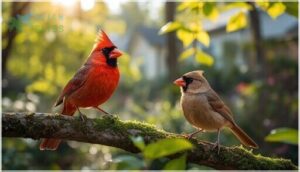
You can spot a Northern Cardinal by its crimson plumage and prominent crest. Males wear bright red feathers with a black mask, while females show pale brown with reddish tinges. Both measure around 8–9 inches with a thick seed-cracking bill.
Listen for clear whistled songs like “cheer, cheer, cheer.” Range expansion means you’ll find them in suburban gardens and woodland edges across eastern North America.
American Robin Characteristics
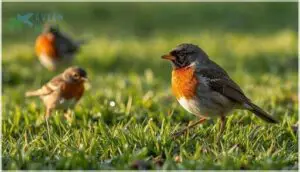
American Robins stand out with their brick-red breast and gray back, making bird identification straightforward for most observers. Males show deeper colors than females, while juveniles display spotted breasts. You’ll notice three key American Robin physical traits:
- Size: 8–11 inches long, the largest North American thrush
- Foraging behavior: Running and stopping on lawns to hunt earthworms
- Vocalizations: Over ten distinct calls beyond their familiar song
Population trends vary regionally across their vast range.
White-breasted Nuthatch Recognition
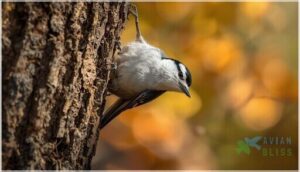
You’ll recognize the White-breasted Nuthatch by its upside-down foraging behavior—it moves headfirst down tree trunks, something most bird species can’t do. Look for a black crown on males (gray on females), white face and breast, and blue-gray wings.
Their nasal “yank, yank, yank” vocalizations analysis helps with bird identification when plumage variations aren’t visible. These birds often travel in pairs, making social interactions easy to spot.
Red-headed Woodpecker Field Marks
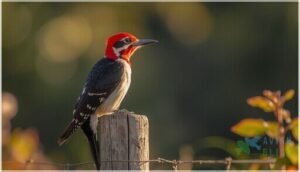
While nuthatches climb down trunks, you’ll notice the Red-headed Woodpecker perched on dead branches or fence posts. Adult plumage is striking—the entire head glows crimson red, paired with bold black wings featuring white wing patches that flash during flight. The body stays pure white underneath.
Here’s what sets this species apart for bird identification:
- Both sexes look identical—sexing challenges arise since males and females share the same crimson head
- Juvenile markings show brown, mottled heads until their first molt transforms them
- Large white wing panels create unmistakable contrast against dark backgrounds
- No streaking or barring disrupts the clean white breast
- Conservation status is endangered in Canada—populations declined 20% over twelve years
Using field guides, compare the uniformly red adult head to other woodpeckers. Bird plumage identification becomes easier when you note that Red-headed Woodpeckers are the only eastern species with completely crimson heads. Bird identification techniques improve when you watch for their habit of storing food under bark—only four North American woodpeckers do this.
Dark-eyed Junco Variations
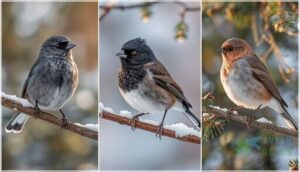
Where woodpeckers perch on posts, Dark-eyed Juncos hop beneath feeders. Bird identification gets tricky—these sparrow-sized birds show five subspecies groups with dramatic plumage differences across habitat ranges.
Slate-colored types wear uniform gray, while Oregon Juncos flash black heads and brown backs. Pink-sided birds sport rosy flanks.
Despite population trends showing 40% declines, you’ll still spot these vocal variations hopping through winter flocks nationwide.
Common Backyard Feeder Birds

Beyond species like juncos, you’ll see dozens of common bird species visiting feeders year-round. Northern Cardinals flash crimson year-round, while Blue Jays show bold blue crests. Understanding feeder bird behavior helps with backyard bird identification.
Over 52 million people attract feeder birds with sunflower seeds and suet. Regional bird variations affect which species appear—eastern feeders host more woodpeckers than western ones.
Key backyard identification points:
- Cardinals and chickadees stay year-round; grosbeaks visit seasonally
- Sunflower seeds attract finches; orioles prefer fruit and jelly
- Ground feeders consume millet scattered below platforms
- Seasonal bird presence shifts—sparrows increase winter visits when natural food disappears
Top 6 Tools for Bird Identification
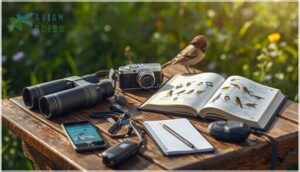
You can’t identify birds without the right gear in hand. The tools you choose make the difference between a fleeting glance and a solid ID that sticks.
Here are six essentials that’ll help you see more, capture details, and confirm what you’re looking at in the field.
1. Nikon Prostaff 3S 8×42 Binoculars
 View On Amazon
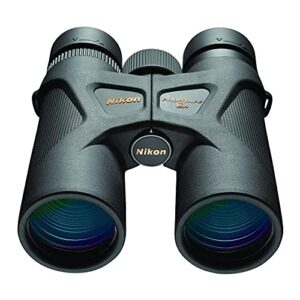
You can’t spot field marks if you can’t see the bird clearly. The Nikon Prostaff 3S 8×42 binoculars deliver solid optical performance for bird identification at an affordable $140 price point.
These binoculars offer multi-coated lenses and a close focus down to 9.8 feet, perfect for observing feeder birds or warblers. Weather resistance and ergonomic features like lightweight construction make them practical for birdwatching hikes.
Their market position as a reliable budget option suits beginners building their bird identification guide toolkit.
Best For: Beginner and intermediate birders who want clear optics and lightweight design for day hikes and backyard observation without breaking the bank.
- Multi-coated lenses and close focus to 9.8 feet make it easy to spot field marks on small songbirds at feeders or in trees.
- Lightweight at 19.9 oz and weatherproof construction handle long hikes and changing conditions without wearing you out.
- Excellent value at $140 with solid build quality and performance that rivals pricier models in good lighting.
- Dimmer in low light compared to premium binoculars, so dawn and dusk birding isn’t as sharp.
- Edge distortion creates a mild fishbowl effect when scanning quickly for moving birds.
- Basic accessories and no tripod mount limit upgrades for more serious field use.
2. Sibley Guide to Birds Second Edition

The Sibley Guide to Birds Second Edition stands as the most thorough bird identification guide for North America, covering 923 species with over 7,000 illustrations. Species coverage expanded by 114 birds since the first edition, while voice descriptions help when visual identification proves difficult.
You’ll find detailed range maps, taxonomic updates aligned with current scientific standards, and improved artwork accuracy throughout.
App integration lets you access this bird identification resource digitally, making it invaluable whether you’re tackling bird identification challenges at home or in the field.
Best For: Birders of all skill levels who want the most comprehensive visual reference for identifying North American birds, whether studying at home or planning field trips.
- Covers 923 species with over 7,000 illustrations showing birds in flight and perched, plus seasonal and age variations for accurate identification.
- Includes detailed voice descriptions and revised range maps for every species, making it easier to identify birds by sound and location.
- Updated taxonomy and expanded coverage of rare species keep you current with the latest ornithological standards.
- At 3 pounds and nearly 10 inches tall, it’s too heavy and bulky to comfortably carry during field outings.
- Small text font makes it difficult to read quickly, especially in outdoor lighting conditions.
- Large size and weight mean you’ll likely need to leave it at home and rely on the app version for actual fieldwork.
3. Panasonic Lumix 4K Zoom Digital Camera
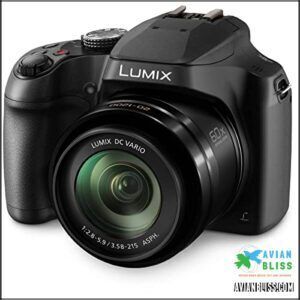
You can capture distant birds with the Panasonic Lumix FZ80D’s impressive 60x optical zoom (20-1200mm), making it perfect for bird photography without getting too close. The 4K video recording lets you extract sharp 8-megapixel stills from footage, which helps when birds won’t stay still.
User reviews highlight its clarity at full zoom in good lighting, while the optical image stabilizer keeps handheld shots sharp.
With Panasonic holding 3.4% market share in 2024 and the FZ80D priced under $400, it’s an affordable tool for photo ID and identifying birds by photo in the field.
Best For: Birdwatchers and wildlife enthusiasts who need powerful zoom for distant subjects without spending more than $400.
- 60x optical zoom (20-1200mm) lets you photograph birds from far away without disturbing them, and the optical image stabilizer keeps shots sharp even at full zoom.
- 4K video recording with the ability to pull 8-megapixel stills from footage gives you multiple chances to capture fast-moving birds in action.
- Priced under $400, it’s one of the most affordable bridge cameras with this zoom range, making it accessible for beginners and hobbyists.
- Performance drops significantly in low light conditions, limiting early morning or evening birding sessions.
- The smaller sensor offers limited creative control over depth of field compared to DSLRs or mirrorless cameras.
- Battery life can be a constraint during all-day outdoor trips, and some users find the menu system confusing to navigate.
4. Celestron Ultima 80mm Angled Spotting Scope
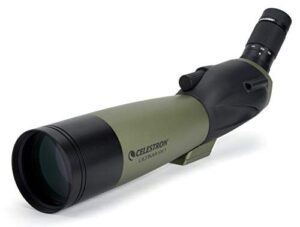
The Celestron Ultima 80mm offers serious optical performance with its 80mm objective lens and 20-60x zoom eyepiece, capturing sharp details for bird identification at distances where binoculars can’t reach. Its 45° angled design ensures comfort during extended birdwatching sessions, while the waterproof, nitrogen-purged body withstands tough weather conditions.
You’ll appreciate the digiscoping adaptability, allowing you to attach your smartphone or DSLR to document species for later review. Market feedback confirms its build quality, making it a practical bird identification resource at $269.95.
Target users include beginners wanting clearer field marks and intermediate birders needing magnification for distant raptors.
Best For: Beginner to intermediate birders who need powerful magnification for identifying distant species and want the flexibility to capture photos through their smartphone or DSLR.
- The 80mm objective lens with 20-60x zoom delivers sharp, bright images that reveal field marks clearly at distances where binoculars fall short, making it easier to identify raptors and other distant birds.
- Waterproof and nitrogen-purged construction means you can use it confidently in rain, fog, or humidity without worrying about internal fogging or damage to the optics.
- Comes with smartphone and DSLR adapters for digiscoping, letting you document rare sightings and review species details later without needing separate expensive camera equipment.
- Image quality degrades noticeably above 40x magnification due to chromatic aberration, which shows up as blue fringing around high-contrast edges and can make identification harder at maximum zoom.
- The zoom mechanism can be finicky at higher magnifications, and the eyepiece may unscrew accidentally while you’re trying to focus, interrupting your observation.
- The included soft carrying case and some accessories feel cheaply made and may not hold up well to regular field use or provide adequate protection during transport.
5. Sony Cyber Shot RX10 IV Camera
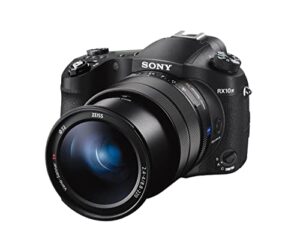
When bird identification demands both reach and rapid autofocus capabilities, the Sony Cyber-Shot RX10 IV delivers with its 24-600mm zoom versatility and 0.03-second focus lock across 315 phase-detection points. You’ll shoot 24 frames per second to document fleeting field marks, while the 20.1-megapixel sensor ensures image quality for precise photo ID review later.
Its durability review highlights weather resistance and 400-shot battery life, making it reliable for fieldwork.
Birding features like Eye AF and 4K video support both bird photography and integration with bird identification apps for your camera roll analysis.
Best For: Birders and wildlife photographers who want a single camera that handles everything from close-up field marks to distant subjects without changing lenses.
- Lightning-fast 0.03-second autofocus with 24 fps burst shooting means you won’t miss quick movements or sudden takeoffs.
- The 24-600mm zoom range covers wide habitat shots and tight close-ups, eliminating the need to carry multiple lenses in the field.
- Weather-resistant build and 400-shot battery life keep you shooting through long birding sessions in varying conditions.
- The smaller 1″ sensor struggles in low light compared to larger DSLR sensors, limiting performance at dawn, dusk, or in dense forest shade.
- Battery life of 400 shots may fall short during all-day birding outings or trips where charging isn’t convenient.
- The camera’s advanced features and settings can feel overwhelming for beginners still learning the basics of bird photography.
6. Vortex Viper HD Angled Spotting Scope
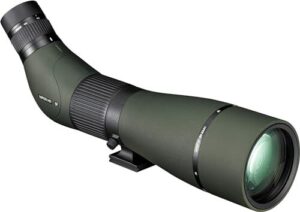
When target identification at extreme distances matters most, the Vortex Viper HD 20-60×85 Angled Spotting Scope gives you premium optical performance without the premium price tag. Its 85mm objective lens and HD glass deliver sharp color fidelity for detecting subtle field marks on distant raptors.
The angled design improves viewing comfort during extended observation sessions, while ArmorTek coatings guarantee rugged build quality in rain or snow.
Bird identification resources become more valuable when paired with this scope’s clarity, and Vortex’s VIP warranty coverage protects your investment unconditionally.
Best For: Hunters, birdwatchers, and long-range shooters who need reliable optical performance at extreme distances without spending top-tier money.
- 85mm objective lens with HD glass delivers sharp, color-accurate images even in low light or at maximum 60x magnification.
- Angled design and adjustable eye relief make extended viewing sessions comfortable, especially when mounted low on a tripod.
- ArmorTek coatings and argon purging create a waterproof, fogproof scope that handles rain, snow, and temperature swings with VIP lifetime warranty backing.
- Narrow field of view on the zoom eyepiece limits how much you can see at higher magnifications compared to fixed-power scopes.
- 76.6 oz weight makes it too heavy for backpacking or long hikes without a solid tripod setup.
- Heat waves and atmospheric distortion can still affect image quality at extreme ranges, regardless of optical quality.
Advanced Bird Identification Challenges

Once you’ve mastered the basics, bird identification gets trickier. You’ll encounter situations where even experienced birders pause and second-guess themselves.
Let’s look at six common challenges that push your skills further and how to tackle them with confidence.
Identifying Raptors in Flight
When you spot raptors overhead, focus on their silhouette and wing posture first. Eagles hold long, rectangular wings while soaring. Hawks show more rounded profiles. Watch how they glide—some species create an “M” shape, others fly with wings in a dihedral.
Plumage variations help too. Light-morph Ferruginous Hawks display striking white undersides.
Migration routes concentrate birds along ridges, giving you perfect identification practice.
Distinguishing Hawks From Falcons
Once you’ve gotten comfortable identifying raptors overhead, you’ll want to separate hawks from falcons. Look at wing shape first—hawks show broad, rounded wings while falcons display long, pointed ones. Flight patterns reveal more: hawks soar lazily on thermals, but falcons beat their wings rapidly during high-speed pursuits.
- Hawks have broad tails; falcons sport narrow, straight-edged tails
- Falcons possess a distinctive beak notch for killing prey
- Size comparison helps, though ranges overlap between 8-30 inches
Separating Look-alike Species
You’ll run into situations where two species look nearly identical. Visual identification fails about 15% of the time with look-alikes, so you need multiple clues.
Listen for vocal differences—calls separate species like Eastern and Western Meadowlarks despite similar plumage patterns. Check habitat overlap and behavioral cues, too.
Some flycatchers require vocal analysis combined with shape details for reliable species identification.
Understanding Transitional Plumage
Beyond look-alikes, you’ll face another challenge: birds that don’t match field guide photos because they’re molting. Transitional plumage happens when birds replace old feathers, creating patchy or uneven appearances that lead to identification errors.
- American Goldfinches shift from bright yellow to drab olive between August and September
- Male ducks develop camouflage “eclipse” plumage after breeding season
- Young eagles take up to 5 years to show full adult coloration
- Seasonal variation causes adult males to temporarily resemble females or juveniles
Using Habitat Clues for Identification
When you’re stuck between two similar species, habitat specialization often breaks the tie. Scott’s Orioles prefer deserts while Evening Grosbeaks nest in pine-oak forests, even though their plumage looks similar.
Detection patterns change by location too—insectivorous birds appear most often at midday in farmland but afternoons in grasslands. Your field guide becomes more accurate when you match birds to their preferred environments.
Leveraging Technology and Birding Apps
Modern bird identification software transforms how you confirm species in the field. The Merlin app uses AI identification accuracy near 100% for common birds, drawing from community photo sharing across over 10,000 species.
App data quality aids conservation impact through platforms like eBird, where your sightings join a billion observations.
Download regional packs for global species coverage, and this bird watching app works offline anywhere.
Frequently Asked Questions (FAQs)
What time of year is best for birding?
Spring and fall offer peak migration times with triple the diversity you’ll see in summer. May brings the most species, but early mornings any season reward you with active birds and clear identification opportunities.
How do weather conditions affect bird identification?
Weather can make or break your birding day. Rain visibility drops, wind effects alter flight patterns, fog disorientation confuses migrants, and temperature influence shifts bird behavior.
Storm activity changes everything you expect to see.
What ethical practices should birders follow while observing?
You should minimize disturbance by keeping distance and moving quietly, respect property boundaries, and follow community standards.
Prioritize habitat conservation, improve safety for wildlife and people, and observe bird behavior without interfering—supporting birdwatching and bird conservation for everyone.
How can I identify birds in poor lighting?
When color fades into shadow, silhouette recognition and behavioral clues step up. Listen for bird calls—acoustic identification shines when vision fails. Thermal imaging and enhanced optics also help, weaving together bird identification tips for bird species identification in poor lighting.
What are the most common bird identification mistakes?
Visual misidentification tops the list—think confusing starlings with blackbirds. Auditory errors crop up when similar songs fool you.
Cognitive biases and statistical fallacies lead to rare bird overconfidence. Methodological limits also skew bird species identification accuracy.
Conclusion
Silent shadows, sudden songs, and subtle shapes—each sighting sharpens your skill. With patience and practice, you’ll turn fleeting flashes into firm identifications.
Field marks, melodies, and movement become your map, guiding you through tangled branches and busy feeders. When you know how to identify different bird species, every walk becomes a window into nature’s secrets.
Let your curiosity lead, your tools support, and your observations grow. Mastery isn’t a mystery; it’s just a matter of mindful attention.
- https://betterwithbirds.com/blogs/bird-identification/understanding-field-guides
- https://nrm.dfg.ca.gov/FileHandler.ashx?DocumentID=193712
- https://www.usgs.gov/centers/eesc/science/north-american-breeding-bird-survey
- http://ebird.org/
- https://support.ebird.org/en/support/solutions/articles/48000966225-merlin-tips-and-tricks