This site is supported by our readers. We may earn a commission, at no cost to you, if you purchase through links.

Step into a field at sunrise, and you’ll hear it: a hidden world of feathers and song, each note echoing a story of habitat. In an old forest, the sharp cry of a woodpecker signals ancient trees; a heron’s silhouette glides silently above a marsh slick with morning light.
Where you stand means everything—habitat and geography shape which birds cross your path, from the wary sparrows in city lots to sandpipers patrolling lonely shorelines. Identifying birds by habitat and location unlocks patterns that make every outing richer, grounding your search in the living geography all around you.
Table Of Contents
Key Takeaways
- Identifying birds by habitat and location quickly narrows down which species you’re likely to spot, as environments like forests, wetlands, grasslands, and cities each host distinct communities.
- Noticing features like size, shape, color patterns, behavior, and song gives you powerful clues for telling birds apart, especially when paired with local knowledge and seasonal timing.
- Shifts in climate, land use, and migration mean bird populations and ranges are constantly changing, so staying alert to ecological changes helps you track new arrivals or losses.
- The best birders lean on useful tools—from binoculars and field guides to community science apps like eBird—to sharpen their skills, connect with others, and make their observations count.
Key Bird Habitats and Their Species
Each bird habitat hosts its own group of signature species and unique surprises. Understanding these environments sets the stage for spotting birds more confidently. Here’s what you need to know about the main types you’ll encounter.
Forests – Deciduous, Coniferous, and Mixed

In forest habitats, you’ll quickly notice how forest layers shape bird flocks and species distribution. For birding by habitat, pay attention to:
- Dense canopy for warblers and nuthatches
- Understory thickets favored by thrushes
- Old-growth snags hosting woodpeckers
- Mixed stands that increase diversity
Understanding how vegetation density impacts avian communities is important for effective conservation. Conservation needs shift as habitat structure changes, guiding solid forest bird identification strategies.
Wetlands – Freshwater and Saltwater

Wetland habitats—both freshwater and saltwater—support striking Wetland Bird Diversity, from herons and rails to shorebirds and gulls. You’ll notice bird habits change with habitat location: egrets prefer marsh edges, while sandpipers probe tidal flats.
Wetlands are crucial as staging sites for migratory birds. Wetland species rely on these areas for migration patterns and breeding, making Conservation Status and Ecological Roles central to birding by habitat identification.
Grasslands and Prairies
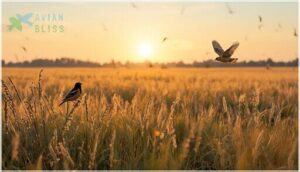
Stepping onto open grassland habitats, you quickly sense how habitat location shapes bird life. Grassland birds—from Bobolinks to Sprague’s Pipits—face steep species decline, driven by habitat fragmentation and changing fire management.
Tracking migration patterns sharpens your birding by habitat skills, while active conservation efforts remain essential for grassland habitat identification and long-term survival.
Coastal and Shoreline Environments

After the open sweep of grasslands, coastal habitats demand a sharper eye. You’ll spot seabirds and shorebirds adapting to shifting tides and winds, all shaped by coastal ecosystem dynamics.
Population trends show rapid change—habitat loss and human disturbance test species resilience daily.
Watch for key coastal identification clues during spring migration; active conservation efforts keep these species within reach.
Urban, Suburban, and Farmland Areas

City life breeds experts in adaptation—urban habitats house a patchwork of resilient birds, though urban bird decline signals shifting populations. In contrast, suburban environments nurture higher species diversity, boosted by greenspace quality effects and connected landscapes.
Farmland habitats tell a different story: habitat loss and trait selection have driven steep declines, reshaping bird identification challenges depending on habitat location and species flexibility.
Mountain and Desert Habitats

At the intersection of altitude and aridity, mountain and desert habitats challenge your bird habitat identification skills. Here, you’ll spot dramatic Elevational Diversity—species turnover spikes with each climb. Desert Adaptations mean birds shift routines and morphologies as climates intensify. Migration Patterns further scramble the mix, rewarding those who track:
- Habitat Heterogeneity along mountain slopes
- Climate Impacts on local occupancy
- Birding by habitat transitions
Essential Bird Identification Techniques

For identifying birds, paying attention to a few key features will take you far. Some clues are easier to spot than others, but they all add up to a clear picture.
Here’s what you’ll want to watch for next.
Using Size and Shape as Identification Clues
Ever wonder how birders spot species at a glance? It all comes down to using relative size, body proportions, and silhouette morphology as sharp bird identification techniques. Analyzing the shape and behavior of a bird—right down to statistical trends—lets you read habitat clues with ease, making location and size your go-to field guides.
| Identification Cue | How It Helps in the Field |
|---|---|
| Relative Size | Narrows species by up to 80% |
| Body Proportions | Distinguishes families (e.g., bill/head, leg length) |
| Silhouette Morphology | Separates cryptic species at distance |
| Shape Behavior | Predicts feeding and movement style |
Recognizing Color Patterns and Markings
Spotting a bird’s true identity often hinges on decoding subtle color patterns and field marks. Plumage coloration tells a sharp story—bright males and muted females showcase striking sexual dimorphism, while seasonal changes can completely alter a bird’s look.
Learn to read the language of wingbars, eyerings, and speculum patches for fast, accurate bird identification anywhere location or habitat clues lead you.
Analyzing Bird Behavior and Movement
Watch birds long enough and you’ll see every wingbeat tells a story—are they flocking in tight formation, tracing ancient migration routes, or staking out territory? Careful bird behavior analysis, especially movement patterns, gives your identification skills a boost. Take note of:
- Flocking Dynamics and Foraging Strategies
- Patterns in Territoriality and Urban Movement
- Subtle clues in migration routes and foraging success
Identifying Birds by Song and Calls
Listening for birds is like decoding nature’s secret language—if you tune in, their avian vocalizations reveal more than just presence. Modern field recording methods, BirdNET performance, and strong song database usage transform bird song identification accuracy, letting you leverage acoustic feature analysis and auditory identification methods to pinpoint species confidently—even when nothing but bird sounds reaches your ears.
Birdsong is nature’s secret code—use careful listening and modern tools to unlock species identities when sightings aren’t enough
| Technique | What to Note | Real-World Benefit |
|---|---|---|
| Acoustic Feature Analysis | Pitch, duration, syllables | Boosts species identification |
| BirdNET Performance | Model accuracy, recall rates | Confirms rare or hidden birds |
| Song Database Usage | Species range, call variety | Guides in unfamiliar territory |
Considering Seasonal and Regional Variations
Once you’ve tuned your ear to local songs, it’s time to look at the bigger picture—birds are constantly on the move. Seasonal habitat use, unpredictable migration timing shifts, and pronounced regional species turnover mean identification requires flexibility. Watch for these telltale signs:
- Sudden flock arrival
- Shifted song patterns
- Unexpected habitat use
- Unseasonal presence
- Weather-driven movement
Leveraging Location and Range for Bird ID

Knowing where and when to look for birds can be just as important as noticing their shape or color. Your location, the time of year, and even recent weather shape which species you’ll see.
Here’s how you can use range and place to narrow down your choices.
Understanding Migration Patterns and Hotspots
How do birds know where to move as seasons change? Migration Flyways—like the Atlantic or Pacific—guide millions each year across vast distances. These patterns create Global Hotspots, with seasonal timing making certain areas pulse with life.
Tracking migratory patterns and flyways with eBird reveals species surges, while Population Threats reshape traditional routes, adding urgency to each trip.
Noting State and Regional Bird Distributions
As you track migration surges, keep an eye on state bird percentages and regional diversity patterns—a species might peak in Colorado but barely register elsewhere. eBird’s occurrence data resolution (about 3×3 km) and abundance trend mapping let you compare state-level breeding populations. Use these population monitoring guides to reveal species distribution patterns and shifts in geographic range, week by week.
- Check state bird percentages during breeding and migration
- Compare regional diversity patterns for surprise hotspots
- Use occurrence data resolution for pinpoint mapping
- Study abundance trend mapping to spot increases or declines
- Rely on population monitoring guides for distribution clarity
Factoring in Climate and Habitat Changes
When you spot strange visitors or notice fewer regulars, you’re likely witnessing the effects of climate change, habitat loss, or shifting migration timing at work. Ecological barriers can funnel or stall range shifts, sometimes pushing local population trends off-course. Every habitat—forest edge or marsh—reveals hints about avian ecology and identification within famously active ecosystems.
| Migration Timing | Range Shifts |
|---|---|
| Habitat Loss | Population Trends |
| Ecological Barriers | Climate Change |
Top Birding Tools for Habitat-Based Identification

Choosing the right tools makes a world of difference when you’re tracking birds by habitat. Good gear will help you spot subtle field marks and catch quick behaviors, no matter where you’re.
Here’s a quick look at some trusted options to keep in your birding kit.
1. Nikon Prostaff 3S 8×42 Binoculars
 View On Amazon
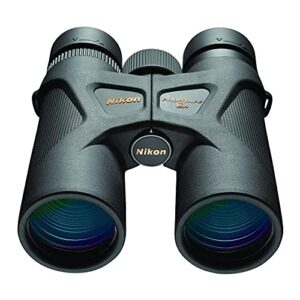
Curious how Optical Performance translates to a better birding experience? The Nikon Prostaff 3S 8×42 binoculars deliver crisp, bright views—even at dawn or dusk—making bird identification in varied habitats surprisingly easy.
Their lightweight Design Features and waterproof construction mean you can venture anywhere, from wetlands to open fields, without worry.
While not perfect in low light, these binoculars hold a strong Market Position thanks to their comfort, value, and lasting durability, making them a smart choice for both new and seasoned birders.
Best For: Birdwatchers and nature lovers who want lightweight, easy-to-use binoculars that deliver sharp, bright images for everyday and all-around outdoor use.
- Multilayer-coated lenses and silver-alloy prisms give bright, clear views, even in tricky light.
- Comfortable and light design, with waterproof and fogproof features for use in any weather.
- Wide field of view and close focus distance make it easy to spot and follow birds up close or far away.
- Not as bright or sharp in low light compared to higher-end models.
- Eyepiece and lens caps can be fussy and may not stay attached well.
- No tripod port and may need a better strap for extended field use.
2. Sibley Guide to Birds Second Edition

No bookshelf is complete without the Sibley Guide to Birds Second Edition. Its guide comprehensiveness is unparalleled, with over 7,000 illustrations and expanded range updates that track subtle shifts in bird habitats.
Each painting captures key field marks, supporting sharp bird identification at a glance. Taxonomic accuracy shines throughout, reflecting the latest ornithological research.
Usability enhancements—like bigger maps and side-by-side species comparisons—turn this identification guide into a true field companion, no matter where your birding adventures take you.
Best For: Birders of all experience levels who want an in-depth, visually rich resource for identifying and learning about North American birds.
- Exceptionally comprehensive, with over 7,000 detailed illustrations and updated range maps.
- Expanded, authoritative information on habitat, vocalizations, and identification for each species.
- Enhanced usability features like larger illustrations and useful side-by-side comparisons.
- Large size and weight make it difficult to carry comfortably in the field.
- Small font size may be challenging for some readers.
- Not ideal for those seeking a compact or pocket-sized bird guide.
3. Panasonic Lumix 4K Zoom Camera

When your birding journey demands crisp documentation and versatility, the Panasonic Lumix 4K Zoom Camera stands out as trusted birding equipment. With 4K video, a powerful optical zoom, and a responsive autofocus system, you’ll capture distant species in sharp detail—even as they dart through varied habitat locations.
Its burst shooting keeps pace with rapid movements, while practical field adaptability ensures reliable handling from wetlands to woodlands.
Paired with digital apps, this camera turns bird identification into an easy, location-aware experience.
Best For: Birdwatchers, outdoor enthusiasts, and casual photographers who want to capture wildlife and distant subjects with ease and high zoom power.
- Impressive 60x optical zoom lets you photograph birds and wildlife from far away.
- 4K video and burst modes are great for catching fast action and fleeting moments.
- Touchscreen controls and Wi-Fi make it easy to share and manage your photos on the go.
- Image quality in low light isn’t the best due to the small sensor size.
- Fixed LCD screen limits creative shooting angles.
- Interface can be overwhelming for beginners at first.
4. Celestron Ultima 80mm Angled Spotting Scope
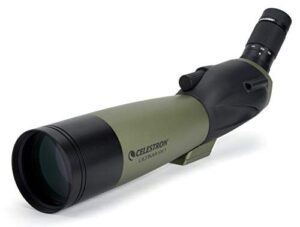
Need to pull distant hawks out of a hazy sky or pinpoint a warbler’s markings across a marsh? The Celestron Ultima 80mm Angled Spotting Scope is your step up from binoculars, with optical performance that shines in low light and a wide field of view that helps you scan new habitat locations.
Its sturdy build quality stands up to real-world field use, and the scope’s digiscoping capabilities are a practical bridge to digital documentation—for an affordability factor that lets you focus on your bird identification techniques.
Best For: Outdoor enthusiasts and birdwatchers who want sharp, bright views of distant wildlife without breaking the bank.
- Stands out in low light with strong brightness and clarity, making it easy to spot birds and wildlife even at dusk.
- Durable, waterproof, and easy to handle in the field, with a comfortable angled eyepiece and soft carrying case.
- Supports digiscoping with cameras or smartphones, so you can capture and share what you see.
- Image gets less sharp and a bit dim above 50x zoom, especially at the maximum magnification.
- Fairly bulky and heavy, so you’ll need a steady tripod and might not want to hike long distances with it.
- Some chromatic aberration and minor edge vignetting at higher magnifications, especially if you wear glasses.
5. Sony Cyber Shot RX10 IV Camera

When a distant warbler blurs against the edge of a marsh or a falcon darts along a ridgeline, the Sony Cyber Shot RX10 IV Camera changes the game. Its powerful Camera Zoom (up to 600mm) and lightning-fast Autofocus Speed mean you’ll catch more details in habitat locations where birds rarely sit still.
Field Usability is high, blending 4K Video Capabilities with reliable controls. It’s no wonder more birders are adopting this hybrid tool to improve both documentation and identification in any location.
Best For: Birdwatchers and outdoor photographers who want all-in-one reach, speed, and video versatility without hauling a full DSLR kit.
- 25x optical zoom (24-600mm) brings distant birds into sharp view, great for field observation and photography.
- Ultra-fast autofocus (0.03 sec, 315 points) and 24 fps burst shooting make it easy to capture fast, unpredictable wildlife.
- 4K video and super slow motion keep quality high whether you’re filming rare birds or replaying behavior in detail.
- Limited low-light performance due to its 1″ sensor, so dusk and shadow shots can be tricky.
- Battery life is decent but may run short during all-day field sessions; a backup battery is wise.
- Manual controls and settings take time to master, posing a challenge for beginners.
6. Vortex Optics Viper HD Spotting Scope
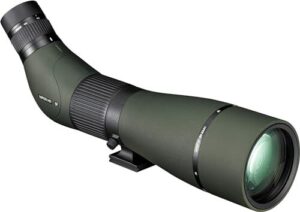
Looking for unmatched clarity to set your sightings apart? The Vortex Optics Viper HD Spotting Scope brings optical performance that turns distant details crisp, even in dense wetlands or windswept prairies.
With a wide field of view and build quality that rivals top binoculars, this birding equipment isn’t just rugged—it’s adaptable in forests, marshes, or hilltops.
Vortex’s standing in the market reflects why birders who care about habitat location and birding precision choose gear that enhances sophisticated bird identification techniques in all conditions.
Best For: Dedicated birders and wildlife enthusiasts who want top-tier image quality and reliable performance in challenging outdoor conditions.
- Vivid, high-definition images thanks to premium HD glass and XR coatings
- Durable, fully waterproof and fogproof build with protective Armortek lens coating
- Wide zoom range and precise focus for versatile, comfortable use in varied habitats
- Heavier design makes it less ideal for backpacking or carrying long distances
- Higher magnification can reduce field of view and image quality at the extreme end
- Requires a solid tripod and some learning curve to get the best results
Improving Skills Through Practice and Community

Sharpening your bird identification skills takes more than just reading guides—it’s about getting involved and staying curious. Practice and connection with other birders make all the difference.
Here’s how you can start building those skills and joining the larger birding community.
Participating in Citizen Science Projects
Citizen Science Projects like eBird turn every sighting and checklist into a thread in the larger tapestry of bird distribution knowledge. You don’t just submit data—you sharpen your own skills, contribute to project impact, and fuel conservation benefits.
Plus, community engagement means your efforts help raise data quality far beyond what one researcher—or even a whole team—could achieve alone.
Practicing With Visual and Auditory Guides
Sharpening your bird identification skills often comes down to hands-on repetition—pairing visual cue accuracy with auditory learning modules. Combined cue methods outperform single-sense approaches, revealing more about each bird’s behavior and habitat location.
Trends show solid gains: with practice, measurable outcomes include faster recognition, fewer mistakes, and a keener ability to spot local or migratory bird species wherever you roam.
Submitting and Reviewing Sightings on EBird
Once you’re comfortable with sight recognition and calls, put those skills to work by submitting sightings on eBird. Every checklist submission—big day or quiet morning—triggers automated filters and Volunteer Reviewers, combining quality control with community engagement.
This powerful review process ensures data quality, making eBird’s global resource even more powerful with each observation you share.
Joining Local Birding Groups and Events
You don’t have to bird alone. Group birding benefits you in ways solo outings can’t—think real-time skill-sharing, conservation involvement, and the energy of community building.
Event participation tips? Show up early, listen more than you talk, and ask about local species.
These gatherings sharpen your bird identification and help you spot birds in fresh habitat locations you might otherwise overlook.
Tracking Personal Progress and Observations
Every serious birder benefits from tracking their observations carefully. With eBird checklists and observation metrics, you turn routine sightings into long-term data, revealing meaningful participation patterns over time.
App-based trends—quick digital training, smooth submissions, and eBirding tools—make progress tracking second nature, allowing you to review, filter, and even compare checklist submissions for skill growth and deeper engagement.
Frequently Asked Questions (FAQs)
How do weather changes affect bird presence locally?
Temperature impacts and precipitation effects can shift which birds you see locally, while wind influence and extreme events, like storms, spark seasonal changes in bird presence, migration patterns, and even force climate adaptation right outside your window.
What common mistakes lead to misidentifying birds?
If you’ve ever mistaken a mailbox for a rare warbler, you know the sting of expectation bias.
Overreliance on color pattern, misinterpreting vocalizations, and ignoring habitat or location all muddle bird species identification, regardless of experience.
How can lighting impact bird color perception?
Lighting dramatically shifts color patterns through habitat light variance and artificial light effects. Rearing condition impact and iridescent feather physics add complexity, making visual identification and interpretation of plumage patterns essential for accurate bird identification in changing environments.
Are there apps for identifying birds from photos?
Yes, digital bird identification apps like Merlin Bird ID let you snap a photo for instant species identification. App accuracy depends on photo quality; most cover thousands of species, follow market trends, and feed global citizen science efforts.
When is the best time of day for birding?
Picture the world waking with the dawn chorus—this is Best Birding Time. Dawn and dusk reveal rich behavior patterns, minimizing midday lulls.
Seasonal shifts and weather impacts influence evening peaks, so align your outings for the fullest habitat location experience.
Conclusion
One day soon, the forest’s concert may change—habitats shift, new calls mingle with old. By honing your skills in identifying birds by habitat and location, you’ll witness each species as well as the subtle dialogue of geography and time.
Familiar trees, distant marshes, and backyard shrubs become keys to unlocking avian stories that might otherwise go unheard. Stay attentive, keep learning; the landscape will always offer new voices, if you know how—and where—to listen.