This site is supported by our readers. We may earn a commission, at no cost to you, if you purchase through links.
Squirrels spend nearly half their daylight hours at bird feeders—not snacking, but caching seeds for later.
That’s not a casual visitor.
That’s a full-time tenant.
Rats follow at night, chewing through plastic ports in days.
Raccoons show up after dark and simply rip lightweight feeders apart.
Most bird feeders aren’t designed to stop any of them.
The good news: the right feeder materials, seed choices, and placement rules can shut pests out without making things harder for the birds you actually want.
Here’s what works.
Table Of Contents
- Key Takeaways
- Why Pests Target Bird Feeders
- Feeder Designs That Block Pests
- Best Seeds for Fewer Pests
- Placement Rules That Reduce Access
- Maintenance Habits That Prevent Infestations
- Top 6 Bird Feeders That Deter Pests
- Buying Guide for Pest-Deterring Feeders
- Frequently Asked Questions (FAQs)
- Why put a potato in your bird feeder?
- Why should you sprinkle coffee grounds around your bird feeder?
- What kind of bird food does not attract rodents?
- How do weather conditions affect pest behavior?
- Can feeders attract beneficial wildlife besides birds?
- What legal restrictions apply to pest control methods?
- How often should I replace my feeder?
- Can bird feeders attract beneficial wildlife too?
- Do feeders affect local bird migration patterns?
- Are bird feeders safe near vegetable gardens?
- Conclusion
Key Takeaways
- Weight-activated perches and metal or glass feeders are your strongest defense—pests can’t chew through them or trigger ports built for lighter birds.
- What you put inside matters as much as the feeder itself: safflower and nyjer seeds naturally turn away squirrels and rats, while corn and loose blends roll out the welcome mat.
- Placement does the heavy lifting—keep feeders 10 feet from trees, 6 feet high on smooth poles, and pair them with baffles above and below to cut off every climbing route.
- Small daily habits like sweeping spilled seed, refilling only what birds finish in a few hours, and bringing feeders in at sunset stop pests before they ever settle in.
Why Pests Target Bird Feeders
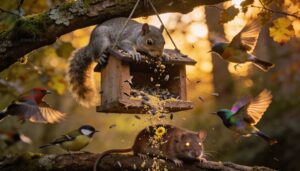
Pests don’t stumble onto your feeder by accident — they’re drawn in by easy food, familiar smells, and materials they can chew right through.
Understanding how birds locate and return to feeders explains why pests follow the same trail — scent, sight, and memory work for them too.
Understanding what pulls them in is the first step to keeping them out. Here’s what’s actually working against you.
Common Feeder Pests: Squirrels, Rats, and Raccoons
Three animals are responsible for most feeder raids: squirrels, rats, and raccoons.
- Squirrels follow squirrel caching habits — hoarding high-fat seeds during daylight hours, occupying feeders over 40% of the time.
- Rats leave rat trail markings near feeders at night, chewing through soft plastic ports.
- Raccoons use raccoon foraging strategies after dark, ripping apart lightweight feeders with ease.
Implementing proper fence height and depth can deter squirrels from feeders.
Seed Spillage and Ground Debris
Squirrels aren’t your only problem. Seed spillage hits the ground fast, and that scattered debris is basically a dinner bell. Hull accumulation effects build up quickly — wet hulls turn slimy, invite mold, and create weed germination risks when viable seed roots into damp soil.
Use seed catchers with drainage holes, choose hard ground surfaces for easier cleanup, and practice regular cleanup daily.
Feeder Materials Pests Can Chew Through
Ground cleanup helps, but the feeder itself can be the weak point.
Thin plastic has plastic weakness — rats chew through it in days. Wood vulnerability is real, too; untreated joints splinter wide open fast. metal fatigue creates tiny gaps at seams.
Choose metal or glass feeders with strong seam integrity and coating durability. Hardware cloth and metal sheeting beat plastic fencing every time.
Birdseed Types That Attract Mammals Most
The feeder’s material matters, but so does what’s inside it. Some seeds are basically a dinner bell for mammals.
- High Fat Content seeds like sunflower seeds draw squirrels quickly
- Large Seed Size makes harvesting easy for raccoons and rats
- Strong Odor from peanut-based bird seed blends signals mammals instantly
- Moist Seed Spoilage and shell hull residue on the ground multiply that scent
Skip corn and loose blends. Choose safflower and nyjer seeds — seed choice for pest control starts there.
Feeder Designs That Block Pests
The right feeder design is your first line of defense against squirrels, rats, and raccoons. Some builds use clever mechanics, others rely on tough materials — but each one makes it harder for pests to get a free meal.
Here are the six feeder designs that do the job best.
Weight-activated Perches and Closing Ports
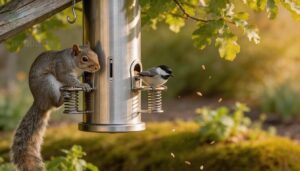
Weight-sensitive perches work like a scale — light enough for a chickadee, too heavy for a squirrel. When a pest lands, mechanical shut mechanism closes the feed ports instantly.
No batteries, no wires.
Adjust the spring tension to match your local birds.
This weight sensor calibration gives you selective bird access without a cage, making it a clean, reliable rodent-proof bird feeder design.
Caged Feeders for Small-bird Access
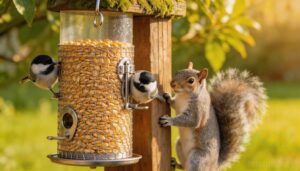
Caged feeders wrap a wire shell around the seed tube, letting small birds slip through while blocking larger pests completely. Openings sized at 1.5 to 2 inches give multi-angle entry to chickadees and goldfinches.
Stainless steel hinges and UV-stabilized reservoir walls hold up outdoors. Sealed gasket lids lock moisture out.
A cage lip guidance edge directs tiny birds straight to perches — keeping your setup squirrelproof and rodentproof.
Metal Mesh, Glass, and Chew-proof Builds
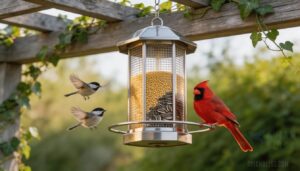
Metal mesh walls give squirrelproof feeders real bite-resistant joints that pests can’t gnaw through.
Glass chambers offer transparency benefits — you spot spoiled seed fast.
Stainless steel delivers corrosion resistance and smart weight distribution, so the feeder stays steady in wind.
UV protection coating prevents fading.
For a true ratproof bird feeder, choose chew-proof builds with all-metal contact points.
Locking Lids and Low-spill Feeder Designs
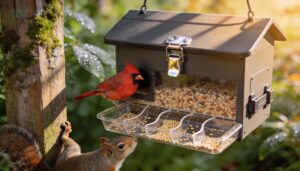
A spilled seed is an open invitation. Locking lids with anti-chew hinges and solid seal integrity keep pests out between refills — check the lock indicator visibility at a glance.
Low-spill tray feeders use smart spill tray geometry to guide fallen seed back in, not onto the ground. Material fatigue resistance ensures latches hold after repeated use.
Tube Feeders With Narrow Openings
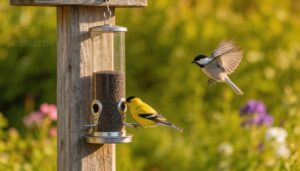
Narrow openings are a quiet pest filter. Tube feeders with small ports practice natural seed flow control — only thin‑billed birds like goldfinches, siskins, and chickadees can reach inside. That beak compatibility locks out larger, seed‑wasting visitors.
Metal ports improve material durability against gnawing. Tighter port size optimization also slows refill frequency, keeping nyjer seed fresher longer and reducing ground spillage that attracts rodents.
Add-on Guards, Shrouds, and Feeder Cages
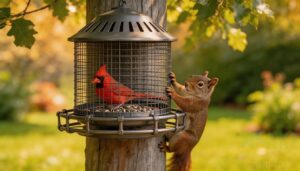
Don’t want to replace your feeder—just defend it? Add-on guards let you upgrade what you already own.
- Snap-On Guard Rings attach in seconds and block climbing pests
- Ventilated Shroud Design keeps airflow while sealing off rodent prying
- Detachable Cage Doors simplify refilling without removing the whole cage
- Anti-Rot Mesh Finish resists weather and repeated gnawing
- Modular Guard Kits expand your protective barriers for feeders over time
Best Seeds for Fewer Pests
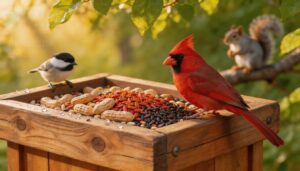
What you put in the feeder matters just as much as the feeder itself. Some seeds naturally turn rats and squirrels away, while others practically roll out the welcome mat.
Here’s what to stock — and what to skip.
Safflower Seed for Rodent Deterrence
Safflower seeds are one of the simplest pest deterrent feeding strategies you can use. Their natural Safflower Bitterness drives most squirrels and raccoons away.
For selecting bird seed varieties to deter rats, safflower is a smart pick — its Nutrient Profile Benefits cardinals and chickadees without drawing rodents.
Still, clean up spills daily, since mice ignore bitterness when food hits the ground.
Nyjer Seed for Small Clinging Birds
Unlike safflower, Nyjer thistle seeds work through size alone. Finch Feeding Patterns show goldfinches, siskins, and redpolls clinging to Mesh Sock Feeders or narrow tube ports — spaces too tight for rats or squirrels.
Nyjer Energy Content is high-fat, supporting Winter Seed Demand during cold months. Capless Feeder Benefits include less spillage, which means fewer pests drawn to the ground.
Single-seed Feeding to Reduce Waste
Nyjer keeps things tidy — and single-seed feeding takes that further. Load one seed type per feeder, and birds clean it out fast, leaving nothing behind.
- Portion Control Mechanisms match Seed Dispensing Accuracy to daily bird intake.
- Weight-sensitive ports prevent seed spillage between visits.
- Bird Preference Studies show less scatter with matched seed-to-feeder pairings.
- Feeder Calibration Techniques use small openings for a rodent-proof bird feeder design.
Seeds to Avoid: Corn, Peanuts, and Loose Blends
Single-seed feeding helps, but corn, peanuts, and loose blends undo your progress. These Mold Prone foods create a strong Scent Trail, draw rodents, and risk Aflatoxin Contamination.
Loose blends pack Excessive Filler—most get scratched onto the ground.
For rat deterrents and squirrel deterrent results, skip these mixes. Use birdseed catchers and seed storage solutions to boost seed spillage prevention.
Capsaicin-treated Birdseed Options
Capsaicin-treated birdseed works as a natural deterrent by coating seeds with a spicy compound that mammals can’t tolerate.
Coating Intensity varies by brand, affecting both Pricing Impact and Legal Availability in your region. Birds have no capsaicin receptors, so Bird Species Tolerance is high.
Store treated birdseed in sealed Storage Containers away from heat to preserve the rat deterrent and squirrel deterrent coating.
Safe Seed Storage in Sealed Metal Containers
Store bird seeds in sealed metal containers made from corrosion-resistant materials like aluminum or stainless steel. An airtight seal keeps moisture and pests out.
Tuck a desiccant inside for desiccant management — it holds seed moisture below 8%.
Use galvanized metal bins with labeling and inventory notes.
Temperature monitoring matters too: keep storage between 32–50°F.
Rodentproof containers and ratproof designs stop gnawing before it starts.
Placement Rules That Reduce Access
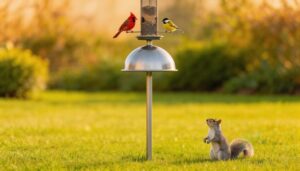
Where you put your feeder matters just as much as what’s in it. A smart setup puts distance, height, and barriers between pests and the seed before they even get close.
Here’s what to get right.
Ideal Feeder Height Above Ground
Most bird feeders work best at 5 to 6 feet above the ground. That’s your Ideal Height Range — high enough to raise bird feeders away from cats and rodents, but low enough for easy refilling. Chickadees and cardinals hit this sweet spot naturally.
For woodpeckers, try 6 to 10 feet. When you raise feeding stations to the right height, maintenance stays realistic and birds keep coming back.
Distance From Trees, Fences, and Walls
Location is everything. Keep these Structure Separation Distances in mind:
- Trees: Follow Tree Proximity Rules — stay 10 feet from trunks, and 8 feet clear of overhead branches.
- Fences: Fence Clearance Guidelines say a minimum of 8 feet from gates, and 6–8 inches from solid panels.
- Walls: Wall Buffer Zones require 6 feet out, and no ivy nearby.
- Wind: Strategic feeder placement means facing prevailing wind away from pest cover.
Smooth Poles, Sleeves, and Pole-mounted Setups
smooth metal pole is one of your best rodent barriers. Rats and squirrels can’t grip a surface with no footholds.
polemountable setups with corrosion resistant coatings rated for wind load conditions.
cable management channels keep wiring tidy and protected. quick release mounts let you move feeders seasonally. adjustable tilt mechanisms help you angle feeders away from prevailing winds and pest cover.
Dome and Cone Baffles Above and Below
Baffles are your secret weapon against climbers. Place a metal cone baffle 4–5 feet up the pole to stop squirrels from below. Add a clear plastic dome above the feeder to block anything coming from overhead.
- Metal cone baffles resist gnawing and slide pests back down
- Clear plastic domes shield seed from rain while keeping birds visible
- Smooth surface finish means no claw grip, no climbing
- Baffle size clearance of 17 inches or wider closes off bypass attempts
Mount both baffles with stable hardware so nothing shifts.
Hanging Clearance to Prevent Squirrel Jumps
Clearance is everything once your baffles are in place. Squirrels can jump up to 8 feet vertically and 10 feet horizontally — so placement math matters.
| Factor | Minimum Requirement | Why It Matters |
|---|---|---|
| Height above ground | 6 feet | Limits vertical jump range |
| Distance from trees/walls | 10 feet | Blocks horizontal launch routes |
| Locking Hardware check | Weekly clearance inspection | Prevents Wind Swing drift |
| Cable Tension rating | Rigid, no-stretch cable | Stops feeder swing toward branches |
| Jump Distance Calculations | 10 ft horizontal buffer | Eliminates squirrel approach angles |
Use smooth metal poles with no footholds. Pair hanging feeders with weight-activated feeders for double coverage.
Keeping Feeders Away From Rodent Shelter
Squirrels aren’t your only concern once the pole is set. Rats and mice use dense shrubs, mulch piles, and ground litter as highways straight to your feeder.
Clear a 3–4 meter Open Ground Buffer around each station. Add a Rodent‑Proof Base beneath it, install Motion‑Activated Lights nearby, and trim all Vegetation Clearance low.
Pole Sleeve Enlargement removes the last foothold.
Maintenance Habits That Prevent Infestations
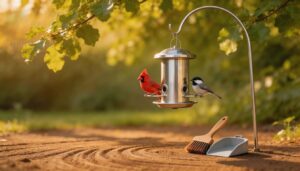
Even the best feeder won’t keep pests away if you skip the upkeep. Small habits done consistently make a bigger difference than any single product.
Here’s what to do regularly to keep rodents and raccoons from turning your feeder into their next meal.
Daily Cleanup of Spilled Seed and Droppings
Sweeping right after birds finish eating is the easiest way to stay ahead of trouble. Do a post-feeding sweep each evening — remove spilled seed before pests find it overnight.
Dampen dry dust first using basic dust dampening techniques, then wear gloves following proper glove use protocol. Keep feeder tools separate from household tools.
This simple bird feeder maintenance routine cuts food waste, reduction opportunities for rodents fast.
Weekly Washing and Tray Scrubbing
Daily sweeping takes care of the surface mess — but once a week, go deeper.
Clean feeders with warm water and a drop of mild soap. Use the soft brush technique on trays and drip channels. Scrub interior surfaces without scratching.
- Rinse with warm water
- Apply mild soap choice
- Scrub tray feeders thoroughly
- Rotating feeder cleaning keeps all units fresh
- Drying prevents rust — air-dry completely before refilling
Refill Amounts Birds Finish Quickly
Only refill what birds can finish in 2–3 hours. Overfilling invites pests and drives up food waste reduction failures fast.
| Species | Seed Consumption Rate | Seasonal Refill Timing |
|---|---|---|
| Goldfinch | Fast – nyjer gone in hours | More frequent in spring |
| Sparrow | Moderate – 1.5–3g daily | Steady year-round |
| Chickadee | Quick bursts, small amounts | Peaks during nesting |
Match feeder capacity planning to your visitors. Weather impact matters too — summer heat spoils seed 20% faster, worsening seed spillage.
Nighttime Feeder Removal for Raccoon Prevention
Raccoons can smell seed from 100 yards away after dark. That’s why an Evening Retrieval Schedule matters — bring feeders in 30 minutes before sunset. This Pre-sunset Storage routine breaks their nightly pattern within two weeks.
Raccoons can smell your feeder from 100 yards away, so bring it in before sunset to break their nightly routine
- Remove Feeders at Night to stop raccoons from returning
- Use Indoor Odor Containment like sealed tubs for Raccoon Scent Masking
- Reinstall at dawn to maintain consistent Bird Feeding Timing
Checking for Gnaw Marks and Barrier Damage
Once a week, give your feeder a quick once-over.
Run a Port Gap Inspection — any opening wider than 1.5mm is an open door for small mammals. Check hinges with a Hinge Wear Assessment for looseness or creaking. Do a Seal Integrity Test and a Mesh Uniformity Check for bent wires.
Surface Burr Detection near ports is a key sign of rodent activity.
When Persistent Pest Activity Needs Intervention
Some problems don’t quit. If pests keep showing up after 14 days of cleaning and deterrents, it’s time to escalate.
Professional Inspection can reveal hidden nesting or entry points.
Threshold Monitoring helps track whether your rodentproof bird feeder design, baffles, and weight-activated feeders are working.
Pest Exclusion, Structural Repair, and Integrated Management tackle what DIY rat control and efforts to monitor and manage food waste can’t fix alone.
Top 6 Bird Feeders That Deter Pests
Not all feeders are built to keep pests out — but these six are. Each one uses metal construction, weight-activated ports, or cage barriers to stop squirrels and rats without turning away the birds you want.
Here’s what made the cut.
1. Youvip Bronze Chew Proof Bird Feeder
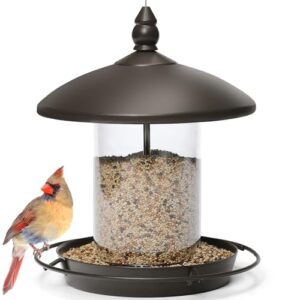
The Youvip Bronze Chew Proof Bird Feeder punches above its $17.59 price tag. Its metal top and base resist gnawing, so squirrels can’t chew their way in.
The 360° perch lets several birds feed at once, and the guard-rail tray keeps seed off the ground.
Cleaning takes about 30 seconds — no tools needed.
At just 1.7 lb, it’s light enough for balconies or garden hooks. Small capacity means you’ll refill often during busy seasons.
| Best For | Backyard bird lovers who want a squirrel-resistant, low-maintenance feeder without spending a lot. |
|---|---|
| Material | Unknown |
| Squirrel Deterrence | Unknown |
| Ease of Refill | Unknown |
| Weather Resistance | Unknown |
| Bird Compatibility | Unknown |
| Price | Unknown |
| Additional Features |
|
- Chew-proof metal build keeps squirrels out and holds up through rough weather
- Cleans and refills in about 30 seconds — no tools, no hassle
- 360° perch lets multiple birds feed at the same time
- Small seed capacity means frequent refills when bird traffic picks up
- Lightweight design can spin or sway in strong wind
- Tight tray openings may jam with larger seeds like sunflower
2. ZeHaiYlf Outdoor Squirrel Proof Bird Feeder
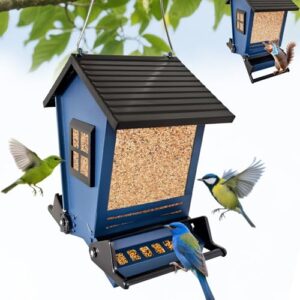
The ZeHaiYlf packs triple squirrel deterrence into one feeder. Weight-activated ports close automatically when anything heavier than a songbird lands — adjustable across three tension settings (200 g, 275 g, 350 g).
The curved body also blocks upside-down acrobatics.
Transparent side panels let you check seed levels at a glance, and drainage holes keep things dry between refills.
It holds 5 lb of seed, so cold-weather refills stay manageable.
Just watch the polystyrene panels — they can crack with rough handling.
| Best For | Bird lovers who are tired of squirrels raiding their feeders and want a low-maintenance option that holds plenty of seed through the colder months. |
|---|---|
| Material | Unknown |
| Squirrel Deterrence | Unknown |
| Ease of Refill | Unknown |
| Weather Resistance | Unknown |
| Bird Compatibility | Unknown |
| Price | Unknown |
| Additional Features |
|
- Three adjustable tension settings mean you can fine-tune exactly which birds get access — and which freeloaders don’t.
- Five pounds of seed capacity cuts down on how often you’re out in the cold refilling it.
- Clear side panels let you see seed levels without opening anything up.
- The polystyrene panels are thin and can crack if handled roughly or in freezing temps.
- Determined squirrels can still get in if the feeder isn’t placed and adjusted correctly.
- The 15-inch rope gives you limited flexibility on hanging height.
3. LSCQYYCC Blue Metal Squirrel Proof Bird Feeder
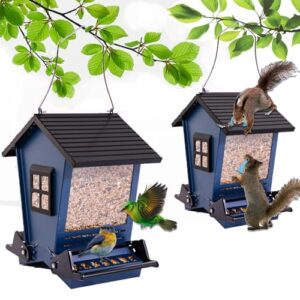
If you want something built to last, the LSCQYYCC is worth a look. Its aluminum frame takes a powder-coated finish that won’t rust, even after months in the rain.
Weight-activated perches shut down the ports the moment a squirrel lands. Clear polycarbonate panels let you monitor seed levels without opening anything up.
At 2.4 lb, it’s light enough to hang anywhere. Keep in mind — larger birds like jays may trip the mechanism too.
| Best For | Backyard bird lovers who are tired of squirrels raiding their feeders and want a durable, low-maintenance setup they can enjoy year-round. |
|---|---|
| Material | Unknown |
| Squirrel Deterrence | Unknown |
| Ease of Refill | Unknown |
| Weather Resistance | Unknown |
| Bird Compatibility | Unknown |
| Price | Unknown |
| Additional Features |
|
- Weight-activated perches shut out squirrels automatically — no extra gadgets needed
- Aluminum frame with powder-coat finish holds up through rain, snow, and everything in between
- Clear polycarbonate sides let you check seed levels at a glance
- Larger birds like cardinals and blue jays can accidentally trigger the squirrel-blocking mechanism
- No mounting hardware included, so you’ll need to source your own hook or pole
- Transparent panels need regular wiping to stay clear and useful
4. Jarkyfine Squirrel Proof Metal Mesh Bird Feeder
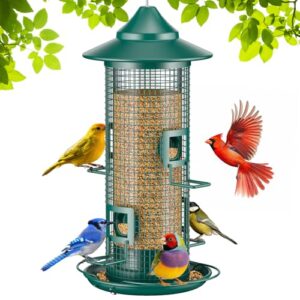
The Jarkyfine takes a different approach — metal mesh wraps the whole body, so squirrels can’t chew through to the seed.
Four ports and two perches let several birds feed at once, which cuts down on pushing and waiting.
transparent tube shows your seed level at a glance. It holds 2 lb of seed and hangs from a hook on a pole or branch.
Plastic parts may wear faster than the metal, so keep that in mind.
| Best For | Bird lovers who want a durable, low-maintenance feeder that keeps squirrels mostly at bay and lets multiple birds eat at once. |
|---|---|
| Material | Unknown |
| Squirrel Deterrence | Unknown |
| Ease of Refill | Unknown |
| Weather Resistance | Unknown |
| Bird Compatibility | Unknown |
| Price | Unknown |
| Additional Features |
|
- Metal mesh body holds up to weather and chewing, so it lasts through the seasons
- Four ports and two perches mean less fighting over spots — more birds, more watching
- The clear tube lets you check seed levels without taking anything apart
- Determined squirrels can still sneak in through the plastic tube or mesh gaps
- Larger birds will struggle with the perches — it’s really built for smaller species
- The plastic parts will likely show wear before the metal does
5. Mosloly Blue Metal Squirrel Proof Cage Feeder
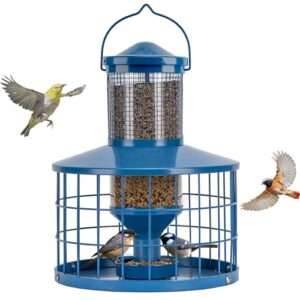
If full metal mesh isn’t your style, the Mosloly takes a cleaner approach. A blue metal cage surrounds a clear plastic tube, holding up to 2.8 lb of seed.
Small songbirds slip through the 1.73 × 1.27‑inch openings easily — squirrels can’t.
The lower tray catches spills, and the modular design makes cleaning straightforward.
At $46.88, it’s a solid pick.
Just watch for rust after heavy rain seasons.
| Best For | Bird watchers who want to attract small songbirds like finches and chickadees while keeping squirrels and bully birds out. |
|---|---|
| Material | Metal (bronze finish) |
| Squirrel Deterrence | Chew-proof metal construction |
| Ease of Refill | One-handed roof button refill |
| Weather Resistance | Rain, wind, hail resistant |
| Bird Compatibility | Finches, buntings, small birds |
| Price | $17.59 |
| Additional Features |
|
- The metal cage mesh is sized just right — small birds get in, squirrels don’t
- Modular design makes refilling and cleaning genuinely easy
- Clear tube lets you see seed levels at a glance without opening anything
- Metal cage can start rusting after a few months of rain exposure
- Plastic tube joints can let moisture in, which leads to moldy seed
- Assembly can be a headache if screws are missing or mismatched (which some users have run into)
6. Feed Garden 6 Port Metal Bird Feeder
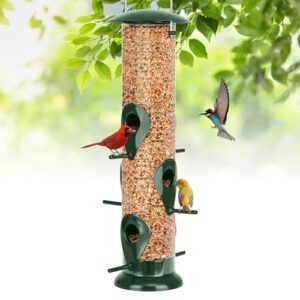
For a budget-friendly finish to this list, the Feed Garden 6 Port Metal Bird Feeder earns its spot at $14.98.
Six metal ports mean several birds feed at once — no crowding, no waiting. The transparent tube lets you check seed levels at a glance. Metal construction resists chewing better than plastic, and the whole thing disassembles quickly for cleaning.
One real note: the lid pulls off easily, so squirrels can get in. Mount it far from jump points.
| Best For | Backyard bird lovers who want a durable, no-fuss feeder without spending a lot. |
|---|---|
| Material | Metal frame & polystyrene |
| Squirrel Deterrence | Weighted tension springs |
| Ease of Refill | Removable top cover |
| Weather Resistance | Drainage holes for ventilation |
| Bird Compatibility | Cardinals, finches, chickadees, jays |
| Price | Unknown |
| Additional Features |
|
- All-metal build holds up way better than plastic — chew-resistant and built to last
- Six feeding ports mean multiple birds can eat at once, no squabbling over spots
- Transparent tube lets you see seed levels without opening anything up
- The lid just pulls off, so squirrels will absolutely figure it out
- The seed capacity is on the smaller side, so you’ll be refilling more often
- Some users have run into mold at the bottom, which takes a bit of work to clean out
Buying Guide for Pest-Deterring Feeders
Not every feeder works for every backyard—your pest problem, space, and budget all shape the right choice. These six factors will help you cut through the noise and pick something that actually holds up.
Here’s what to look for before you buy.
Best Feeder Type for Your Backyard Pests
worst backyard pest points the way to your best feeder.
Squirrels? Weight-activated feeders shut ports the moment they land. Rats? Rodent-proof bird feeder designs with narrow tubes and adjustable baffle heights cut off ground access fast.
Hybrid feeder designs with modular feeder components let you swap parts as pest pressure shifts — so your setup evolves with the problem.
Capacity Versus Seed Freshness
Bigger isn’t always better. Large-capacity feeders cut your refill frequency, but seed sitting in the tube too long picks up moisture and goes stale fast.
Aim for Container Size Balance — fill only what birds finish in two to three days.
Rotate batches weekly, store extras in sealed metal bins, and practice solid seed storage hygiene to keep pests uninterested.
Weather Resistance and Outdoor Durability
Your feeder takes a beating year‑round. Choose materials that fight back.
- UV Stabilized Plastics resist cracking and yellowing after years of sun
- Powder Coated Steel blocks rust for up to five years in rain and humidity
- Drainage Systems expel water fast, stopping mold before it starts
- Rain Guard Roofs keep seed dry through heavy downpours
- Chew Proof Coatings outlast squirrels indefinitely
Weather‑resistant feeder materials and durable metal construction aren’t extras — they’re essentials.
Ease of Cleaning and Refilling
dirty feeder drives birds away and pulls pests in.
Look for a Detachable Tray Design so you can clean feeders without disassembling everything.
A Self-Sealing Lid and Spill-Guard Funnel prevent seed spillage during refills.
Use Non-Abrasive Cleaning with a Modular Cleaning Brush to protect coatings.
Good bird feeder hygiene and feeder maintenance best practices keep seed fresh and pests away.
Mounting Style: Hanging, Pole, or Station
How you mount your feeder matters more than most people think.
- Hanging feeders with Adjustable Hanging Chains work best under eaves or sheltered spots
- Smooth metal poles with Anti‑Sway Brackets stay stable in open yards
- Feeding stations on Modular Station Bases with Concrete Anchor Foundations handle multiple feeders at once
- Locking Mount Brackets and baffles block climbing pests on all mounting options
Value, Longevity, and Replacement Parts
cheap feeder replaced twice costs more than one quality buy.
Look for lifetime guarantee coverage, metal construction, and available replacement parts before purchasing.
| Feature | Budget Feeder | Premium Feeder |
|---|---|---|
| Warranty Coverage | None | Lifetime Guarantee |
| Material Durability | Thin plastic | Weather-resistant metal |
| Replacement Parts | Unavailable | Easily sourced |
Rodent-proof bird feeder design with weight-activated mechanisms saves money long-term.
Frequently Asked Questions (FAQs)
Why put a potato in your bird feeder?
Think outside the nest — plain cooked potato gives birds quick energy boost, winter warmth, Vitamin C support, B vitamin health, and potassium muscle aid without attracting rodents like seeds do.
Why should you sprinkle coffee grounds around your bird feeder?
Coffee grounds work as a scent deterrent by masking seed odor, making rodent aversion natural and simple.
Freshness potency fades after rain washout, so reapply often for steady pest control around spilled seed.
What kind of bird food does not attract rodents?
Safflower and nyjer seeds naturally repel rodents. Hot pepper suet and hulled sunflower chips work well too.
Rodents hate the bitter taste and tiny size.
Stock these, and most mammals simply move on.
How do weather conditions affect pest behavior?
Weather drives pest behavior year-round. Heat brings insects, rain spoils seed fast, and high humidity spikes mite activity. Wind carries scent trails far. Winter sends rodents straight to your feeder.
Can feeders attract beneficial wildlife besides birds?
Yes, feeders can. Spilled seed draws chipmunks, foxes, and lizards into Reptile Shelters and Amphibian Habitat zones. Bat Foraging Zones thrive nearby, supporting natural pest control beyond birds.
What legal restrictions apply to pest control methods?
Not all pest control methods are legal everywhere. Pesticides require registration, and applicator licensing may apply.
Always follow label compliance rules and recordkeeping rules. Prioritize nonchemical, nontoxic pest control methods to respect public safety limits and protect birds.
How often should I replace my feeder?
Most feeders last one to two years before seasonal wear, pest damage, or material breakdown forces replacement. Inspect every two weeks. Replace sooner if gnaw marks, cracks, or mold appear.
Can bird feeders attract beneficial wildlife too?
Absolutely.
Insectivorous birds like wrens and bluebirds show up regularly, turning your yard into a predator perch that provides habitat enrichment and genuine biodiversity support through feeding — a quiet win for any wildlife-friendly garden.
Do feeders affect local bird migration patterns?
Your feeder won’t rewrite migration timing. Birds move based on daylight shifts and fat reserve building — not your seed supply.
They may use it as a migration stopover, but they’ll still leave on schedule.
Are bird feeders safe near vegetable gardens?
Yes, but placement matters. Keep feeders 10–15 feet from vegetable beds.
Without proper feeder hygiene, impact control, and preventing seed spillage, you risk soil contamination, crop damage risk, and unwanted wildlife interaction near your garden.
Conclusion
battle against pests rages on, but with the right arsenal, victory is within reach. By choosing bird feeders that deter pests, like those featured here, you’ll reclaim your backyard oasis.
Remember, the right feeder materials, seed choices, and placement rules can make all the difference.
Invest in a pest-deterring feeder today and enjoy a serene bird-watching experience. Your feathered friends will thank you, and so will your sanity.
- https://langley.wbu.com/rat-solutions
- https://romneypestcontrol.com/how-to-keep-rats-away-from-bird-feeders/
- https://www.hummingbirdsplus.org/nature-blog-network/how-to-keep-mice-and-rats-away-from-bird-feeders/
- https://urldefense.com/v3/__https:/www.audubon.org/conservation/migratory-bird-initiative__;!!Ivohdkk!mPpiN3As7ALlwJB4EmotRMy_FIxhv2LT--TO1nzygcOz-eIDB5lmaJGqdlhpjteXQRB7FIZCvqX63ySjFpjV0QqiW9fZgpo$
- https://pmc.ncbi.nlm.nih.gov/articles/PMC4206278/