
This site is supported by our readers. We may earn a commission, at no cost to you, if you purchase through links.

A falcon folds its wings and drops from the sky at over 200 miles per hour, while a hummingbird hovers mid-air with wings beating 80 times per second. These aren’t just impressive feats—they’re deliberate strategies shaped by millions of years of evolution.
Decoding bird flight patterns reveals a hidden language written in wingbeats, glides, and turns. Each movement tells you something important about a bird’s anatomy, habitat, and survival tactics.
When you learn to read these aerial signatures, you gain a powerful identification tool that works from hundreds of yards away, even when field marks and colors fade into silhouettes against the sky.
Table Of Contents
- Key Takeaways
- What Are Bird Flight Patterns?
- Key Mechanics Behind Bird Flight
- Wing Shapes and Their Influence
- Common Bird Flight Styles
- Decoding Flock Flight Formations
- Migration and Seasonal Flight Changes
- Advanced and Specialized Flight Patterns
- Anatomy’s Role in Flight Patterns
- Identifying Birds by Flight Behavior
- Conservation Insights From Flight Patterns
- Frequently Asked Questions (FAQs)
- Conclusion
Key Takeaways
- Bird flight patterns—flapping, gliding, soaring, hovering, and bounding—serve as reliable identification tools that work at distances where plumage details fade, with features like wingbeat frequency (ranging 2.5–30 Hz across species) and flight silhouettes providing 90%+ accuracy in distinguishing bird classes.
- Wing morphology directly determines flight capabilities: long, pointed wings with high aspect ratios enable energy-efficient migration (albatrosses reach 18:1 glide ratios), while short, rounded wings sacrifice endurance for the tight-turning agility needed in dense forest habitats.
- Flocking formations like V-patterns aren’t just visually striking—they’re aerodynamic solutions that reduce energy expenditure by 11–30% through upwash exploitation, while murmurations use local neighbor-tracking rules to create collective motion that confuses predators without centralized leadership.
- Tracking shifts in migration timing, flock cohesion, and flight corridor usage provides quantifiable ecological indicators—radar data revealed a 13% decline in North American nocturnal migrants from 2007–2017, turning flight pattern analysis into a practical conservation tool for identifying habitat degradation and climate impacts.
What Are Bird Flight Patterns?
Bird flight patterns are the distinct ways birds move through the air, shaped by their anatomy, environment, and survival needs. These patterns aren’t just beautiful to watch—they’re essential clues that reveal how birds hunt, migrate, and interact with their world.
Understanding what flight patterns are, why they matter, and how they help you identify species sets the foundation for everything that follows.
Definition of Flight Patterns
You’ll find that bird flight patterns represent scientifically distinct modes of aerial locomotion—flapping, gliding, soaring, fluttering, and hovering. Research classifies these flight pattern types into six core behaviors: cruising, climbing, diving, gliding, soaring, and turning.
Direct flight shows consistent wingbeats, undulating flight combines flapping with short glides, and bounding flight alternates rapid flapping with folded-wing coasting phases.
Understanding flight kinematics requires precise 3D tracking of avian movements.
Importance in Avian Behavior
Flight patterns shape nearly every aspect of avian behavior. When you observe a bird’s movement, you’re watching foraging efficiency in action—soaring raptors minimize flapping to extend search time, while seabirds may fly 50–70% of daylight hours during chick-rearing.
Flight also drives predator avoidance, social coordination, and communication transfer within flocks, revealing how decision-making trade-offs between time, energy, and risk govern survival strategies across habitats.
Recent research indicates that migration patterns are shifting due to climate change.
Role in Species Identification
Beyond revealing how birds behave, distinct flight signatures let you pinpoint species from afar. Norwegian surveys show 92% of birdwatchers rank overall flight style among their top identification cues, while wingbeat frequency—ranging 2.5–30 Hz—separates bird classes with over 90% accuracy in radar studies. Morphology correlation matters too: soarers display longer wings than flappers, a trait now powering automated identification systems.
- Herons retract necks in flight; cranes extend theirs—a reliable behavior recognition key
- Wingbeat pattern separates similar raptors when plumage details blur at distance
- AI tools classify nocturnal migrants by linking flight calls to species-level traits
- Machine learning maps wing length to soaring versus flapping modes across 635 species
Key Mechanics Behind Bird Flight
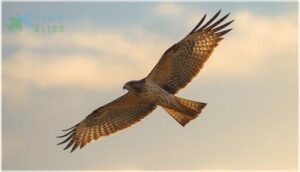
Bird flight isn’t magic—it’s physics in action. When you watch a hawk circle overhead or a sparrow dart between branches, you’re seeing aerodynamic forces working together in perfect balance.
Let’s break down the three core mechanics that make it all possible.
Lift and Thrust Generation
You might imagine bird flight as a simple up-and-down process, but it’s far more intricate. Lift is generated when wing surfaces create pressure differences, with leading vortices boosting lift coefficients up to threefold in hovering birds.
Thrust efficiency depends on rotating the lift vector forward during downstrokes, influenced by angle of attack and wing shape. Aerodynamic models now integrate these flight mechanics to predict real-time flight dynamics.
Aerodynamic Forces at Play
When you watch a bird slice through the air, aerodynamic forces work in precise balance. Here’s what drives flight mechanics:
- Lift counteracts gravity, generated through pressure distribution across wing surfaces.
- Drag opposes forward motion, minimized by wing shape.
- Thrust propels birds ahead, varying with flapping frequency.
- Reynolds number determines flow behavior around wings.
- Formation aerodynamics reduce resistance, improving flight dynamics for trailing birds.
Wing and Tail Functionality
Throughout each wingbeat, you’ll notice how wing aerodynamics and tail steering work together—not as separate systems, but as integrated flight dynamics. Wing morphology generates lift while the tail provides flight stability, especially at low speeds.
In tail-supported climbers, feather mechanics deliver impressive load support through geometric changes in the rachis structure. This anatomy explains why wing shape alone doesn’t determine performance; tail function matters equally.
Wing Shapes and Their Influence
A bird’s wing is much more than a simple paddle pushing through air—it’s a precision tool shaped by evolution to match specific flight demands. The length, width, and curvature of wings determine whether a bird can sprint through dense foliage, glide effortlessly over ocean waves, or hover in place like a helicopter.
Let’s examine how these structural differences translate into distinct flight capabilities across different species and environments.
Long Vs. Short Wings

Think of a bird’s wings as the blueprint for its lifestyle. Long, pointed wings slice through air with minimal drag, making them ideal for migration energy expenditure and sustained travel—bar-tailed godwits with this anatomy fly 8,425 miles nonstop.
Short, rounded wings suit quick bursts and tight turns, perfect for habitat flight adaptation in forests where agility trumps endurance in flight mechanics comparison.
Aspect Ratio and Camber

You’ll find two measurements driving bird flight patterns: aspect ratio (wingspan squared divided by wing area) and wing camber (that upward curve in cross-section). These aerodynamics determine flight performance across species—albatrosses hit aspect ratios of 18 for ocean gliding, while hummingbirds maintain 3.0–4.5 for hovering agility.
Avian research shows:
- High camber boosts lift by 18% in optimized wing shape anatomy
- Aspect ratio data correlates directly with flight speed
- Camber variation distinguishes ducks from passerines, shaping each bird’s flight style
Adaptations for Specific Habitats

Forest maneuverability demands short, rounded wings—Andean species show 8–15% shorter wings than open-habitat relatives, reducing stall speed by 20%. Open-country efficiency favors pointed wings for cruising flight, while coastal wind adaptations drive seabirds toward higher wing loading (explaining 31% of wind-tolerance variation).
High-altitude soaring requires extended wings for thermal exploitation, and urban collisions disproportionately affect long-winged migrants traversing obstacle-rich airspaces.
Environmental factors directly sculpt avian biology through wing shape.
Common Bird Flight Styles

Once you understand how wings work, you can start recognizing the distinct ways birds actually move through the air.
Each flight style reflects a bird’s size, habitat, and energy needs, making it a powerful clue for identification.
Let’s look at the three most common patterns you’ll see in the field.
Direct Flapping Flight
Direct flapping flight is the workhorse of bird flight patterns, involving continuous wing beats to generate lift and thrust. Anatomy matters here: wingbeat frequency ranges from 3 Hz in geese to over 20 Hz in small songbirds, with energy expenditure averaging 9.2 times basal metabolic rate.
This flapping aerodynamics style permits flight speeds from 10 to 60 km/h, making species like pigeons and swans masters of sustained, level flight.
Gliding and Soaring Techniques
Gliding and soaring represent energy conservation masterpieces in avian aerodynamics. Wandering albatrosses achieve glide ratios near 21:1, traveling 21 meters forward per meter of altitude lost through kinetic soaring over ocean winds. Meanwhile, vultures excel at thermal soaring, circling in rising air columns before gliding horizontally—a technique that reduces flapping frequency dramatically during long-range movements.
Specialized shoulder-lock mechanisms in albatrosses hold wings outstretched with minimal muscular effort, showcasing striking morphological adaptations for sustained flight.
Bounding and Undulating Flight
While albatrosses hold their wings locked for hours, small birds under 0.25 kg employ a strikingly different strategy for energy efficiency.
Bounding and undulating flight patterns alternate between powered flapping bursts and unpowered phases—either ballistic bounds or shallow glides.
Finches, woodpeckers, and wagtails demonstrate this kinematic analysis clearly: their rollercoaster trajectories can reduce mechanical power by 15%, aided by muscle correlates that improve brief, high-intensity contractions over sustained effort.
Decoding Flock Flight Formations

When birds fly together, they’re not just keeping each other company—they’re solving complex aerodynamic puzzles in real time. You’ll notice distinct patterns emerge depending on the species, distance traveled, and environmental conditions.
Let’s break down the most common flock formations and what drives birds to adopt each strategy.
V-Formation and Energy Efficiency
When you watch geese flying overhead in a V-shaped formation, you’re witnessing one of nature’s most efficient energy conservation strategies. Through upwash exploitation and precise formation geometry, birds tap into wingtip vortices created by neighbors ahead.
Research shows metabolic savings reach 11-30% compared to solo flight. Flapping synchronization and role rotation guarantee fair distribution of the demanding lead position, making aerodynamics work for the entire flock.
Swarming and Murmuration Patterns
Unlike structured V-formations, murmurations create mesmerizing, fluid displays where flock density shifts constantly and formation shifts occur in milliseconds. Starlings track six or seven nearest neighbors through local interactions, creating flocking behavior that ripples across thousands of birds.
Mathematical models reveal information transfer propagates without central leadership—just individual responses generating collective motion. These flock dynamics demonstrate how simple rules produce breathtaking aerial choreography that confuses predators while maintaining group cohesion.
Communication Within Flocks
Beyond visual synchronization, flocks rely on vocal signals and quorum sensing to orchestrate movements. Green woodhoopoes use group-specific calls that trigger collective action once signal intensity crosses specific thresholds.
Leadership behaviors shift constantly—pigeons display shifting information flow where no single bird dominates, yet directional changes propagate through the flock within seconds.
These layered communication systems explain how flocking behavior and sociality produce such coordinated aerial displays.
Migration and Seasonal Flight Changes
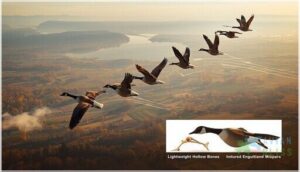
Migration pushes birds to their physical limits, requiring strategies that differ completely from everyday flight. You’ll notice changes in everything from wing motion to body composition as birds prepare for journeys spanning thousands of miles.
Let’s examine how birds manage these impressive feats through specialized flight tactics, energy-saving adaptations, and precise coordination.
Long-Distance Flight Strategies
Long-distance bird migration demands tactical precision. Bar-tailed godwits complete 13,560-kilometer non-stop flights from Alaska to Tasmania, relying on altitude selection to exploit wind support above 5,000 meters where oxygen drops below 50% of sea-level.
Bar-tailed godwits fly 13,560 kilometers nonstop from Alaska to Tasmania, climbing above 5,000 meters to harness high-altitude winds where oxygen is half that of sea level
Stopover tactics matter too—the Texas Gulf Coast functions as a critical refueling “fire escape” for billions of songbirds.
Navigation cues, including magnetic compass orientation, guide these impressive journeys through changing climates.
Energy Conservation During Migration
When birds tackle avian migration, energy conservation becomes survival arithmetic. Fat storage accounts for up to 50% of pre-departure body mass, fueling flights where flapping costs ten times more than gliding.
V-formation benefits deliver up to 25% energy savings through aerodynamics, while altitude adjustment exploits tailwinds that cut transport costs by over 20%.
Physiological adaptations—including reduced heart rates and body temperature—further trim expenses. Understanding these flight patterns reveals how atmospheric conditions shape migratory success across continents.
Navigational Cues and Coordination
Traversing thousands of miles requires more than strong wings. Migratory birds integrate geomagnetic detection, celestial navigation, and environmental cues to maintain their course during avian migration.
Within flocks, leadership roles shift dynamically based on position and turn direction, while visual alignment rules keep neighbors coordinated. These flock dynamics reveal how bird behavior transforms individual flight patterns into collective precision across continents.
Advanced and Specialized Flight Patterns

Not all birds follow the same script when they take to the air. Some have evolved flight techniques so specialized they push the boundaries of what seems physically possible, from defying gravity mid-air to executing split-second aerial acrobatics.
Let’s explore three of the most striking flight patterns you’ll encounter in the avian world.
Hovering and Stationary Flight
Hovering flight patterns demand more energy than any other bird behavior—hummingbirds burn roughly 22–24 calories per gram of body weight per hour, showcasing extreme energy expenditure. You’ll notice true hovering is rare, restricted to just 2% of bird species due to anatomical limits. Here’s what makes hovering aerodynamics striking:
- Lift coefficient requirements: Hummingbirds need 1.8 compared to insects’ 0.8
- Wingbeat frequency: Rapid beats create figure-eight patterns for sustained lift
- Environmental effects: Wind velocity and air density dramatically impact duration
- Technological inspiration: Biomimetic drones now mimic hummingbird maneuvers
Understanding these flight patterns reveals how anatomy shapes bird behavior in striking ways.
Acrobatic and Erratic Maneuvers
Think of a swallow darting after insects—that’s evasive flight at its peak. Aerial agility lets birds execute high-G turns and obstacle avoidance during predator evasion, with hummingbirds reaching 11.8 m/s² backward acceleration in escape trials.
You’ll see wavering flight paths in pursuit specialists, where bird behavior involves rapid heading changes without losing speed, demonstrating how bird flight patterns blend physics with survival instinct.
Courtship and Display Flights
When males perform steep dives or rapid circuits around display arenas, you’re witnessing sexual selection in action. Aerial displays correlate with polygynous mating systems and plumage elaboration, as seen in hummingbirds reaching 9 g during courtship dives.
These courtship and mating behaviors carry significant energetic costs—manakin heart rates exceed 1,300 beats per minute—yet they’re essential for reproductive success in bird flight patterns shaped by mate choice.
Anatomy’s Role in Flight Patterns
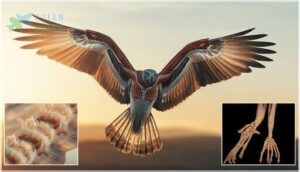
Flight isn’t just about what birds do in the air—it’s what they’re built for from the inside out. Every bone, muscle, and feather plays a specific role in getting them airborne and keeping them there.
Let’s break down the key anatomical features that make bird flight patterns possible.
Bone Structure and Weight Reduction
Bird anatomy reveals a stunning engineering secret: hollow, air-filled pneumatic bones. You’ll find air space occupying 43% to 66% of total bone volume in flying birds, slashing density from 1.71 g/cm³ down to just 1.02 g/cm³.
- Structural adaptations include thinner bone walls without sacrificing strength
- Evolutionary influences favor aerial efficiency over aquatic diving species
- Ontogeny development shows pneumatization occurs post-hatching as air sacs extend inward
These aerodynamic principles demonstrate how bone density reduction directly facilitates sustained flight.
Muscle Groups Driving Flight
You’ll notice flight muscles make up a surprising portion of a bird’s body mass. The pectoralis dominance is striking—accounting for 17-25% of total weight and driving every powerful downstroke. Meanwhile, supracoracoideus function facilitates upstroke through an ingenious pulley system.
Secondary muscles fine-tune wing movement during turns and adjustments. Fiber adaptation determines whether a species excels at hovering or sustained migration, directly influencing power output and overall avian locomotion efficiency.
Tail Feathers and Steering
Tail morphology determines how precisely a bird steers. The center of lift sits just forward of the widest point, maximizing steering efficiency during sharp turns.
When you watch tail feathers fan out asymmetrically, you’re seeing maneuverability control in action—producing rolling and yawing forces. Evolutionary adaptations even include drooping outer feathers for drag reduction at low speeds, showing how avian locomotion demands constantly refine flight patterns.
Identifying Birds by Flight Behavior

You don’t always need binoculars and a field guide to identify birds—sometimes their flight tells you everything. The way a bird moves through the air, from its wingbeat rhythm to the habitat it chooses, can narrow down species faster than you’d expect.
Let’s break down the flight behaviors that turn a distant silhouette into a confident identification.
Observing Wingbeats and Silhouettes
You can distinguish species mid-flight by tracking wingbeat frequency and silhouette identification—flight behavior clues that reveal identity before colors even register. Hummingbirds hit 80 beats per second, while swans manage just three.
Data-driven recognition techniques now achieve 80% accuracy using wing beats, tail shapes, and body ratios. These bird identification techniques transform birdwatching, letting you decode bird species characteristics through bird flight patterns identification alone.
Habitat-Based Flight Indicators
Where a bird flies tells you what it’s. Wildlife observation reveals habitat-specific bird behavior patterns that turn landscapes into identification guides. Watch for these indicators:
- Forest cover above 70% attracts insectivorous migrants traversing dense canopies with agile, maneuvering flight
- Skyglow effects concentrate stopover species in lit urban corridors
- Precipitation levels predict waterfowl flight activity
- Topographic lift zones draw soaring raptors and storks
- Resource availability timing aligns hummingbird hovering with flower blooms
Ecological niches shape bird flight patterns you’ll recognize instantly.
Linking Flight to Bird Species
When you combine wingbeat frequency with flight tracks, species-level identification becomes remarkably precise. Computer vision systems now extract these patterns from video, achieving accuracy rates above 70% for hummingbirds and waterfowl.
Observer accuracy improves when you integrate silhouette analysis with behavior. Experienced birders instinctively merge appearance with flight patterns analysis, turning real-time bird identification into a systematic skill backed by quantifiable system accuracy.
Conservation Insights From Flight Patterns

Understanding how birds move through the air isn’t just about admiring their grace—it’s become a powerful tool for protecting species and their habitats. When you track flight patterns, you’re basically reading the health of entire ecosystems and spotting trouble before it’s too late.
Here’s how scientists and conservationists use these aerial clues to make real-world differences.
Protecting Migratory Routes
Protecting migratory routes demands international agreements like the Convention on Migratory Species, which connects 133 countries in flyway conservation efforts. Habitat connectivity across continents matters—over 50 million waterbirds depend on the East Asian-Australasian corridor alone.
Wildlife conservation efforts now blend technological monitoring with community involvement, using tracking stations to pinpoint critical stopover sites. Effective animal migration protection requires coordinated action spanning borders, habitats, and cultures.
Flight Patterns as Ecological Indicators
When you track shifts in migration timing or flock behavior, you’re fundamentally reading nature’s health report card. Climate change and habitat degradation leave aerial signatures in altered routes, earlier arrivals, and declining biomass—weather radar detected a 13% drop in nocturnal migrants across North America from 2007 to 2017.
Flight patterns reveal ecological niches under pressure:
- Biodiversity loss shows up when flock cohesion weakens in fragmented landscapes
- Disturbance detection through flight initiation distance quantifies stress in urban zones
- Conservation planning uses passage metrics to identify critical stopover hotspots
Environmental influences on bird flight provide data-driven insights for ecological research, turning everyday observations into powerful conservation tools.
Applications in Wildlife Management
When you watch a raptor soar through a wind farm corridor, you’re witnessing collision mitigation in action—GPS tracking predicted 7.5 golden eagle fatalities annually at one U.S. facility, shaping turbine placement.
Wildlife conservation and ecology integrate flight data into spatial planning, disease surveillance networks, and population management.
Habitat protection now targets stopover bottlenecks identified through telemetry, turning avian behavior and ecology into decision-support tools across conservation biology and management landscapes.
Frequently Asked Questions (FAQs)
How do weather conditions affect bird flight patterns?
Weather shapes bird flight patterns dramatically. Wind effects alter groundspeed and altitude choices, while temperature impacts soaring efficiency.
Precipitation influence forces costly flapping, and pressure changes trigger migration timing.
Extreme events disrupt traditional aerodynamics.
Can injured birds adapt their flight techniques temporarily?
Yes, injured birds employ striking flight modifications through injury compensation—increasing wingbeat frequency up to 25%, adjusting stroke amplitude, and shifting body position.
However, fracture recovery remains challenging, with rehabilitation success rates of just 2% for wing fractures, increasing predation vulnerability.
Do nocturnal birds fly differently than diurnal species?
Like ships switching from sail to sonar after dark, nocturnal birds deploy broader wings, quieter feather surfaces, and amplitude-based wingbeat adjustments.
Sensory flight adaptations and light-dependent behavior reshape everything from migratory route differences to diurnal energy efficiency across animal behavior and ecology.
How does age influence a birds flight efficiency?
Age dramatically affects flight efficiency through multiple factors. Juvenile flight speed lags adults by roughly 25%, while energy expenditure runs 14% higher due to underdeveloped muscle development and poor wind influence judgment, before senescence decline reduces performance again.
What role does altitude play in flight pattern selection?
You might think birds fly wherever they like, but altitude isn’t random. Wind assistance, air density, and energy expenditure drive their choices.
Migration layers form where conditions align, revealing striking ecological adaptation across species.
Conclusion
You might think decoding bird flight patterns requires years of fieldwork and specialized equipment. The truth? You already have everything you need—your eyes and attention. Once you recognize how a woodpecker’s undulating flight differs from a falcon’s power dive, you’ve unlocked a skill that transforms every sky into a readable map.
Wing shapes, glide ratios, and flock formations aren’t just fascinating details. They’re your direct line to understanding survival itself, written in motion across open air.
- https://www.biorxiv.org/content/10.1101/2025.06.10.658879v1.full-text
- https://pmc.ncbi.nlm.nih.gov/articles/PMC11708819/
- https://royalsocietypublishing.org/doi/10.1098/rsif.2022.0168
- https://journals.biologists.com/jeb/article/189/1/251/6785/Energy-savings-in-formation-flight-of-pink-footed
- https://www.pnas.org/doi/10.1073/pnas.2410048121